In 30 seconds
In May 2023, Matthew Berman reviewed StableStudio, the open-source interface derived from DreamStudio. He demonstrates generation and editing, explains that his local interface still uses Stability AI’s hosted service, and walks through the installation steps available at the time.
- 1Open-source interfaceStableStudio offers a graphical interface for Stable Diffusion and invites community development.
- 2Local interface, hosted generationBerman’s setup needs a DreamStudio API key and consumes credits even though the interface runs on localhost.
- 3Editing canvasThe demonstrated canvas can extend an image and also supports using an image as a starting point.
- 4Setup in the recordingBerman clones the repository, installs dependencies with Yarn and starts a local development server.
Takeaways
- StableStudio’s interface can run locally while image generation in the demonstration uses a hosted API.
- The demonstrated setup requires a DreamStudio account, API key and generation credits.
- The interface provides prompts, styles, aspect ratios, image counts and an editing canvas.
- Local inference and other plugins were presented as development possibilities in the 2023 announcement.
Read the edited text by chapter
The open-source release
Berman introduces StableStudio and discusses the community development goals and proposed extensions.
Matthew Berman introduces StableStudio, Stability AI’s open-source release of the interface behind DreamStudio. In this May 2023 video he reviews the announcement, demonstrates image generation and editing, and shows how he runs the interface locally.
StableStudio provides a graphical interface for working with Stable Diffusion. Berman values having a dedicated interface instead of relying on a chat application. He sees the release as an opportunity for outside developers to extend and iterate on the software.
DreamStudio remained Stability AI’s hosted implementation. Berman highlights the announcement’s ambition for community development, contrasting the number of independent contributors who can experiment with the constraints of a single company.
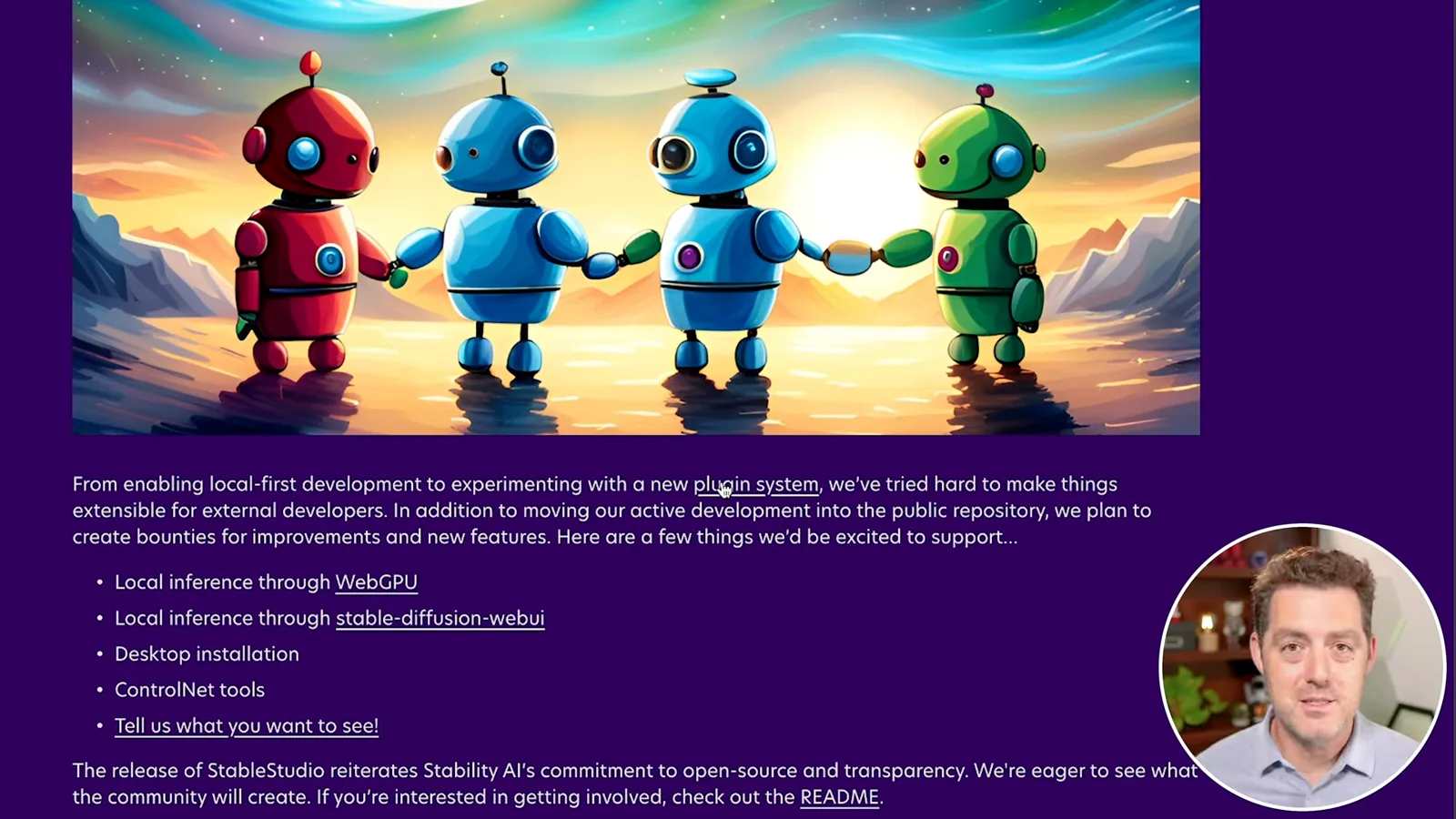
The announcement also mentioned a prospective chat interface and a plugin system. The project sought help with ideas including local inference through WebGPU or Stable Diffusion Web UI, a desktop installer and ControlNet tools. These were requests or future possibilities in the 2023 announcement, not features demonstrated as already available.
Generation and editing
The local interface uses a hosted API in this demonstration. Berman shows prompts, styles, image examples and editing tools.
Berman distinguishes local hosting of the interface from local image generation: in his demonstration the interface still calls Stability AI’s hosted service. Users need a DreamStudio account and API key, and generation consumes credits; additional credits can be purchased.
He hopes plugins could eventually connect the interface to local hardware or other cloud services. In the version he shows, the interface offers prompts, negative prompts, styles, aspect ratio and image count. Higher image counts and quality consume more credits.
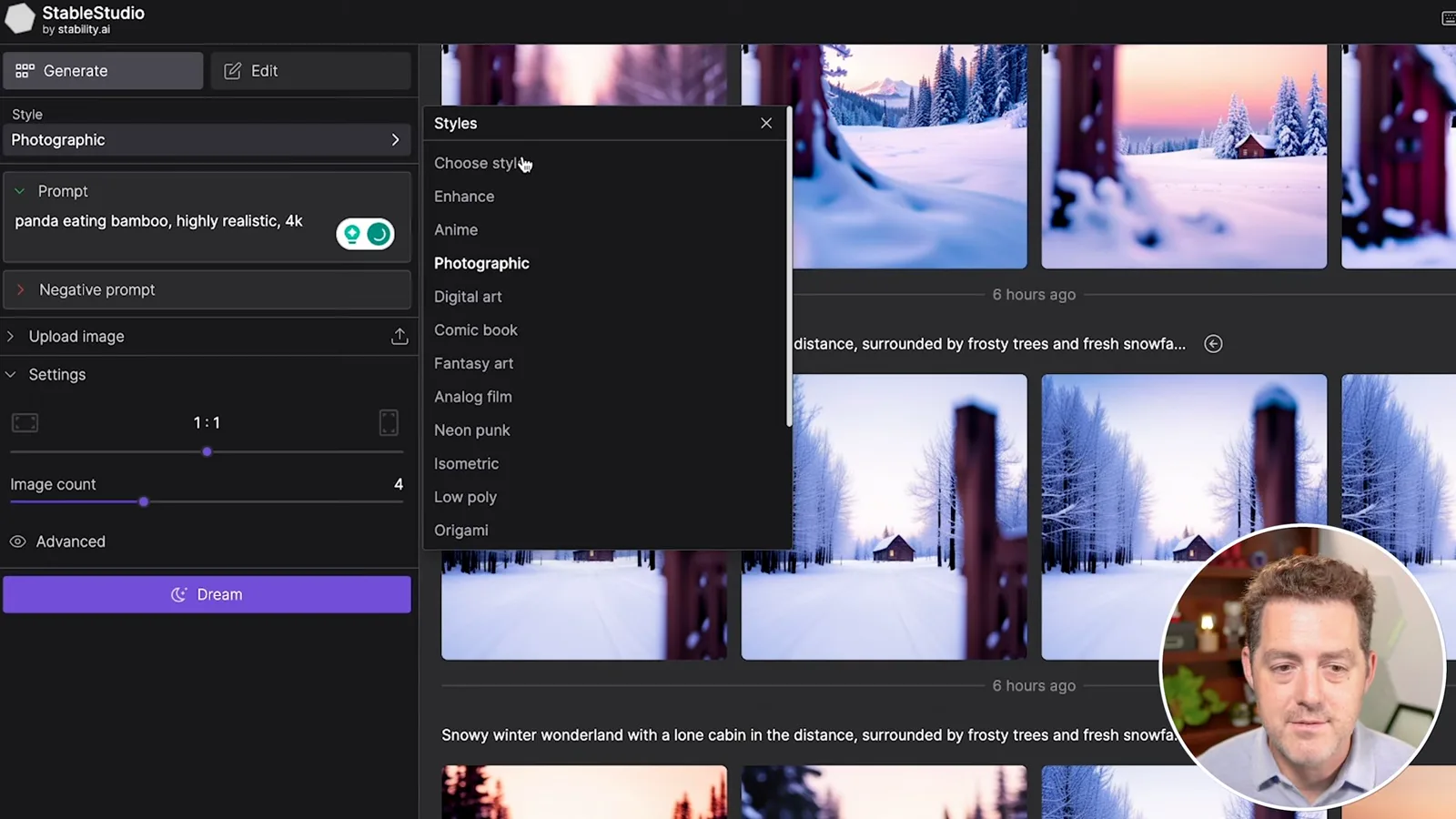
Berman shows generated winter landscapes, cheesecake images and pandas, including an anime-style panda. He notes that one cheesecake appeared in a snowy scene because he used a previous image as a seed. He likes some results, while judging others less realistic and the panda’s eyes imperfect.
The editing canvas can extend an existing image into a selected area. The interface also allows images to be used as a starting point, downloaded or deleted. Settings contain the API key field and links to related resources.
Installing the interface
He shows the repository setup, starts a local server and explains where to obtain the API key.
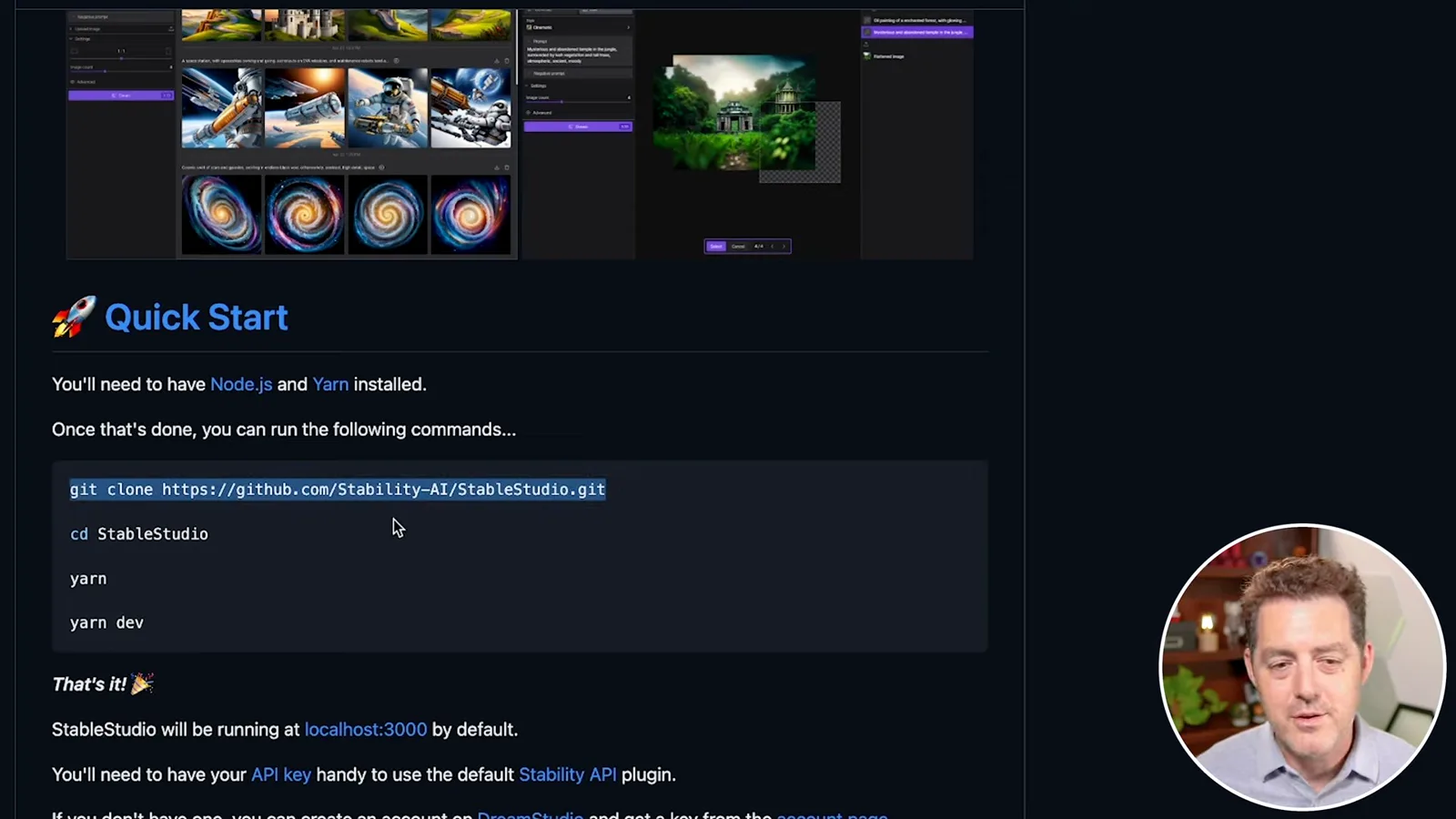
For the installation shown in 2023, Berman clones the StableStudio repository, changes into its directory, runs yarn to install dependencies and runs yarn dev to start the development server. He opens the localhost address in a browser; the on-screen quick start lists Node.js and Yarn as prerequisites.
He compares the local interface with hosted DreamStudio and shows where an account holder can create and copy an API key. Entering that key in StableStudio connects the demonstrated interface to the hosted service. He closes by looking forward to community extensions.
More from this channel
 14:45EN
 Matthew Berman· Oct 29, 2026Matthew Berman Examines Google’s Gemini 4 Carbon AnnouncementMatthew Berman · Forward FutureMatthew Berman reviews Google’s reported benchmark results, staged rollout and pricing for Gemini 4 Carbon, while noting he has not yet used the model.
 21:11ENMatthew Berman· Oct 28, 2026Matthew Berman tests DeepSeek V4.1 Flash: coding, vision and local appsMatthew Berman · Forward FutureA hands-on tour of visual coding, image reasoning, local applications and provider economics reveals both impressive results and visible flaws.
 34:21ENMatthew Berman· Oct 27, 2026Matthew Berman Examines Anthropic’s IPO Filing, AI Growth and GovernanceMatthew Berman, Sam Altman · Forward FutureThe presenter reviews the S-1’s financial metrics, compute strategy and voting structure while questioning the tension between rapid AI development and safety.
 0:26ENMatthew Berman· Oct 25, 2026Sam Altman on Human Values and Problem-Solving in an AI WorldSam Altman · OpenAIIn a short interview excerpt, Altman considers the enjoyment of solving hard problems and the human role in interpreting results.
 0:36ENMatthew Berman· Oct 25, 2026Kimi K3.1 and a Rubik’s Cube Solver DemonstrationMatthew Berman · Forward FutureMatthew Berman shows a scrambled virtual cube being solved and gives the Kimi K3.1 test a favorable assessment.
 0:21ENMatthew Berman· Oct 24, 2026An AI-Generated Kimi Benchmark Chart Used Invented ScoresMatthew Berman · Forward FutureMatthew Berman asks for a graph of Kimi K3.1 Pro benchmarks, then discovers that the displayed figures are illustrative placeholders.