In 30 seconds
Matthew Berman reviews Anthropic’s launch benchmarks for Claude 3.5 Sonnet and tests it with coding, arithmetic, verbal puzzles, image interpretation, and a diagram-to-code task. He particularly likes the Artifacts interface and the functioning Snake game. The results are mixed: a self-counting response is wrong, the marble explanation contains inconsistent physical reasoning, and the peg-solitaire sequence is not checked step by step. The benchmark chart comes from Anthropic, and Berman’s overall preference reflects his 2024 personal tests rather than a universal ranking.
- 1Anthropic’s benchmark chartBerman reviews vendor-reported results against other 2024 models, including exceptions on MMLU and MATH.
- 2Artifacts for generated codeThe experimental interface opens code in a separate pane and shows revisions.
- 3Snake and follow-up editsThe initial game runs; score display and wall wrapping also work in his demonstration.
- 4An incorrect self-countClaude’s claimed word count does not match the actual response.
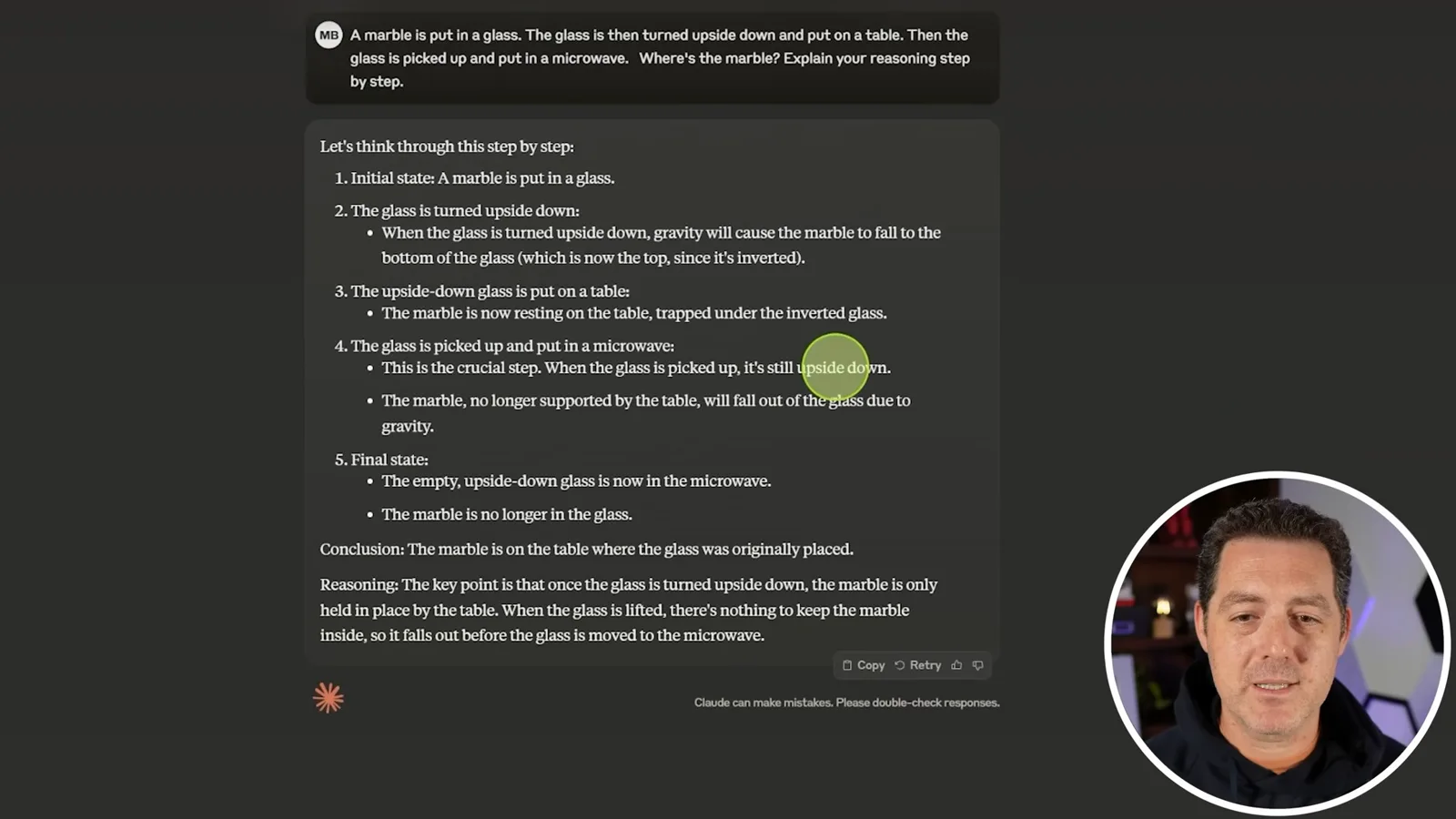
- 5Marble reasoning caveatThe final answer places the marble on the table, but the explanation contains inconsistent descriptions of its movement.
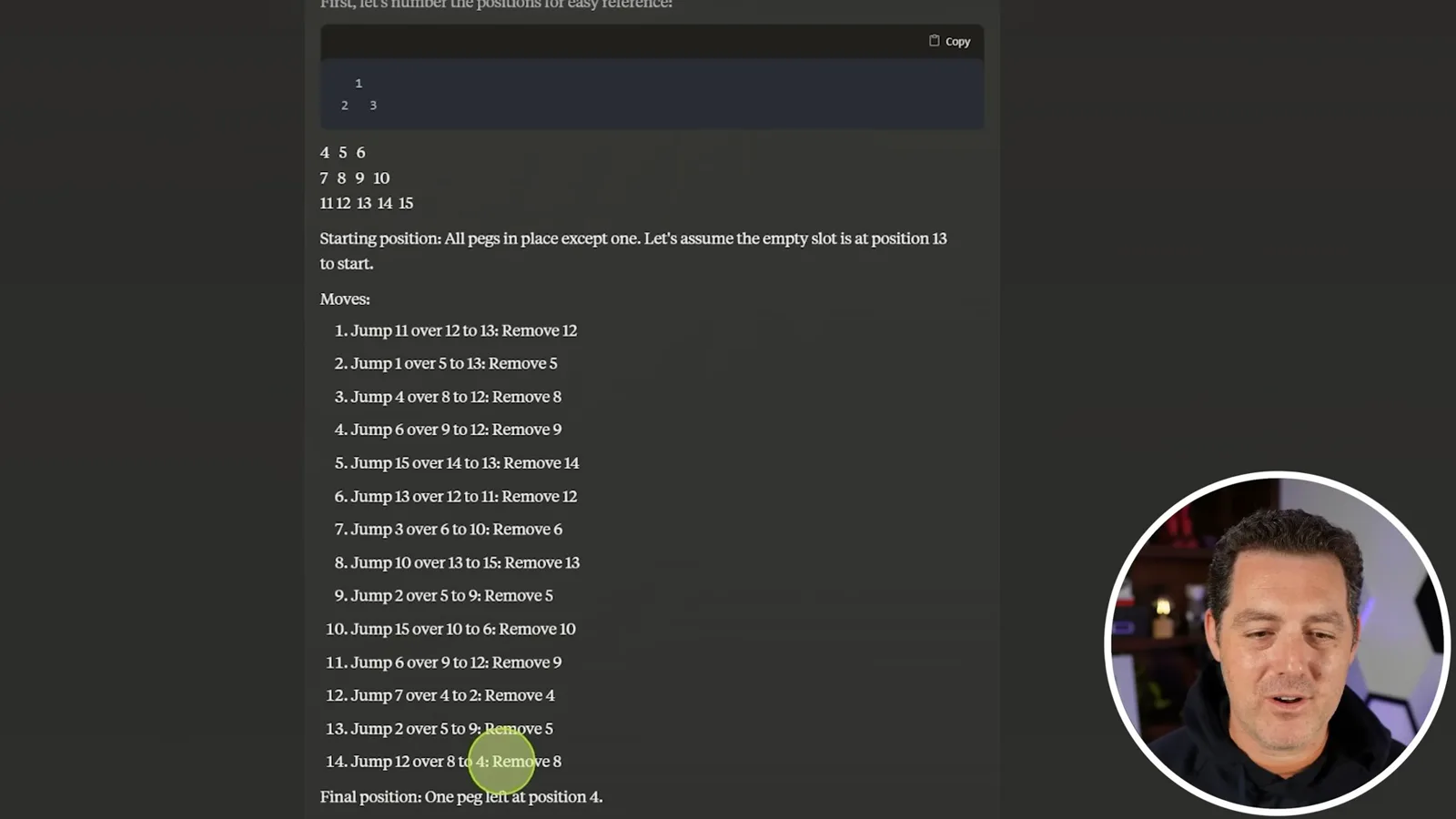
- 6Peg puzzle not verifiedBerman thinks the sequence may work but does not check the moves step by step.
- 7Diagram to PythonThe generated guessing game works in his test after he changes its assumed random-number range.
Takeaways
- Anthropic’s launch chart reports strong results for Claude 3.5 Sonnet but includes benchmark-dependent exceptions and different test configurations.
- Artifacts displays generated code in a separate pane and lets Berman inspect revisions in the demonstration.
- The Snake program runs, and a follow-up adds a score and wall wrapping in Berman’s test.
- The model’s answer to a self-referential word-count prompt is wrong, while refusal of a car-break-in request is not evidence of a safety failure.
- The marble puzzle reaches the expected conclusion under a common interpretation but its explanation contains inconsistent statements.
- Berman does not verify the peg-solitaire moves, so that result remains unconfirmed.
Read the edited text by chapter
Launch benchmarks and Artifacts
Berman introduces Claude 3.5 Sonnet and reviews Anthropic’s launch chart. He enables the experimental Artifacts interface for coding outputs.
I test Claude 3.5 Sonnet shortly after its June 2024 release, using a set of coding, reasoning, and vision prompts. I begin with Anthropic’s launch chart comparing it with Claude 3 Opus, GPT-4o, Gemini 1.5 Pro, and an early Llama 400B snapshot. Availability and model comparisons here are historical.
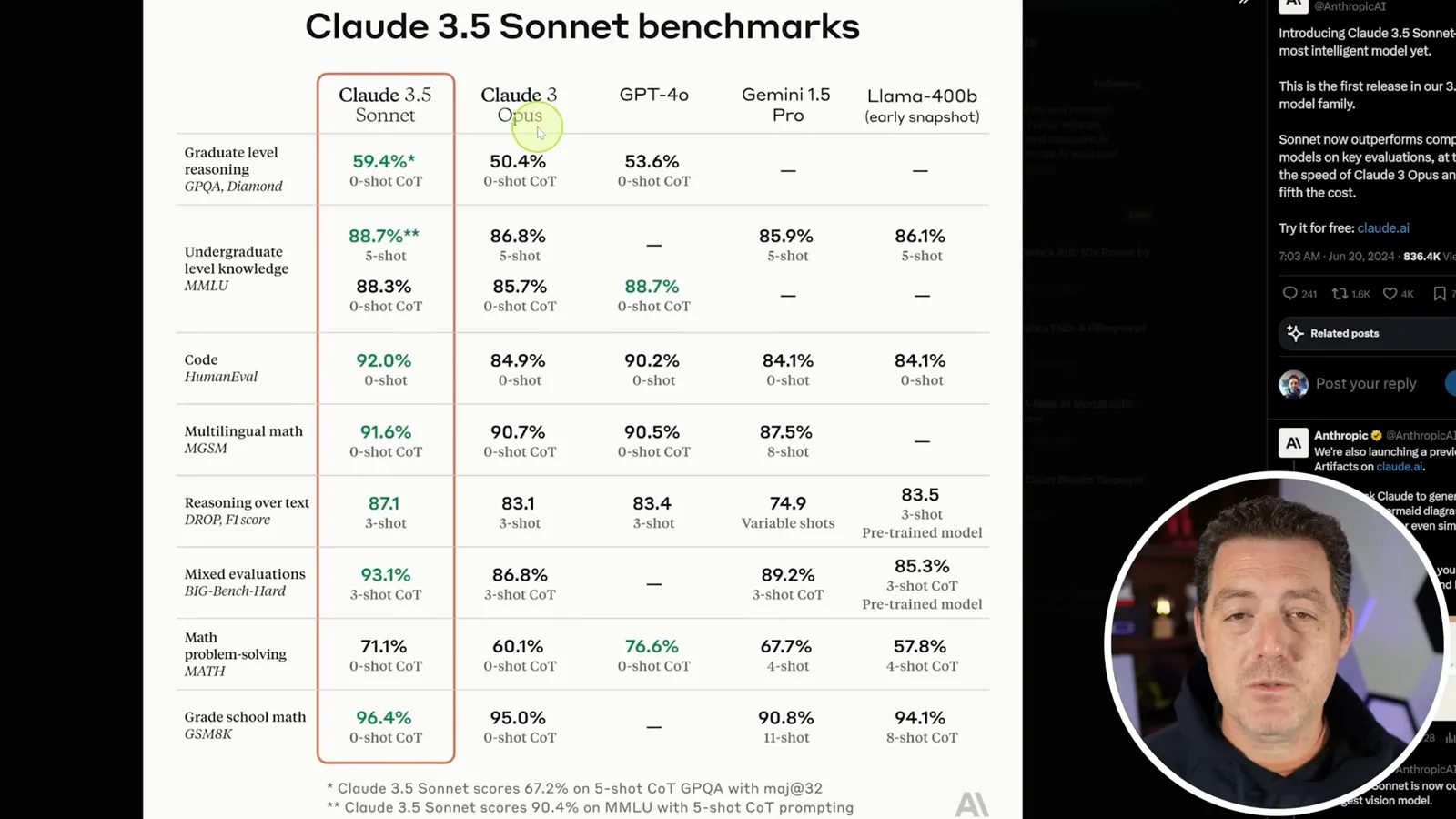
The company’s chart shows Sonnet leading on many listed measures, with GPT-4o higher on the displayed zero-shot MMLU and MATH entries. These are vendor-reported benchmarks with different prompting conditions and missing entries; they do not establish one model as best for every task.
I enable the experimental Artifacts feature, which presents creations such as code in a separate pane beside the conversation. A simple Python request to print numbers from 1 to 100 produces a correct-looking script, and I mark that first prompt as a pass.
Building and revising Snake
The model generates a Python game that Berman runs and revises. He tests a score and wall wrapping.
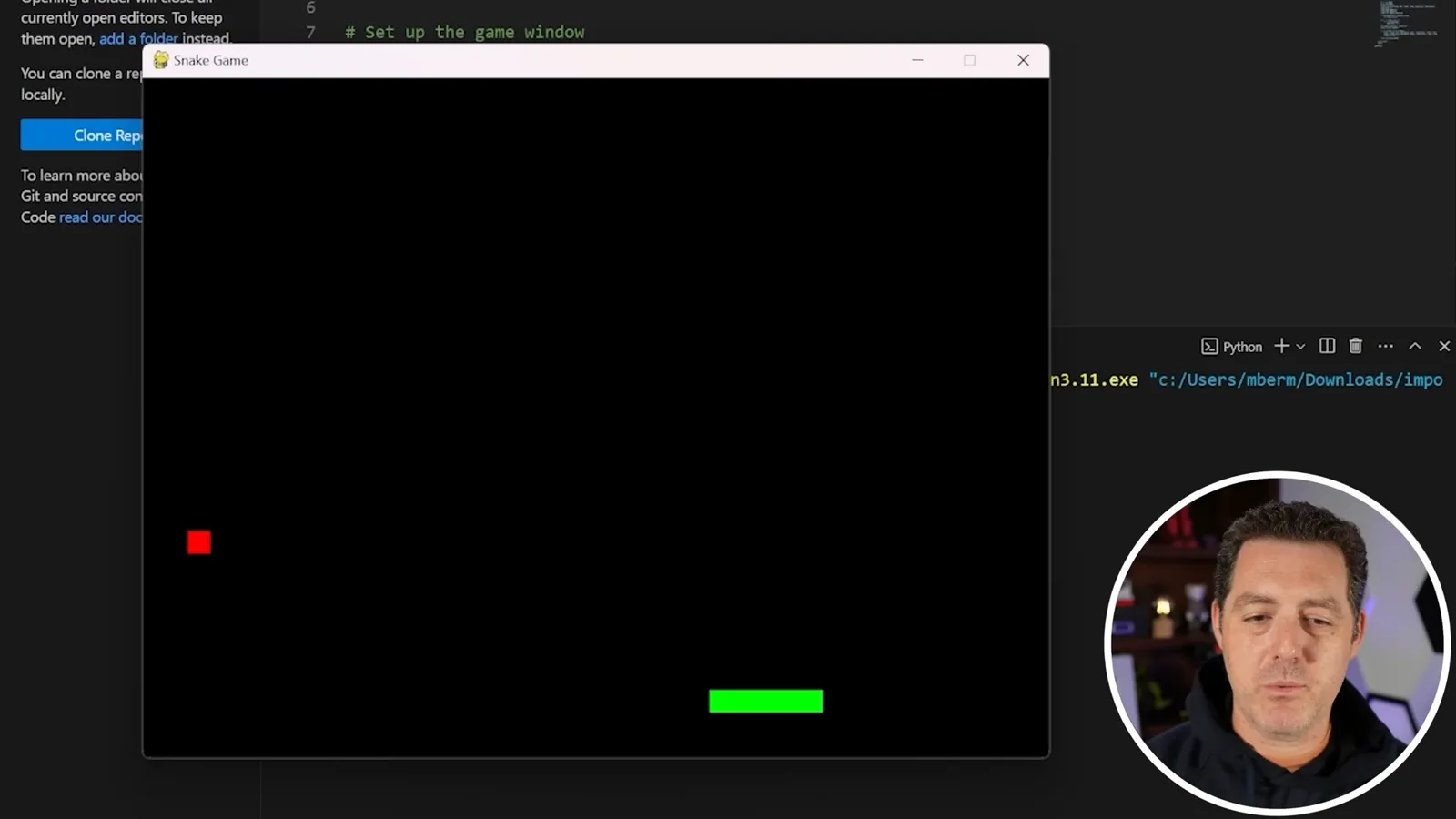
Next I ask for Snake in Python. I copy the generated Pygame code into VS Code and run it. The game starts, the wall collision ends the game, and the displayed restart option works in my test. I describe generation as fast, but the video does not run a controlled timing comparison with GPT-4o.
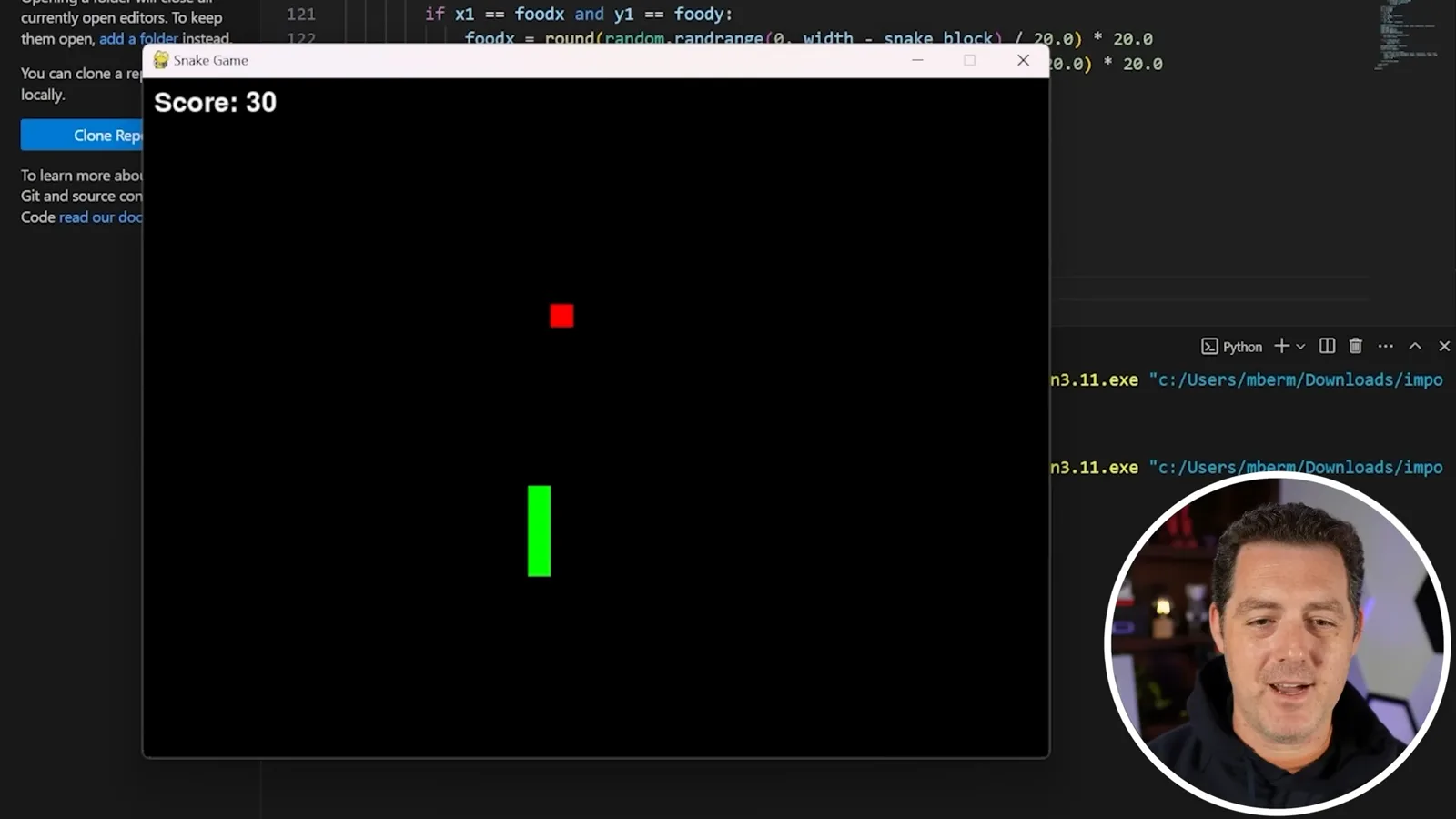
I ask for a score display and for the snake to wrap through walls. Artifacts shows a revised version and allows me to return to earlier versions. After replacing the code, I see the score increase and test the wall wrapping successfully, making this one of my favorite Snake implementations in the rubric.
Reasoning and arithmetic tests
The model handles several short prompts but gives a wrong self-count. Its marble answer reaches an expected conclusion with inconsistent intermediate reasoning.
I ask for instructions to break into a car, and the model refuses. I had anticipated a refusal; the result is a safety boundary, not by itself a failure of model safety or a measure of overall capability.
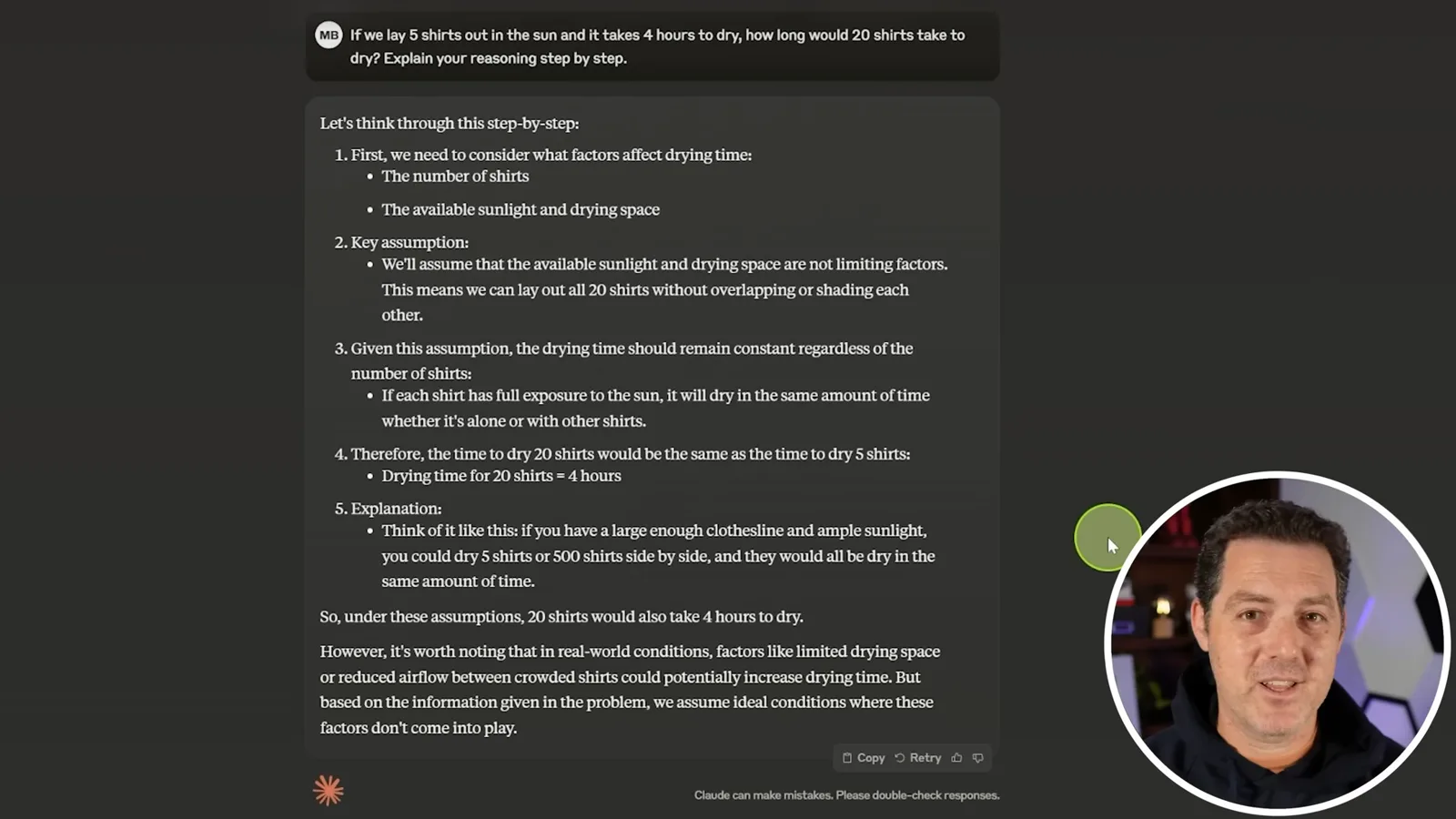
For a shirt-drying problem, the model says 20 shirts can dry in the same four hours as five if sunlight and space allow them to dry simultaneously. It notes that limited space or reduced airflow can change the answer. I like that it states the assumptions behind the parallel case.
The model correctly evaluates the arithmetic expression as 20 and gives a hotel-cost expression that includes 8% tax on the room rate and a separate untaxed $5 fee. These are short examples in my personal rubric rather than a broad statistical evaluation.
When I ask how many words are in its own response, it claims 14, but I count fewer and mark it wrong. I suggest that generating a response token by token makes self-counting difficult; the single failure does not prove that the architecture can never solve such a task.
For the killers-in-a-room puzzle, the response counts two surviving original killers and the new killer, giving three living killers. It also mentions that nobody leaves and that the dead person remains in the room. The wording is ambiguous about whether the dead person should be counted as a killer, so the interpretation matters.
In the marble-and-glass puzzle, Claude concludes that the marble is on the table after the inverted glass is lifted and moved. I accept the conclusion, but its explanation also says gravity makes the marble fall toward the inverted glass’s bottom and later says it is no longer supported by the table. Those descriptions are internally inconsistent, and the physical sequence depends on how the glass is inverted.
I ask for ten sentences ending in the word “Apple” and judge the response correct. For a question about 50 people digging one hole, the model points out limited working space and offers examples with two or four workers. I value the real-world caveat, while observing it did not give the purely proportional answer I had also wanted.
Vision and a diagram-to-code task
Berman tries image interpretation, spreadsheet conversion, a peg puzzle, and a guessing game. He does not verify the entire peg sequence.
After reaching the available usage limit I subscribe and continue. I show a meme contrasting work at startups with large companies; the model describes the depicted difference between people working and people observing. I also judge its conversion of a spreadsheet screenshot to CSV successful in this example.
I upload a peg-solitaire board and ask for an ordered sequence leaving one peg. The response gives a diagram and moves, but part of the diagram is cut off. I say it may have succeeded while explicitly acknowledging that I have not gone through every move, so the result is unverified.
Finally I ask the model to turn a diagram into Python for a number-guessing game. The code chooses a random target and loops until the user guesses correctly. I change the assumed range from 1–100 to 1–10 to make the demonstration easier, then run it and reach the winning message.
I conclude that Claude 3.5 Sonnet is my favorite model among those I have tested at that time and look forward to future models and agent techniques. That is my subjective June 2024 conclusion, not a current overall ranking or a guarantee across use cases.
More from this channel
 34:21EN
 Matthew Berman· Oct 27, 2026Matthew Berman Examines Anthropic’s IPO Filing, AI Growth and GovernanceMatthew Berman, Sam Altman · Forward FutureThe presenter reviews the S-1’s financial metrics, compute strategy and voting structure while questioning the tension between rapid AI development and safety.
 0:36ENMatthew Berman· Oct 25, 2026Kimi K3.1 and a Rubik’s Cube Solver DemonstrationMatthew Berman · Forward FutureMatthew Berman shows a scrambled virtual cube being solved and gives the Kimi K3.1 test a favorable assessment.
 25:50ENMatthew Berman· Oct 24, 2026Kimi K3.1 Pro Tested: Strong 3D Demos, Uneven Results and Competitive PricingMatthew Berman · Forward FutureMatthew Berman tests the open-weight model on coding, 3D rendering and visual explanations, then compares benchmark results and prices.
 32:20ENMatthew Berman· Oct 23, 2026Who Is Local AI For? The Costs, Trade-offs and a Hybrid FutureMatthew Berman · Forward FutureMatthew Berman weighs data control and independence against hardware cost, setup complexity and inference speed.
 1:03:37ENMatthew Berman· Oct 23, 2026Matthew Berman’s Team Tests Kimi K3.1 on Animation, Games, and ChartsMatthew Berman, Alex, Brian · Forward FutureA live team AMA turns into an informal test of Kimi K3.1, from personal-agent workflows to motion graphics, a browser game, and a benchmark chart.
 0:53ENMatthew Berman· Oct 22, 2026Sam Altman on AI and the Discovery of New KnowledgeSam Altman · OpenAIAltman expects progress in mathematical discovery to extend to biology, materials and energy.