In 30 seconds
In this February 2026 short, Matthew Berman shows an OpenClaw assistant researching a proposed video and adding a task to Asana. The accompanying prompt describes a broader workflow for research, duplicate checks and concise production briefs; its similarity threshold is a configuration choice, not a guarantee of accuracy.
- 1Start with an ideaBerman asks his assistant to find sources and visual material for a proposed video.
- 2Create a production taskThe assistant adds a card to an Asana video pipeline with researched material.
- 3Research and deduplicateThe description supplies a longer prompt for searching sources, comparing past ideas and creating a brief.
Takeaways
- A chat message can trigger research for articles, videos, posts and visual material related to an idea.
- The example creates an Asana task containing research links and a production outline.
- The supplied prompt proposes similarity-based duplicate checks, but the short does not establish their accuracy.
Read the edited text by chapter
From an idea to a task
Berman demonstrates research from a chat request and shows the resulting Asana task. He shares a broader prompt for a content pipeline.
My team shares articles that might make interesting videos. In this OpenClaw example, I tell my assistant that an article is a video idea and ask it to find relevant articles, videos, posts and graphs I could show alongside it.
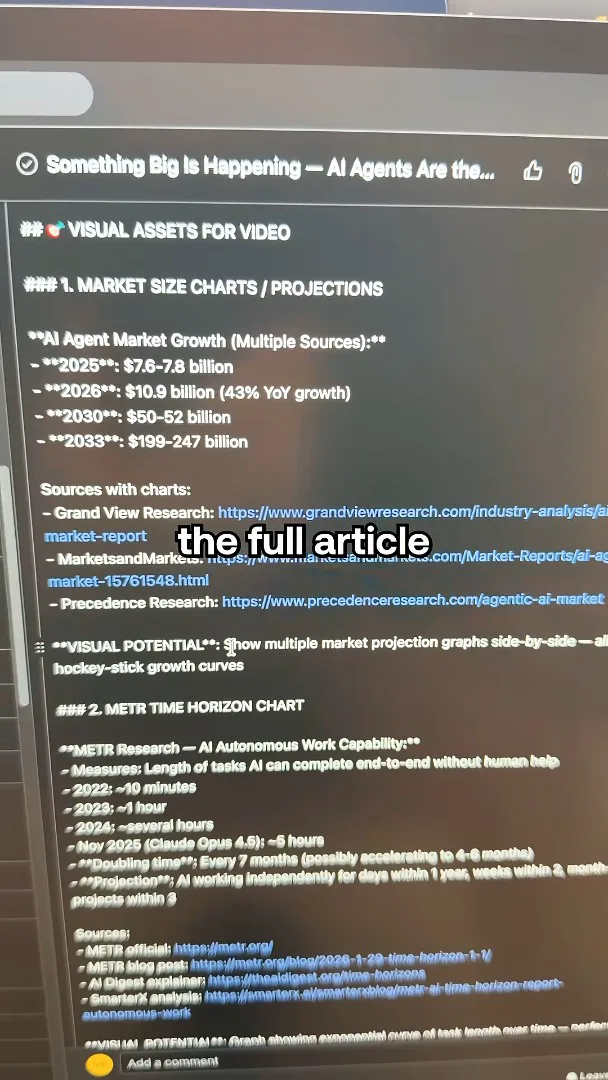
When the research finishes, the assistant creates a card in my Asana video pipeline. I open the card to show source material and a video outline assembled from the article; the short shows a result, not a systematic assessment of source quality.
The video description provides a broader content-idea prompt: research a topic, compare it with past ideas using semantic and keyword similarity, and create a concise task if it passes a duplicate check. Its proposed 40% cutoff is a chosen rule and can produce false matches or miss duplicates, so the output still needs review.
More from this channel
 34:21EN
 Matthew Berman· Oct 27, 2026Matthew Berman Examines Anthropic’s IPO Filing, AI Growth and GovernanceMatthew Berman, Sam Altman · Forward FutureThe presenter reviews the S-1’s financial metrics, compute strategy and voting structure while questioning the tension between rapid AI development and safety.
 0:36ENMatthew Berman· Oct 25, 2026Kimi K3.1 and a Rubik’s Cube Solver DemonstrationMatthew Berman · Forward FutureMatthew Berman shows a scrambled virtual cube being solved and gives the Kimi K3.1 test a favorable assessment.
 25:50ENMatthew Berman· Oct 24, 2026Kimi K3.1 Pro Tested: Strong 3D Demos, Uneven Results and Competitive PricingMatthew Berman · Forward FutureMatthew Berman tests the open-weight model on coding, 3D rendering and visual explanations, then compares benchmark results and prices.
 32:20ENMatthew Berman· Oct 23, 2026Who Is Local AI For? The Costs, Trade-offs and a Hybrid FutureMatthew Berman · Forward FutureMatthew Berman weighs data control and independence against hardware cost, setup complexity and inference speed.
 1:03:37ENMatthew Berman· Oct 23, 2026Matthew Berman’s Team Tests Kimi K3.1 on Animation, Games, and ChartsMatthew Berman, Alex, Brian · Forward FutureA live team AMA turns into an informal test of Kimi K3.1, from personal-agent workflows to motion graphics, a browser game, and a benchmark chart.
 0:53ENMatthew Berman· Oct 22, 2026Sam Altman on AI and the Discovery of New KnowledgeSam Altman · OpenAIAltman expects progress in mathematical discovery to extend to biology, materials and energy.