Using OpenClaw to Research and Organize Video Ideas

Matthew Berman demonstrates an assistant that gathers sources and creates a task in a video-production pipeline.

MBMatthew BermanAnime · Forward Future
Chaîne
Matthew Berman
Publié
11 févr. 2026
Vidéo
0:51
Lecture
1 min
Diapositives
1
Original
anglais
Ouvrir sur YouTube
En faisant défiler, la vidéo se réduit en bas à droite et continue. Les sous-titres suivent votre langue de lecture.
Langue de lectureDisponible en 2 langues
Cet article n’est pas encore disponible en français ; il s’affiche dans l’original en anglais.
RÉSUMÉ

En 30 secondes

In this February 2026 short, Matthew Berman shows an OpenClaw assistant researching a proposed video and adding a task to Asana. The accompanying prompt describes a broader workflow for research, duplicate checks and concise production briefs; its similarity threshold is a configuration choice, not a guarantee of accuracy.

  1. 1Start with an ideaBerman asks his assistant to find sources and visual material for a proposed video.
  2. 2Create a production taskThe assistant adds a card to an Asana video pipeline with researched material.
  3. 3Research and deduplicateThe description supplies a longer prompt for searching sources, comparing past ideas and creating a brief.

À retenir

  1. A chat message can trigger research for articles, videos, posts and visual material related to an idea.
  2. The example creates an Asana task containing research links and a production outline.
  3. The supplied prompt proposes similarity-based duplicate checks, but the short does not establish their accuracy.
TEXTE INTÉGRAL

Lire le texte remanié, chapitre par chapitre

Transcription seule
01

From an idea to a task

Berman demonstrates research from a chat request and shows the resulting Asana task. He shares a broader prompt for a content pipeline.

My team shares articles that might make interesting videos. In this OpenClaw example, I tell my assistant that an article is a video idea and ask it to find relevant articles, videos, posts and graphs I could show alongside it.
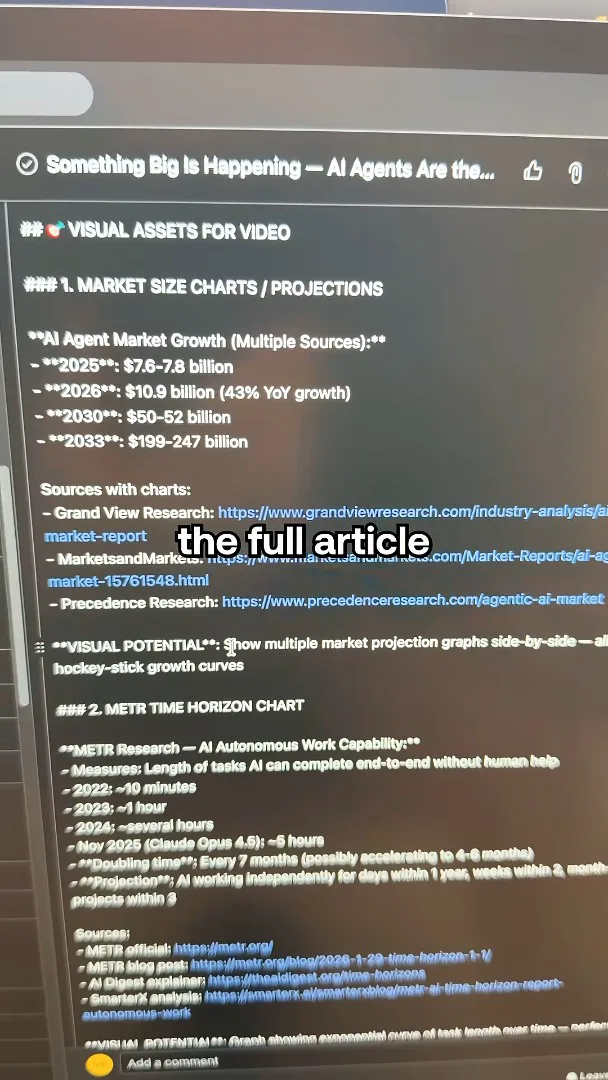
Research material in the video pipeline
DIAPOSITIVE 1 / 1Research material in the video pipelineThe task contains links and proposed visual assets gathered for the video idea.

When the research finishes, the assistant creates a card in my Asana video pipeline. I open the card to show source material and a video outline assembled from the article; the short shows a result, not a systematic assessment of source quality.

The video description provides a broader content-idea prompt: research a topic, compare it with past ideas using semantic and keyword similarity, and create a concise task if it passes a duplicate check. Its proposed 40% cutoff is a chosen rule and can produce false matches or miss duplicates, so the output still needs review.

Sur la même chaîne

6 diapositives25:50EN
MBMatthew Berman· 24 oct. 2026Kimi K3.1 Pro Tested: Strong 3D Demos, Uneven Results and Competitive PricingMatthew Berman · Forward FutureMatthew Berman tests the open-weight model on coding, 3D rendering and visual explanations, then compares benchmark results and prices.Open-weight modelsBenchmarksAI cost & performance+1
2 diapositives32:20EN
MBMatthew Berman· 23 oct. 2026Who Is Local AI For? The Costs, Trade-offs and a Hybrid FutureMatthew Berman · Forward FutureMatthew Berman weighs data control and independence against hardware cost, setup complexity and inference speed.Local inferenceOpen-weight modelsAI cost & performance+1
45:08EN
MBMatthew Berman· 21 oct. 2026Sam Altman on AI Discovery, Consciousness, Compute and a Human-Centered FutureMatthew Berman, Sam Altman · Forward FutureIn a conversation with Matthew Berman, Altman discusses scientific progress, personal assistants, recursive self-improvement and the importance of human agency.AI for sciencePersonal agentsConsciousness+2
0:32EN
MBMatthew Berman· 21 oct. 2026Sam Altman on the Continuing Demand for Software WorkSam Altman, Matthew Berman · OpenAIIn a short interview excerpt, Altman says demand for software may be larger than expected even as AI changes how it is made.Future of WorkSoftware engineeringAgents de code
5 diapositives12:14EN
MBMatthew Berman· 14 oct. 2026Gemini 4 Argon Tested: 3D Demos, a Spreadsheet Prototype and Benchmark ResultsMatthew Berman · Forward FutureMatthew Berman tests Google’s model on games and visual projects, then compares reported coding and agent benchmarks.GeminiBenchmarksAgents de code+1
5 diapositives10:36EN
MBMatthew Berman· 13 oct. 2026Meta Muse Wonder Tested: Strong Benchmarks, Mixed Demos and Quota FrictionMatthew Berman · Forward FutureMatthew Berman tests Meta’s models on browser demos and reviews their published benchmark scores, availability and cost.Modèles et entraînementBenchmarksAI cost & performance+1