In 30 Sekunden
3Blue1Brown solves the ladybug clock puzzle by waiting for a first visit to a neighbor of the target. The resulting random-walk question is identical for all eleven possible last numbers, giving each probability 1/11.
- 1Equal-looking outcomesSimulations suggest the eleven possible last numbers are equally likely.
- 2Wait for a neighborThe ladybug eventually reaches a neighbor of the target with probability one.
- 3Reduce to a random walkFrom there the relevant walk must reach +10 before −1.
- 4Every number has probability 1/11The same argument applies to every number other than the starting point.
Das Wichtigste
- Simulations suggest the eleven possible last numbers are equally likely.
- The ladybug eventually reaches a neighbor of the target with probability one.
- From there the relevant walk must reach +10 before −1.
- The same argument applies to every number other than the starting point.
Den bearbeiteten Text nach Kapiteln lesen
The clock puzzle
A ladybug’s random walk colors numbers on a clock.
A ladybug starts at 12 on a clock and takes random steps clockwise or counterclockwise, each with equal probability. Every number she touches turns red. What is the probability that 6 is the last number to be colored?
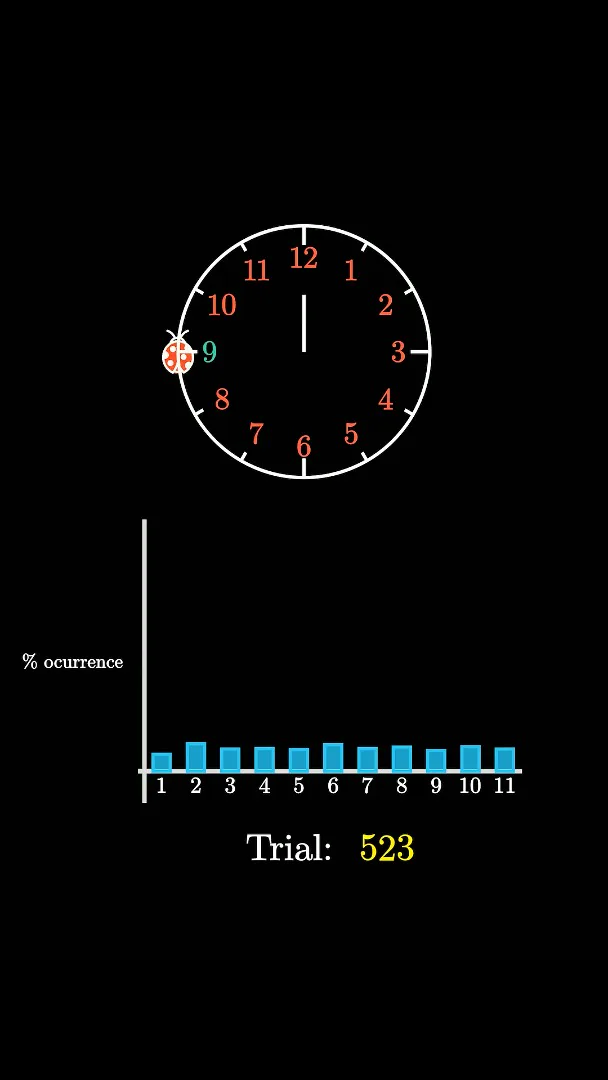
When I simulate the walk many times and record the final number, all numbers from 1 through 11 appear about equally likely. That is surprising: one might initially expect 6, opposite the start, to be less likely than 1 or 11.
Wait for a neighbor
Reframe the question at the first visit to either neighbor of the target.
The key is to wait until the ladybug first reaches either neighbor of 6, namely 5 or 7. This eventually happens with probability one, so waiting for that moment does not change the probability of the final outcome.
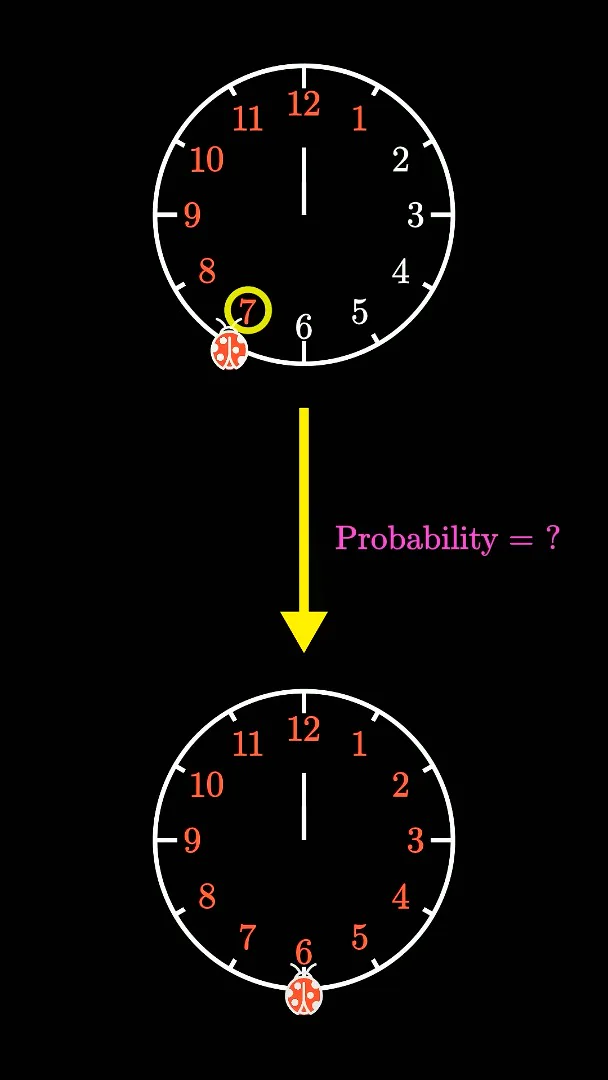
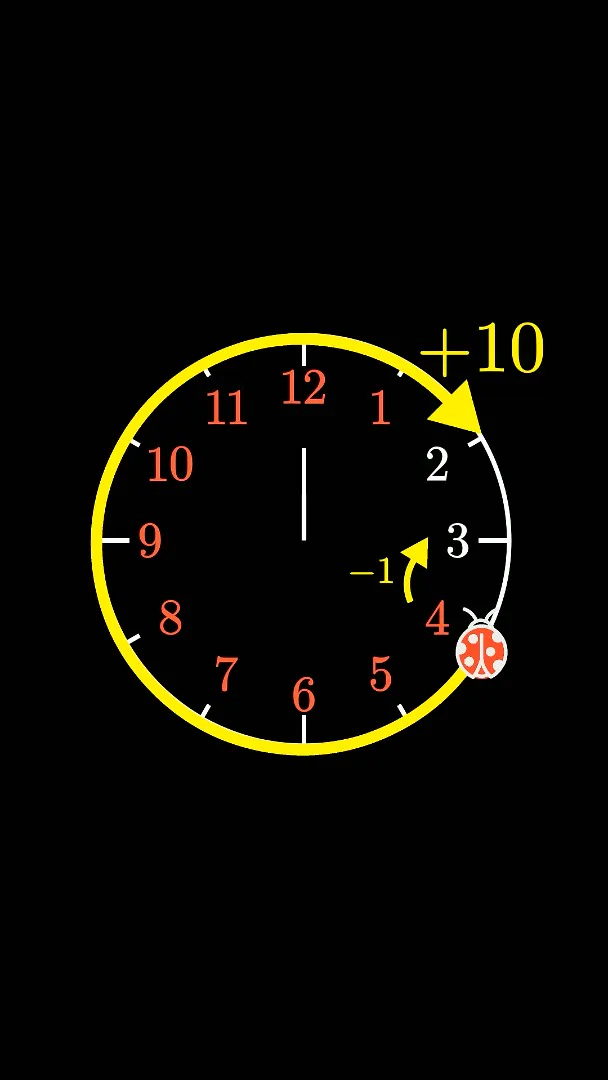
Suppose she reaches 7 first. For 6 to be last, she must reach the still-untouched 5 by going around the other way before ever touching 6. That is a net ten steps clockwise before one step counterclockwise. Once she reaches 5 this way, every other number has been colored.
The same probability for all
The same random-walk problem applies to each possible last number.
Straighten the circle into a random walk: each step is +1 or −1 with equal probability, and the question is whether the walk reaches +10 before −1. We do not need to calculate this directly to finish the argument.
Nothing about the argument is special to 6. For 3, wait until the ladybug first reaches 2 or 4, then the same ten-steps-versus-one-step question applies. The probability is identical for every possible final number from 1 to 11, so each must have probability 1/11.
Mehr aus diesem Kanal
 40:44EN
 3Blue1Brown· 16. Okt. 2026Grant Sanderson: There's never been a better time to go into mathGrant Sanderson, Constantin Kogler · 3Blue1BrownStudents fear AI has solved mathematics. Grant Sanderson argues the opposite: even if machines prove theorems better than we do, the institution of math stays valuable—and this is a rare moment when newcomers can reshape it.
 51:55EN3Blue1Brown· 18. Sept. 2026The last IMO problem AI could not solveGrant Sanderson · 3Blue1BrownGrant Sanderson walks through IMO 2025 Problem 6 — a tiling puzzle that frontier models missed — and the visual patience it takes to prove a construction is optimal.
 0:55EN3Blue1Brown· 24. Juli 2026The 64 Sugar Cubes Puzzle: Six Equal DistancesA 4×4×4 block has three colors; prove that six same-colored pairs share a distance.
 2:25EN3Blue1Brown· 12. Juni 2026How Shannon Measured the Entropy of EnglishA guessing game helped Claude Shannon estimate how much information English text contains, and why prediction is central to compression.
 1:02EN3Blue1Brown· 10. Juni 2026A Robot Walk and the Puzzle of Optimal Binary EncodingHow few bits does it take to send directions that occur with unequal frequencies?
 32:19EN3Blue1Brown· 7. Juni 2026Reinventing Entropy: Why Prediction Helps Compress LanguageA robot’s movement code leads from prefix-free encoding to Shannon information and the entropy of language.