30초 요약
In this December 2024 news roundup, Matthew Berman reviews research demos and product announcements from Google DeepMind, World Labs, ElevenLabs, Tencent, Qwen, Prime Intellect, Anthropic, Runway, Amazon and OpenAI. He is enthusiastic about generated environments and agents while noting some demo and model limitations. The video includes a paid Build Your Store AI sponsorship; product claims and prices are historical.
- 1Genie 2 worldsDeepMind showed image-conditioned environments controlled by keyboard and mouse in research demonstrations.
- 2A different 3D approachWorld Labs let users explore limited browser scenes built from an image.
- 3An experimental reasoning modelQwQ-32B-Preview offered downloadable weights alongside documented limitations and vendor-reported benchmarks.
- 4Distributed trainingPrime Intellect released a model trained across distributed machines and supporting materials.
- 5Connecting agents with MCPAnthropic introduced an open client-server protocol for connecting AI applications with tools and data.
- 6Amazon NovaAmazon announced a family of text and multimodal models, with availability and specifications described as of 2024.
핵심 정리
- Genie 2 generated action-controllable visual environments from an image in research demonstrations, not a finished game engine.
- World Labs showed limited navigable 3D scenes, while ElevenLabs presented voice agents and podcast generation.
- HunyuanVideo and QwQ released downloadable weights, with licensing and model limitations that matter in use.
- INTELLECT-1 demonstrated a specific distributed 10B training run, not the elimination of compute or coordination costs.
- MCP proposed a shared interface for connecting AI applications with tools and data; security depends on implementation and permissions.
- Amazon’s Nova lineup and AWS–Anthropic investment were announced in 2024, and descriptions in the video reflect that time.
챕터별로 다듬은 전문 읽기
Genie 2 and generated worlds
Google DeepMind demonstrates action-controlled scenes generated from images. Berman discusses the visual examples and discloses the video sponsor.
This December 2024 roundup covers generated worlds and video, voice agents, open-weight reasoning, distributed training and a new protocol for AI tools. These are historical announcements and demos: product availability, prices and capabilities may have changed.
[Google DeepMind’s Genie 2](https://deepmind.google/blog/genie-2-a-large-scale-foundation-world-model/) generates action-controllable environments from a single prompt image, intended in part to train and evaluate embodied agents. A human or AI agent can use keyboard and mouse inputs. DeepMind showed research examples lasting up to a minute; these clips are demonstrations, not a complete commercial game release.
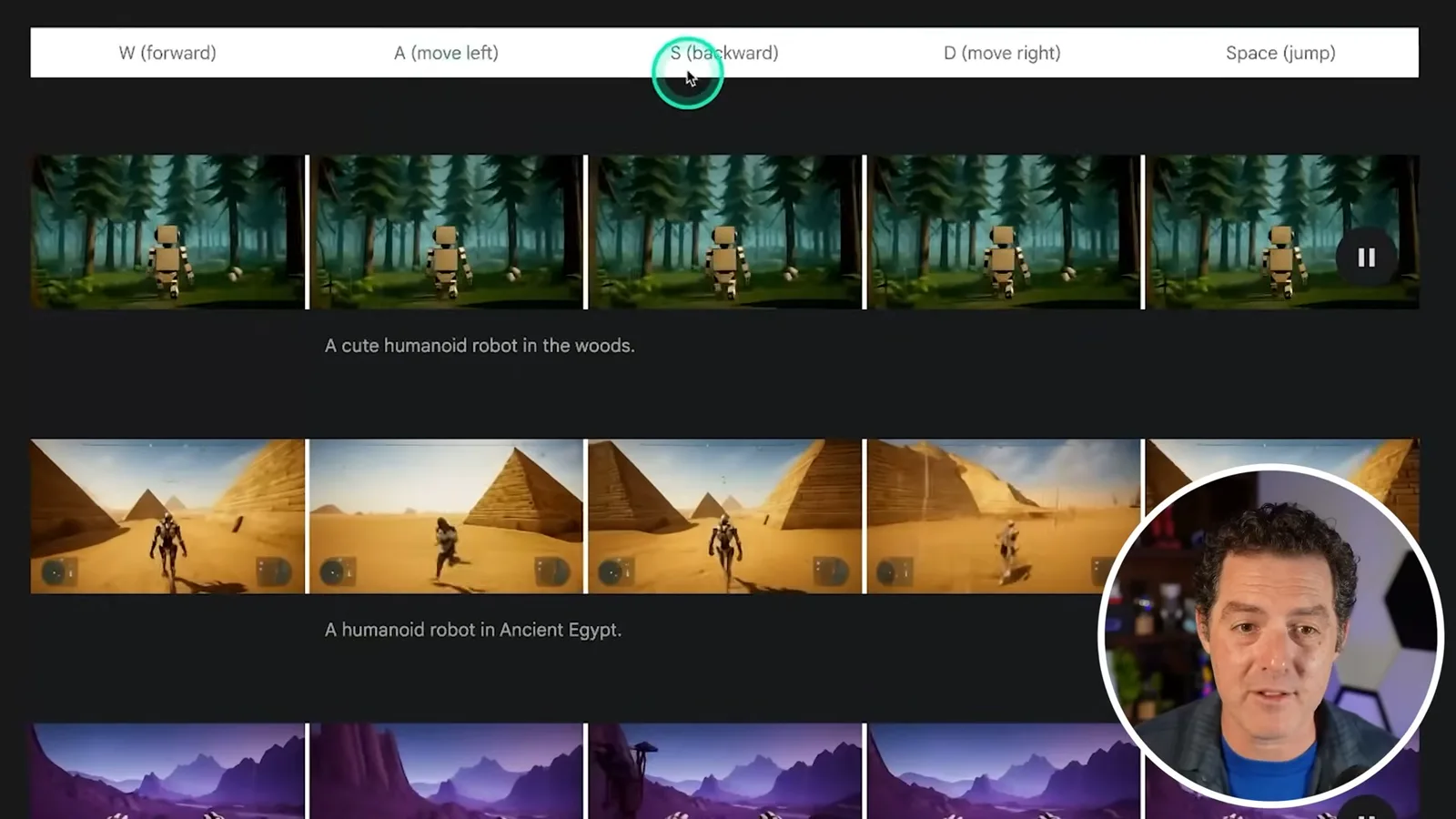
The examples show robots responding to forward, sideways and jump controls in forests, deserts and other scenes. A boat moves from water onto sand with a different apparent response. I find the behavior impressive, although visual plausibility in a demonstration does not establish a general or physically accurate simulation.
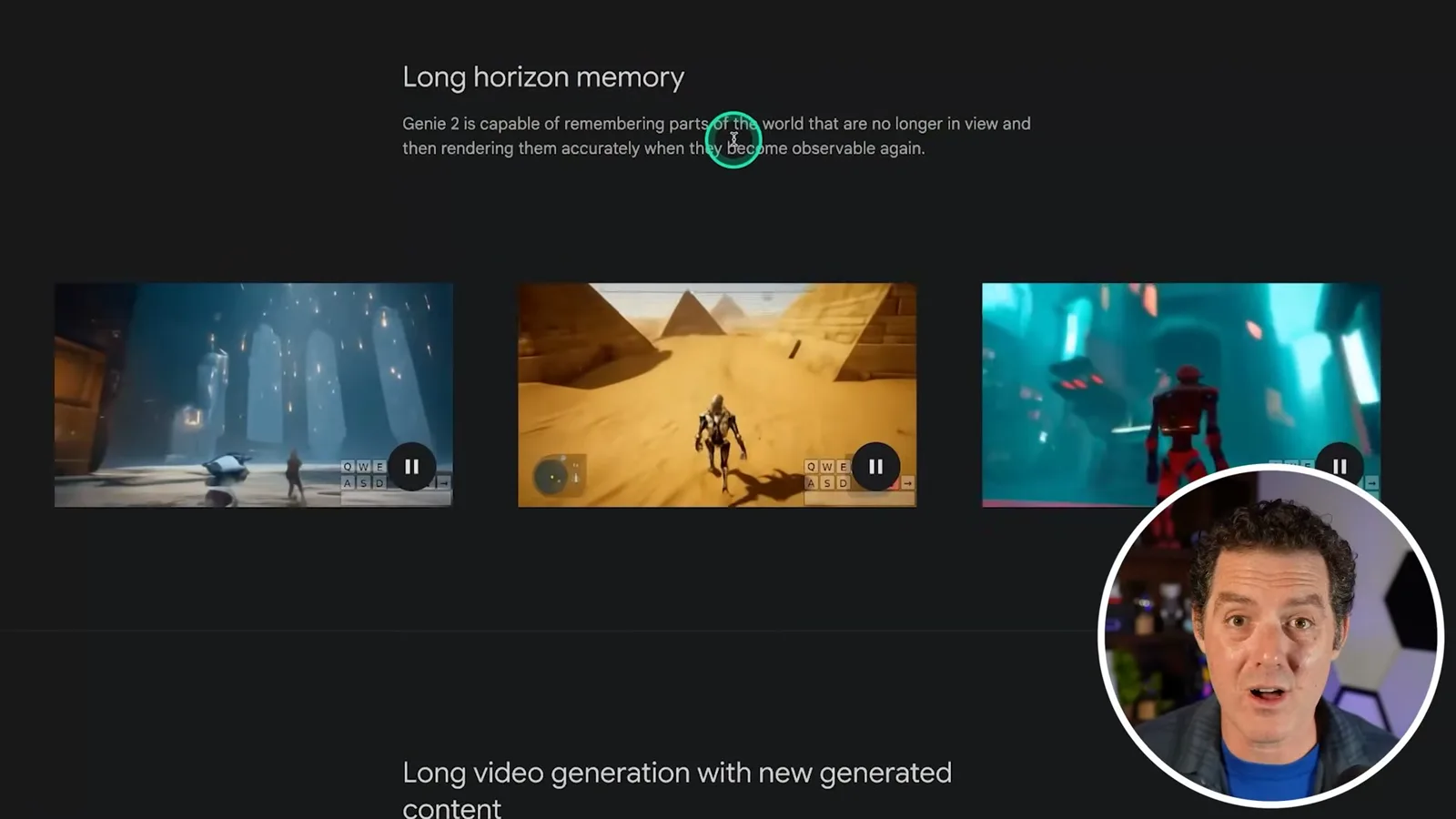
DeepMind also describes “long horizon memory”: portions of a scene that leave the frame can reappear when the viewpoint returns. Its examples include characters moving around a landscape and pyramids. This reminds me of early Sora videos in which objects reappear after being obscured, but consistency in selected clips does not guarantee perfect memory in all cases.
The video includes a paid sponsorship by Build Your Store AI. I demonstrate its proposed Shopify storefront setup and mention a promotional price of $1 per month for the first three months; that offer is historical, and creating a store does not guarantee business success.
More Genie 2 demonstrations include a town, a racing scene, a samurai popping balloons and an exploding barrel. A character climbing a ladder seems to coordinate hands and feet. These are generated visual responses to actions rather than proof that the system possesses a conventional game engine or reliably simulates physics.
I also examine smoke, a torch lighting a dungeon, and scenes generated from real images or concept art. The attraction is being able to explore an idea immediately instead of building every asset by hand. The model is a research demonstration, and my prediction that it will transform games is an expectation, not an established result.
World Labs and ElevenLabs
World Labs shows navigable 3D scenes, and ElevenLabs introduces voice agents and podcast-style audio. Berman distinguishes the limited demos from broader product claims.
World Labs, founded by Fei-Fei Li and colleagues, showed a different approach: generating navigable 3D scenes from a single image. The company provided interactive browser examples, whereas the Genie 2 examples I show were videos. I find the result less game-like but still intriguing.
World Labs explains that an explicit 3D scene can retain its structure when the camera looks away and returns; a depth map visualizes distance from the camera. Its examples also show changing lighting and revealing more of a scene around an input image. This distinction from video generation is about scene representation, not proof of perfect real-world physics.
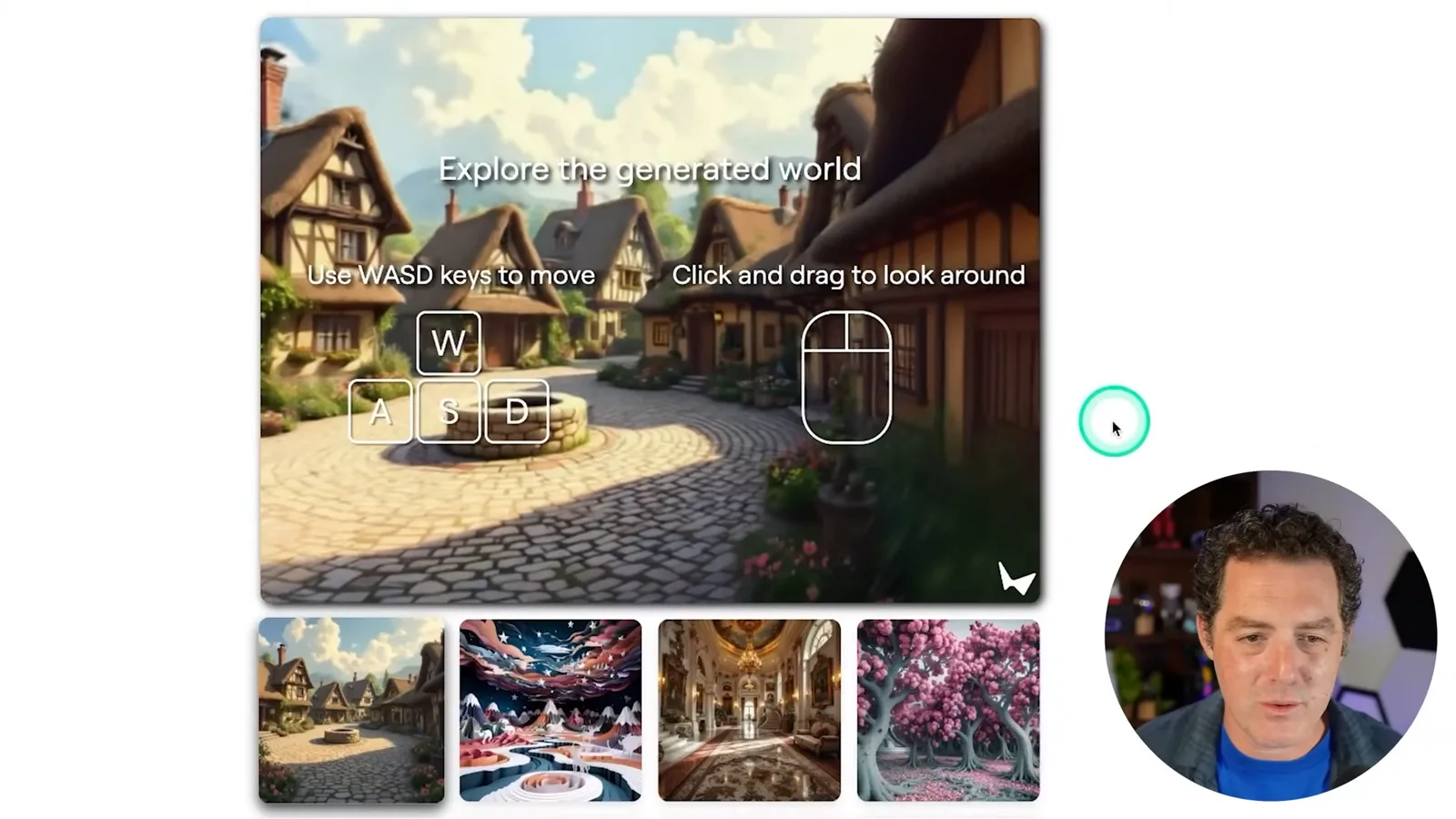
I try the World Labs browser demos. They allow looking around in different directions, but movement is limited to a small area before hitting a boundary. That limitation matters: what is available is a navigable demonstration rather than a fully open, interactive game world.
ElevenLabs introduced Conversational AI for building voice agents. Its promotional demo presents low-latency conversations, configurable voices, a knowledge base, selectable language models, conversation analysis and website or SDK deployment. Its order-status and refund examples illustrate proposed uses; they do not independently establish performance or security in production.
I compare the service with OpenAI’s Advanced Voice Mode and suggest that ElevenLabs may pass audio through transcription, a language model and speech generation. That is my interpretation of the architecture and latency, not a measured head-to-head comparison. The available model integrations and ability to respond to vocal cues are worth testing for a specific use case.
ElevenLabs also introduced GenFM in its ElevenReader iOS app, creating podcast-style audio from sources such as PDFs, articles, ebooks, links and text. The demonstration uses synthetic hosts to discuss Cinderella, atomic theory and a recipe. The company advertised support for 32 languages at the time.
Video, reasoning and distributed training
Berman reviews HunyuanVideo, QwQ-32B-Preview and INTELLECT-1. He discusses generated samples, model limitations and the promise of distributed compute.
Tencent released HunyuanVideo, with downloadable model weights and code for generating video from text. I look at short examples, including a futuristic character, a panda on a bicycle and liquid or mud. Some faces look uncanny despite impressive visual motion. [Tencent’s repository](https://github.com/Tencent-Hunyuan/HunyuanVideo) provides the release; its community license includes conditions and territorial restrictions, so downloadable weights do not mean unrestricted use.
Many of the example clips are only a few seconds long. Longer generation can require more computing resources and time, and a polished sample is not proof that every prompt will work equally well. I mention a separate tutorial on Mochi and invite viewers to request one for HunyuanVideo.
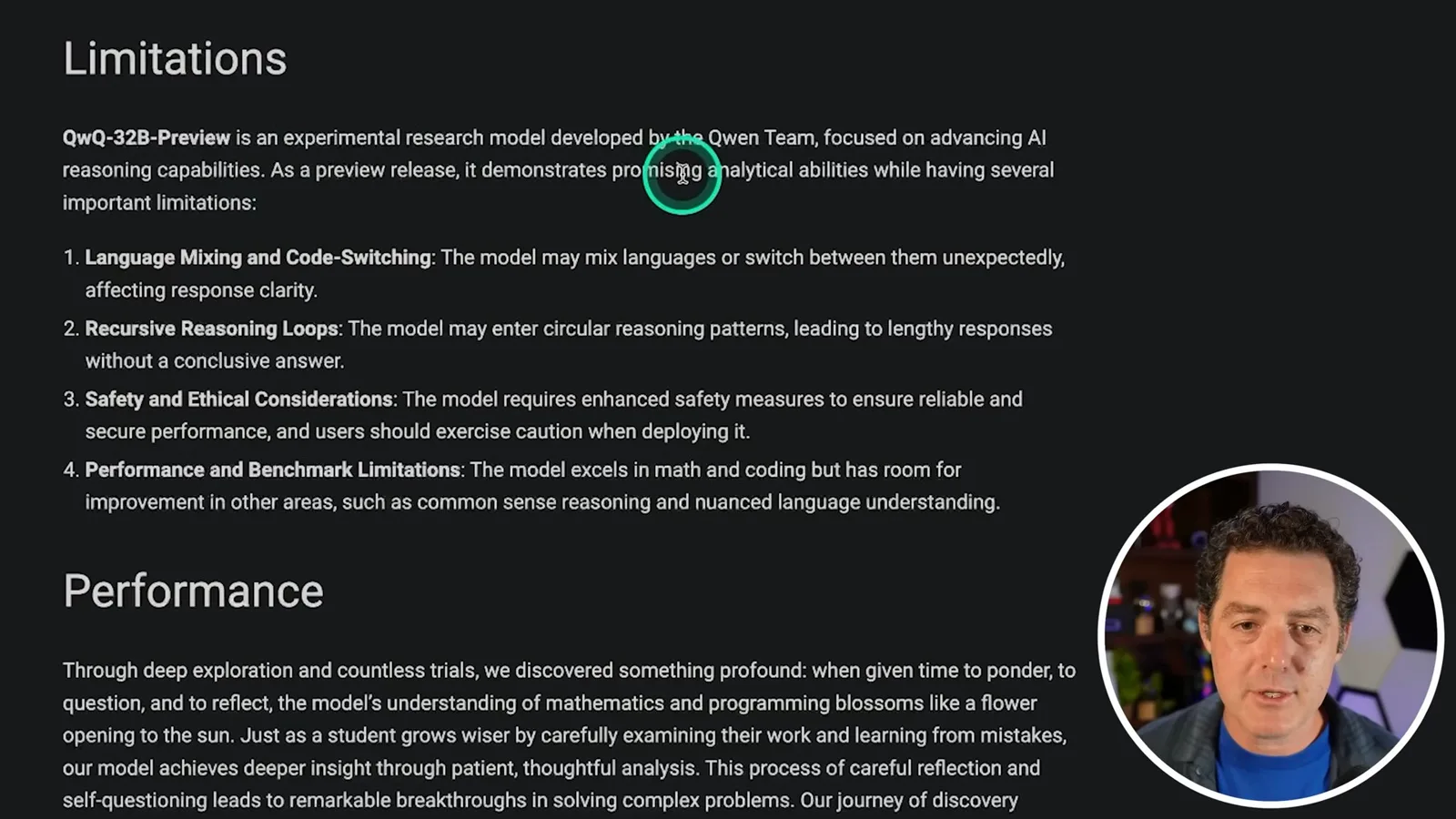
The Qwen team released [QwQ-32B-Preview](https://qwenlm.github.io/blog/qwq-32b-preview/), an experimental 32-billion-parameter reasoning model with downloadable weights. Its creators say it can mix languages, enter recursive reasoning loops and need additional safety measures; they also note weaknesses in common-sense reasoning and nuanced language understanding.
The team’s benchmark chart compares the preview with OpenAI’s o1-preview on AIME, GPQA, MATH-500 and LiveCodeBench. Berman highlights different wins and losses in that vendor-reported table; the results depend on evaluation setup and do not establish a general winner. A displayed arithmetic problem shows a long visible reasoning trace before the answer, unlike the hidden reasoning of o1-preview.
Prime Intellect’s INTELLECT-1 explores training a 10-billion-parameter model across geographically distributed machines. The release includes model checkpoints, a training framework and technical documentation. I see this as a possible way for an open community to pool resources rather than rely entirely on one company’s data center.
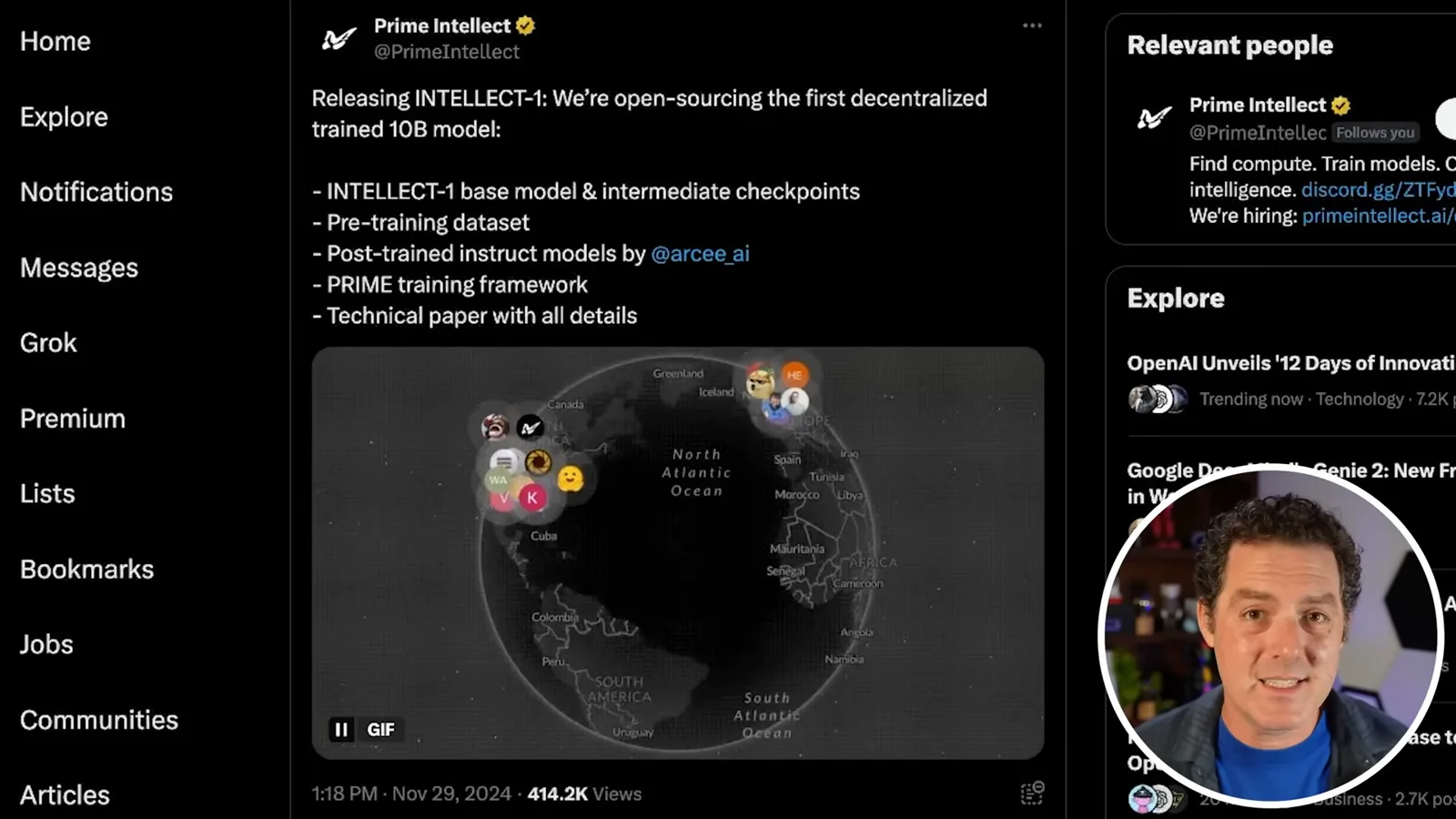
My own two RTX A6000 GPUs often sit idle, so I imagine donating some compute to a project like this. This is a vision of wider participation, not a claim that arbitrary idle consumer machines can already train frontier models without coordination, costs or networking constraints. The 10B example demonstrates a particular distributed training run, not that data centers are obsolete.
MCP and creative tools
Anthropic’s Model Context Protocol prompts a discussion of agents and software interfaces. Berman also looks at GenChess and Runway Frames.
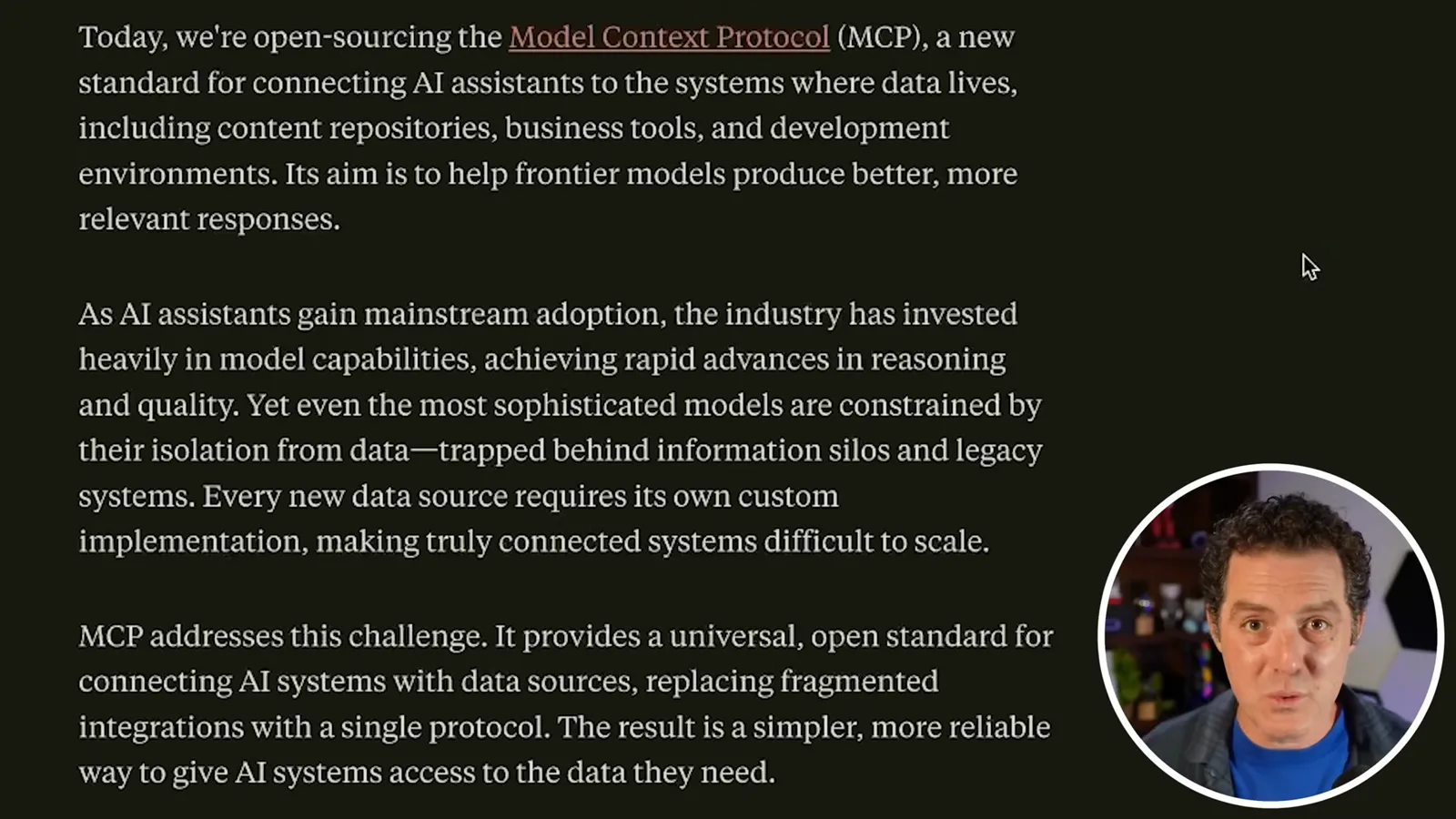
Anthropic announced the [Model Context Protocol](https://www.anthropic.com/news/model-context-protocol), an open standard for connecting AI applications to data sources and tools. Developers can expose data through MCP servers and connect applications through clients; the initial release included a specification, SDKs and examples for Google Drive, Slack, GitHub, Git, Postgres and Puppeteer.
I see standardized connections as part of the shift toward agents that can act on digital systems. MCP provides a common interface, not automatic security or universal access: permissions, trust and implementation still matter. My longer-term view is that agents might assemble interfaces on demand and change how software businesses work.
For example, I speculate that a product built mainly as a user interface over a database could face disruption if an agent can retrieve the data and produce the interface a user needs. I mention Salesforce as an example and think such a shift could take five to ten years. That is a forecast, not evidence that existing applications will disappear.
Google’s GenChess is a playful experiment that creates themed chess pieces. I try generating a robot-inspired set after looking at an ice-cream example, and show that users can inspect and edit variations. As a chess fan, I enjoy the idea of customizing the look of a game.
Runway introduced Frames, an image-generation model marketed for visual fidelity and consistent style. I review examples with cinematic, album-art, nature and disposable-camera aesthetics. These curated samples look striking to me, though the subjective impressions and company claims are not independent benchmarks.
Amazon models and OpenAI’s upcoming announcements
Amazon introduces the Nova family and expands its partnership with Anthropic. Berman closes with the then-upcoming 12 Days of OpenAI.
AWS introduced Amazon Nova models on Bedrock. In the [original announcement](https://aws.amazon.com/blogs/aws/introducing-amazon-nova-frontier-intelligence-and-industry-leading-price-performance/), Micro was a text-only model with a 128,000-token context; Lite handled text, images and video with up to 300,000 input tokens and up to 30 minutes of video; Pro was a larger multimodal option. These are launch-era descriptions.
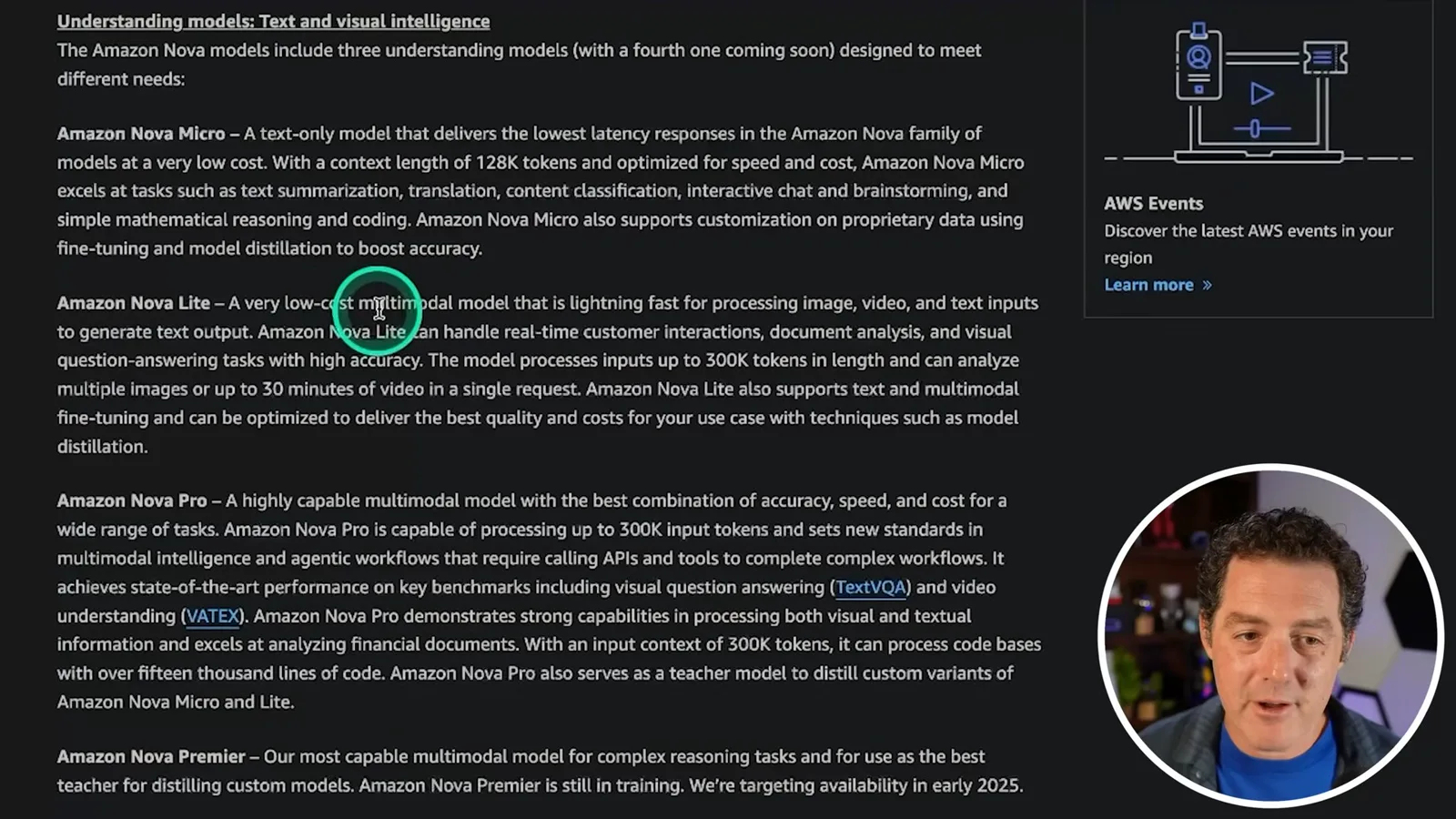
AWS said Nova Premier was still in training and targeted early 2025 at the time. The forecast was not a current availability statement. I welcome another model family in the market, while treating Amazon’s price-performance claims as its own rather than as a verified universal comparison.
Anthropic also announced an additional $4 billion investment from Amazon and a deeper AWS cloud and training partnership. The collaboration included work on Trainium hardware and the Neuron software stack. The investment figure refers to that 2024 announcement, not the companies’ full relationship across all later years.
Finally, Sam Altman teased “12 Days of OpenAI,” with weekday livestreams featuring launches or demonstrations. At the time of this recording I did not know what the announcements would be, so I look forward to following them rather than predicting their contents.
같은 채널의 다른 글
 34:21EN
 Matthew Berman· 2026년 10월 27일Matthew Berman Examines Anthropic’s IPO Filing, AI Growth and GovernanceMatthew Berman, Sam Altman · Forward FutureThe presenter reviews the S-1’s financial metrics, compute strategy and voting structure while questioning the tension between rapid AI development and safety.
 0:26ENMatthew Berman· 2026년 10월 25일Sam Altman on Human Values and Problem-Solving in an AI WorldSam Altman · OpenAIIn a short interview excerpt, Altman considers the enjoyment of solving hard problems and the human role in interpreting results.
 0:36ENMatthew Berman· 2026년 10월 25일Kimi K3.1 and a Rubik’s Cube Solver DemonstrationMatthew Berman · Forward FutureMatthew Berman shows a scrambled virtual cube being solved and gives the Kimi K3.1 test a favorable assessment.
 0:21ENMatthew Berman· 2026년 10월 24일An AI-Generated Kimi Benchmark Chart Used Invented ScoresMatthew Berman · Forward FutureMatthew Berman asks for a graph of Kimi K3.1 Pro benchmarks, then discovers that the displayed figures are illustrative placeholders.
 25:50ENMatthew Berman· 2026년 10월 24일Kimi K3.1 Pro Tested: Strong 3D Demos, Uneven Results and Competitive PricingMatthew Berman · Forward FutureMatthew Berman tests the open-weight model on coding, 3D rendering and visual explanations, then compares benchmark results and prices.
 32:20ENMatthew Berman· 2026년 10월 23일Who Is Local AI For? The Costs, Trade-offs and a Hybrid FutureMatthew Berman · Forward FutureMatthew Berman weighs data control and independence against hardware cost, setup complexity and inference speed.