30초 요약
Sawyer finds the expected separation between two independently scheduled exams in a five-day week to be 1.6 days, and between the earliest and latest of three to be 2.4 days. He uses a table, a tail-sum formula, symmetry, and linearity of expectation before leaving a half-court shooting problem for viewers.
- 1The half-court challengeDanielle makes 20% of her attempts; the episode asks for the expected number of attempts to make one and, as a bonus, two in a row.
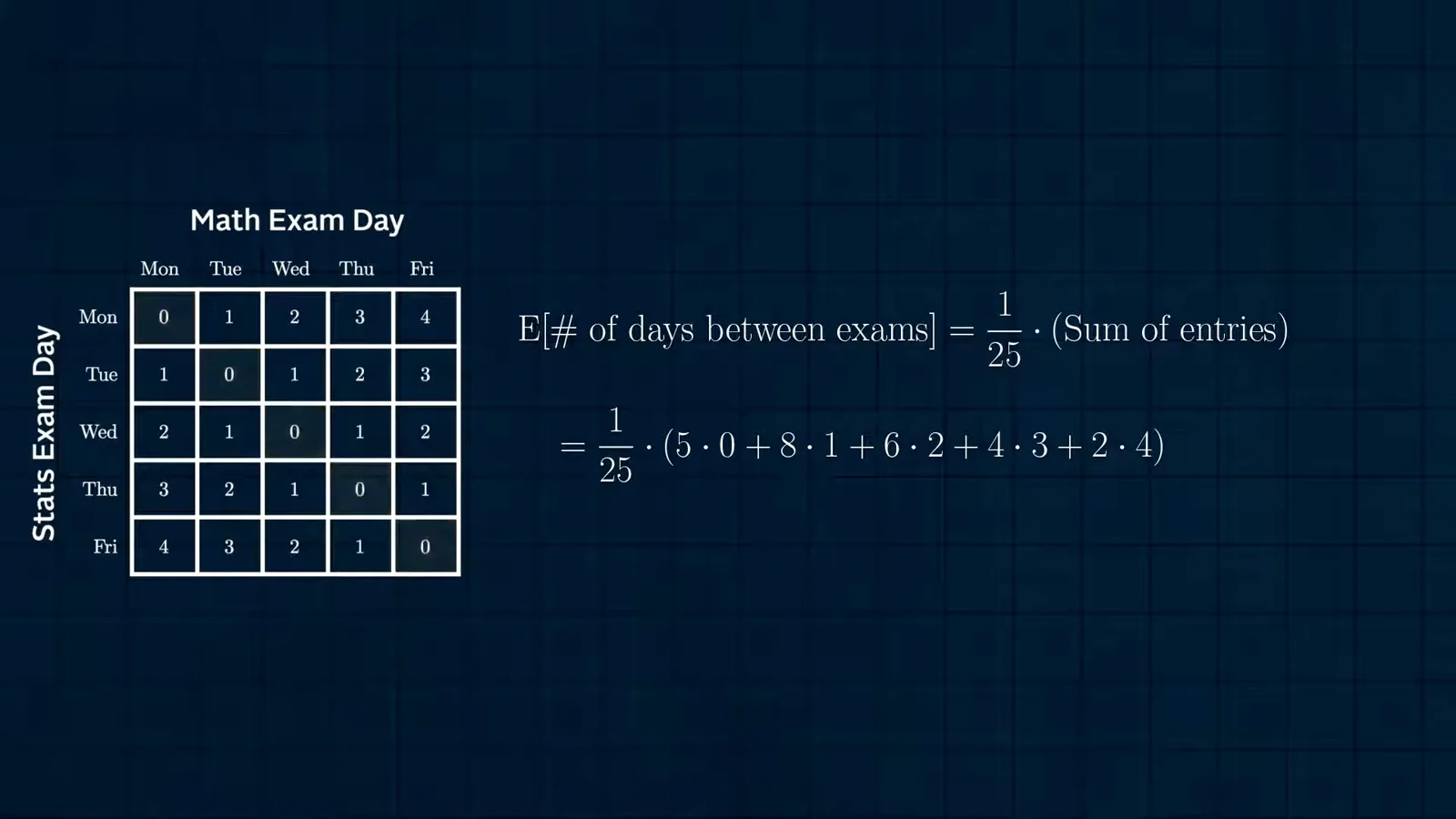
- 2Twenty-five exam schedulesA 5-by-5 table gives an expected separation of 40/25 = 1.6 days for two exams.
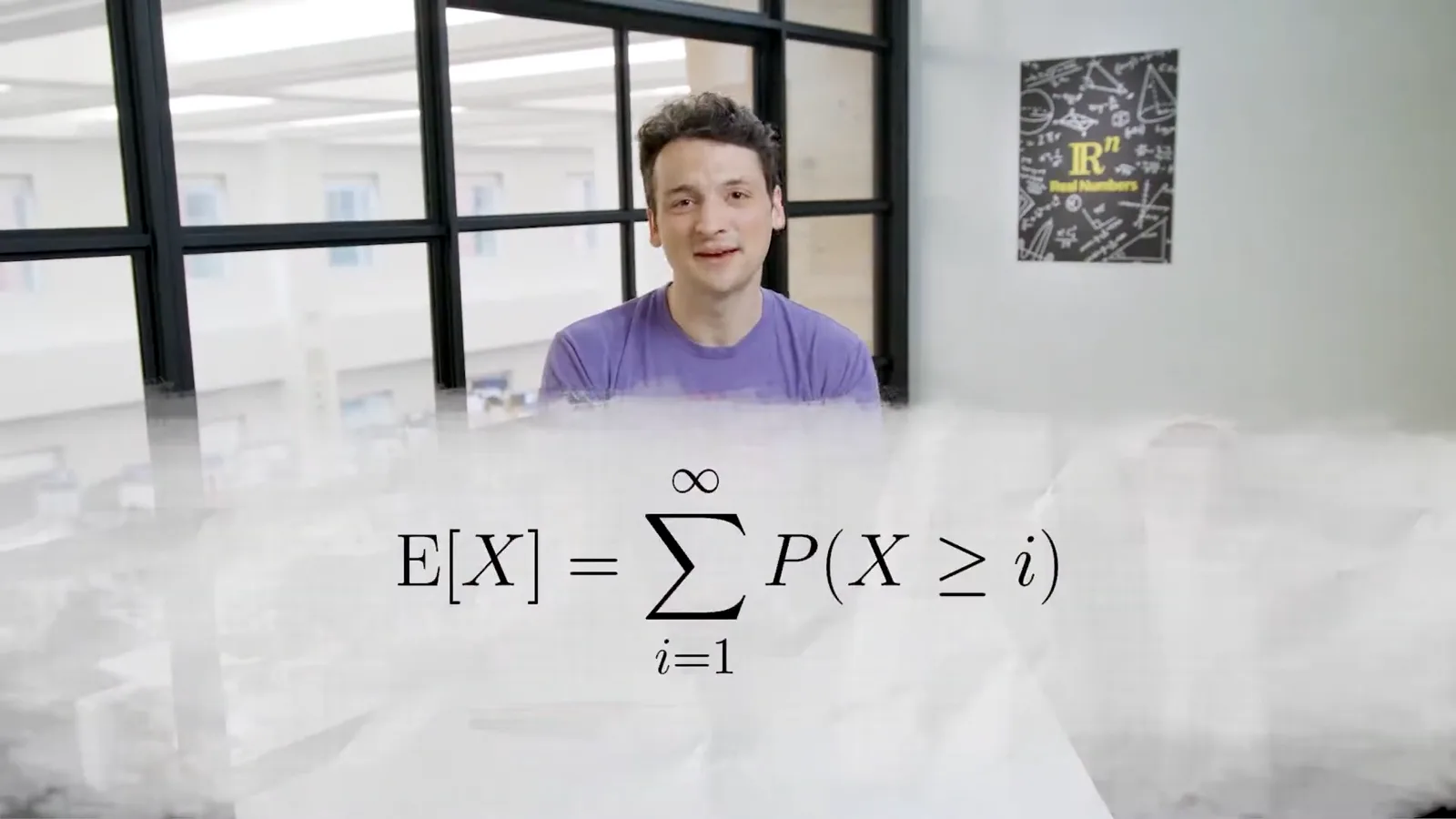
- 3A tail-sum identityFor nonnegative integer-valued X, E[X] = Σ P(X ≥ i), summing from i = 1.
- 4Three exams span 2.4 daysThe tail-sum and symmetry method extends to the earliest and latest of three exams.
- 5Use pairwise distancesThe three pairwise gaps add up to twice the earliest-to-latest span, giving a second route to 2.4 days.
핵심 정리
- Two independent uniformly scheduled exams over five weekdays are separated by an expected 1.6 days.
- For a nonnegative integer-valued random variable, its expectation is the sum of its tail probabilities.
- Symmetry connects the expected earliest and latest exam days.
- With three independent exams, the expected span from earliest to latest is 2.4 days.
- For three ordered dates, the sum of all pairwise distances is twice the span.
챕터별로 다듬은 전문 읽기
A basketball challenge
Sawyer poses an expected-attempts problem with a 20% half-court success rate. A bonus asks about two consecutive successes.
Welcome to Real Numbers. Our expected-value sequence ends with a basketball problem: Danielle finishes practice by taking half-court shots until she makes one.
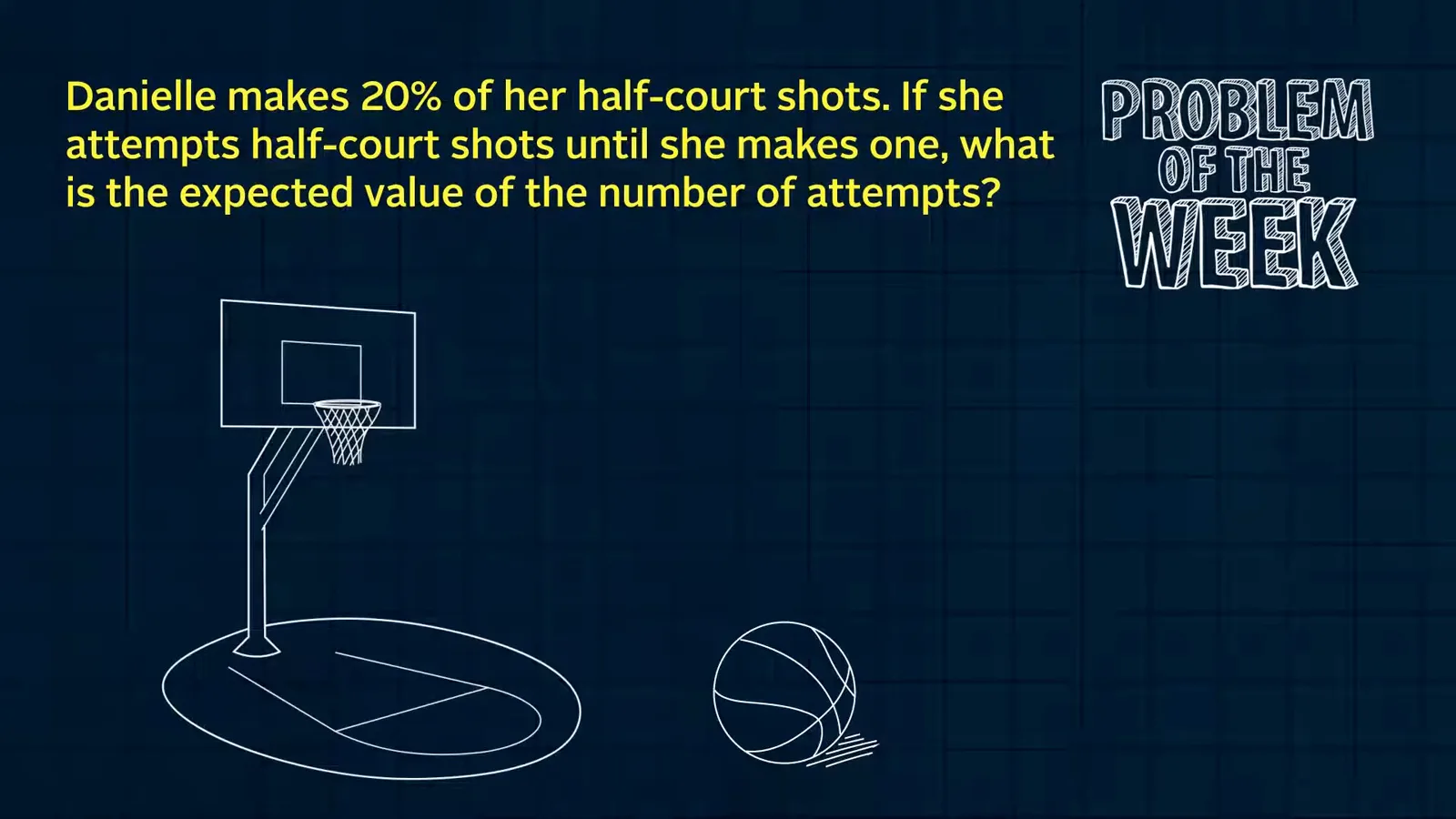
Danielle makes 20% of her half-court attempts. What is the expected number of attempts before she makes one? As a bonus, what is the expected number if she stops only after making two in a row? This episode leaves the questions for viewers to solve.
Two exam dates
The 25 equally likely weekday pairs yield an expected separation of 1.6 days. A second method uses the expected latest and earliest dates.
First, let’s solve last week’s problem. Jayden has two final exams, each independently and uniformly scheduled on one of the five weekdays. What is the expected number of days between them?
There are 25 equally likely combinations. Make a 5-by-5 table, with the day of the math exam along one axis and the statistics exam along the other, and fill each entry with the distance between those days.
The diagonal has five zeros, for exams on the same day. The next diagonals contain eight ones, then six twos, four threes, and two fours. The fours correspond to one exam on Monday and the other on Friday.
Every entry has probability 1/25, so the expectation is (5×0 + 8×1 + 6×2 + 4×3 + 2×4)/25 = 40/25 = 8/5, or 1.6 days.
For a third exam, directly enumerating a 5-by-5-by-5 table is more cumbersome. Instead, number weekdays from 1 to 5. If L is the later day and K the earlier day, the gap is L − K, and linearity gives E[L − K] = E[L] − E[K].
The later day is the maximum of the two dates. In the table of maxima, the number of entries equal to 3 is 3² − 2²: the entries inside the upper-left 3-by-3 square but outside the 2-by-2 square. The same pattern holds for each day.
Summing those maxima gives 1×1² + 2×(2²−1²) + 3×(3²−2²) + 4×(4²−3²) + 5×(5²−4²). Rearranging yields 125 − 16 − 9 − 4 − 1 = 95.
Tail sums and three exams
Sawyer introduces the tail-sum identity and applies it to three exams. Symmetry gives an expected span of 2.4 days.
This rearrangement reflects a general tail-sum identity: for a nonnegative integer-valued random variable X, E[X] = Σ from i = 1 to infinity of P(X ≥ i). It follows by expressing P(X = i) as P(X ≥ i) − P(X ≥ i+1) and rearranging the expectation sum.
For two exams, the expected later day is 95/25 = 19/5 = 3.8. Reversing the week maps day i to 6 − i and swaps earliest and latest, so the expected earlier day is 6 − 3.8 = 2.2. Their difference is again 1.6 days.
With three independent exams, the probability that the latest day is less than i is ((i−1)/5)³: all three exams must lie in the first i−1 days. Thus P(L ≥ i) = 1 − (i−1)³/125.
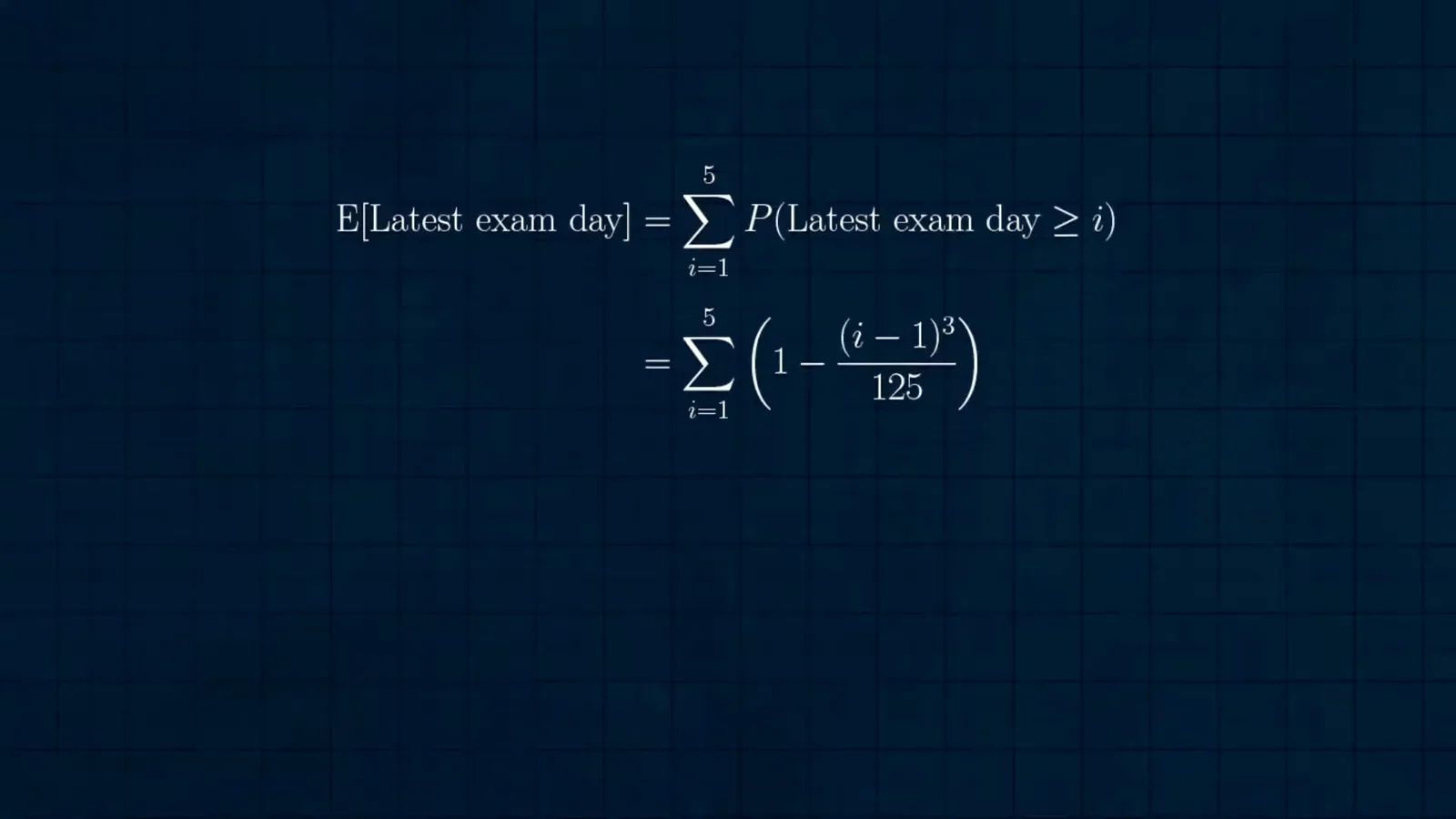
Summing the five tail probabilities gives E[L] = 5 − (1³ + 2³ + 3³ + 4³)/125 = 4.2. By symmetry E[K] = 6 − 4.2 = 1.8, so the expected span from earliest to latest is 2.4 days.
A pairwise-distance shortcut
The three pairwise gaps sum to twice the full span. Linearity recovers the same three-exam result.
There is another route using the two-exam answer. For three ordered exam days, the earliest-to-middle gap plus the middle-to-latest gap equals the earliest-to-latest gap. Adding the full gap once more shows that the three pairwise distances sum to twice the full span.
Each pair has expected separation 8/5 days, regardless of which class is earliest. By linearity, twice the expected span is 3 × 8/5; the span is therefore 3/2 × 8/5 = 12/5 = 2.4 days, matching the previous method.
For this episode’s challenge, return to Danielle’s 20% half-court success rate. Work out the expected attempts for one successful shot and, for the bonus, for two consecutive successful shots, and show your reasoning.
같은 채널의 다른 글
 1:48:29EN
 1:36:37EN
 1:05:45EN
 1:25:00EN
 1:16:29EN
 27:39EN