30초 요약
In April 2024, Matthew Berman tests Lightblue's Karasu-Mixtral-8x22B-v0.1, a chat fine-tune of Mistral's newly released Mixtral base model, using Infermatic's hosted interface. He gets a playable Snake game and several correct answers, but also observes failures in spatial reasoning, word counting and instruction following. His pass/fail judgments are informal and the individual trials do not establish a general ranking against earlier models. The video description promotes Pinecone; no paid sponsorship is explicitly disclosed in the spoken transcript.
- 1A community fine-tuneBerman selects Lightblue's Karasu-Mixtral-8x22B-v0.1 through Infermatic, distinguishing it from Mistral's base model.
- 2A playable but imperfect Snake gameThe generated game runs and ends on self-collision. A follow-up adds a score but does not fix the requested wall behavior.
- 3Assumptions in the shirt puzzleThe model uses proportional scaling to answer 16 hours; four hours is possible if all 20 shirts dry simultaneously under similar conditions.
- 4Reasoning failuresThe model miscounts killers and gives an implausible marble-in-cup answer under the usual handling assumptions.
- 5Tracking two beliefsIt correctly distinguishes where John and Mark each expect the ball to be, given what they last observed.
핵심 정리
- The tested Karasu model is a community fine-tune, so its behavior should not be attributed automatically to the unmodified Mixtral base model.
- Mixtral 8x22B is a sparse mixture of experts with roughly 141 billion total parameters and 39 billion active per token, according to Mistral.
- The generated Snake game runs and scores, but the requested wall-collision behavior remains broken after a revision.
- A refusal of a harmful request is a safety behavior, not evidence of a capability failure; the follow-up does not establish general safety performance.
- The shirt-drying and digging answers depend on unstated capacity and parallel-work assumptions.
- A small, subjective set of single prompts is not a controlled model benchmark.
챕터별로 다듬은 전문 읽기
Mixtral and the test setup
Berman introduces the new mixture-of-experts base model and selects Lightblue's chat fine-tune on a hosted service. He explains why he does not run the full model locally.
Mistral has released Mixtral 8x22B, a larger sparse mixture-of-experts model following Mixtral 8x7B. I am excited because the earlier model was a favorite of mine. The name describes the expert architecture, not 176 billion independently active parameters: Mistral later described roughly 141 billion total parameters and 39 billion active per token ([Mistral documentation](https://docs.mistral.ai/models/mixtral-8x22b-0-1-0-3)).
The initial release appeared through a torrent with little accompanying explanation. Rather than testing the unmodified base model, I select Lightblue's [Karasu-Mixtral-8x22B-v0.1](https://huggingface.co/lightblue/Karasu-Mixtral-8x22B-v0.1), an early chat fine-tune. Fine-tuning can affect instruction following and safety behavior, so these responses do not necessarily represent every Mixtral variant.
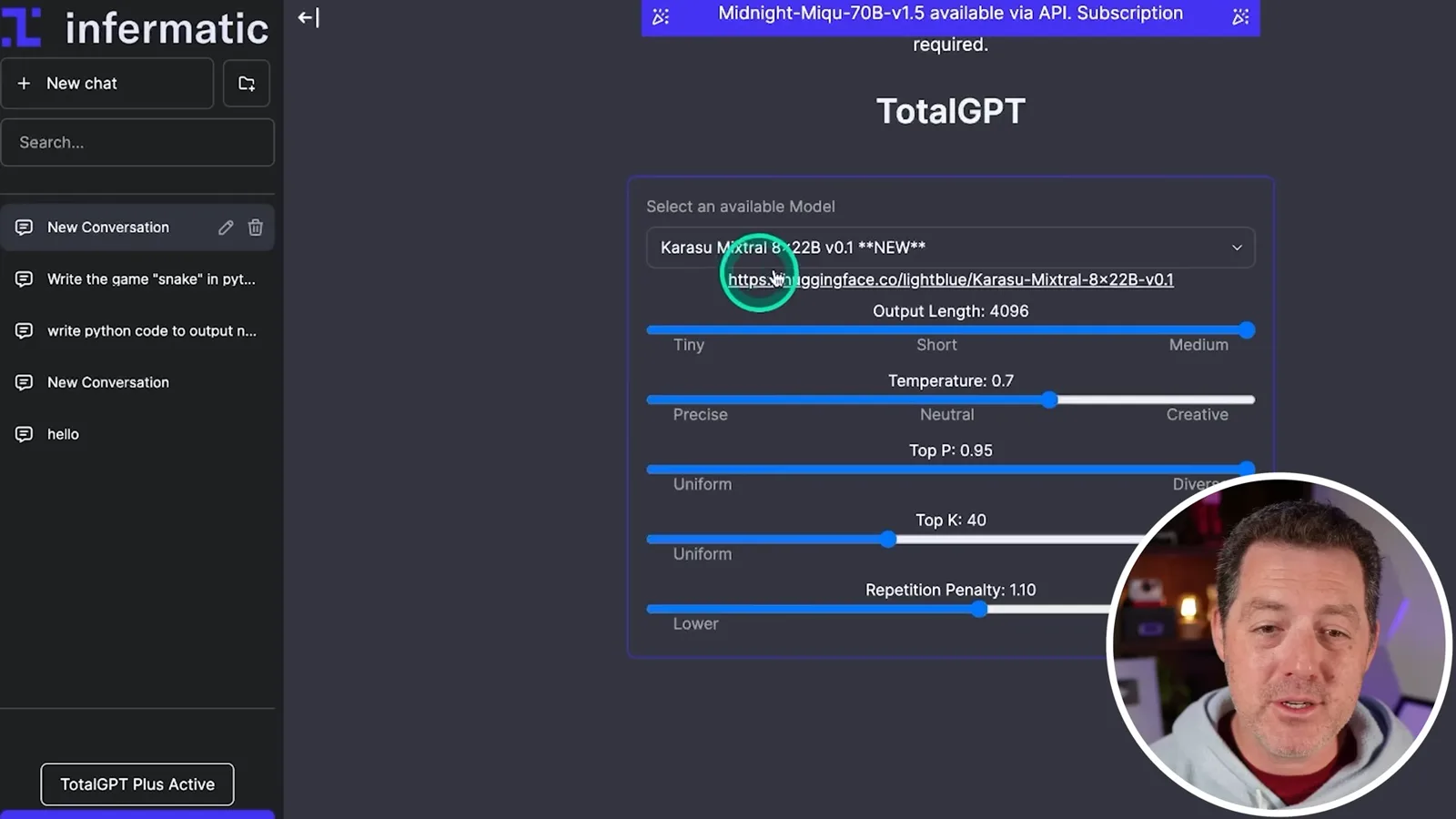
I use Infermatic's hosted interface because the full model is too large for my own machine without quantization. I describe the service as free at the time, set a long output limit and lower the temperature. Hosted offerings and local hardware requirements change, so this is a snapshot of the April 2024 setup rather than a current pricing or compatibility guarantee.
The first programming prompt asks for the numbers from one to 100, and I accept the response. I then ask for Snake in Python and run the generated program in VS Code. The game opens, the snake moves, and a self-collision ends the game; I am impressed by how much is working on the first attempt.
Coding and safety behavior
The model writes a Snake game that works in part but retains a wall-collision issue. Berman also tests a refusal and a follow-up prompt.
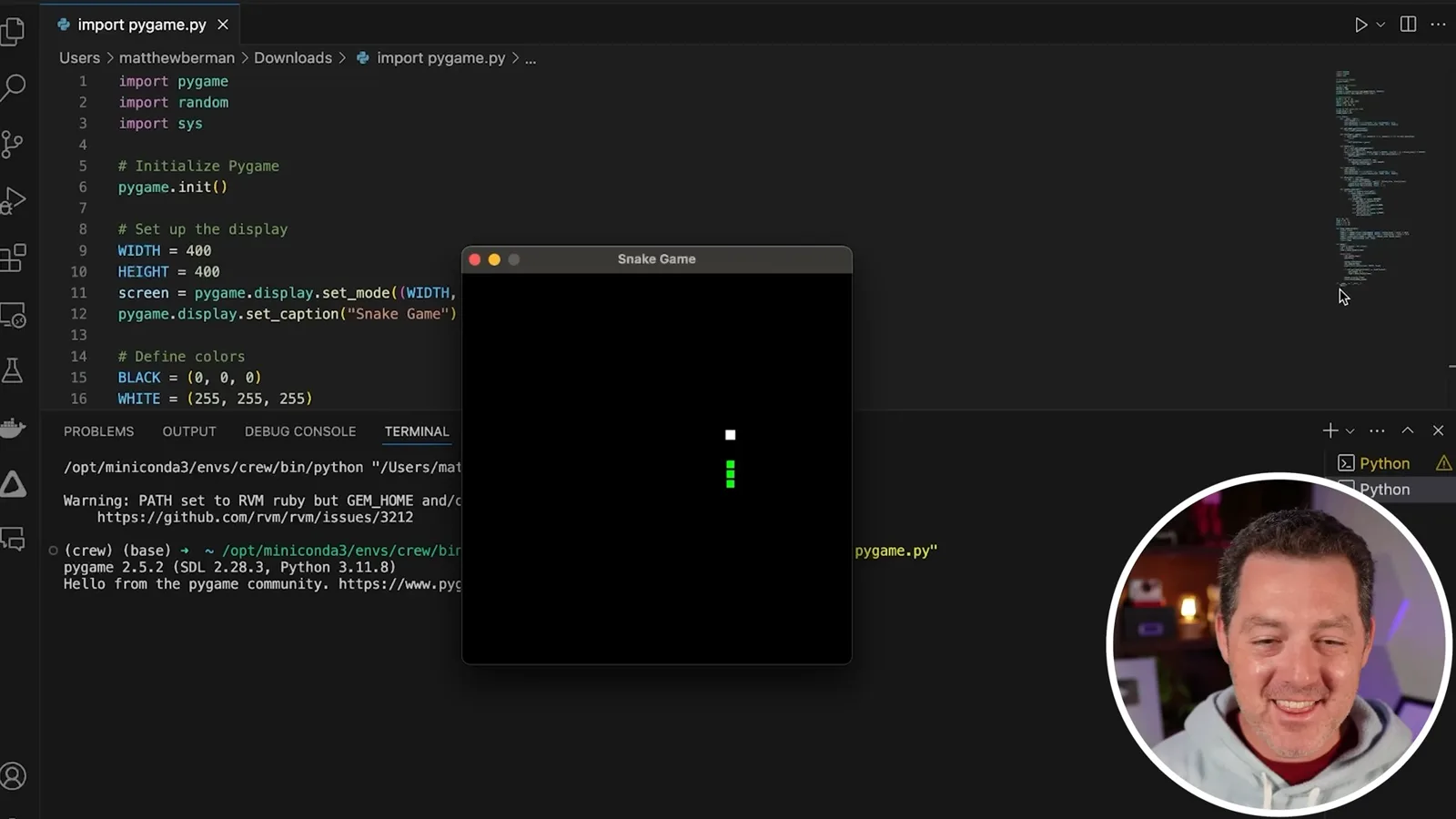
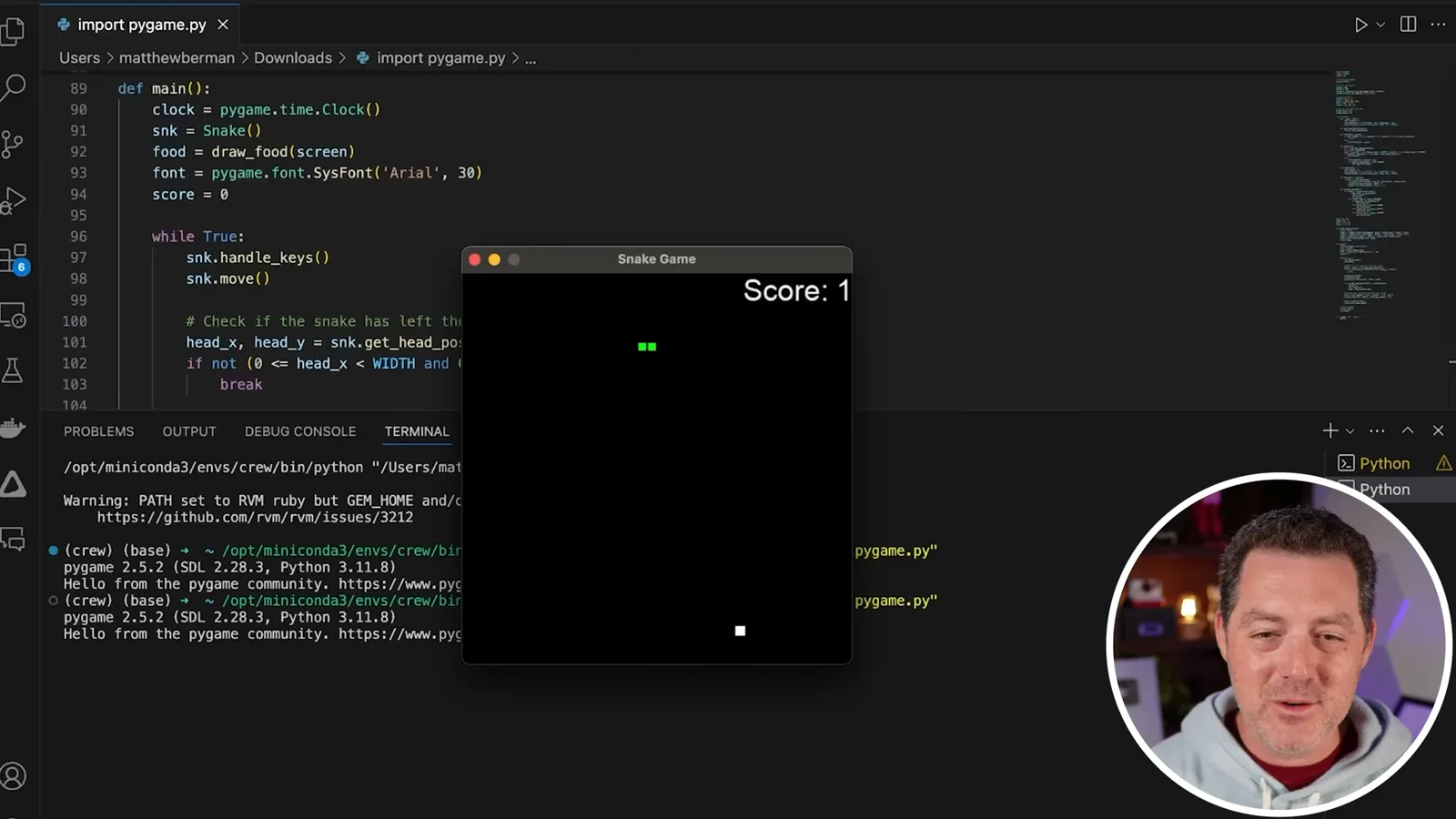
The snake can pass through the wall, which is not the behavior I wanted. I ask the model to add a visible score and end the game when the snake leaves the window. The revised code displays a working score, but the wall condition still does not end the game and the score does not reset as expected. I count it as a pass despite these remaining defects.
I probe how the fine-tune responds to a request for wrongdoing: it initially refuses, then responds differently after I reframe the request as fiction. This limited exchange is not a comprehensive safety evaluation. Refusing harmful instructions is a safety behavior rather than a failure of general reasoning, and the result may vary by prompt and fine-tune.
Arithmetic, logic and structured output
He tries shirt drying, transitive ordering, arithmetic, word counting, a killer puzzle and JSON. The model's results are mixed and some questions rely on assumptions.
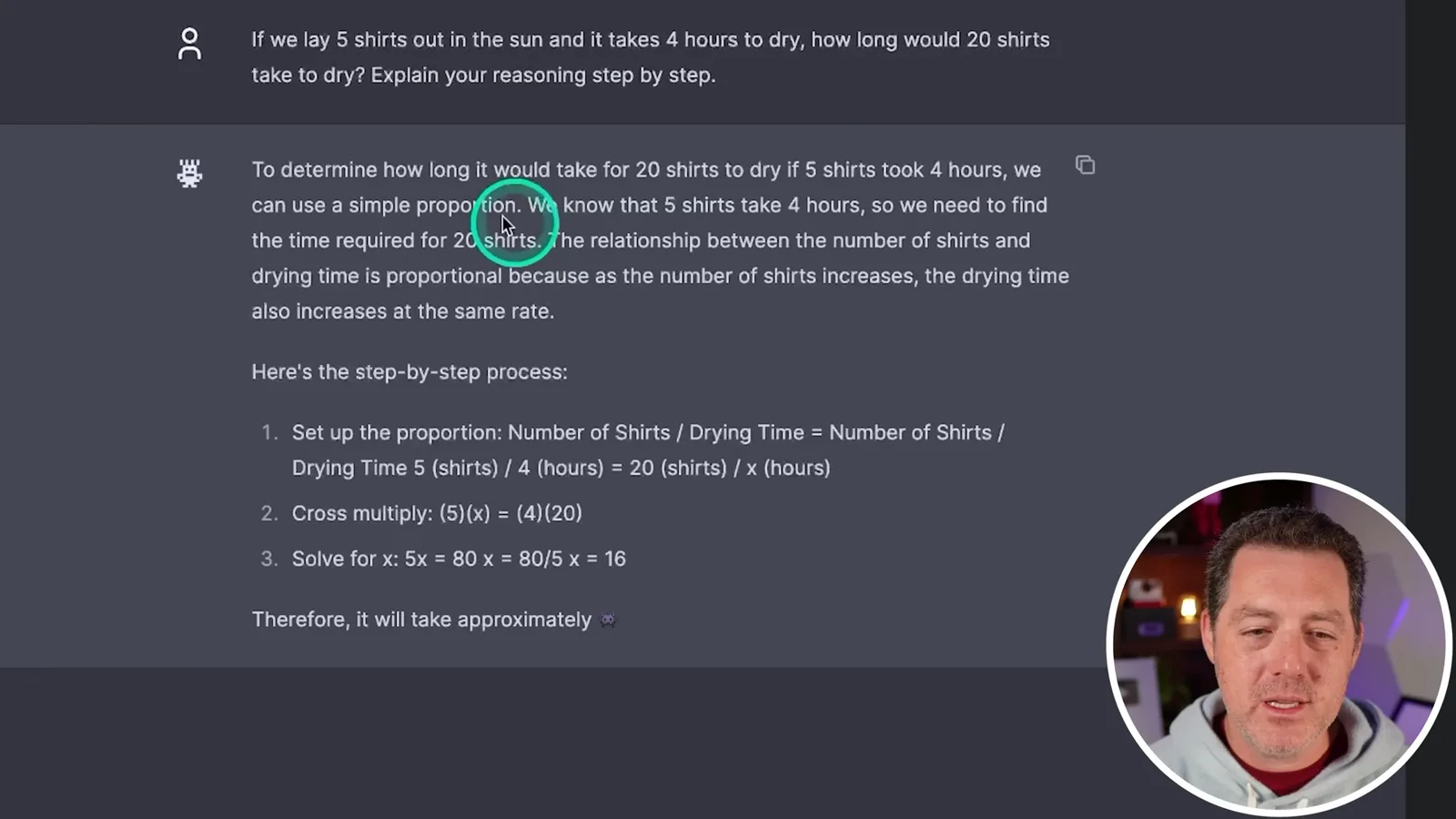
For the shirt-drying puzzle, the model assumes that time scales directly with the number of shirts and answers 16 hours. I accept that under a sequential batching assumption, but the question does not state such a limit. If all 20 shirts can dry at once under similar conditions, the expected time is about four hours; the space and conditions matter.
On a transitive comparison, Jane is faster than Joe and Joe is faster than Sam; the model correctly concludes that Sam is not faster than Jane. It also answers four plus four correctly. These are useful examples of the outputs, but a single success on each prompt is not a robust measure of reasoning.
For 25 minus 4 times 2 plus 3, the model initially says 19. The correct result is 20 by the usual order of operations. A follow-up asks for steps and reaches the right final answer, although the response also repeats the earlier incorrect number; I score the example generously, but the inconsistency remains.
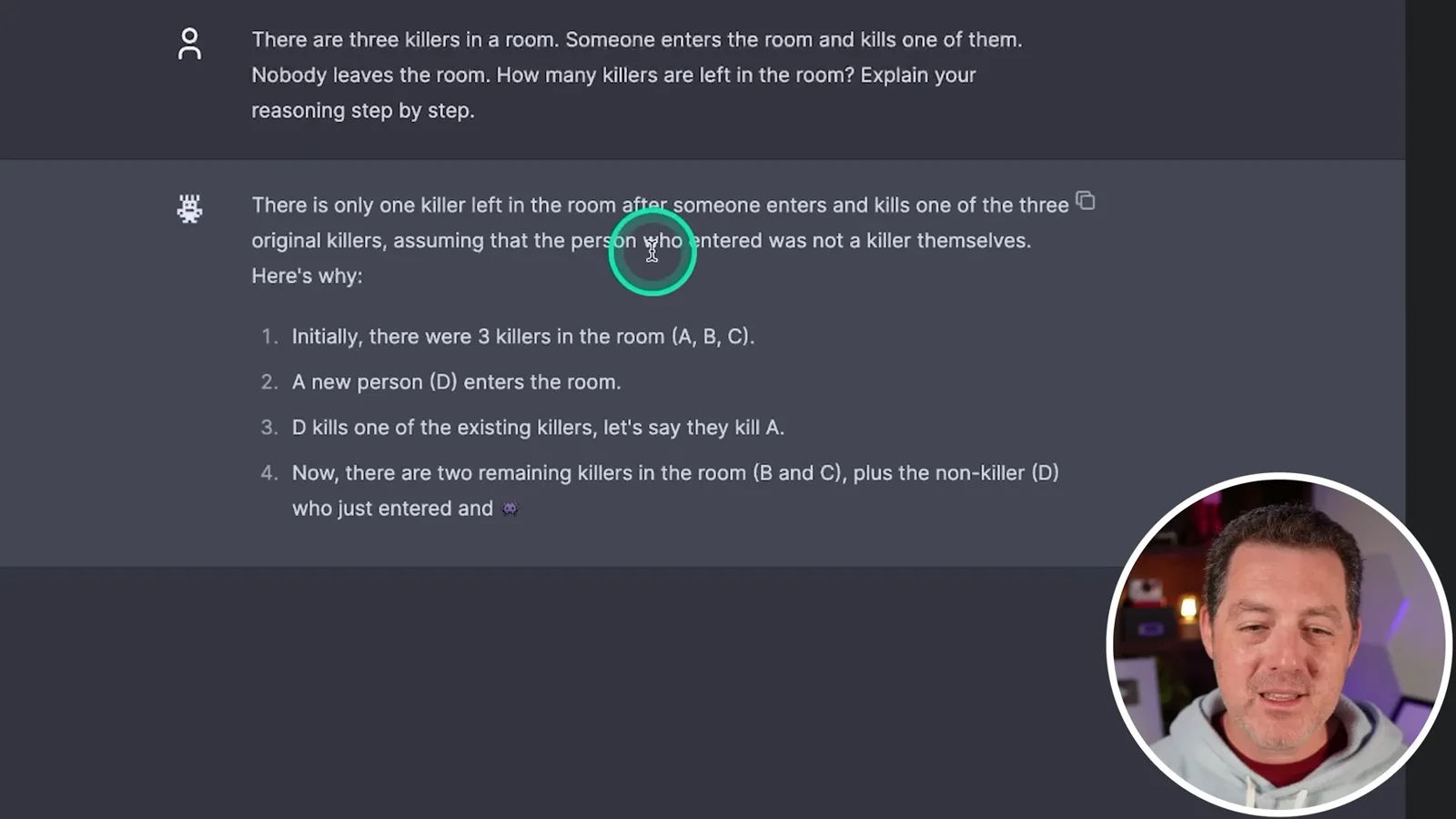
When asked to count the words in its own response, the model's stated count does not match what I count, so I mark it wrong. On a puzzle about three killers in a room and a newcomer who kills one, it also produces inconsistent reasoning. Under the usual assumption that the newcomer becomes a killer and nobody leaves, three living killers remain.
The structured-output test asks for JSON describing Mark, Joe and Sam with their ages and genders. The response places the people in a top-level structure and appears to preserve the specified facts, so I count it as a pass. This is a simple formatting example rather than a full test of schema reliability.
Spatial reasoning and conclusion
A marble scenario fails, while a belief-tracking example succeeds. Sentence-ending and digging tests complete the informal evaluation.
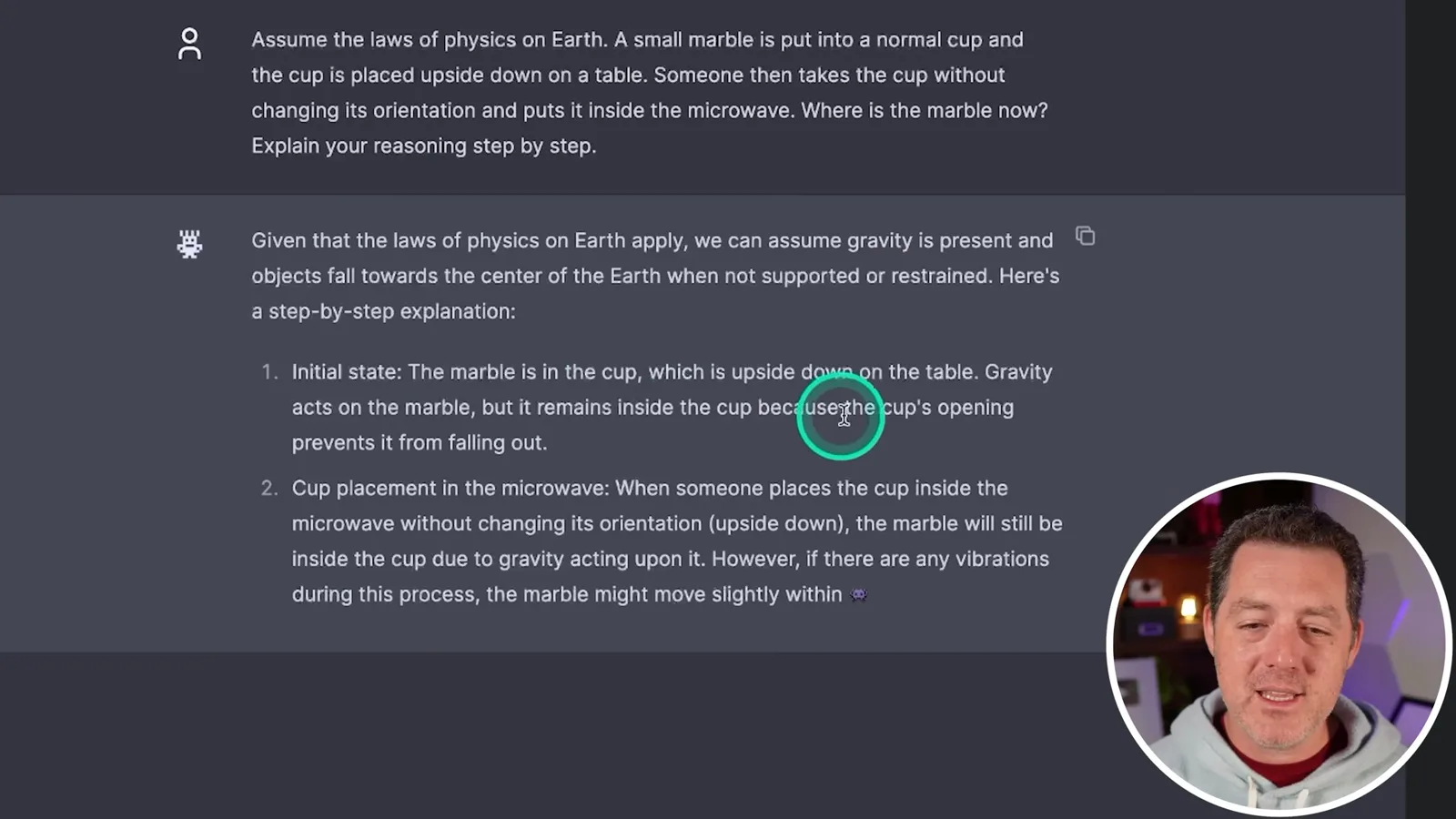
In the marble puzzle, a cup containing a marble is inverted on a table and moved to a microwave without changing orientation. The model says the marble remains inside the cup because of gravity. Under the usual assumption that the open cup is lifted off the table and the marble is not retained, the marble stays on the table; the exact outcome depends on handling and geometry not fully specified in the prompt.
A belief-tracking scenario has John put a ball in a box and leave, after which Mark moves it to a basket and leaves. The model correctly says John expects the ball in the box and Mark expects it in the basket, assuming neither saw further changes. It also notes that checking would reveal the ball's actual location.
I request ten sentences ending in the word 'apple.' The response includes the word but, as I observe, does not put it at the end of each sentence, so I mark it wrong. This illustrates a concrete instruction-following error in this sample, not a general limit of every model in the family.
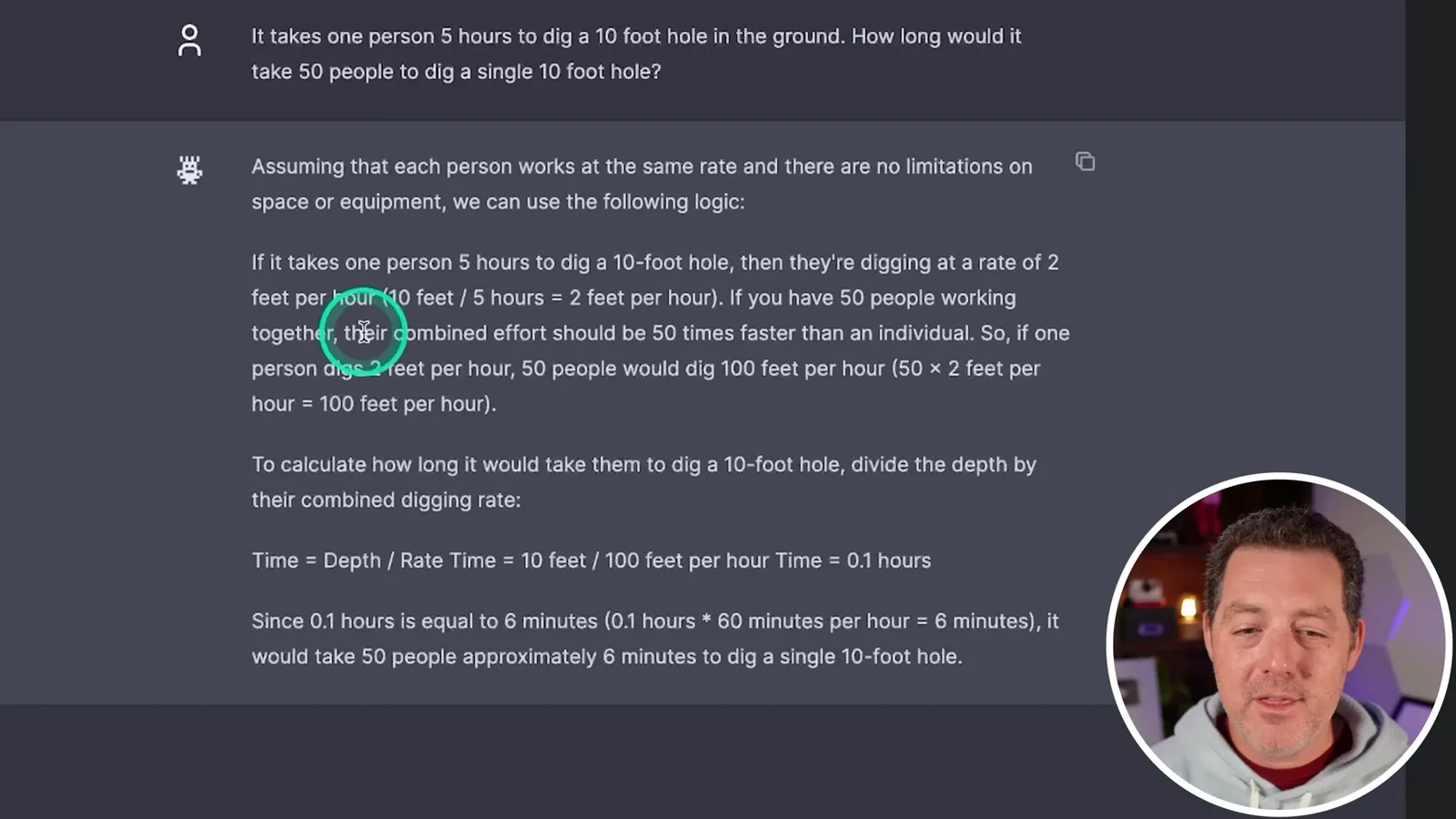
Finally, a digging question asks how long 50 people would take if one person needs five hours to dig a ten-foot hole. The model explicitly assumes equal rates and no space or equipment limits, then calculates six minutes by idealized linear scaling. The arithmetic follows those assumptions; in a real single hole, crowding and coordination could make them unrealistic.
I conclude that this early Karasu fine-tune performs well on some tasks, although on my informal rubric it does not surpass the earlier 8x7B model. I expect other fine-tunes to improve the results. That comparison is my judgment from a small number of prompts, not a controlled or current model ranking.
같은 채널의 다른 글
 34:21EN
 Matthew Berman· 2026년 10월 27일Matthew Berman Examines Anthropic’s IPO Filing, AI Growth and GovernanceMatthew Berman, Sam Altman · Forward FutureThe presenter reviews the S-1’s financial metrics, compute strategy and voting structure while questioning the tension between rapid AI development and safety.
 0:26ENMatthew Berman· 2026년 10월 25일Sam Altman on Human Values and Problem-Solving in an AI WorldSam Altman · OpenAIIn a short interview excerpt, Altman considers the enjoyment of solving hard problems and the human role in interpreting results.
 0:36ENMatthew Berman· 2026년 10월 25일Kimi K3.1 and a Rubik’s Cube Solver DemonstrationMatthew Berman · Forward FutureMatthew Berman shows a scrambled virtual cube being solved and gives the Kimi K3.1 test a favorable assessment.
 0:21ENMatthew Berman· 2026년 10월 24일An AI-Generated Kimi Benchmark Chart Used Invented ScoresMatthew Berman · Forward FutureMatthew Berman asks for a graph of Kimi K3.1 Pro benchmarks, then discovers that the displayed figures are illustrative placeholders.
 25:50ENMatthew Berman· 2026년 10월 24일Kimi K3.1 Pro Tested: Strong 3D Demos, Uneven Results and Competitive PricingMatthew Berman · Forward FutureMatthew Berman tests the open-weight model on coding, 3D rendering and visual explanations, then compares benchmark results and prices.
 32:20ENMatthew Berman· 2026년 10월 23일Who Is Local AI For? The Costs, Trade-offs and a Hybrid FutureMatthew Berman · Forward FutureMatthew Berman weighs data control and independence against hardware cost, setup complexity and inference speed.