30초 요약
In August 2025, Matthew Berman discusses AI memory and personalization, open-weight model releases, Google Opal, coding-agent instructions, a mathematical proof claim, Atlas and Figure robot demonstrations, and corporate and chip reports. The video is sponsored by AWS. A later OpenAI paper clarifies that the highlighted GPT-5 optimization result improved an earlier paper version but did not surpass the later, already-known optimal bound.
- 1Memory and personalizationBerman considers the utility of model memory alongside risks of sycophancy and echo chambers; no GPT-6 date is given.
- 2Open-weight modelsHe discusses DeepSeek V3.1 and Qwen-Image-Edit, showing selected image-editing examples without a controlled evaluation.
- 3Agent instructions and OpalAGENTS.md provides repository guidance, while Google’s experimental Opal creates visual AI workflows.
- 4A proof claim revisitedBubeck verified a proof improving an earlier bound; later documentation identifies the stronger known result in a later paper version.
- 5Robotics demonstrationsAtlas performs a demonstrated manipulation task and Figure 02 traverses rough ground; the footage is bounded by the depicted scenarios.
- 6Corporate and chip reportsBerman reviews reports on OpenAI infrastructure, Meta’s research organization and Nvidia’s proposed China-market chip.
핵심 정리
- Altman discussed desired memory and personalization without announcing a GPT-6 release date or a confirmed feature list.
- DeepSeek V3.1 and Qwen-Image-Edit were releases discussed in August 2025; model availability and hardware requirements depend on configuration.
- AGENTS.md offers a shared convention for project instructions, although support and precedence vary by tool.
- The cited GPT-5 proof improved an earlier bound, but a later version of the source paper had already established a stronger optimal result.
- Atlas and Figure footage shows selected robot demonstrations, not general proof of unrestricted autonomy or reliable operation in all settings.
- The reported Meta reorganization and proposed Nvidia B30A were contemporary reports; details and future availability were not guaranteed.
챕터별로 다듬은 전문 읽기
Memory, DeepSeek and Qwen
Berman discusses Altman’s remarks on personalization and the release of DeepSeek V3.1. He reviews Qwen image-editing examples.
In August 2025, reports about Sam Altman’s discussion with journalists raised questions about what might come after GPT-5. Altman discussed demand for memory and personalization, but did not give a GPT-6 release date. My interpretation that a future model might have deeper memory is speculation, not a confirmed product specification.
I think memory can make an assistant more useful by retaining preferences and reducing repeated prompting. But personalization has tradeoffs: a model that simply reflects every user preference may reinforce an echo chamber or become sycophantic. How to balance customization, independent judgment and user control remains a difficult product problem.
DeepSeek released V3.1 as an open-weight model; I note that running a large model locally may require substantial GPU memory or quantization. I also mention an alleged delay to R2 involving Chinese chips, but that is an unverified report, not an established reason for a release decision. DeepSeek’s [release notes](https://api-docs.deepseek.com/news/news250821/) describe V3.1 as supporting thinking and non-thinking modes.
Qwen-Image-Edit is another open-weight release. Its team demonstrates bilingual text edits, semantic changes and changes to visual appearance. I review examples of a mascot, a person and a car rendered from different angles; when an input does not show a face or surface, the model must infer or invent the hidden details rather than recover verified ground truth.
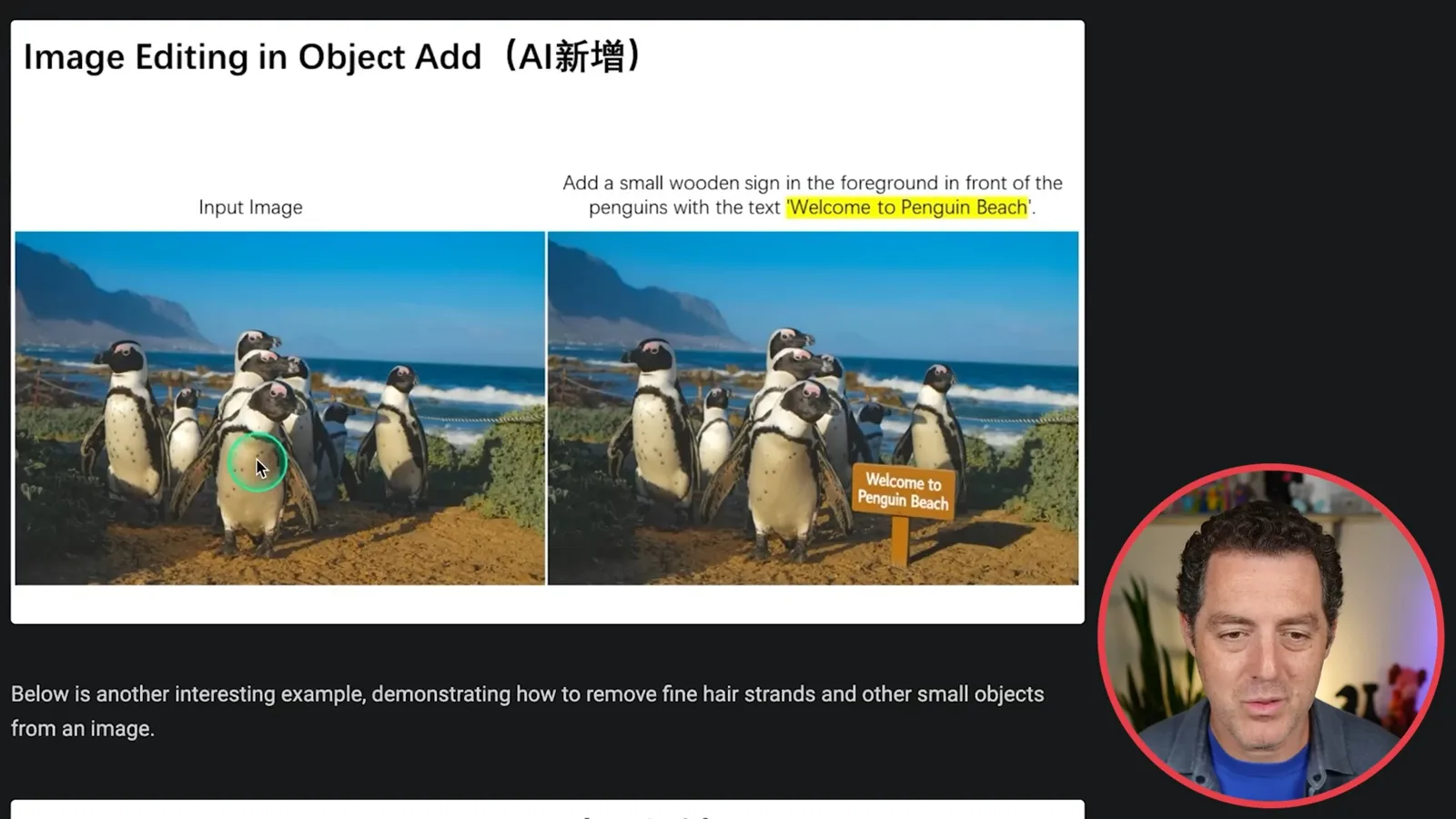
Other selected examples change clothing and artistic style, add a sign to a penguin scene, remove a hair from a menu and recolor a single letter. I am impressed by the apparent preservation of unchanged regions and text, and by background replacement and virtual try-on. These are supplied demonstrations, not a controlled test of how reliably the model makes those edits.
AWS, AGENTS.md and Opal
The AWS-sponsored segment presents Bedrock features. Berman then discusses repository instructions and Google’s visual mini-app tool.
AWS sponsors this video. I describe Amazon Bedrock features including prompt management and optimization, routing among models, prompt caching and model distillation. Capabilities, supported models, pricing and availability depend on the service configuration; the segment is a sponsor presentation, not an independent benchmark.
Several coding-agent tools have adopted AGENTS.md, a shared place for project-specific instructions such as coding conventions and workflows. I welcome the idea because separate tools can otherwise require separate instruction files. It is a convention, not a guarantee that all tools interpret instructions or precedence identically ([AGENTS.md](https://agents.md/)).
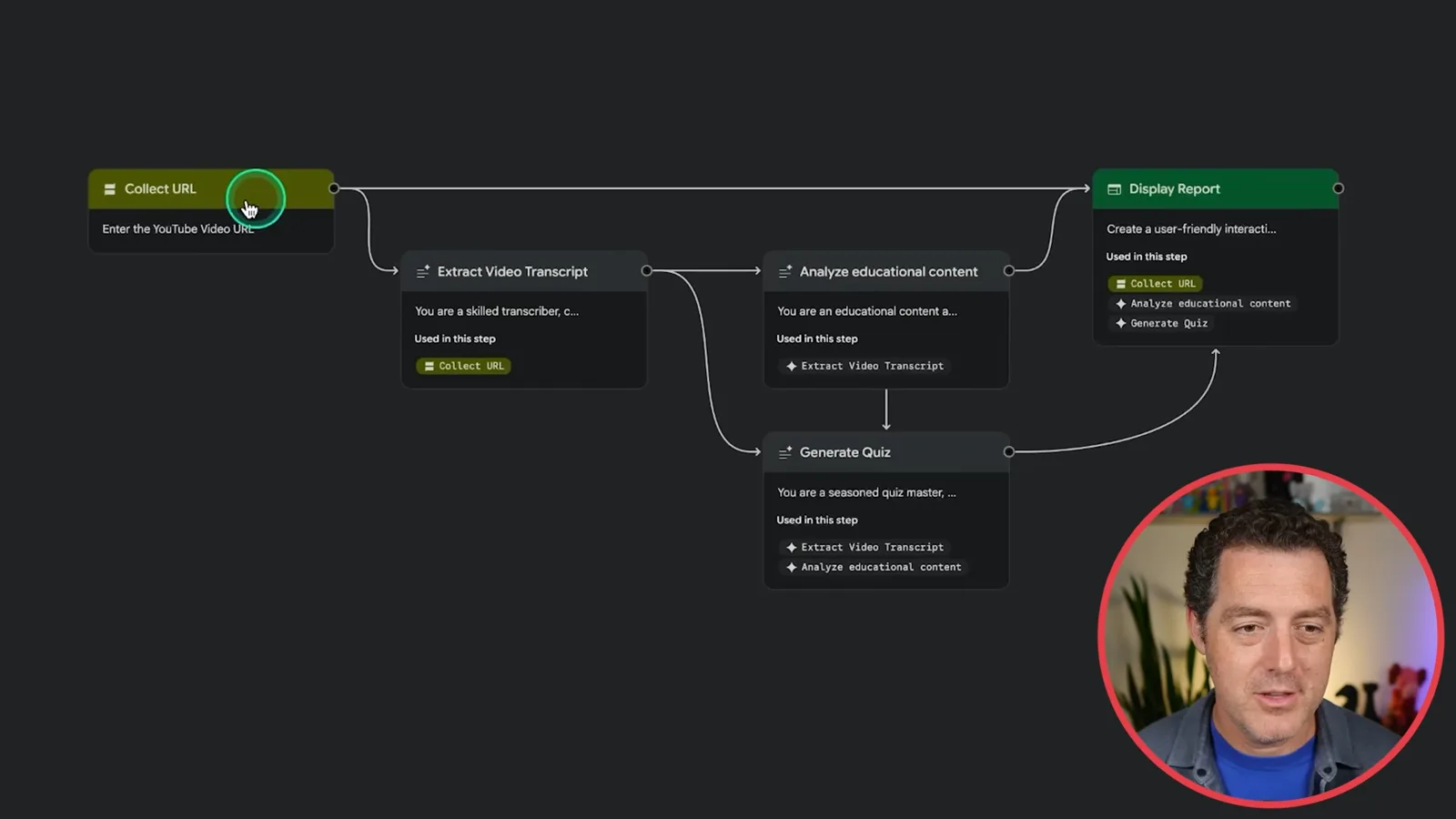
Google’s Opal lets users describe a mini-app and inspect or edit a node-based workflow. I explore a template that takes a YouTube URL, extracts information, analyzes educational content, generates a quiz and displays the result; the interface supports sharing, remixing and manual edits. Google launched Opal as a US-only public beta in July 2025, before the video, so the assertion that beta only began at the video’s date is incorrect ([Google](https://developers.googleblog.com/en/introducing-opal/)).
Home assistants, memory and mathematics
Google and Perplexity announce or discuss AI products, while Bubeck presents a GPT-5 proof example. Its later mathematical context matters.
At its Made by Google event, the company introduced Gemini for Home as a new voice-assistant experience. I am interested in more capable assistants and compare the announcement with my own use of a Pixel phone. It is an announcement and does not establish that every home device had already received the new assistant.
Perplexity CEO Aravind Srinivas describes a “super memory” feature in testing and shares an example in which a greeting elicits a response reflecting prior user context. I see memory as a potentially valuable part of the application layer. The quoted claim that it performs better than alternatives is a company executive’s assessment, not a demonstrated independent comparison.
OpenAI researcher Sébastien Bubeck says GPT-5 Pro improved a step-size bound in a convex optimization paper and that he checked the proof. I find the example exciting but acknowledge the mathematics is beyond my own expertise. His 2025 statement is not by itself independent verification that the problem was newly solved.
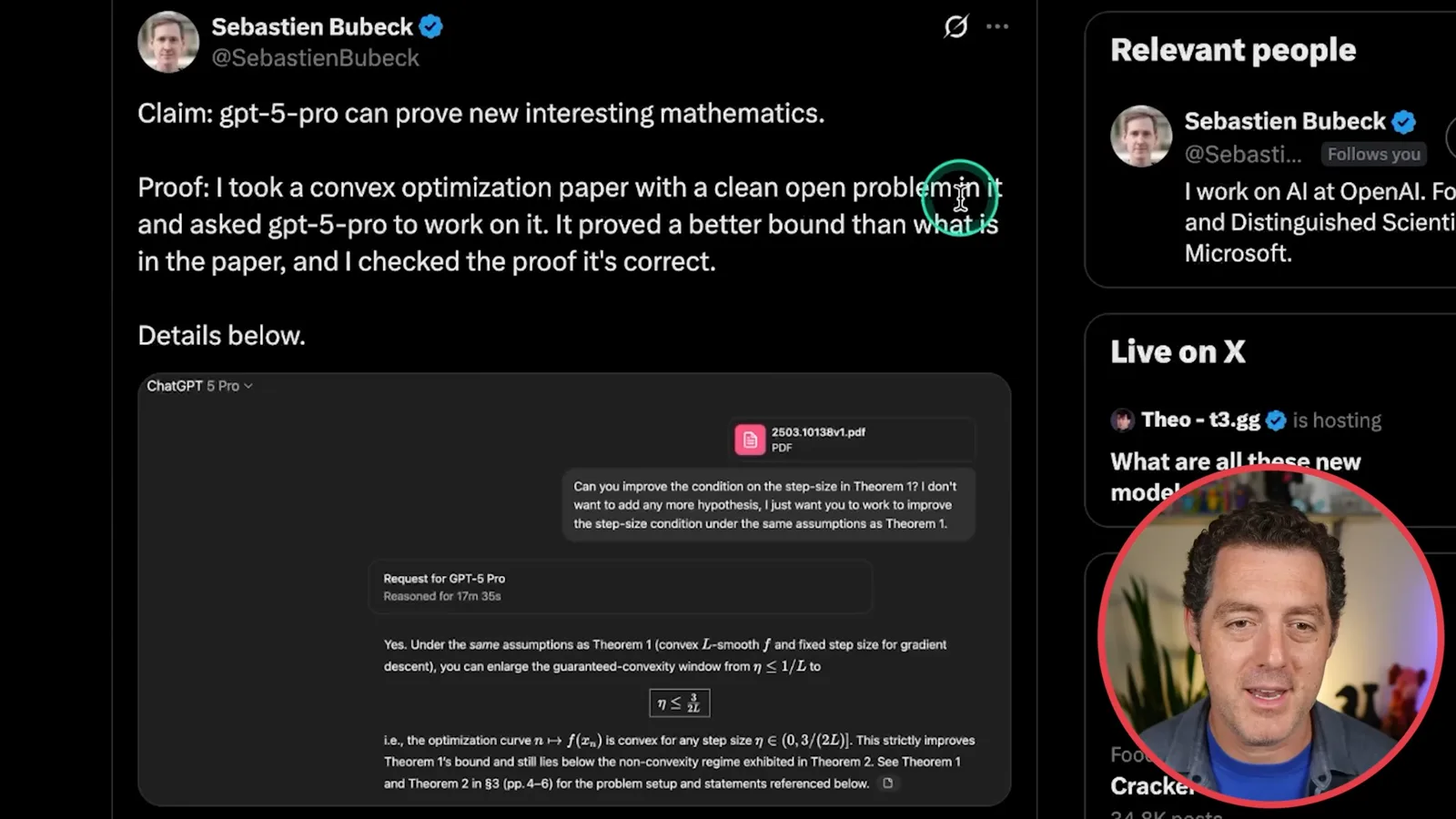
A later [OpenAI research paper](https://cdn.openai.com/pdf/4a25f921-e4e0-479a-9b38-5367b47e8fd0/early-science-acceleration-experiments-with-gpt-5.pdf) places this exact example under independent rediscovery: given version one, GPT-5 improved the bound from 1/L to 1.5/L, while version two had already established the optimal 1.75/L bound. Bubeck reports verifying the intermediate proof. This illustrates a useful research interaction, but not a new best-known result for that problem.
I argue that application scaffolding, including memory and tools, can make existing model intelligence useful in more workflows. That is my assessment; the value and reliability of a complete system still depend on implementation, evaluation and the task.
Atlas and Figure robots
Berman reviews robot manipulation and locomotion footage. The demonstrations show specific tasks under specific conditions.
Boston Dynamics shows Atlas opening a box, moving objects and adapting when a person disturbs the setup. The video labels the sequence autonomous and real-time; I am impressed by the manipulation and by the displayed visualization. The selected demonstration supports a claim about that setup, not a guarantee that the robot can handle arbitrary environments without intervention.
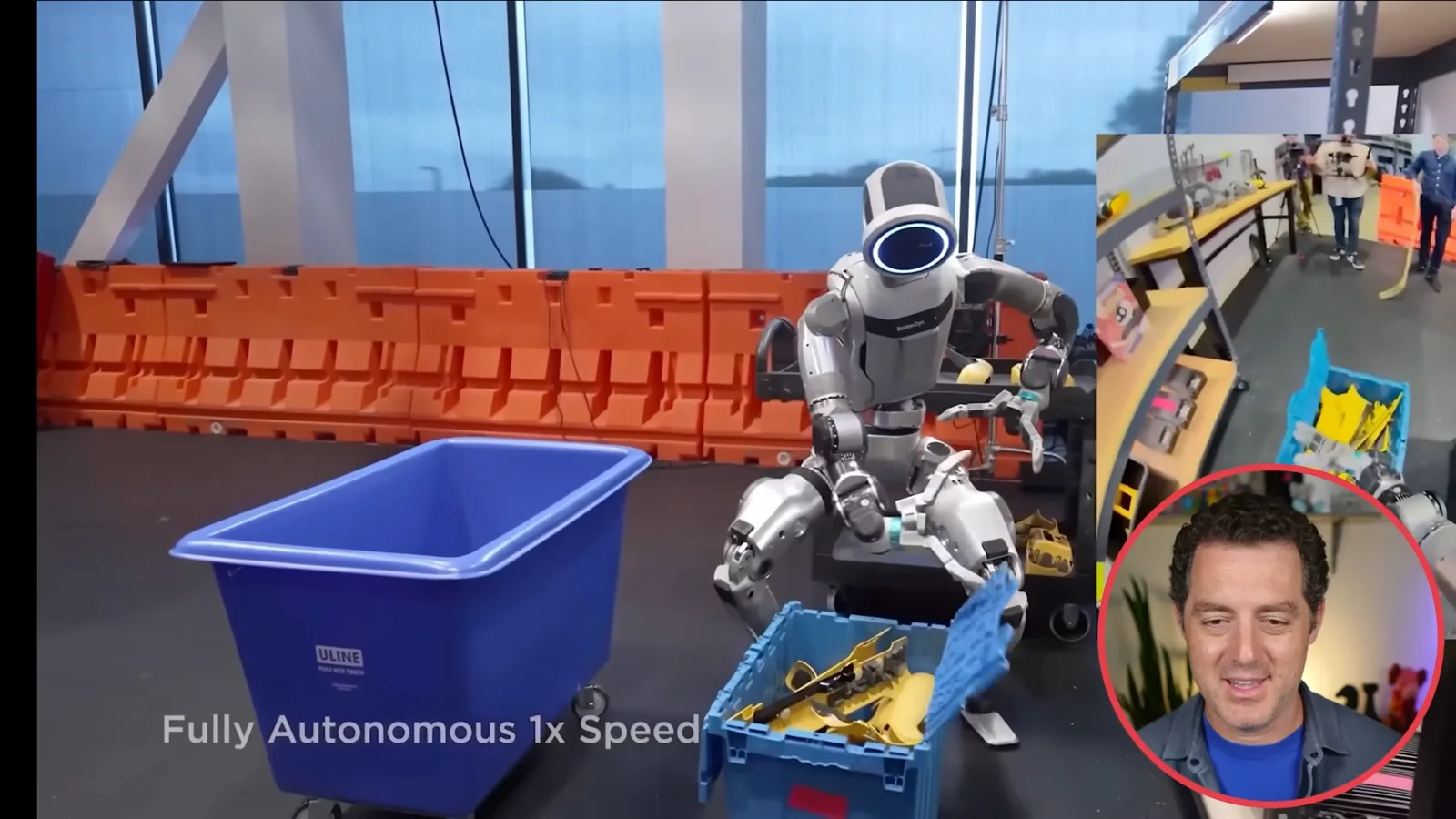
I discuss the reported use of language-conditioned whole-body control and a training pipeline involving teleoperated demonstrations, data curation, model training and evaluation. The company describes these research directions in its [Atlas article](https://bostondynamics.com/blog/large-behavior-models-atlas-find-new-footing/). The footage alone does not show exactly which components were used in every displayed action.
A Figure 02 video shows a robot navigating outdoor vegetation and obstacles, including correcting a caught foot. The movement looks uneven, but I find the recovery impressive. I mention reinforcement learning and neural control as trends; the clip does not independently establish the exact controller or general reliability on all terrain.
Coding, infrastructure and reorganization
The video closes with a Cursor model, reports on OpenAI infrastructure and Meta’s teams, and a Reuters report about a China-targeted Nvidia chip.
Cursor offers a model called Sonic, and I mention speculation that it might be related to a forthcoming Grok coding model. I do not know its identity, so that connection remains a rumor. Separately, Bloomberg reports that OpenAI might eventually sell infrastructure capacity; I see it as a possible future direction, not an immediate announced service.
Business Insider reports another Meta AI reorganization under Alexandr Wang. The reported memo describes a role for FAIR, research leadership by Shengjia Zhao, product responsibilities for former GitHub CEO Nat Friedman and infrastructure leadership by Aparna Ramani, alongside changes to the AGI Foundations team. These reflect the reported August 2025 organization, not necessarily its later structure.
Reuters also reports, citing people briefed on the matter, that Nvidia is developing a China-targeted chip tentatively called B30A. The sources described a single-die design and expected performance relative to the H20 and B300. Those details were reported plans subject to export controls and change, not a confirmed shipment or independently measured product specification ([Reuters](https://www.investing.com/news/stock-market-news/exclusivenvidia-working-on-new-ai-chip-for-china-that-outperforms-the-h20-sources-say-4199124)).
같은 채널의 다른 글
 34:21EN
 Matthew Berman· 2026년 10월 27일Matthew Berman Examines Anthropic’s IPO Filing, AI Growth and GovernanceMatthew Berman, Sam Altman · Forward FutureThe presenter reviews the S-1’s financial metrics, compute strategy and voting structure while questioning the tension between rapid AI development and safety.
 0:26ENMatthew Berman· 2026년 10월 25일Sam Altman on Human Values and Problem-Solving in an AI WorldSam Altman · OpenAIIn a short interview excerpt, Altman considers the enjoyment of solving hard problems and the human role in interpreting results.
 0:36ENMatthew Berman· 2026년 10월 25일Kimi K3.1 and a Rubik’s Cube Solver DemonstrationMatthew Berman · Forward FutureMatthew Berman shows a scrambled virtual cube being solved and gives the Kimi K3.1 test a favorable assessment.
 0:21ENMatthew Berman· 2026년 10월 24일An AI-Generated Kimi Benchmark Chart Used Invented ScoresMatthew Berman · Forward FutureMatthew Berman asks for a graph of Kimi K3.1 Pro benchmarks, then discovers that the displayed figures are illustrative placeholders.
 25:50ENMatthew Berman· 2026년 10월 24일Kimi K3.1 Pro Tested: Strong 3D Demos, Uneven Results and Competitive PricingMatthew Berman · Forward FutureMatthew Berman tests the open-weight model on coding, 3D rendering and visual explanations, then compares benchmark results and prices.
 32:20ENMatthew Berman· 2026년 10월 23일Who Is Local AI For? The Costs, Trade-offs and a Hybrid FutureMatthew Berman · Forward FutureMatthew Berman weighs data control and independence against hardware cost, setup complexity and inference speed.