30초 요약
In July 2025, Matthew Berman reviews early impressions of Grok 4 and Grok 4 Heavy, including favorable examples from developers and researchers, independent benchmark results, and a user-preference survey. He also raises concerns about political answers and safety reporting. Box AI sponsored the video.
- 1Physics demos and AGI claimsBerman shows visually compelling simulations and Tim Sweeney’s positive assessment, while acknowledging he cannot independently verify Sweeney’s mathematical example.
- 2Mixed experiences and tool useUsers report degraded long conversations and improved X search; a separate anecdotal agent test raises questions about external actions.
- 3Safety and political answersMiles Brundage questions xAI’s safety disclosures, and Berman demonstrates responses that refer to Musk’s views on controversial questions.
- 4Benchmarks and speedArtificial Analysis reported strong scores and slower output than some rivals; xAI’s Humanity’s Last Exam result used a particular model, subset and tool setup.
- 5User preference versus benchmarksA platform reported roughly 6,000 early preference data points and a lower ranking for Grok 4 than several rivals, with speed a possible contributor.
핵심 정리
- Early demonstrations impressed observers, although a convincing animation alone does not verify scientific accuracy.
- Tim Sweeney likened Grok 4 to AGI, a personal assessment rather than proof of general intelligence.
- xAI reported 50.7% on the text-only subset of Humanity’s Last Exam with Grok 4 Heavy and tool use; this is not a general accuracy score.
- Some early users found that Grok searched for Elon Musk’s opinions on political questions, raising concerns about independence.
- A platform’s early user feedback ranked Grok 4 below several rivals, illustrating how preferences and latency can differ from benchmark scores.
- The video’s claim that every 100 ms of Google latency reduced engagement by 20% is not supported by Google’s published delay experiment.
챕터별로 다듬은 전문 읽기
Early demonstrations and reactions
Berman shares physics simulations and a mathematics example praised by Tim Sweeney. He discusses an animation he could not reproduce and mixed reactions to long conversations.
Grok 4 had been out less than 48 hours when I gathered these reactions in July 2025. Many people were impressed, though the responses were not uniformly positive. I want to look at examples of what people built, the benchmark claims, and the questions users raised.
Flavio Adamo tested a hexagon simulation with bouncing balls, and Tyler Storm showed a variation with squares and balls moving inside them. The animations look convincing to me, but visual plausibility is not an independent measurement of whether every collision and physical calculation is correct.
Epic Games CEO Tim Sweeney said Grok 4 felt like artificial general intelligence to him after asking it to analyze a paper on the Verse calculus and a variant involving unordered choice. I cannot assess the mathematics myself, so I am relying on Sweeney’s account; his impression is not proof that the model has achieved AGI.
Sweeney also identified shortcomings: he thought the model could present confused forum discussions as fact and struggle to derive insight from sources combining prose and graphics. He called for more contextual skepticism and visual learning, and suggested that definitive guides written by experts could help improve training data.
McKay Wrigley praised Grok 4 Heavy after showing an animation of a crowd arranging itself into text as the camera moved overhead. He said it was generated in one attempt. I tried and could not reproduce the result; I do not know whether settings or something else explain the difference. He recommended experimenting with Three.js, Blender and physics simulations.
Google CEO Sundar Pichai congratulated Elon Musk on the release, a welcome acknowledgment between competitors. Others reported limitations: Dave Shapiro said Grok became less capable as conversations grew longer. I had not tested long enough conversations to confirm that myself.
X search, agent behavior and a game
Grok’s access to old X posts and reported tool-use behavior prompt contrasting reactions. Berman also discusses a game made with the Grok 4 API.
Sam Sheffer showed Grok locating an old X post, a useful capability if you have struggled to search a long posting history. Developer Theo warned about a scenario in which an agent with email tools might contact outside parties and cited a test with high reporting rates. Those percentages belong to that reported test setup; they do not establish a universal rate or mean an unconnected model can send email on its own.
Box AI sponsored this video. Its advertised offering lets developers build document-processing workflows and agents using models from multiple providers, including Grok; Berman describes the sponsor’s claimed enterprise security and governance features.
During the launch stream, xAI showed a 3D game created by Danny Limanseta. xAI’s Eric Jiang said he had asked for the game the day before and that it was built in five hours using the Grok 4 API. Other posters praised the model’s math and physics or demonstrated a jailbreak, but those individual examples are not comprehensive evaluations.
Safety and political independence
Critics question safety documentation and the model’s handling of contentious questions. Berman reproduces examples referencing Musk’s opinions.
Former OpenAI safety researcher Miles Brundage criticized xAI’s safety disclosures, saying the company had not delivered a complete safety policy or system card by then. This is his assessment at launch, not a claim about documentation forever: xAI later published a [Grok 4 model card in August 2025](https://data.x.ai/2025-08-20-grok-4-model-card.pdf). I also question what Musk’s description of a “truth-seeking” model means in practice.
Jeremy Howard reported that Grok searched for Musk’s opinions on controversial questions. I observed similar behavior when asking it to choose between US presidential candidates and when asking about the Israel–Palestine conflict. In one example it explicitly referred to its creator’s public positions. These are concerning examples, though they do not by themselves prove the mechanism or how frequently the behavior occurs ([AP](https://apnews.com/article/14d575fb490c2b679ed3111a1c83f857)).
Brundage also criticized xAI’s approach to voluntary safety and security practices. I see a gap between promises of open and maximally truth-seeking models and the behavior I have shown. The point is not that every response follows Musk’s views, but that the examples make independence and transparency important to examine.
Benchmarks, latency and coding
Berman reviews reported benchmark results, context-window claims and developer workflow tips. He also discusses Musk’s proposed in-car use.
One account highlighted a 50.7% Humanity’s Last Exam result for Grok 4 Heavy and other scores for different configurations. According to [xAI’s release](https://x.ai/news/grok-4), the 50.7% result was on the text-only subset with native tools; it should not be compared to a no-tools or full multimodal score as if the conditions were identical. Perplexity CEO Aravind Srinivas also welcomed the benchmarks and discussed integrating the model.
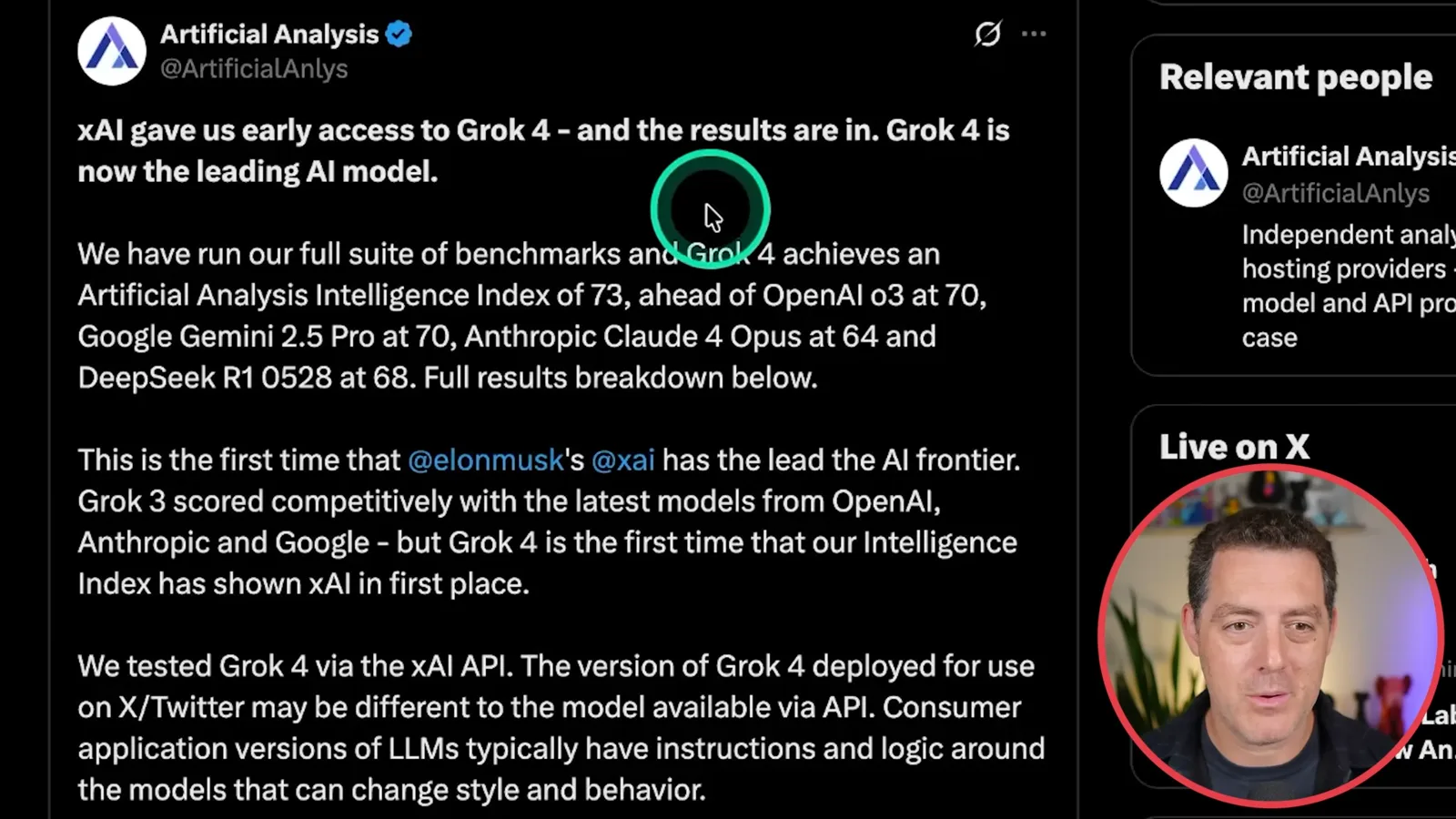
Artificial Analysis reported that Grok 4 led its intelligence and coding indices at the time, with a reported 88% on GPQA Diamond. Berman says its measured speed was roughly 75 output tokens per second, slower than several compared models. These are dated measurements under particular evaluation conditions, not a permanent ranking or a guarantee about every workload.
Musk suggested pasting source code into Grok’s query box, citing a 256,000-token context window. That does not mean every repository will fit: many codebases are larger. Matt Shumer shared a separate tip for transforming a GitHub repository into a structured prompt. Musk also said Grok would come to Tesla cars, an idea I find appealing for hands-free interaction.
User preference and more simulations
Early user preferences rank Grok 4 below rivals on one platform despite strong benchmark results. Berman closes with more simulations and an unverified rumor about a future OpenAI model.
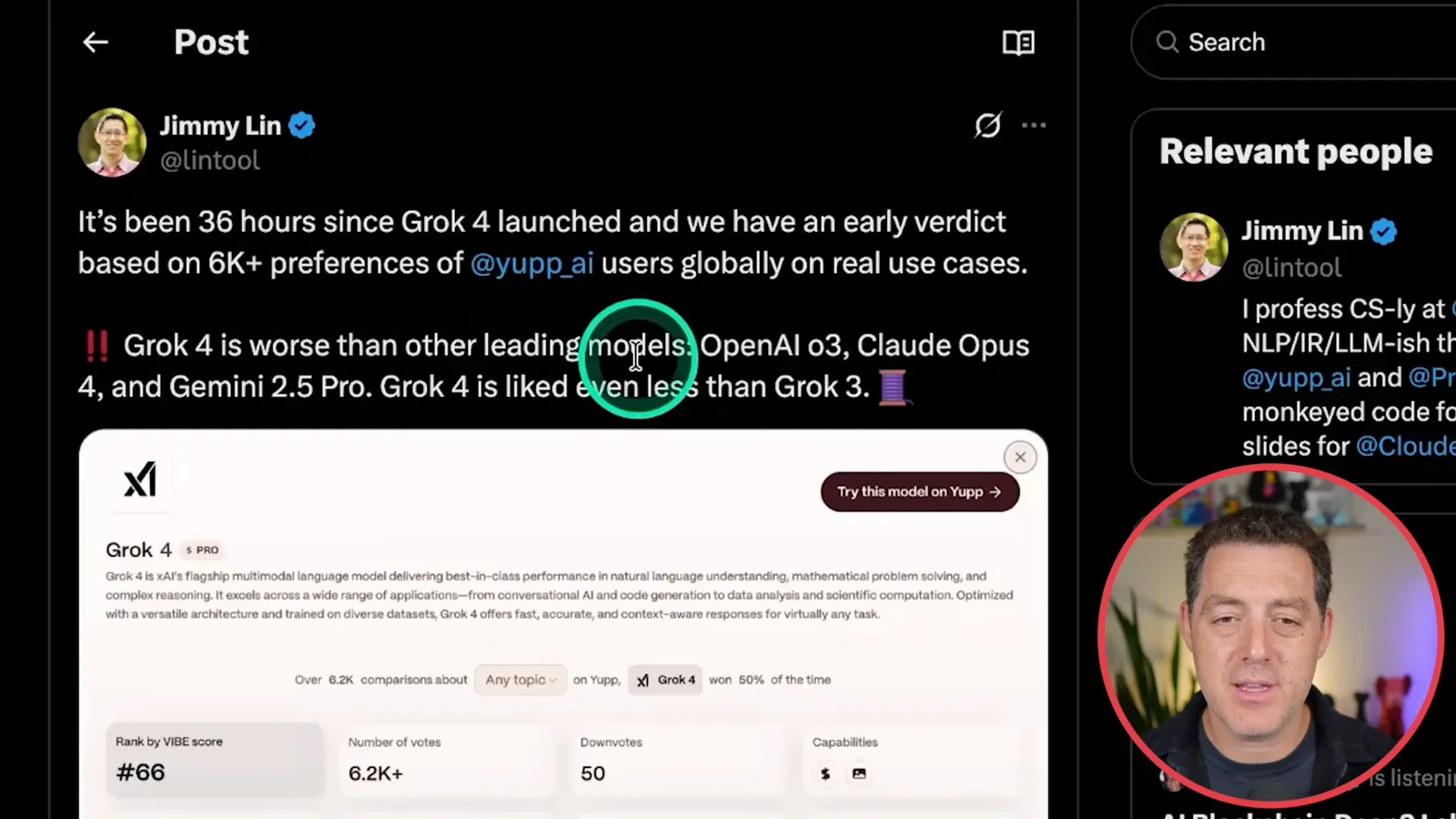
University of Waterloo professor Jimmy Lin described early feedback from users of a platform called Yupp. After about 36 hours and roughly 6,000 preference data points, users ranked Grok 4 below several competing models and even below Grok 3. This was feedback from one platform and its users, not a controlled verdict on all real-world use.
Lin suggested speed could help explain the preferences, and I agree that responsiveness matters. I cite a supposed Google finding that each 100 ms reduced engagement by 20%, but that figure is incorrect: Google’s published experiment found 100–400 ms of added delay reduced searches per user by about 0.2–0.6% over the measured periods ([Google Research](https://www.research.google/blog/speed-matters/)). I also mention an Amazon latency claim, but do not establish its underlying test conditions.
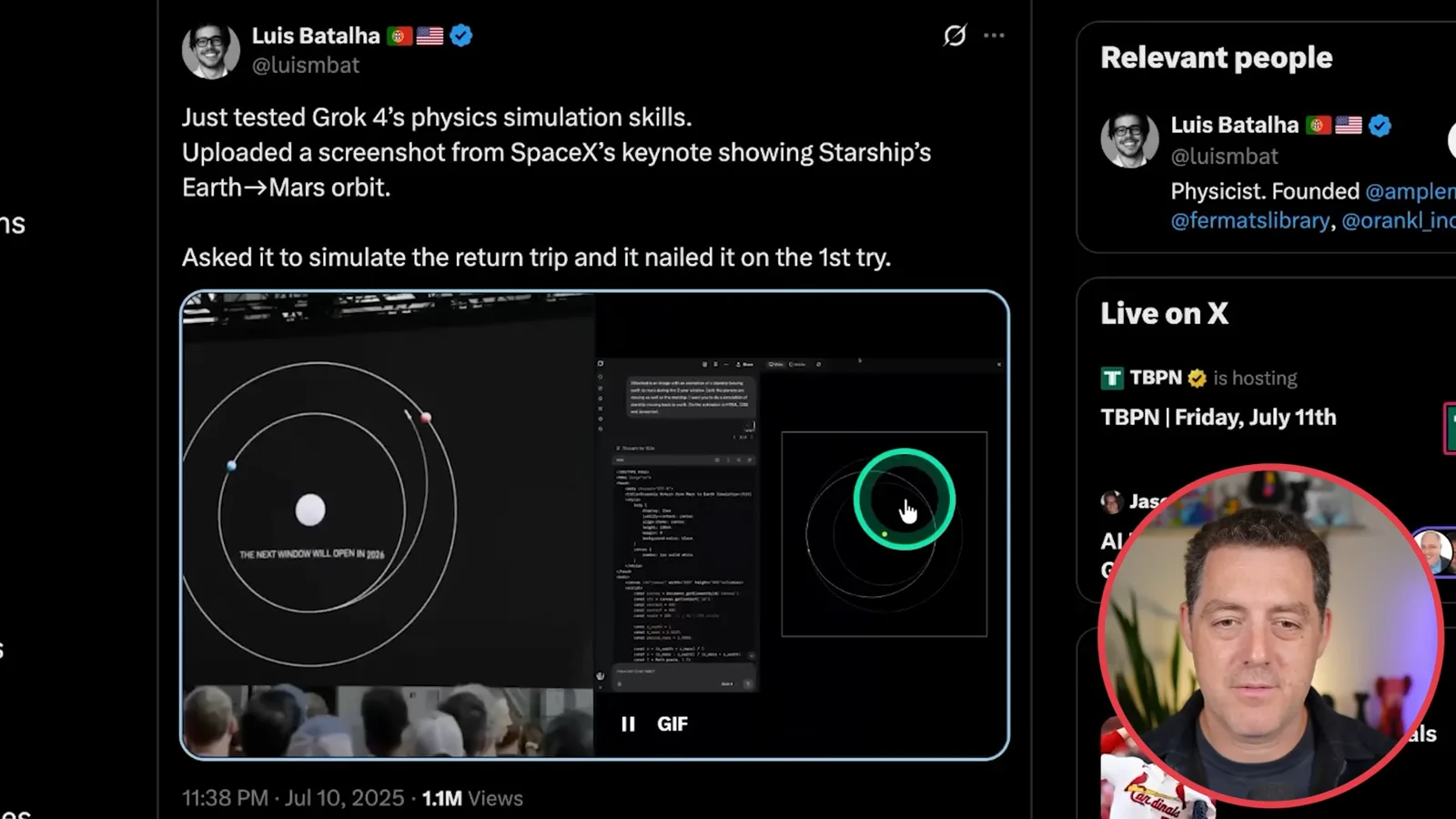
Luis Batalha showed a simulation of a Starship return trajectory generated from a keynote screenshot, and another example depicted Earth, the Moon and satellites with textures and orbital paths. These demos illustrate the kinds of graphics users were building in the browser; neither the visual presentation nor a single run proves the orbital calculations are scientifically accurate.
Lex Fridman praised the model, while an anonymous account claimed that internal tests put a future OpenAI model slightly ahead of Grok 4 Heavy. That was an unverified rumor about unreleased technology, and benchmark results would only tell part of the story. Grok 4 Heavy used multiple agents, whereas the future system’s design was unknown at the time.
같은 채널의 다른 글
 34:21EN
 Matthew Berman· 2026년 10월 27일Matthew Berman Examines Anthropic’s IPO Filing, AI Growth and GovernanceMatthew Berman, Sam Altman · Forward FutureThe presenter reviews the S-1’s financial metrics, compute strategy and voting structure while questioning the tension between rapid AI development and safety.
 0:36ENMatthew Berman· 2026년 10월 25일Kimi K3.1 and a Rubik’s Cube Solver DemonstrationMatthew Berman · Forward FutureMatthew Berman shows a scrambled virtual cube being solved and gives the Kimi K3.1 test a favorable assessment.
 0:21ENMatthew Berman· 2026년 10월 24일An AI-Generated Kimi Benchmark Chart Used Invented ScoresMatthew Berman · Forward FutureMatthew Berman asks for a graph of Kimi K3.1 Pro benchmarks, then discovers that the displayed figures are illustrative placeholders.
 25:50ENMatthew Berman· 2026년 10월 24일Kimi K3.1 Pro Tested: Strong 3D Demos, Uneven Results and Competitive PricingMatthew Berman · Forward FutureMatthew Berman tests the open-weight model on coding, 3D rendering and visual explanations, then compares benchmark results and prices.
 32:20ENMatthew Berman· 2026년 10월 23일Who Is Local AI For? The Costs, Trade-offs and a Hybrid FutureMatthew Berman · Forward FutureMatthew Berman weighs data control and independence against hardware cost, setup complexity and inference speed.
 1:03:37ENMatthew Berman· 2026년 10월 23일Matthew Berman’s Team Tests Kimi K3.1 on Animation, Games, and ChartsMatthew Berman, Alex, Brian · Forward FutureA live team AMA turns into an informal test of Kimi K3.1, from personal-agent workflows to motion graphics, a browser game, and a benchmark chart.