30초 요약
In March 2026, Matthew Berman introduces ARC-AGI-3, an interactive benchmark in which agents infer goals and mechanics by acting in unfamiliar environments. He contrasts it with ARC-AGI-1 and 2, then works through one level and examines an early replay and leaderboard. ARC Prize reports that its environments were human-solvable and early frontier systems scored below 1% under the tested settings. The score measures progress and action efficiency relative to human baselines; human solvability does not mean every person solves every game, and a benchmark score alone cannot establish or rule out general intelligence.
- 1From examples to generalizationThe first ARC tasks use a few input-output examples to infer a transformation and apply it to a new grid.
- 2A harder second benchmarkBerman walks through a more complex symbolic grid puzzle and a historical cost-versus-score leaderboard.
- 3Interactive environmentsARC-AGI-3 asks agents to explore turn-based games and infer their mechanics and objectives without explicit natural-language instructions.
- 4Discovering a level’s ruleBerman observes the character and move bar, then discovers that a plus-shaped object changes an orientation before he reaches the goal.
- 5Early scores and human calibrationThe displayed March 2026 runs show low AI scores on the selected game, while the benchmark uses human results to calibrate efficiency.
핵심 정리
- ARC-AGI-1 and 2 ask test-takers to infer grid transformations from examples; ARC-AGI-3 adds interactive, turn-based environments.
- Agents must infer goals and mechanics from observations and feedback instead of receiving explicit instructions.
- The benchmark’s scoring incorporates progress and action efficiency against human baselines, not just a simple percentage of games won.
- ARC Prize says tested environments were human-solvable; this does not mean every human participant solved every environment.
- Early March 2026 model scores were below 1% in the reported setups, and depend on models, harnesses and evaluation conditions.
- Berman’s demonstration solves an opening level, not the entirety of the multi-level game.
챕터별로 다듬은 전문 읽기
What ARC-AGI measures
Berman introduces the benchmark series as a test of adaptation and generalization. He shows a simple ARC-AGI-1 grid transformation and a more complex ARC-AGI-2 example.
ARC-AGI-3 introduces an interactive benchmark designed to test how AI agents adapt to unfamiliar problems. In March 2026 its organizers reported that humans could solve the tested environments while early frontier systems scored below 1% under their evaluation setup. That result is a meaningful gap on this benchmark, not proof that every person succeeds or a complete measurement of general intelligence.
The ARC series aims to measure a particular kind of generalization: learning a new rule from a small amount of information and applying it to a new situation. I find this different from tests that mainly ask for an answer to a familiar question. Other challenging benchmarks also remain unsaturated; ARC is not the only one.
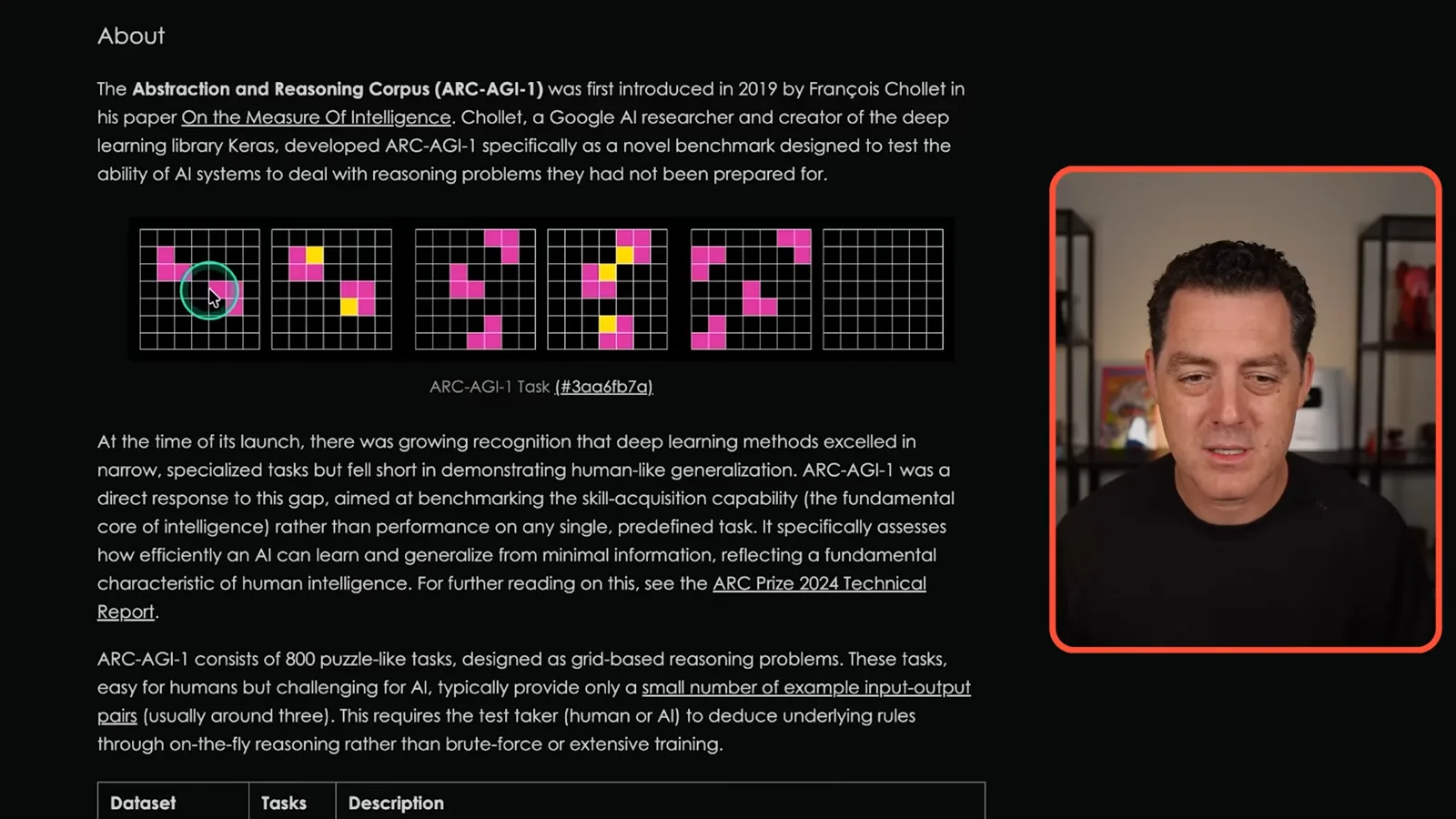
In an ARC-AGI-1 example, the test-taker sees a few input-output grid pairs. The examples show groups of three pink cells becoming complete two-by-two squares when a yellow cell fills each gap. Applying that inferred rule to the new input produces the proposed solution.
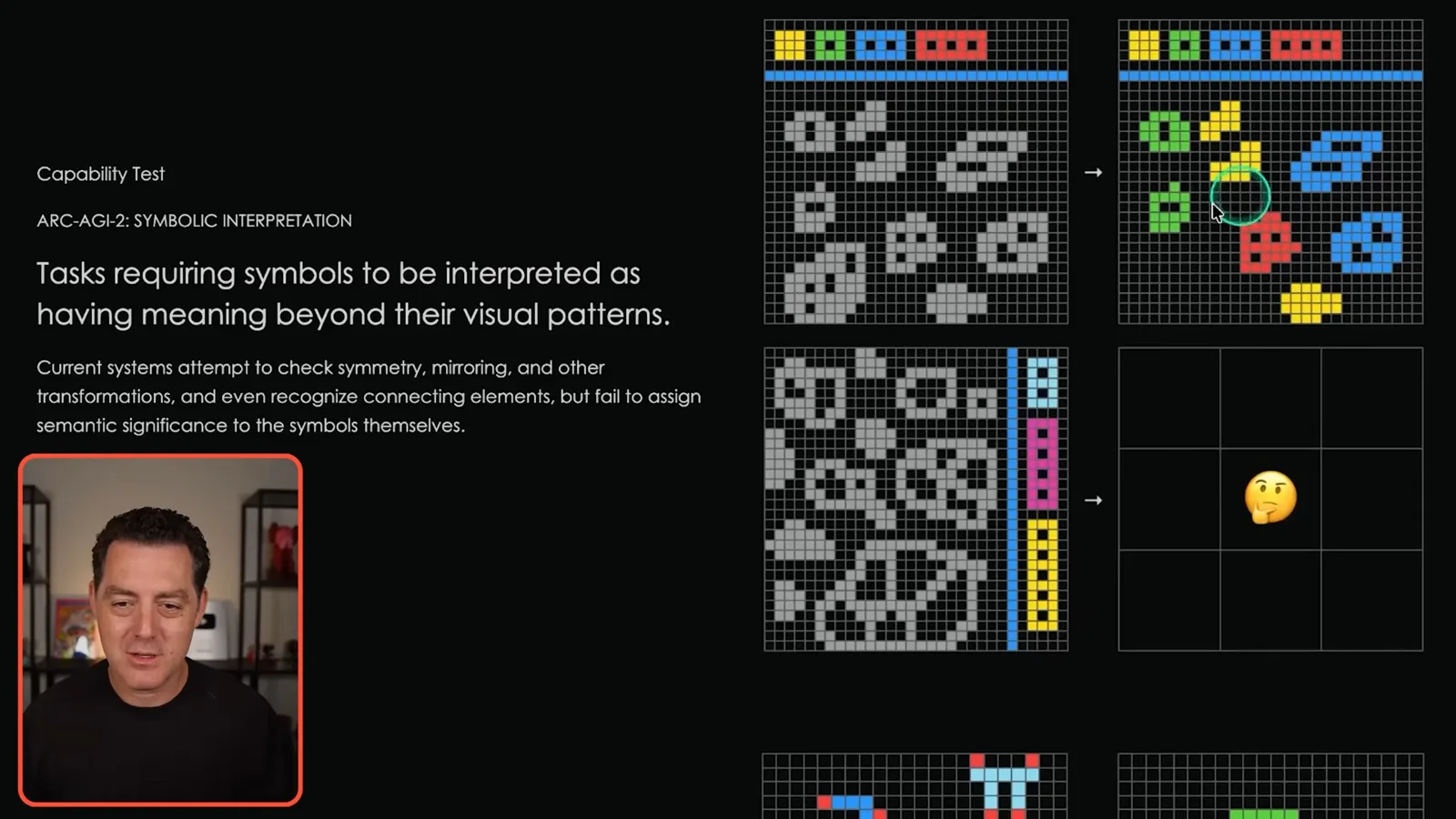
ARC-AGI-2 keeps the grid format but presents more difficult symbolic relationships. In the example I inspect, a colored key appears to encode the number of enclosed gaps in each shape. I reason through the examples and use that interpretation to predict the missing output.
Scores, costs and benchmark context
He reviews historical leaderboards and discusses cost per task. Benchmark results reflect particular datasets and setups and do not prove that all humans solve every task.
I look at a leaderboard plotting score against cost per task. In the displayed March 2026 snapshot, strong systems achieve high scores on ARC-AGI-1 and lower scores on the harder second benchmark, with cost varying by configuration. These figures change over time and depend on the evaluation set and system; they are not current rankings.
Playing an ARC-AGI-3 level
The third benchmark uses interactive games with unknown goals and limited actions. Berman experiments with movement and discovers a rule that lets him complete one level.
Cost matters because the benchmark is interested in efficient skill acquisition, not simply getting an answer after unlimited computation. The organizers calibrate tasks with human participants, but a statement that each task or environment is human-solvable is not a claim that every individual solves every task or solves it effortlessly.
ARC-AGI-3 moves from static examples to interactive, turn-based environments. A player or agent receives observations and possible actions but no explicit description of the objective or mechanics. The challenge is to explore, infer what matters and use feedback to plan under action limits.
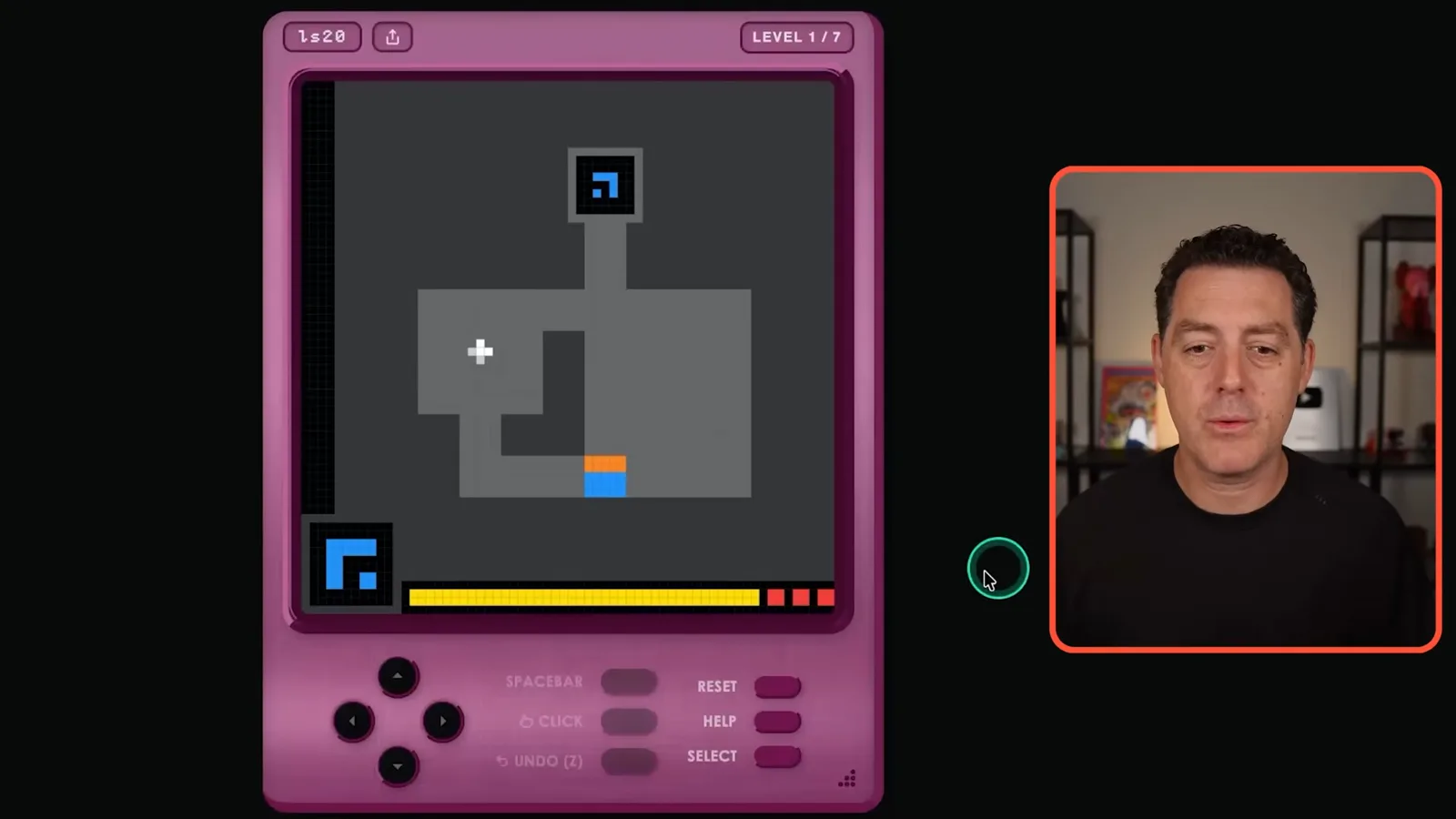
I start one game and examine the screen before moving. I see a yellow bar, a plus sign, a colored object and a symbol that may indicate a goal. I do not know yet which object I control or whether the bar represents health or a move budget, so I test an action.
Pressing up moves the colored object and reduces the yellow bar, suggesting that it tracks available moves. Going straight to the upper area does not finish the level. I notice the two symbols have different orientations and form a new hypothesis: perhaps touching the plus will change the orientation.
I reset, move toward the plus and see the goal symbol change. Once the orientations match, I continue to the destination and complete the displayed opening level. This demonstration illustrates exploration and inference on one level; the screen shows the game has additional levels.
Early model results and replay
Berman compares displayed early AI results with a human baseline and watches an agent struggle. He points readers to the benchmark’s games and prize.
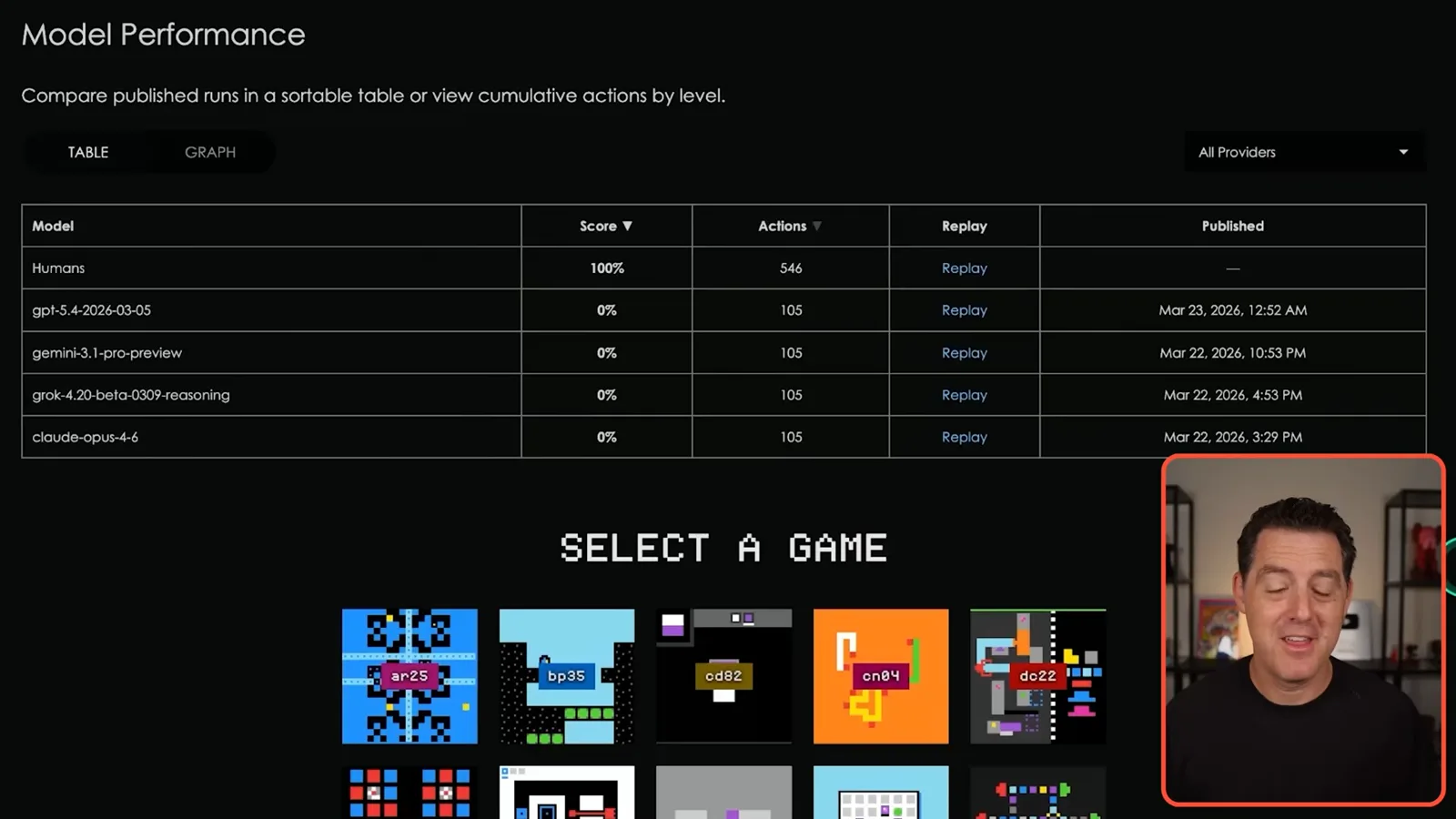
I compare that experience with the displayed replay results. The selected game’s table shows a human baseline at 100% and several model runs at 0%; I then watch a GPT-5.4 run repeat moves without finding the demonstrated route. Those are specific runs in a particular harness, not evidence that the models can never solve any related problem.
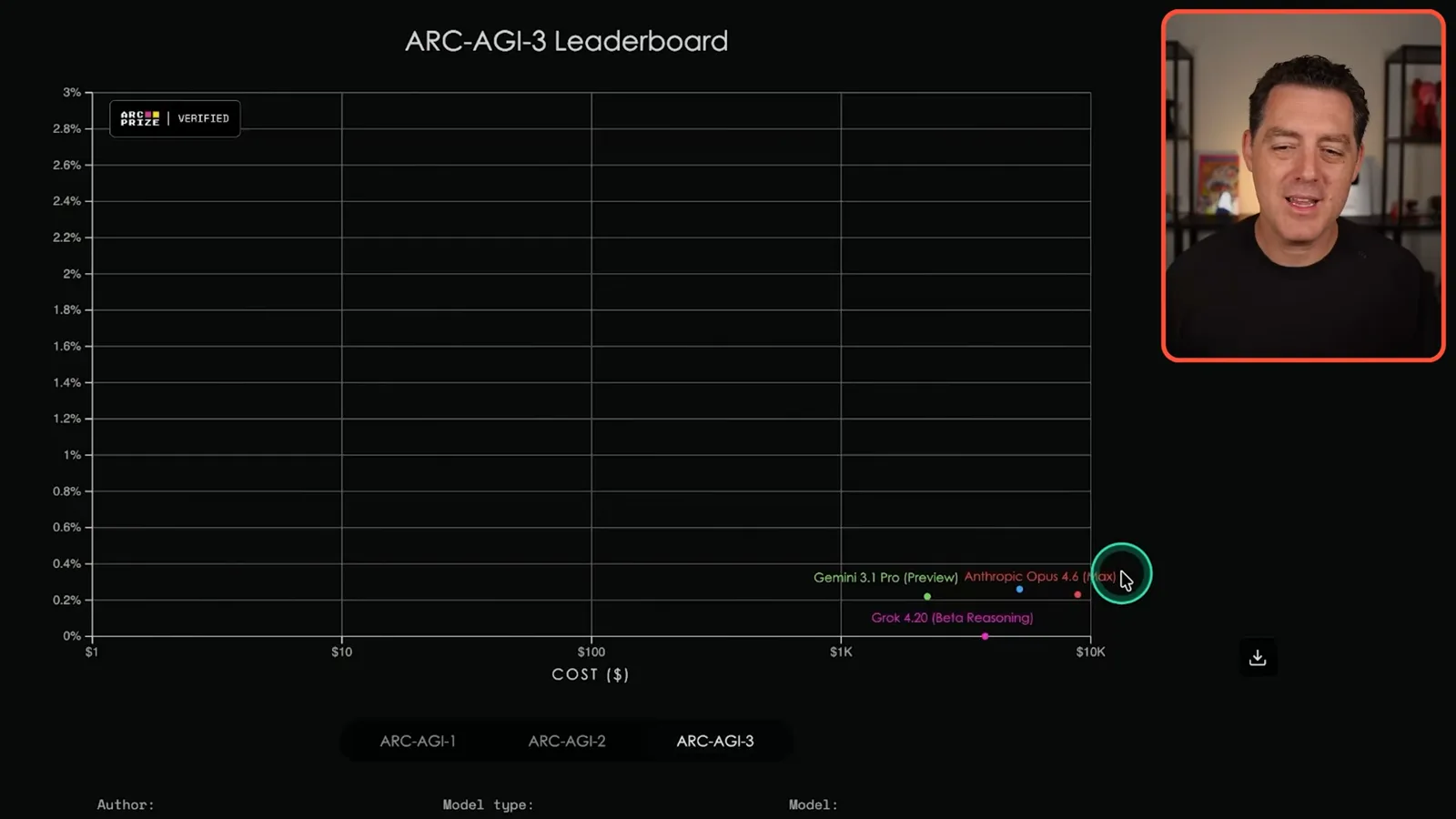
The historical overall leaderboard I show has a leading result around 0.3%, with a substantial reported cost. ARC-AGI-3 scoring reflects level progress and action efficiency relative to human baselines rather than just the share of games completed. I mention the prize and invite viewers to try the different games; neither one level nor one benchmark settles the broader AGI question.
같은 채널의 다른 글
 34:21EN
 Matthew Berman· 2026년 10월 27일Matthew Berman Examines Anthropic’s IPO Filing, AI Growth and GovernanceMatthew Berman, Sam Altman · Forward FutureThe presenter reviews the S-1’s financial metrics, compute strategy and voting structure while questioning the tension between rapid AI development and safety.
 0:36ENMatthew Berman· 2026년 10월 25일Kimi K3.1 and a Rubik’s Cube Solver DemonstrationMatthew Berman · Forward FutureMatthew Berman shows a scrambled virtual cube being solved and gives the Kimi K3.1 test a favorable assessment.
 25:50ENMatthew Berman· 2026년 10월 24일Kimi K3.1 Pro Tested: Strong 3D Demos, Uneven Results and Competitive PricingMatthew Berman · Forward FutureMatthew Berman tests the open-weight model on coding, 3D rendering and visual explanations, then compares benchmark results and prices.
 32:20ENMatthew Berman· 2026년 10월 23일Who Is Local AI For? The Costs, Trade-offs and a Hybrid FutureMatthew Berman · Forward FutureMatthew Berman weighs data control and independence against hardware cost, setup complexity and inference speed.
 1:03:37ENMatthew Berman· 2026년 10월 23일Matthew Berman’s Team Tests Kimi K3.1 on Animation, Games, and ChartsMatthew Berman, Alex, Brian · Forward FutureA live team AMA turns into an informal test of Kimi K3.1, from personal-agent workflows to motion graphics, a browser game, and a benchmark chart.
 0:53ENMatthew Berman· 2026년 10월 22일Sam Altman on AI and the Discovery of New KnowledgeSam Altman · OpenAIAltman expects progress in mathematical discovery to extend to biology, materials and energy.