30초 요약
Matthew Berman highlights Neel Somani's report that GPT-5.2 Pro generated a proof for Erdős problem 397, which was submitted and accepted by Terence Tao. He extrapolates from this result to a possible intelligence explosion and scientific advances. A full human solution from 2012 was subsequently identified, so the AI proof was not the first solution to the problem; neither the result nor its acceptance establishes that an intelligence explosion is underway.
- 1An AI-assisted proofBerman recounts Somani's submitted proof and Tao's acceptance. The later discovery of a 2012 human solution changes the interpretation of the result.
- 2A wave of math resultsBerman describes several recent AI-assisted results, but their difficulty and novelty vary and require individual review.
- 3A speculative feedback loopHe imagines AI improving its own algorithms and contributing to medicine and materials. This proof does not demonstrate that such a loop has occurred.
핵심 정리
- Somani reported generating a proof for Erdős problem 397 with GPT-5.2 Pro and formalizing it with Harmonic's tools.
- A complete human solution from 2012 was later found, so the AI-generated proof was not the first solution.
- The video does not establish that this was among the hardest mathematical problems or that only a few hundred people could solve it.
- Recursive AI improvement and applications to disease and materials remain speculative conclusions rather than demonstrated results.
챕터별로 다듬은 전문 읽기
The Erdős proof
Berman describes Somani's GPT-5.2 Pro proof for problem 397 and its acceptance. A previous complete human solution was later identified.
Neel Somani reported using ChatGPT to produce a proof for an Erdős problem. The post shown in the video identifies it as problem 397 and says GPT-5.2 Pro generated the proof, which was formalized with Harmonic and accepted by Terence Tao. I describe it as one of the hardest problems on Earth, but that ranking and my estimate of how many people could solve it are not established.
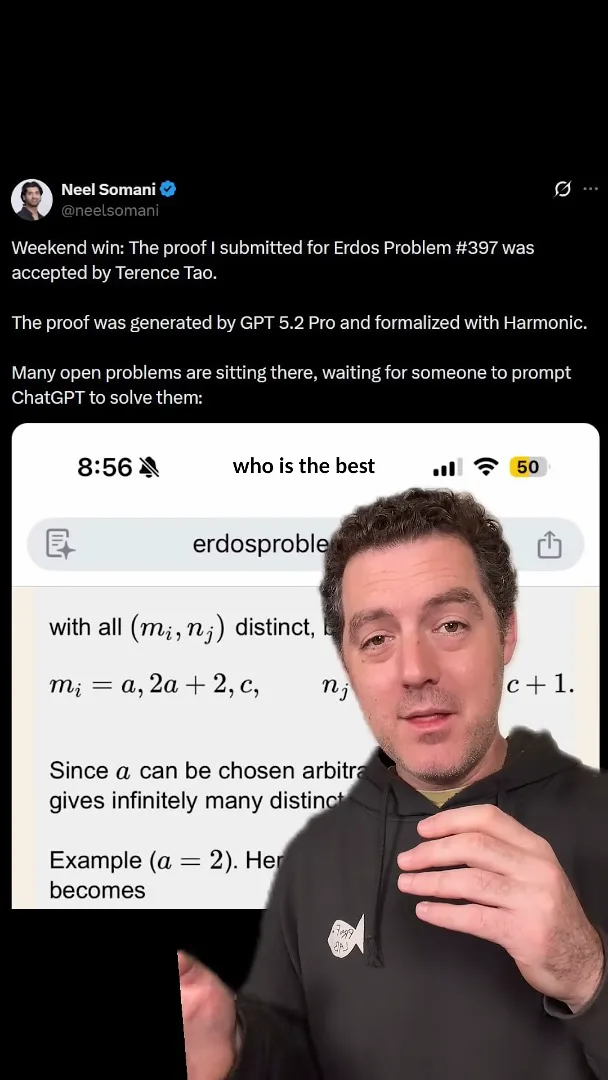
I say this was the sixth such result in two weeks and see it as evidence that AI is advancing quickly in mathematics. Individual problems and contributions differ, however, and a human solution to problem 397 had already appeared in 2012; it was identified later. The generated proof was therefore not the first solution, even though it was a distinct AI-assisted proof.
Possible implications
Berman speculates about recursively improving AI and scientific applications. The mathematical result alone does not establish those outcomes.
I wonder whether AI that can solve difficult mathematics might design better algorithms for itself, apply those improvements and set off an intelligence explosion. In that imagined future, more powerful AI might help tackle diseases or develop new materials. These are possibilities, not outcomes established by this mathematical result.
Somani, a quantitative researcher, says the model produced the proof in about 15 minutes after prompting. I think this could be the beginning of an intelligence explosion. That remains speculation: a proof, even one accepted after review, does not demonstrate recursive self-improvement or a medical breakthrough.
같은 채널의 다른 글
 34:21EN
 Matthew Berman· 2026년 10월 27일Matthew Berman Examines Anthropic’s IPO Filing, AI Growth and GovernanceMatthew Berman, Sam Altman · Forward FutureThe presenter reviews the S-1’s financial metrics, compute strategy and voting structure while questioning the tension between rapid AI development and safety.
 0:26ENMatthew Berman· 2026년 10월 25일Sam Altman on Human Values and Problem-Solving in an AI WorldSam Altman · OpenAIIn a short interview excerpt, Altman considers the enjoyment of solving hard problems and the human role in interpreting results.
 0:36ENMatthew Berman· 2026년 10월 25일Kimi K3.1 and a Rubik’s Cube Solver DemonstrationMatthew Berman · Forward FutureMatthew Berman shows a scrambled virtual cube being solved and gives the Kimi K3.1 test a favorable assessment.
 0:21ENMatthew Berman· 2026년 10월 24일An AI-Generated Kimi Benchmark Chart Used Invented ScoresMatthew Berman · Forward FutureMatthew Berman asks for a graph of Kimi K3.1 Pro benchmarks, then discovers that the displayed figures are illustrative placeholders.
 25:50ENMatthew Berman· 2026년 10월 24일Kimi K3.1 Pro Tested: Strong 3D Demos, Uneven Results and Competitive PricingMatthew Berman · Forward FutureMatthew Berman tests the open-weight model on coding, 3D rendering and visual explanations, then compares benchmark results and prices.
 32:20ENMatthew Berman· 2026년 10월 23일Who Is Local AI For? The Costs, Trade-offs and a Hybrid FutureMatthew Berman · Forward FutureMatthew Berman weighs data control and independence against hardware cost, setup complexity and inference speed.