30초 요약
In September 2026, Matthew Berman reviews DeepSeek V4.1 Flash, a 552-billion-parameter mixture-of-experts model with an asymmetric architecture and a smaller KV cache. He discusses DeepSeek’s reported benchmarks, release-time API prices and possible deployment benefits. His informal tests show quick generation but mixed quality: two Rubik’s Cube implementations mishandle the simulation, a portrait is stylized and lacking detail, and a water-impact app has adjustable controls but an imperfect simulation. These demonstrations are not a comprehensive benchmark.
- 1Reported benchmark comparisonsDeepSeek’s chart reports a 74.2 on DeepSWE v1.1 and 88.1 on CyberGym. These are vendor-reported results under specific test conditions, not proof of universal superiority.
- 2Asymmetric mixture of expertsThe model has 552 billion total parameters, with 8 billion active for input and 16 billion for output, according to DeepSeek.
- 3A smaller KV cacheDeepSeek reports cache requirements of one-quarter the HBM and one-eighth the SSD storage of its previous generation; this comparison concerns the cache, not the entire model.
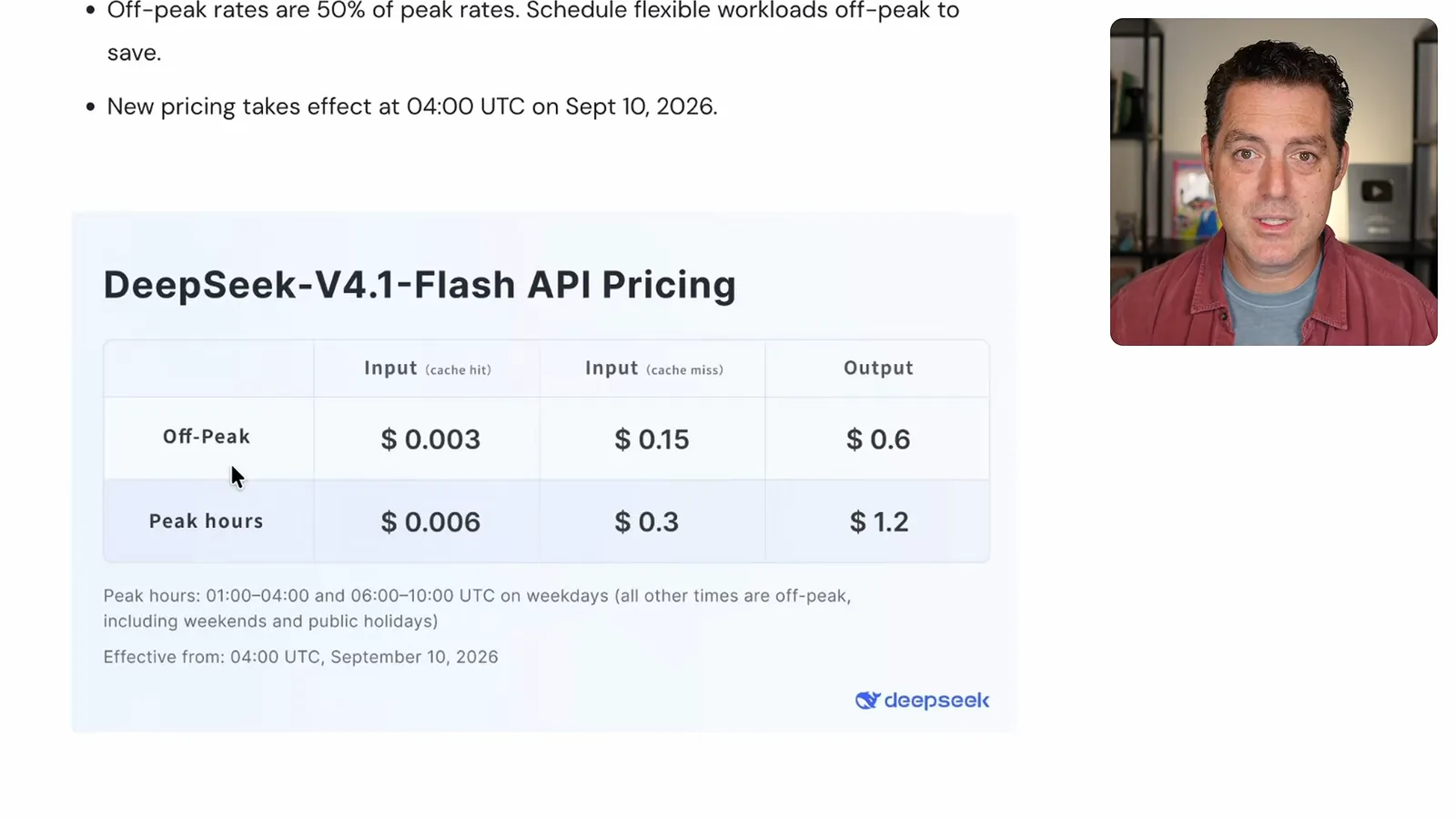
- 4Release-time API pricesBerman reads peak and off-peak rates, including $0.15/$0.30 per million uncached input tokens and $0.60/$1.20 per million output tokens at release.
- 5Mixed practical testsThe model generated quickly, but the Rubik’s Cube simulations had visible defects. Other tests produced a stylized portrait and an adjustable water-impact app with limited simulation fidelity.
핵심 정리
- DeepSeek reports 552 billion total parameters, with 8 billion active for input and 16 billion for output.
- DeepSeek says the new model’s KV cache needs one-quarter the high-bandwidth memory and one-eighth the SSD storage of the previous generation’s cache.
- Release-time API prices differed by peak and off-peak periods and by cached input, uncached input and output.
- Berman’s quick tests showed high apparent generation speed but flawed Rubik’s Cube behavior and uneven visual results.
- Open weights and a technical report provide deployment and research options, though local operation depends on sufficient hardware and software support.
챕터별로 다듬은 전문 읽기
Benchmark claims and the architecture
Berman introduces V4.1 Flash and reviews DeepSeek’s benchmark chart. He explains the reported mixture-of-experts and asymmetric input/output architecture.
DeepSeek V4.1 Flash is here, and its combination of low price, speed and reported benchmark results caught my attention. I see a recurring pattern: frontier models advance, then open-weight models approach earlier generations, potentially becoming easier to deploy later. But my own small set of tests did not always match the promise of the benchmark chart.
DeepSeek compares V4.1 Flash with Kimi K3, GLM 5.3, Claude Opus 5 and GPT 5.6 Sol. Its chart reports 30.0 on Terminal-Bench 3.0, 74.2 on DeepSWE v1.1 and 88.1 on CyberGym. On the chart both Opus 5 and GPT 5.6 Sol score higher on Terminal-Bench; performance depends on the benchmark and its testing conditions.
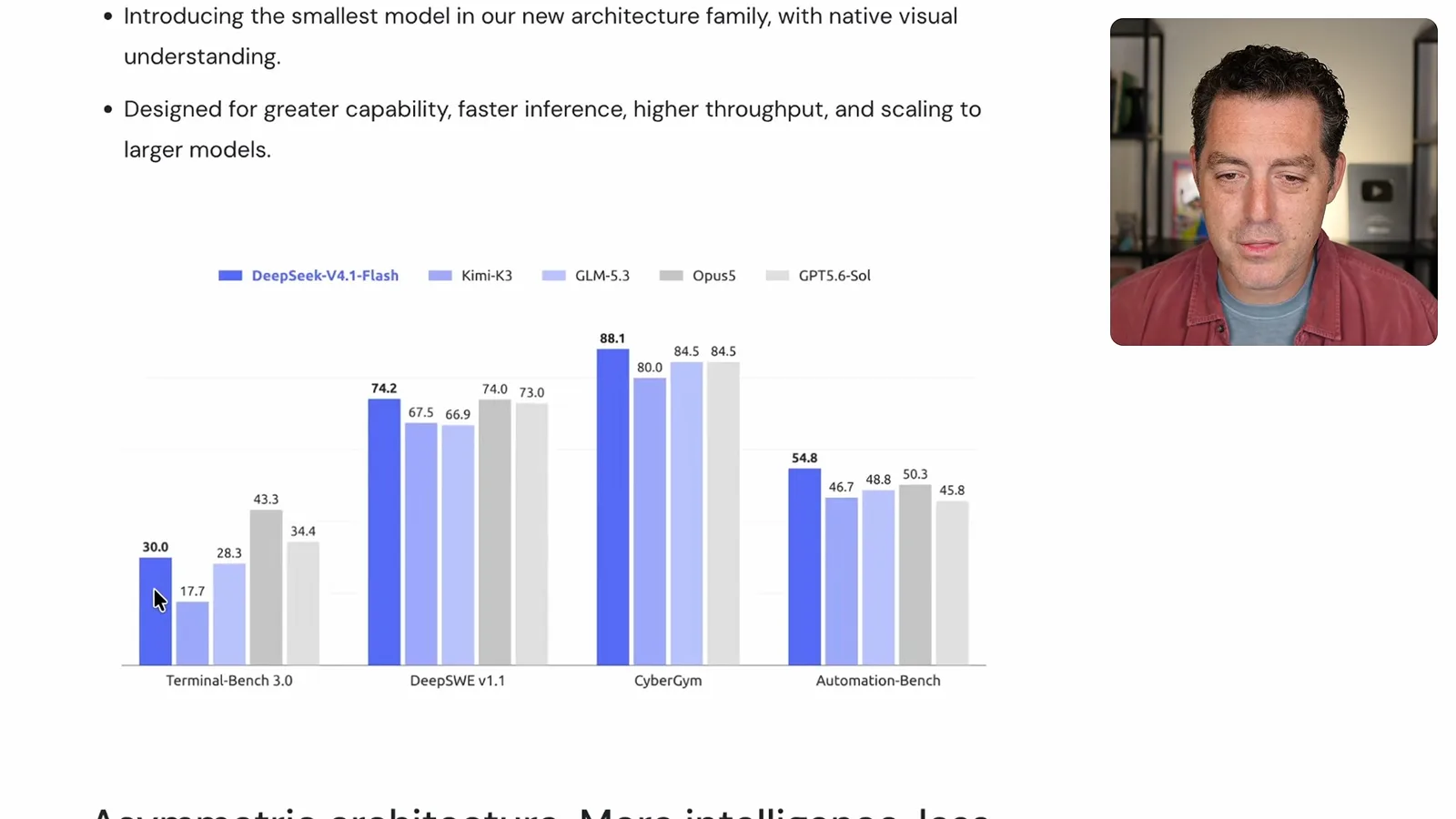
The model has 552 billion total parameters. I find the efficiency more interesting than the overall size: a mixture-of-experts model routes work through selected parts of its weights instead of activating all of them for every token. This can reduce the computation needed for inference, although it does not mean the unused weights disappear from deployment requirements.
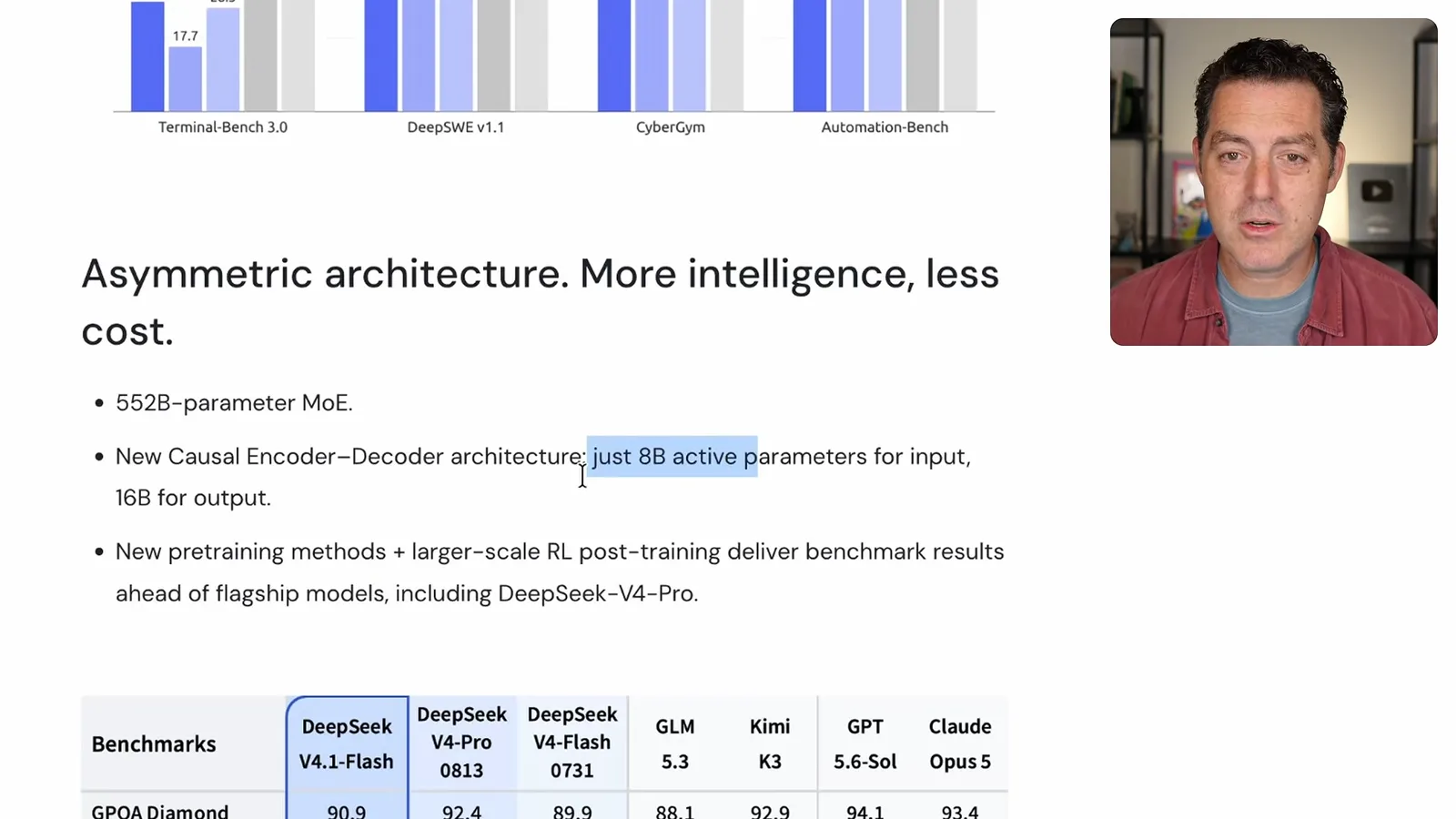
DeepSeek describes a causal encoder–decoder architecture with 8 billion active parameters for input and 16 billion for output. It attributes the reported performance to this architecture, new pretraining methods and larger-scale reinforcement learning post-training. In my use, the model feels very fast, and I will demonstrate that shortly.
The benchmark results are uneven across categories. DeepSeek’s CyberGym score leads the models in the displayed comparison, while its ExploitGym score is below several competitors in the table. These are specific reported evaluations, not evidence that one model is better at every task.
Memory efficiency and prices
The discussion turns to KV cache compression, rising memory costs and the model’s release-time API prices. Berman considers the implications for open-weight deployment and lower-cost workloads.
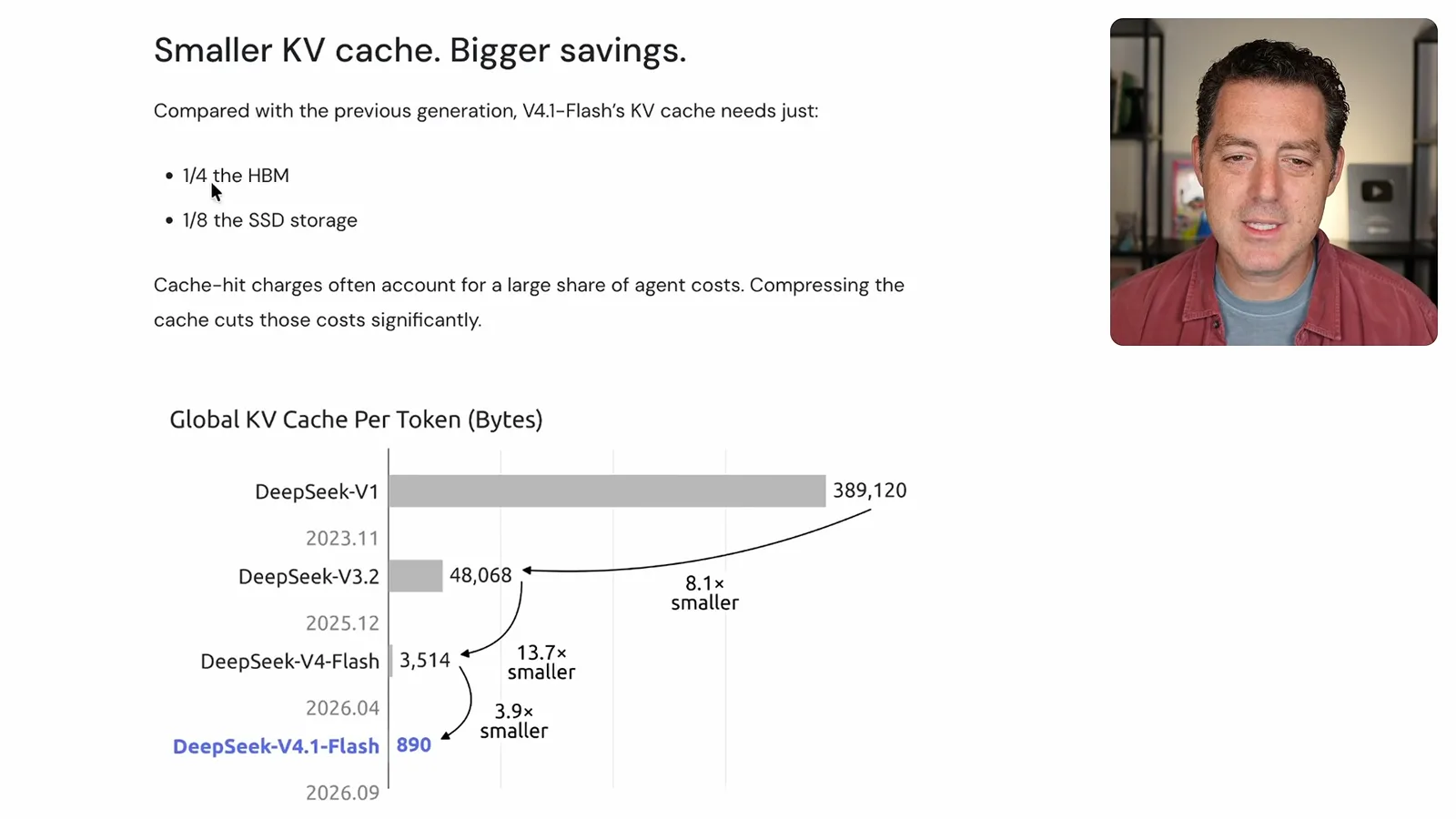
The next claim concerns the KV cache, which stores intermediate attention information used during generation. DeepSeek says V4.1 Flash’s cache requires one-quarter of the high-bandwidth memory and one-eighth of the SSD storage of the previous generation’s cache. That is a cache comparison, not a claim that the complete model requires one-quarter as much memory.
I look at charts showing how memory prices have risen and connect that pressure to growing AI demand and constrained supply. High-bandwidth memory is an important cost for serving models, so reducing cache requirements can matter. The charts are illustrative; individual product prices and their causes vary.
DeepSeek’s chart shows a substantial decline in global KV cache bytes per token across its model generations: from V1 to V3.2, then V4 Flash, and finally V4.1 Flash. The newest step is roughly a fourfold reduction relative to V4 Flash. Less cache storage can support higher throughput and lower serving costs, depending on the workload.
The release-time API prices vary by peak and off-peak hours. For one million uncached input tokens, DeepSeek listed $0.15 off-peak and $0.30 peak; output was $0.60 and $1.20 respectively. Cached input was $0.003 and $0.006 per million tokens. Those are the rates shown in September 2026, not a promise of current prices.
The weights are available to download, so deployment is not limited to sending data to DeepSeek’s hosted service. A third-party cloud or a local setup may be an option, subject to the hardware, implementation and any quantization available. Open weights do not by themselves guarantee that a 552-billion-parameter model fits on an ordinary computer.
DeepSeek has become known for efficiency. I think the market increasingly has a distinction between the most expensive frontier models and faster, cheaper models that are good enough for many tasks. I speculate that routine work such as making a website or a PDF often does not need the most expensive model, though the right choice depends on quality requirements and the particular job.
DeepSeek also released a technical report describing its architecture and techniques. That makes the work more useful to other researchers and developers, who can study the methods and build on the available material. The availability of weights and a report should still be considered alongside the applicable license and practical deployment constraints.
Speed and Rubik’s Cube tests
Berman first demonstrates generation speed, then tests two Rubik’s Cube implementations. He finds errors in the scramble and solve behavior.
For a speed demonstration, I ask for a thousand-word essay about DeepSeek. The response appears very quickly; I estimate roughly 200 tokens per second and around six seconds, but this is a visual estimate, not a controlled measurement. Fast generation is impressive, but speed alone does not establish correctness.
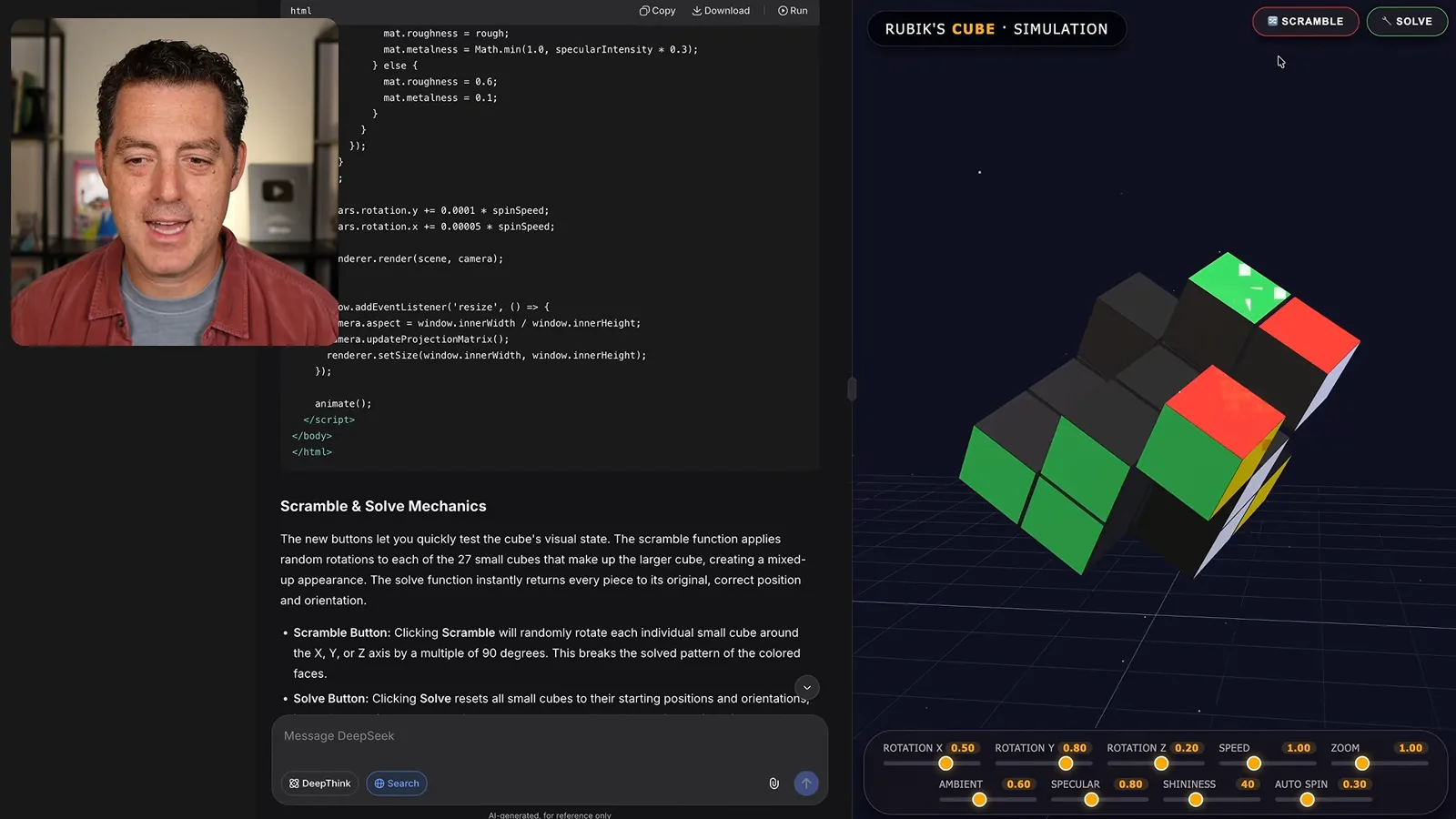
My first Rubik’s Cube simulation finishes in about 12 seconds and initially looks plausible. When I scramble it, the behavior breaks: pieces move incorrectly, and the solve action snaps the cube back to its original state. I also cannot manipulate individual sides as expected, which makes the result disappointing for this test.
I run the same prompt using DeepSeek V4.1 Flash through a Codex harness. The second interface looks different and has more controls, but its squares appear disconnected and colors change incorrectly during scrambling and solving. The harness and execution environment differ from the first test, so these examples should not be treated as a controlled comparison.
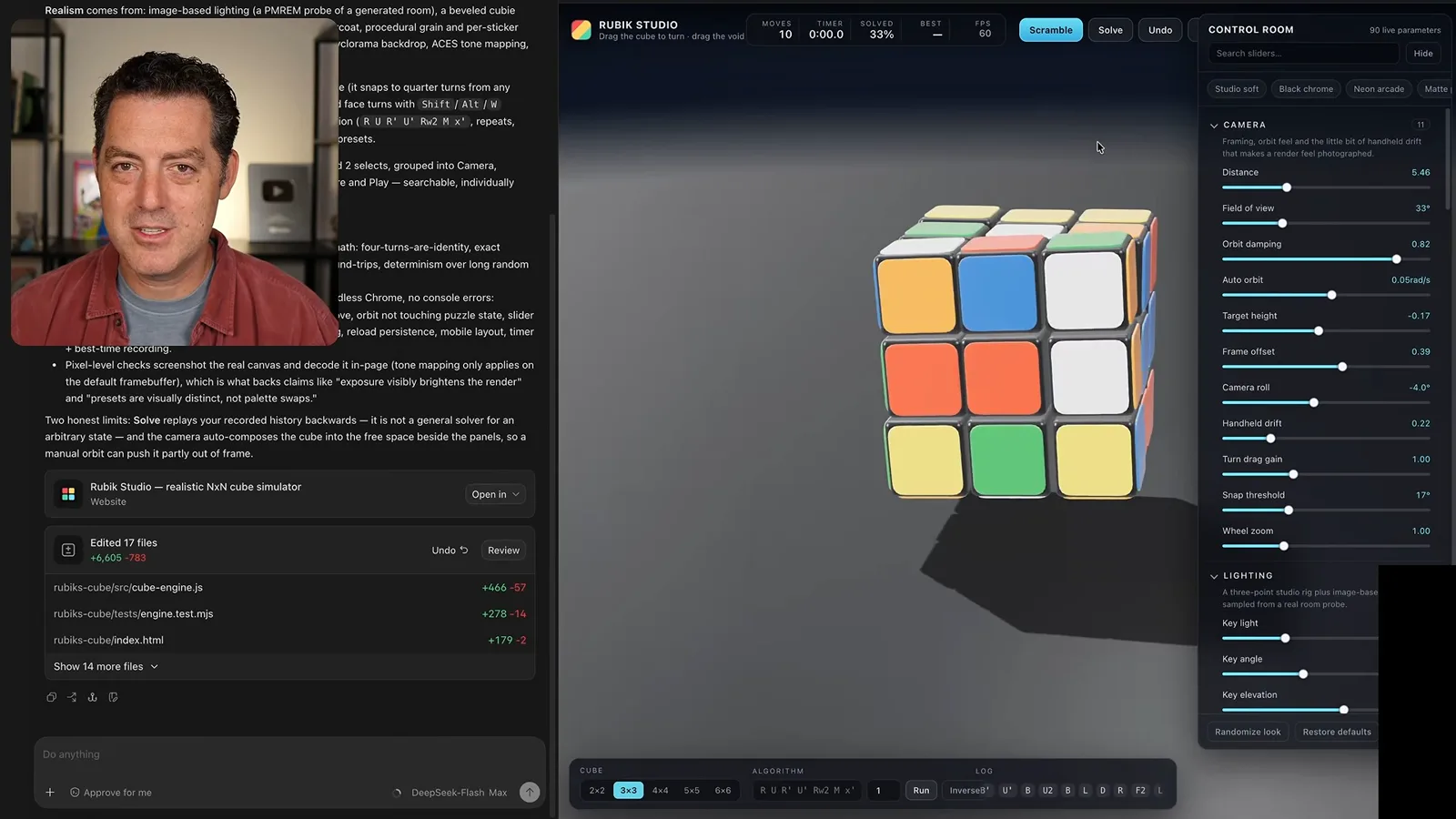
The second app’s solve function replays recorded moves backwards. That can undo a known scramble, but it is not a general solver for an arbitrary cube state; the displayed app also identifies this limitation. I see an unsuccessful result after repeated scrambling and conclude that this particular implementation falls short of my expectations.
Portrait and water-impact demos
A painting comparison and a ray-traced water simulation show further strengths and limitations. Berman concludes that the model is an inexpensive, fast workhorse, while leaving its comparison with GLM 5.3 open.
For another point of comparison, my colleague Alex has been asking models to paint a reference portrait in Microsoft Paint. I show an Astra example with layered brush strokes, then ask DeepSeek through Codex to use a browser-based Paint-like application. The environments are not identical: my test uses a different portrait and a web replica.
The DeepSeek result is stylized and recognizable as an attempt, but it lacks the detail I admired in the other example. It does not reproduce the same layered-brush technique. This is an informal visual judgment on one attempt rather than a standardized head-to-head evaluation.
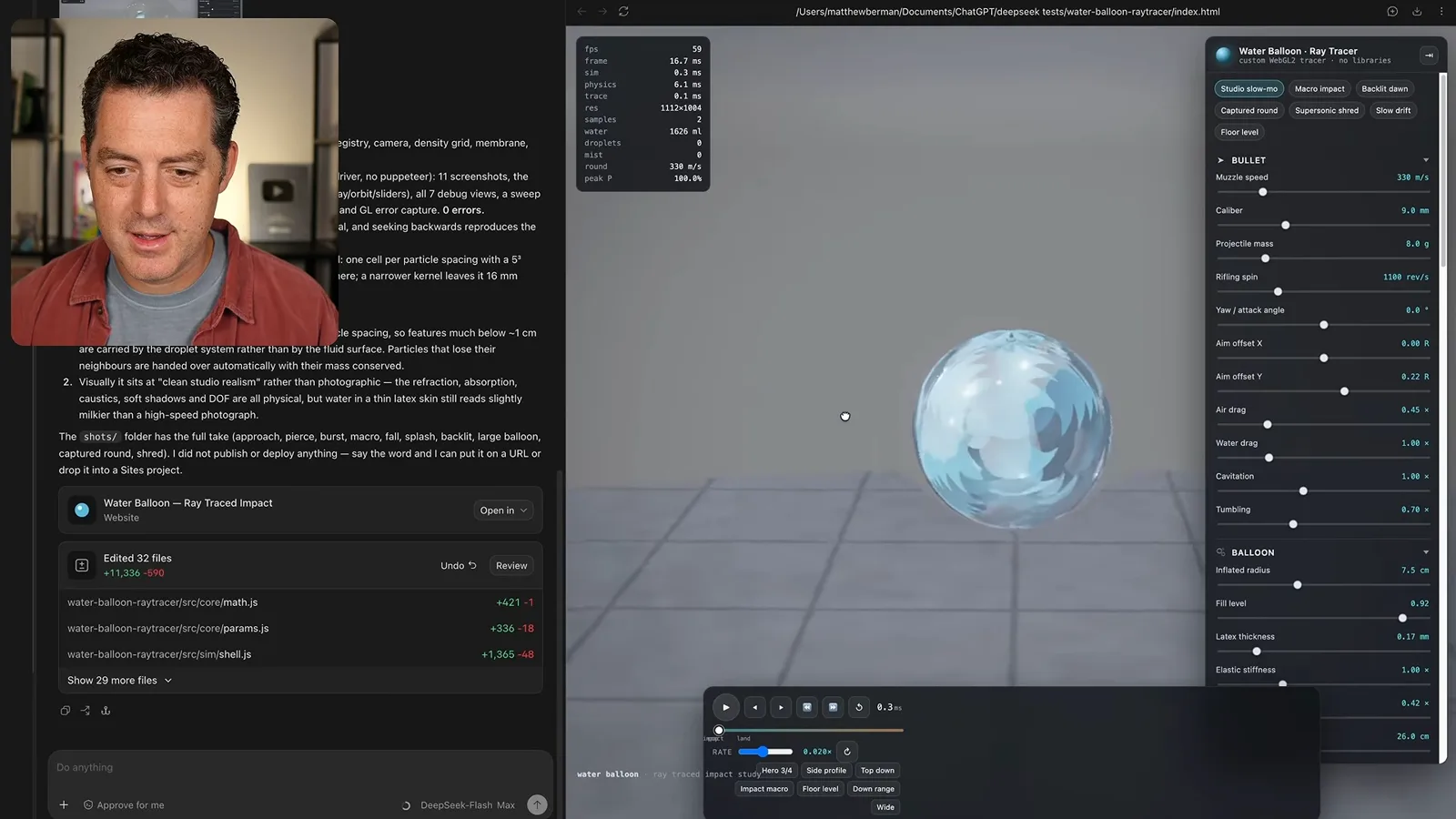
Finally, I ask for a ray-traced 3D simulation of a projectile passing through water. The generated application provides controls for muzzle speed, caliber, mass, spin and other parameters, but the actual simulation leaves something to be desired in my view. I come away seeing a fast, inexpensive workhorse, while remaining unsure how it compares overall with GLM 5.3.
같은 채널의 다른 글
 34:21EN
 Matthew Berman· 2026년 10월 27일Matthew Berman Examines Anthropic’s IPO Filing, AI Growth and GovernanceMatthew Berman, Sam Altman · Forward FutureThe presenter reviews the S-1’s financial metrics, compute strategy and voting structure while questioning the tension between rapid AI development and safety.
 0:26ENMatthew Berman· 2026년 10월 25일Sam Altman on Human Values and Problem-Solving in an AI WorldSam Altman · OpenAIIn a short interview excerpt, Altman considers the enjoyment of solving hard problems and the human role in interpreting results.
 0:36ENMatthew Berman· 2026년 10월 25일Kimi K3.1 and a Rubik’s Cube Solver DemonstrationMatthew Berman · Forward FutureMatthew Berman shows a scrambled virtual cube being solved and gives the Kimi K3.1 test a favorable assessment.
 0:21ENMatthew Berman· 2026년 10월 24일An AI-Generated Kimi Benchmark Chart Used Invented ScoresMatthew Berman · Forward FutureMatthew Berman asks for a graph of Kimi K3.1 Pro benchmarks, then discovers that the displayed figures are illustrative placeholders.
 25:50ENMatthew Berman· 2026년 10월 24일Kimi K3.1 Pro Tested: Strong 3D Demos, Uneven Results and Competitive PricingMatthew Berman · Forward FutureMatthew Berman tests the open-weight model on coding, 3D rendering and visual explanations, then compares benchmark results and prices.
 32:20ENMatthew Berman· 2026년 10월 23일Who Is Local AI For? The Costs, Trade-offs and a Hybrid FutureMatthew Berman · Forward FutureMatthew Berman weighs data control and independence against hardware cost, setup complexity and inference speed.