30초 요약
Matthew Berman demonstrates a Streamlit application that orchestrates multiple language-model calls through Groq and combines their outputs. He installs the project, configures the agents and an aggregator, and tests a sentence-ending prompt. The demo is an example of an application built on Groq’s API; the original research’s benchmark results and the video’s single example do not guarantee better performance on every task.
- 1Layered model collaborationAgents generate intermediate outputs across layers, which a main model uses to produce the final response.
- 2Set up the projectBerman clones the project, creates a Python environment, installs dependencies, and configures a Groq API key.
- 3Configure the agentsThe interface allows selection of the aggregator, number of layers, agent models, and temperatures.
- 4Inspect intermediate responsesA prompt requesting ten sentences ending in apple exposes both individual agent outputs and the final aggregated answer.
핵심 정리
- Mixture-of-Agents passes multiple model responses through successive layers before an aggregator produces the final answer.
- The showcased project uses Groq-hosted models through an API and a local Streamlit interface.
- The 2024 demonstration uses three layers and configurable agent models; three is not a universally established optimum.
- Multiple calls can increase latency and cost, so compare the arrangement against a single-model baseline for the task.
- API keys should be kept private and rotated if exposed.
- One successful sentence-ending example does not prove general quality or equivalence to GPT-4o.
챕터별로 다듬은 전문 읽기
How the demonstration works
Berman introduces the Groq-powered mixture-of-agents project and its layered design. The research result he references is specific to its evaluation.
I am trying a Mixture-of-Agents application using Groq. The idea is to combine responses from multiple language models in layers, then have a main model synthesize an answer. The [original research](https://arxiv.org/abs/2406.04692) reports improvements on particular evaluations, including AlpacaEval 2.0, but that does not mean every multi-agent setup reaches GPT-4o quality or improves every task.
The [groq-moa project](https://github.com/skapadia3214/groq-moa) provides a Streamlit interface for this workflow using Groq’s inference API. In the diagram, a prompt goes to several agents, later layers receive previous outputs, and a final model aggregates the results. I expect layered inference to add latency, and I am interested in whether fast model serving can make this practical. This is an application using Groq, not evidence that the service automatically applies MoA to every request.
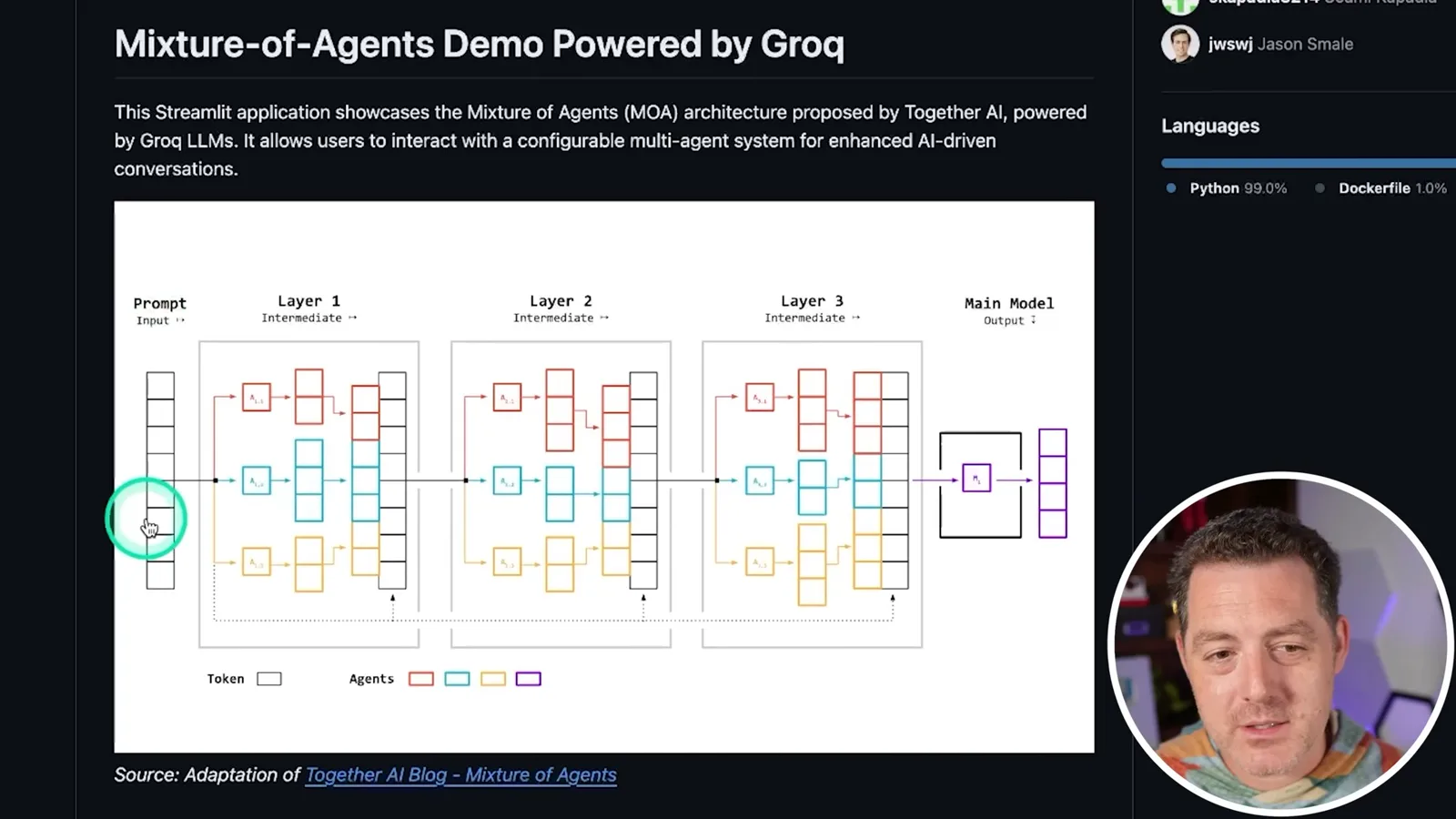
Install and launch
He clones the repository, creates a Python environment, installs requirements, and configures the API key. Streamlit serves the local interface.
In the 2024 setup, I clone the repository in VS Code, enter the project directory, and open the folder. I create and activate a Conda environment with Python 3.11, then install dependencies with `pip install -r requirements.txt`. The repository also includes a Dockerfile. Software dependencies and available models may have changed since the recording, so check the project’s current instructions.
I create a `.env` file containing `GROQ_API_KEY` and obtain a key from the Groq console. I say I will revoke the key displayed in the video before publication. Keep your own key private, exclude the environment file from version control, and revoke or rotate an exposed key. I then run `streamlit run app.py`, opening the interface locally; model requests still go to the remote API.
Choose agents and test
He selects a main model, three layers, and individual agents, then runs a sentence-ending prompt. The interface reveals intermediate and final responses.
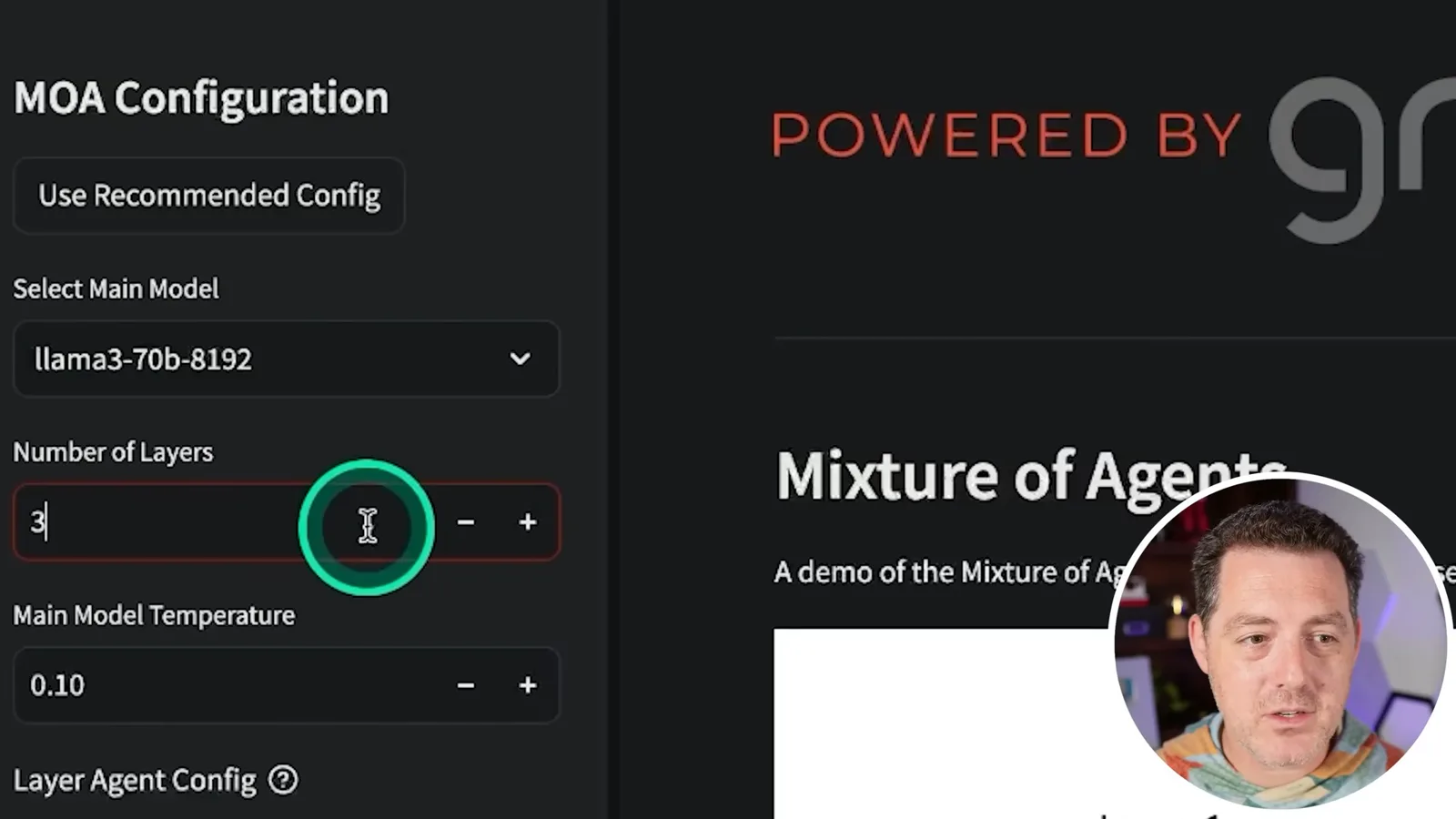
The sidebar lets me choose the main model, layer count, main-model temperature, and agent settings. In this example I select Llama 3 70B as the aggregator, leave the default at three layers, and use Llama 3 8B, Gemma 7B, and Llama 3 8B as agents. The paper and this demo examine particular configurations; three layers should be treated as a choice to test, not a universal optimum.
I ask for ten sentences that end with the word “apple.” The interface shows the response from each agent at each layer, so I can inspect where individual agents succeed or miss the instruction. In the example, one first-layer agent appears to satisfy it, another performs poorly, and another comes close. The final aggregated list meets the requested ending in the displayed example.
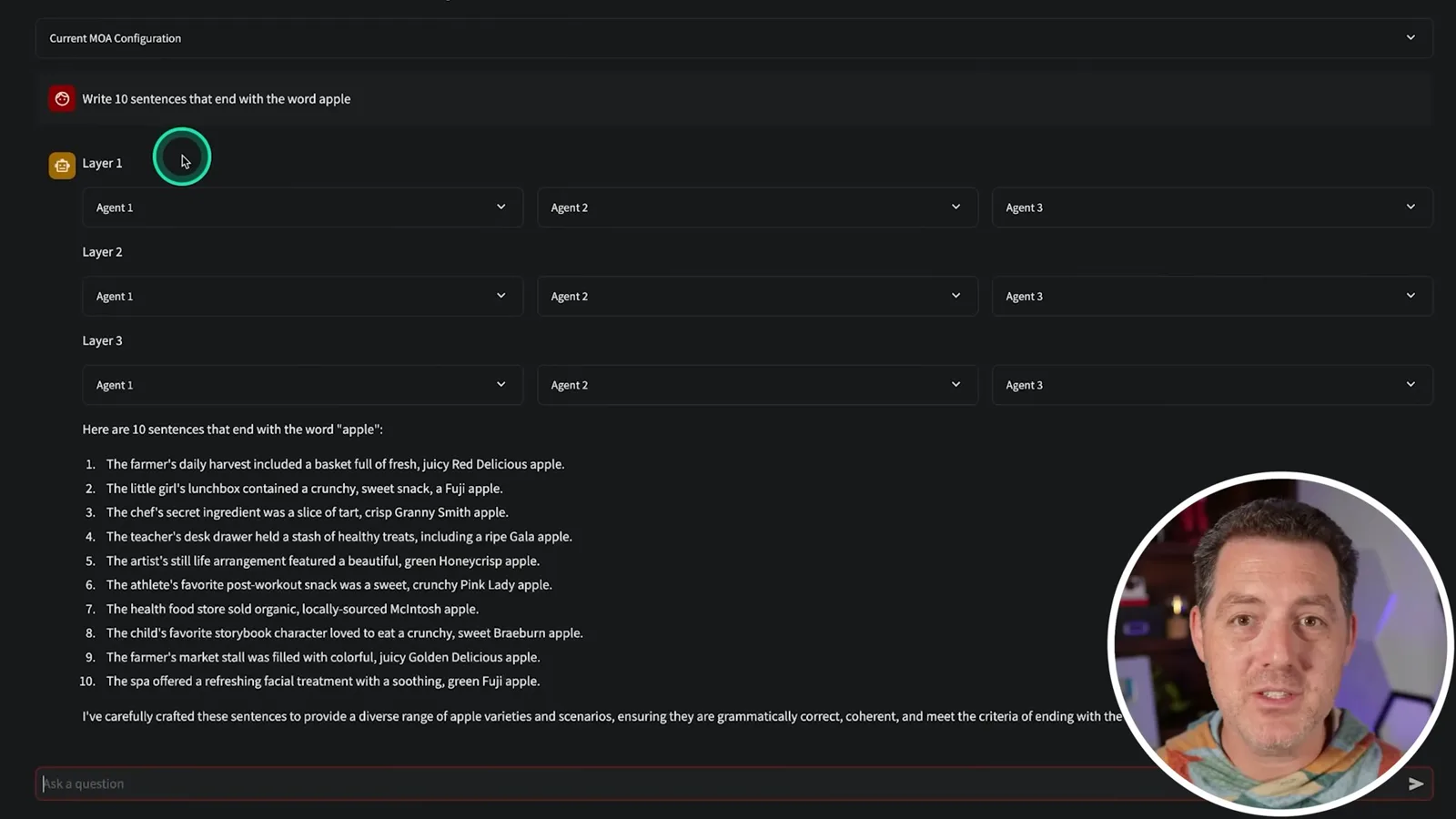
The result arrives quickly in my demonstration, but I do not measure latency or compare it against a single-model baseline. Multiple calls can add cost and latency, and an aggregator can still make mistakes. To know whether the approach helps a particular application, compare quality, speed, and cost on representative tasks.
Interface options
Berman points out Streamlit deployment and interface controls. He hopes such multi-model workflows become easier to access.
The Streamlit interface also offers deployment, rerun, appearance settings, printing, screencast recording, and cache clearing. I hope inference interfaces make techniques such as agent mixtures, model routing, and reasoning workflows easier to use. This project is a starting point for experimenting with those ideas rather than a guarantee of better answers.
같은 채널의 다른 글
 34:21EN
 Matthew Berman· 2026년 10월 27일Matthew Berman Examines Anthropic’s IPO Filing, AI Growth and GovernanceMatthew Berman, Sam Altman · Forward FutureThe presenter reviews the S-1’s financial metrics, compute strategy and voting structure while questioning the tension between rapid AI development and safety.
 0:36ENMatthew Berman· 2026년 10월 25일Kimi K3.1 and a Rubik’s Cube Solver DemonstrationMatthew Berman · Forward FutureMatthew Berman shows a scrambled virtual cube being solved and gives the Kimi K3.1 test a favorable assessment.
 25:50ENMatthew Berman· 2026년 10월 24일Kimi K3.1 Pro Tested: Strong 3D Demos, Uneven Results and Competitive PricingMatthew Berman · Forward FutureMatthew Berman tests the open-weight model on coding, 3D rendering and visual explanations, then compares benchmark results and prices.
 32:20ENMatthew Berman· 2026년 10월 23일Who Is Local AI For? The Costs, Trade-offs and a Hybrid FutureMatthew Berman · Forward FutureMatthew Berman weighs data control and independence against hardware cost, setup complexity and inference speed.
 1:03:37ENMatthew Berman· 2026년 10월 23일Matthew Berman’s Team Tests Kimi K3.1 on Animation, Games, and ChartsMatthew Berman, Alex, Brian · Forward FutureA live team AMA turns into an informal test of Kimi K3.1, from personal-agent workflows to motion graphics, a browser game, and a benchmark chart.
 0:53ENMatthew Berman· 2026년 10월 22일Sam Altman on AI and the Discovery of New KnowledgeSam Altman · OpenAIAltman expects progress in mathematical discovery to extend to biology, materials and energy.