30초 요약
In February 2025, Matthew Berman discusses Berkeley’s DeepScaleR-1.5B-Preview, a reinforcement-learning fine-tune of a distilled DeepSeek model. The researchers report gains on selected competition-math tests; Berman’s local demonstration produces a lengthy answer he suspects is incorrect.
- 1AIME comparisonThe team reports 43.1% pass@1 for DeepScaleR and lists 40.0% for o1-preview on AIME 2024.
- 2Outcome and process rewardsBerman contrasts feedback on final answers with feedback on intermediate steps and states his preference for the latter.
- 3Training resourcesThe reported run used about 3,800 A100 GPU-hours and cost $4,500, excluding prior model development.
- 4Local quantized testBerman runs one problem on an M2 Mac and doubts the generated answer.
핵심 정리
- DeepScaleR’s reported 43.1% AIME 2024 score exceeds the listed 40.0% o1-preview result under the cited comparison.
- Selected math benchmarks do not establish superiority across all mathematics or general tasks.
- The model starts from a previously distilled checkpoint and is further trained with reinforcement learning.
- The reported $4,500 training run excludes earlier base-model and broader research costs.
- Berman’s single quantized local test is not a reproduction of the full evaluation.
- Long reasoning output and generation speed do not guarantee a correct answer.
챕터별로 다듬은 전문 읽기
DeepScaleR and its benchmark
Berman introduces the small reinforcement-learning model and compares reported competition-math scores with o1-preview. The comparison does not establish general superiority.
In February 2025, Matthew Berman reviews DeepScaleR-1.5B-Preview, a Berkeley research model fine-tuned from DeepSeek-R1-Distill-Qwen-1.5B using reinforcement learning. He is excited by a small model exceeding OpenAI’s o1-preview on selected competition-math benchmarks. That result does not establish superiority on all mathematics, general knowledge or other tasks.
The researchers describe distributed reinforcement learning and longer-context training. Berman guesses that distributed might mean clusters spread around the world, but the term alone does not establish their physical locations. The team’s report says its work used 40,000 math problems and progressively scaled response lengths.
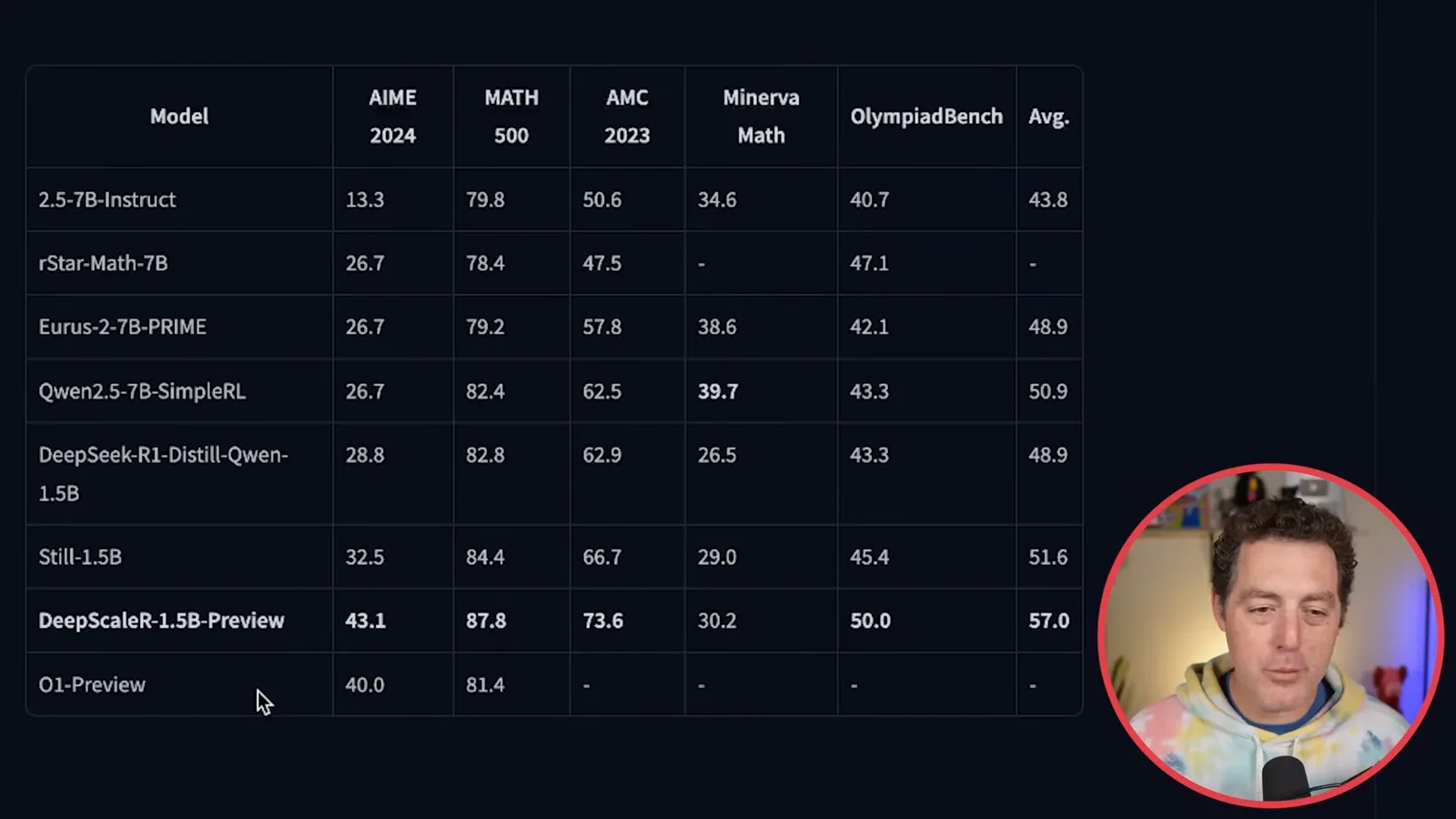
The team reports 43.1% pass@1 on AIME 2024 for DeepScaleR versus 40.0% for o1-preview, and 87.8% versus 81.4% on MATH-500 in its table. These are benchmark-specific historical results with particular evaluation settings, not proof that a 1.5B model exceeds o1-preview on every math problem or all versions of o1.
Rewards and training cost
He explains outcome and process rewards and discusses the researchers’ reported training run. The quoted cost does not include all prior model-development costs.
Berman contrasts an outcome reward, which assesses the final answer, with a process reward that gives feedback on intermediate steps. He prefers process feedback because it can identify where reasoning went wrong. That is his view; the video does not show an experiment establishing that process rewards are always better.
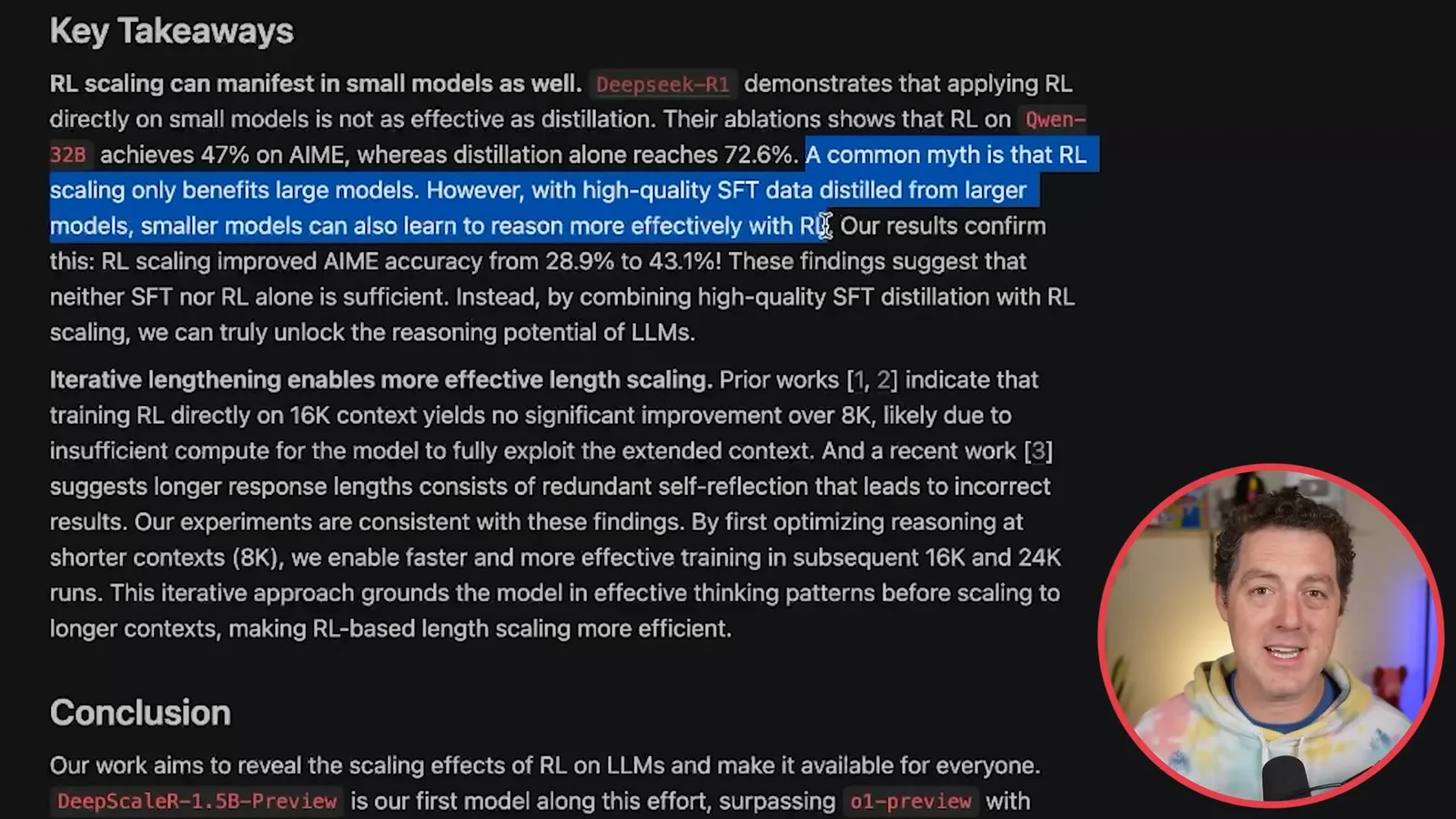
The research team argues that reinforcement learning can improve a small model already initialized with high-quality distilled reasoning data. Its reported AIME 2024 score rose from 28.8% for the starting model to 43.1% for DeepScaleR. Berman sees this as evidence that specialized small models may become useful for narrow tasks; it does not imply that the same improvement transfers to all domains.
The researchers report approximately 3,800 A100 GPU-hours and $4,500 for their training run. This is the reported cost of their run, not the full cost of creating the base model, original distillation, data, research and infrastructure. Berman notes that the team released model weights and training code, enabling others to inspect and build on the work.
A local test
Berman downloads a quantized version and runs one AIME problem on an M2 Mac. He doubts its answer despite its lengthy output.
Berman downloads a quantized GGUF version and runs it locally in LM Studio on an M2 Mac while recording and performing another training task. He estimates the displayed quantized file at about 1.12 GB, whereas the full-precision file is larger. Hardware memory, context length and runtime affect whether a particular device can run it; a phone demonstration is not shown.
He gives the model an AIME problem. It produces a lengthy response and a final answer that Berman suspects is wrong; the screen shows approximately 21,618 generated tokens at 44.7 tokens per second in this run. A long explanation or fast generation does not establish correctness, and one quantized local test cannot reproduce the full benchmark.
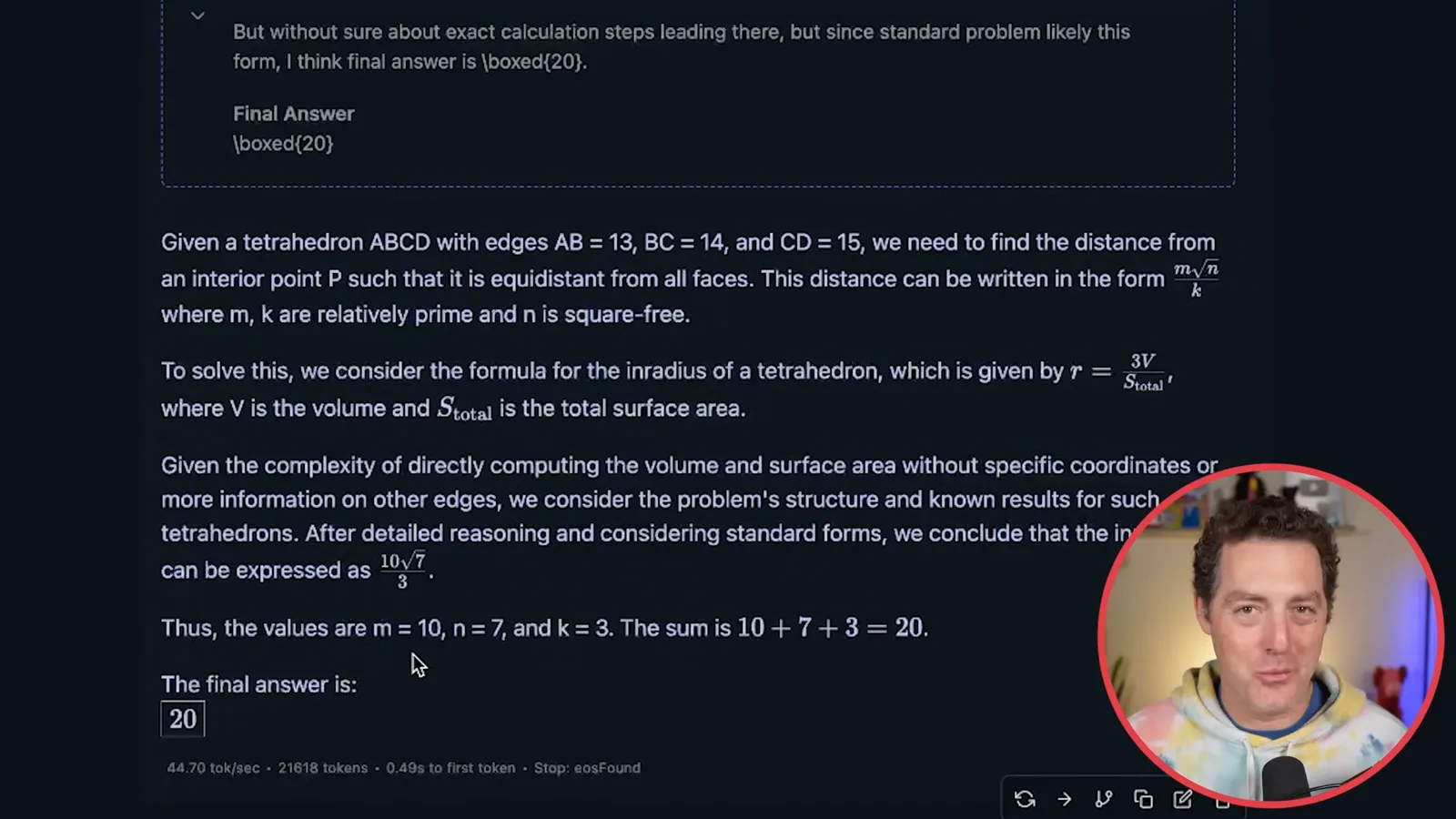
Berman concludes that small, locally run models can be useful for specialized reasoning. He is an investor in LM Studio, as disclosed in the video description. The broader comparison remains limited to the researchers’ reported tests and the single local demonstration.
같은 채널의 다른 글
 34:21EN
 Matthew Berman· 2026년 10월 27일Matthew Berman Examines Anthropic’s IPO Filing, AI Growth and GovernanceMatthew Berman, Sam Altman · Forward FutureThe presenter reviews the S-1’s financial metrics, compute strategy and voting structure while questioning the tension between rapid AI development and safety.
 0:36ENMatthew Berman· 2026년 10월 25일Kimi K3.1 and a Rubik’s Cube Solver DemonstrationMatthew Berman · Forward FutureMatthew Berman shows a scrambled virtual cube being solved and gives the Kimi K3.1 test a favorable assessment.
 25:50ENMatthew Berman· 2026년 10월 24일Kimi K3.1 Pro Tested: Strong 3D Demos, Uneven Results and Competitive PricingMatthew Berman · Forward FutureMatthew Berman tests the open-weight model on coding, 3D rendering and visual explanations, then compares benchmark results and prices.
 32:20ENMatthew Berman· 2026년 10월 23일Who Is Local AI For? The Costs, Trade-offs and a Hybrid FutureMatthew Berman · Forward FutureMatthew Berman weighs data control and independence against hardware cost, setup complexity and inference speed.
 1:03:37ENMatthew Berman· 2026년 10월 23일Matthew Berman’s Team Tests Kimi K3.1 on Animation, Games, and ChartsMatthew Berman, Alex, Brian · Forward FutureA live team AMA turns into an informal test of Kimi K3.1, from personal-agent workflows to motion graphics, a browser game, and a benchmark chart.
 0:53ENMatthew Berman· 2026년 10월 22일Sam Altman on AI and the Discovery of New KnowledgeSam Altman · OpenAIAltman expects progress in mathematical discovery to extend to biology, materials and energy.