30초 요약
Matthew Berman discusses HuggingGPT, a research system that uses an LLM to plan tasks, select models from Hugging Face, run them and combine their results. He describes the architecture as a possible step toward artificial general intelligence, a speculative assessment rather than proof of AGI. The video attributes the work to Hugging Face; the paper identifies its researchers with Zhejiang University and Microsoft Research Asia. Hugging Face hosts the models used by the system.
- 1An orchestrator for specialist modelsBerman describes a central language model coordinating a collection of specialist models to address multistep requests.
- 2An image exampleThe paper's diagram shows an image description and object-counting request handled through multiple visual models.
- 3Four stagesThe system plans tasks, selects models, executes them and combines their outputs into a response.
- 4Routing via descriptionsThe controller uses model descriptions to choose specialist models. Berman sees this approach as promising, while its relation to AGI remains an interpretation.
핵심 정리
- HuggingGPT uses a language model as a controller for specialist AI models.
- Its four stages are task planning, model selection, task execution and response generation.
- Model descriptions help the controller select tools for subtasks across modalities.
- The paper illustrates the approach with image captioning, classification and object detection.
- Berman's examples and AGI claims describe potential, not a demonstration that every proposed workflow works or that AGI has been achieved.
챕터별로 다듬은 전문 읽기
The idea behind HuggingGPT
Berman introduces the system as a way to bring different AI tools under a language-model controller. He uses a PDF summary as a hypothetical multistep example.
HuggingGPT proposes bringing a collection of AI models together under the control of a language model. Hugging Face hosts many models and tools, which makes it a useful source of specialists. In the video I describe the project as coming from Hugging Face; the paper actually lists researchers from Zhejiang University and Microsoft Research Asia.
The idea is to use a central controller to choose tools for different pieces of a user's request. For example, summarizing a PDF might involve extracting text and images before assembling an answer. That is an illustrative possibility, not a demonstration of that particular workflow in this video.
How the workflow operates
He discusses the paper's image example and the four stages of planning, selection, execution and response generation.
The paper argues that complex tasks may span domains and modalities, while a single language model can struggle with the full range. Its proposed solution is to let the language model coordinate external models that handle specialized subtasks. I find the idea of one model directing others exciting.
The paper's diagram gives an image example: a user asks what a picture depicts and how many objects it contains. The illustrated response describes giraffes and zebras, reports five detected objects and draws bounding boxes, combining image classification, object detection and image captioning.
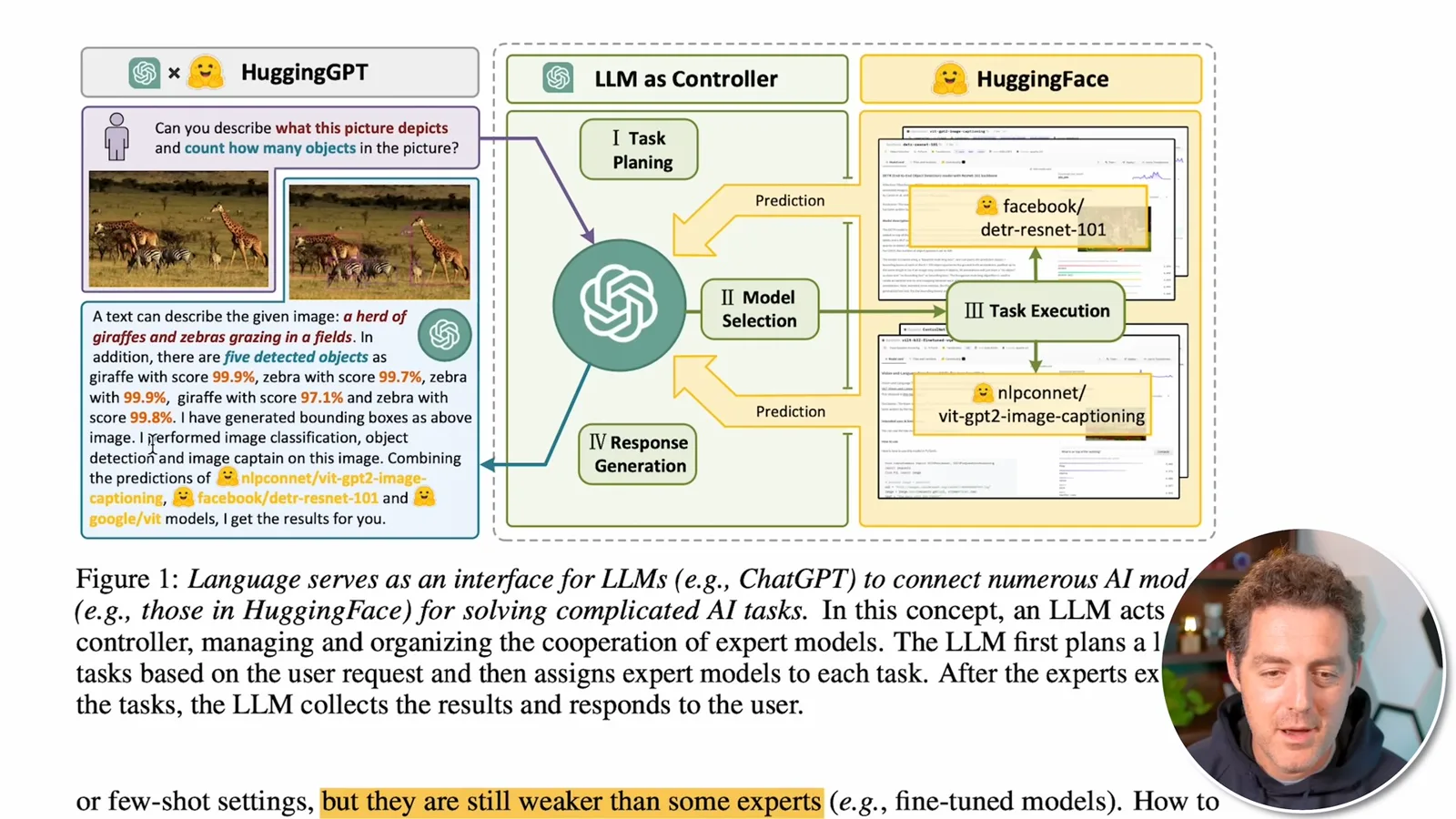
The workflow has four stages. First, task planning turns the request into subtasks. Next, model selection chooses suitable models; task execution runs those models; and response generation combines their outputs into an answer for the user.
Specialists and multimodal tasks
The proposed controller draws on specialist models for different tasks and modalities. Berman explains model selection and offers his view on its significance.
The authors argue that general language models can be strong at zero-shot or few-shot tasks but may still be weaker than specialist models on particular problems. In this architecture, the general model acts as the orchestrator while specialized models contribute their strengths to individual tasks.
Berman says the project integrated hundreds of Hugging Face models around ChatGPT and covered 24 task types, including text classification, object detection, segmentation, image generation, question answering, speech synthesis and text-to-video. These are the paper's historical scope, not a guarantee that all models or services remain available.
Imagine asking for a multimedia presentation about seagulls: research, text, images and possibly video could become separate subtasks. Berman suggests that a controller working with specialist models could coordinate them. This is his hypothetical example of the architecture's potential, rather than an observed end-to-end result.
The paper describes the language model as an interface that routes requests to expert models. It selects models using their descriptions on Hugging Face, allowing the system to organize different specialists through a common language interface. Berman argues that this could be a step toward AGI, though such a system does not establish that AGI has been reached.
The paper contains further examples of how the system might be used. I am excited to try it and explore how general and specialized models can work together.
같은 채널의 다른 글
 34:21EN
 Matthew Berman· 2026년 10월 27일Matthew Berman Examines Anthropic’s IPO Filing, AI Growth and GovernanceMatthew Berman, Sam Altman · Forward FutureThe presenter reviews the S-1’s financial metrics, compute strategy and voting structure while questioning the tension between rapid AI development and safety.
 0:36ENMatthew Berman· 2026년 10월 25일Kimi K3.1 and a Rubik’s Cube Solver DemonstrationMatthew Berman · Forward FutureMatthew Berman shows a scrambled virtual cube being solved and gives the Kimi K3.1 test a favorable assessment.
 25:50ENMatthew Berman· 2026년 10월 24일Kimi K3.1 Pro Tested: Strong 3D Demos, Uneven Results and Competitive PricingMatthew Berman · Forward FutureMatthew Berman tests the open-weight model on coding, 3D rendering and visual explanations, then compares benchmark results and prices.
 32:20ENMatthew Berman· 2026년 10월 23일Who Is Local AI For? The Costs, Trade-offs and a Hybrid FutureMatthew Berman · Forward FutureMatthew Berman weighs data control and independence against hardware cost, setup complexity and inference speed.
 1:03:37ENMatthew Berman· 2026년 10월 23일Matthew Berman’s Team Tests Kimi K3.1 on Animation, Games, and ChartsMatthew Berman, Alex, Brian · Forward FutureA live team AMA turns into an informal test of Kimi K3.1, from personal-agent workflows to motion graphics, a browser game, and a benchmark chart.
 0:53ENMatthew Berman· 2026년 10월 22일Sam Altman on AI and the Discovery of New KnowledgeSam Altman · OpenAIAltman expects progress in mathematical discovery to extend to biology, materials and energy.