30초 요약
Matthew Berman reviews Anthropic’s June 2026 Fable 5 and Mythos 5 release, combining company-reported benchmarks with his own impressions of code review, verbosity, clarifying questions and parallel agents. His video is sponsored by Here.Now, which hosts his demonstrations. Fable was offered generally with stronger safeguards, while Mythos was limited to trusted partners. The launch pricing and retention policy are historical; access was suspended on June 12 and restored beginning July 1.
- 1Two access levelsAnthropic offered Fable generally with safeguards and restricted Mythos to trusted partners; the video’s initial suggestion that Mythos was publicly released is inaccurate.
- 2Benchmarks need contextThe company reports results on SWE-Bench Pro and other tests. Their scores apply to the stated evaluation configurations.
- 3Price and routingAt launch Anthropic listed $10 per million input tokens and $50 per million output tokens; Berman recommends matching model cost to task difficulty.
- 4Parallel work consumes tokensBerman sees over 100 subagents in a review and observes that the token budget rises quickly.
- 5Access changed after the videoAccess was suspended on June 12 and restored starting July 1; Mythos remained limited to approved organizations.
- 6Two browser demosBerman demonstrates a scramble-and-solve cube and an interactive fluid simulation; neither is a comprehensive model evaluation.
핵심 정리
- Fable 5 and Mythos 5 share an underlying model but were released with different safeguards and access restrictions.
- Anthropic-reported benchmarks and Berman’s individual tests measure particular setups, not general reliability.
- Berman’s claim of 10 trillion parameters is unverified; the launch announcement does not disclose model size.
- Parallel agents can broaden work but can also rapidly increase token use and cost.
- Berman praises deep code review while reporting excessive clarification, verbose explanations and long waits.
- A brief suspension and later restoration of access followed the June 2026 launch.
챕터별로 다듬은 전문 읽기
Fable, Mythos and launch benchmarks
Berman reviews the new models and benchmark table. The two variants had different safeguards and access restrictions.
Anthropic has announced Claude Fable 5 and Mythos 5, and I have had early access to Fable. My initial impression is that it behaves differently from models I have previously tested, particularly on long coding tasks. This is a personal review, not an independent controlled comparison.
A distinction matters: [Anthropic’s June 9, 2026 announcement](https://www.anthropic.com/news/claude-fable-5-mythos-5) says Fable 5 was offered for general use with stronger safeguards, while Mythos 5 was restricted to a small set of trusted cybersecurity partners. They share an underlying model, with some safeguards lifted for Mythos; it was not an unrestricted public release.
Anthropic’s benchmark table groups the two model variants. It reports 80.3% on SWE-Bench Pro for Fable/Mythos 5, against 69.2% for Opus 4.8 and 58.6% for GPT-5.5, under the company’s stated evaluation conditions. I am cautious about inferring everyday experience from a single benchmark, particularly when my experience of competing models differs from the ranking.
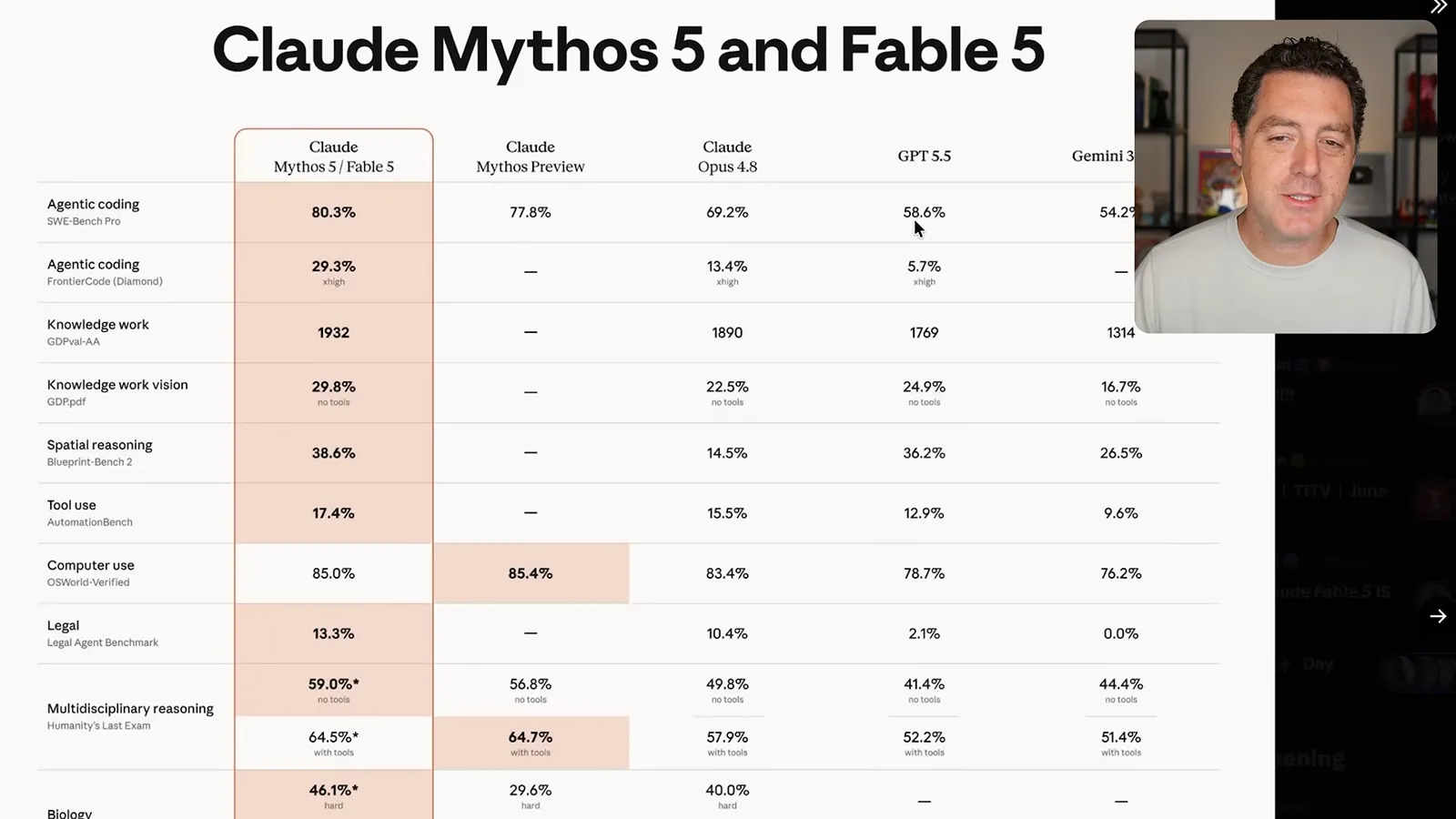
The comparison includes knowledge work, spatial reasoning, tool use, computer use and legal tasks. For example, the table reports 38.6% on Blueprint-Bench 2 and 85.0% on OSWorld-Verified. These scores measure particular tests and configurations, not an overall percentage of tasks the model can perform.
Anthropic reports stronger results on several tests, including FrontierCode, and I found Fable capable during early use. I also claim the model has 10 trillion parameters; Anthropic’s launch announcement does not disclose a parameter count, so that figure is unverified and should not be treated as an official specification.
The most noticeable difference in my own testing is how thoroughly the model explores a task. Even a small request can turn into a broad review of the codebase, while longer and more complex work prompts extensive investigation. That may be useful, but it also changes how long a task takes and how much context and compute it consumes.
Safety, pricing and long-running work
He discusses classifiers, launch prices, model routing and a reported Stripe migration example.
Anthropic said its initial safety classifiers would sometimes flag harmless requests and trigger, on average, in less than 5% of sessions. In my limited testing I did not personally notice a false positive, although I was not explicitly asking it to audit my application’s security. My experience does not establish the overall false-positive rate.
At launch, Anthropic listed both models at $10 per million input tokens and $50 per million output tokens. I see this as a reason to route difficult work to a more expensive model and handle simpler work with a cheaper one. The right choice depends on whether the improvement is worth the actual cost of the task.
Fable often ran for several minutes rather than immediately returning an answer. Anthropic highlights a Stripe example in which Fable reportedly helped migrate a large codebase in a day rather than an estimated two months of manual team work. This is a reported customer case and estimate, not evidence that every migration will see the same improvement.
Dense output, effort and parallel agents
Berman describes verbose answers and a large agent workflow, then discusses performance and inference cost.
Anthropic also describes improved token efficiency. What stood out to me was the density and technicality of the model’s explanations: the output was lengthy but packed with detail, and I often had to slow down to follow it. That observation alone does not measure information-theoretic efficiency or establish a causal improvement in intelligence.
I speculate that future models might communicate using a more compressed language that humans cannot easily read. Such a system could potentially have efficiency advantages, but it would create oversight challenges. This is a thought experiment prompted by my experience, not something demonstrated by Fable in the video.
I tried different effort settings and found the highest setting excessive for many of my own requests. My practical suggestion is to start with a lower effort level and raise it when the task actually needs more work. The appropriate setting still needs to be evaluated against the quality, time and cost of the particular task.
In the workflows feature I watched a planning agent delegate reviews to many subagents in parallel. For a codebase review, I saw more than 100 agents working across files and the token budget climbing rapidly. Parallelism can broaden the work, but it is also a reason to monitor spending and review the results.
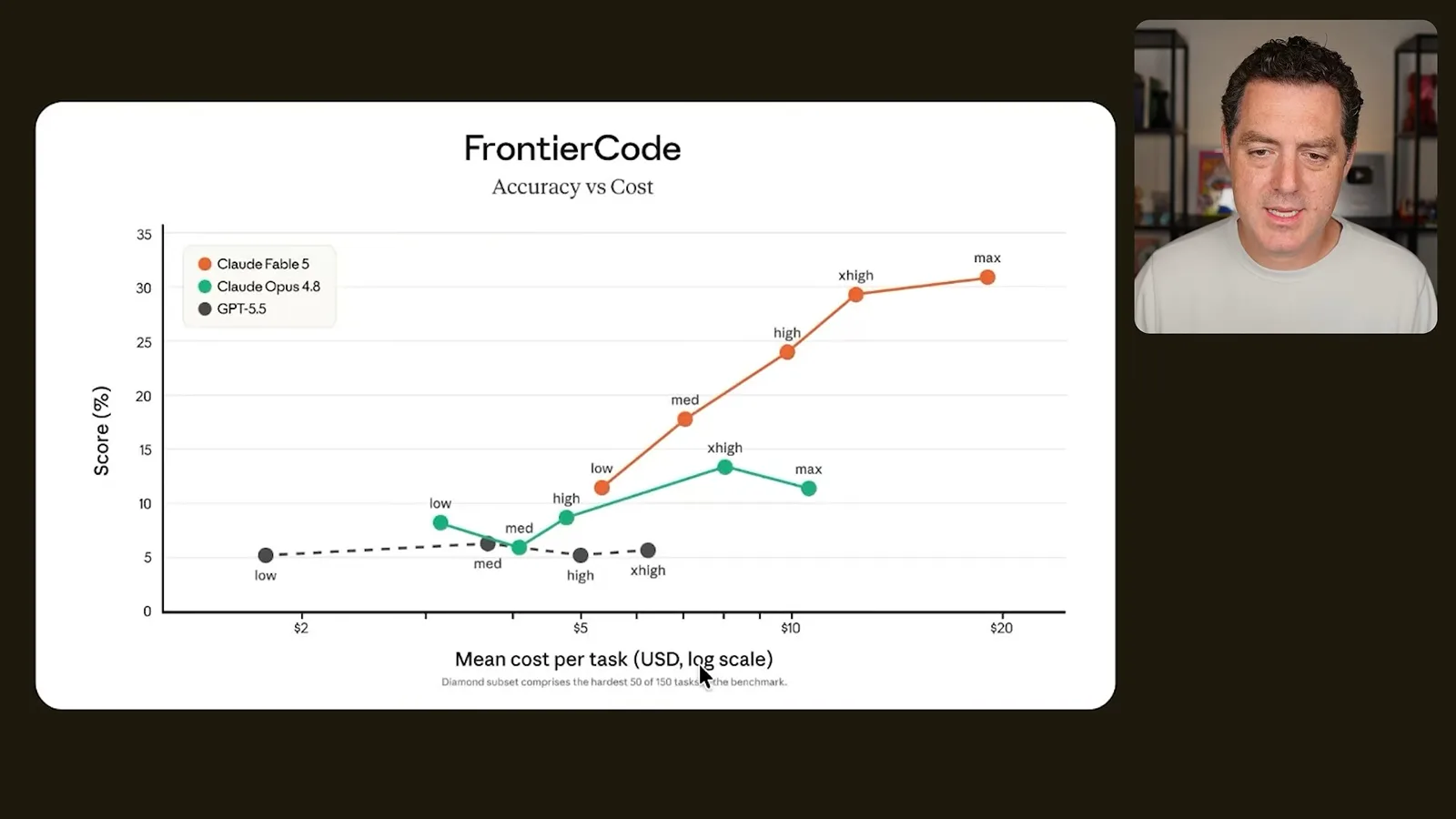
The displayed FrontierCode chart compares score and mean cost per task at different effort settings. I discuss evidence that additional inference can improve results on demanding tasks. That does not prove that quality will always improve indefinitely with more tokens; the relationship depends on the task, model and evaluation.
Demonstrations and release policy
He examines game and research examples, speculates about release motives and discusses data retention. Later access changes provide historical context.
Anthropic shows Fable completing Pokémon FireRed with visual input rather than the complex helper harness used for earlier models. The video also shows a solar-system simulation. These are specific demonstrations under particular setups, not proof that the model can reliably complete any game or simulation.
I explain why I have moved away from simple visual model tests: several contemporary models can already make impressive browser demos. The distinction I want to understand is how a model behaves on the difficult, longer tasks I actually need done, although that kind of impression is subjective.
Anthropic also describes a roughly tenfold acceleration of aspects of drug design in an internal protein-design example. That claim concerns the described research process, not proof that a medicine was developed or clinically validated ten times faster.
I question the timing and messaging around Mythos and suggest Anthropic may have wanted an internal lead before broader release. That is my speculation about its motives. Anthropic’s published explanation emphasizes the need for safeguards and controlled access; the video does not establish the company’s internal decision-making.
Anthropic says it is concerned about attempts to extract model capabilities to train competing systems and about the proliferation of powerful capabilities without safeguards. It says requests flagged as possible distillation attempts may fall back to Opus 4.8. I also offer my own estimate of the gap between open models and the frontier; that estimate is not a measured result.
The launch announcement describes a 30-day retention requirement for business customer traffic on these models, including through first- and third-party services, with stated privacy protections and safety purposes. These are Anthropic’s policy descriptions at launch; the applicable terms and exceptions should be checked directly rather than inferred from the video.
Availability and access changed after the recording. Anthropic [said access was suspended on June 12, 2026](https://www.anthropic.com/news/fable-mythos-access) following a US government directive, then [announced restoration](https://www.anthropic.com/news/redeploying-fable-5) starting July 1. Fable was again broadly available, while Mythos access remained restricted to approved organizations.
Hands-on review and workflow friction
His codebase review finds useful issues but also long waits, complex explanations and repeated approval requests.
In my own codebase review, Fable examined security, documentation, logical gaps, user experience and test coverage. I say it found issues that other models had missed, although the review was not a blinded head-to-head evaluation. I also found it slower and more verbose than I wanted.
The explanations frequently became highly technical, and I updated my Claude instructions to ask for simpler language. Even then I often had to request a plain explanation again. A technically detailed answer is not automatically a usable one if the person reviewing it cannot easily understand the decisions.
Another frustration was repeated clarification. I describe a typical flow in which the model asks several questions, summarizes my answers for confirmation, asks to write a specification, requests approval of it and then asks how to delegate the work. Once it starts building, I like the result, but the repeated confirmations interrupt the task.
I also describe long quiet periods at the start of requests: the displayed token count could remain low while the timer advanced, then increase sharply once parallel workflows began. That is an observation of the interface in my sessions, not a measurement of what the model was doing internally.
I consider the combination of capable models, parallel workflows and loops that continue working toward a goal. I think this could make software production much more automated and call the unused capacity “model overhang.” This is a forecast, and effective use still requires budgets, supervision and checks.
Rubik’s Cube and fluid simulation
Berman demonstrates two browser projects and closes with his views on workflows and loops.
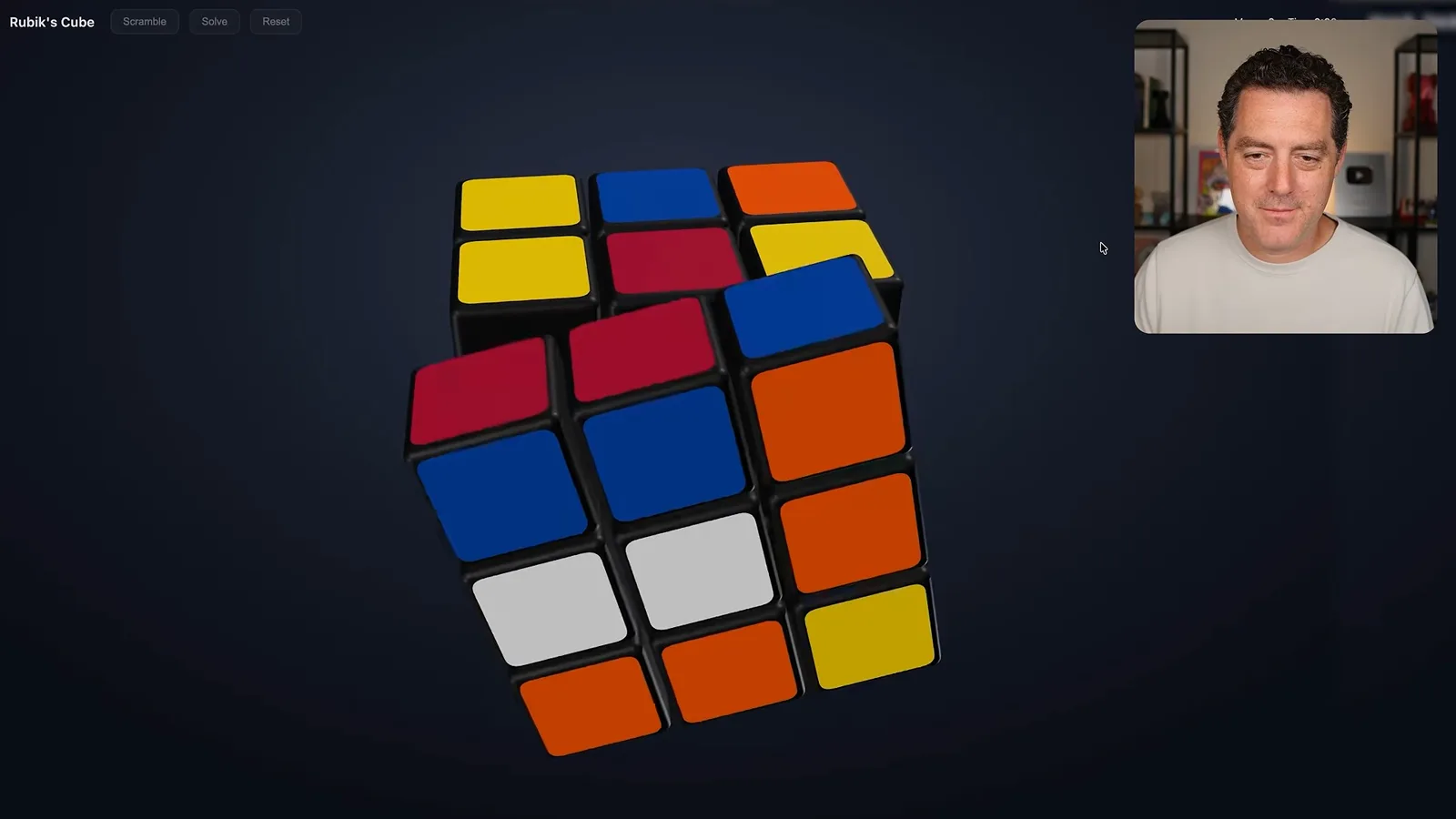
For a browser test, I ask Fable to build an interactive 3D Rubik’s Cube that can turn, scramble and solve. In the demonstration I scramble it and press solve; the cube returns to a solved state. I find the rendering and interaction impressive, while the clip is one example rather than a comprehensive correctness test.
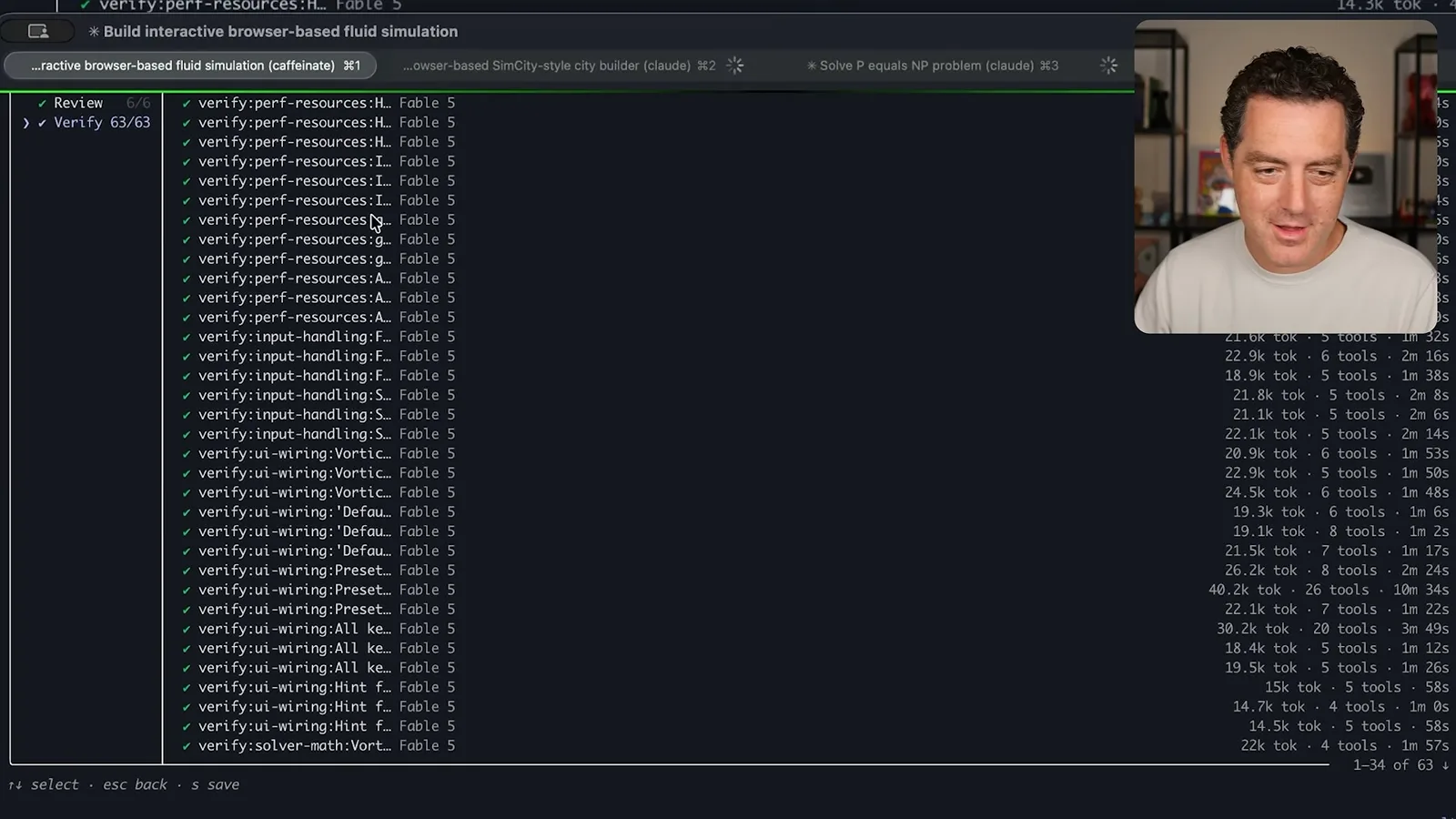
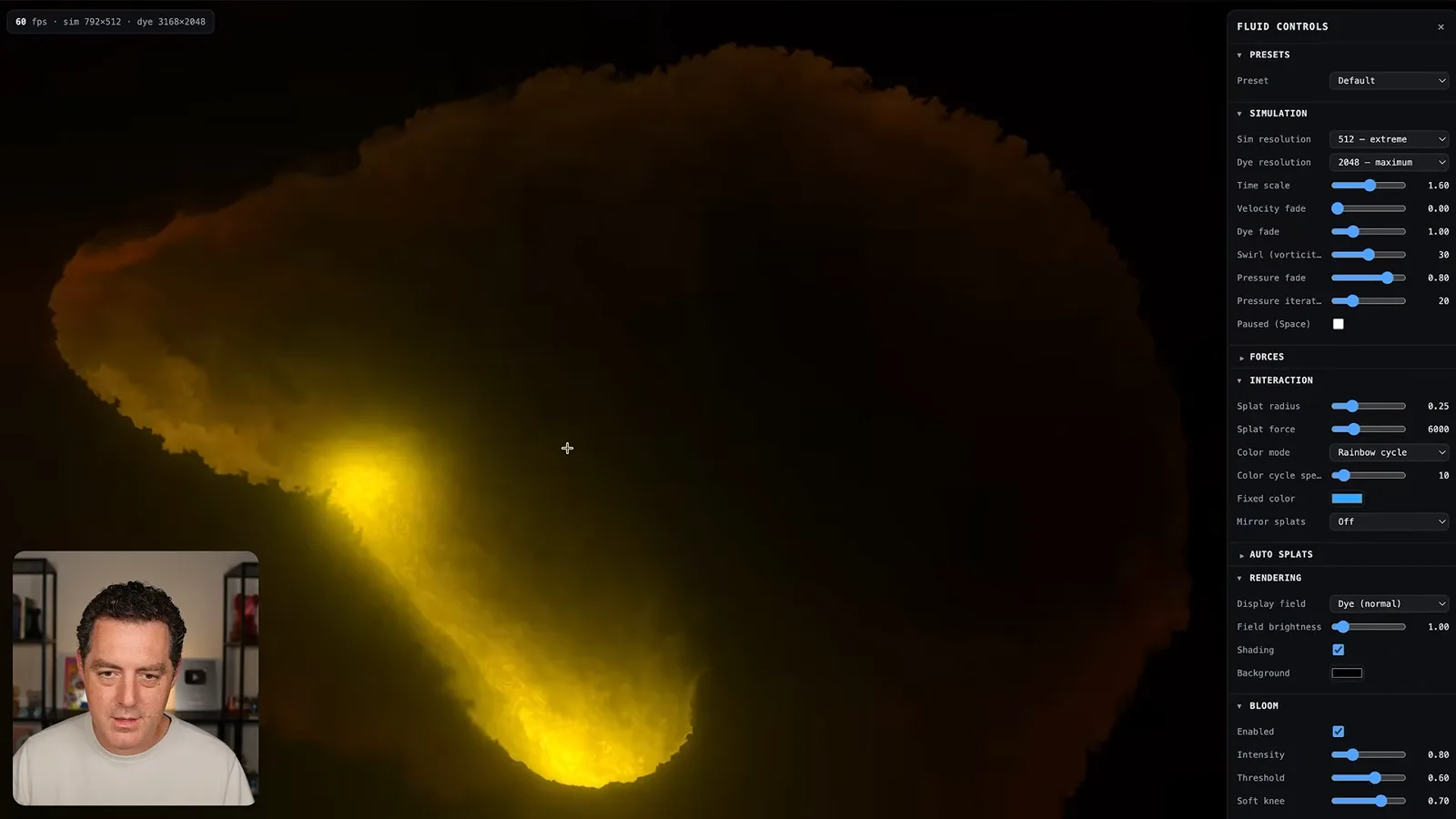
I then ask for an interactive real-time fluid simulation with mouse interaction and adjustable controls, and instruct the model to make its own implementation choices. The workflow display shows 63 verification agents; I estimate that many used roughly 20,000–30,000 tokens apiece. These figures describe the visible run, not a standard cost for the task.
In the resulting browser demo I adjust resolution, time scale, fading, swirl and the size of the interaction. The visible fluid responds to the controls, and I consider it the best such demo I have generated with a model. The video does not independently verify its physical accuracy.
I close by emphasizing that workflows and loops can extend what the model does. The demonstration links are hosted using Here.Now, which sponsored the video; its sponsorship is relevant context for the product mention.
같은 채널의 다른 글
 34:21EN
 Matthew Berman· 2026년 10월 27일Matthew Berman Examines Anthropic’s IPO Filing, AI Growth and GovernanceMatthew Berman, Sam Altman · Forward FutureThe presenter reviews the S-1’s financial metrics, compute strategy and voting structure while questioning the tension between rapid AI development and safety.
 0:36ENMatthew Berman· 2026년 10월 25일Kimi K3.1 and a Rubik’s Cube Solver DemonstrationMatthew Berman · Forward FutureMatthew Berman shows a scrambled virtual cube being solved and gives the Kimi K3.1 test a favorable assessment.
 25:50ENMatthew Berman· 2026년 10월 24일Kimi K3.1 Pro Tested: Strong 3D Demos, Uneven Results and Competitive PricingMatthew Berman · Forward FutureMatthew Berman tests the open-weight model on coding, 3D rendering and visual explanations, then compares benchmark results and prices.
 32:20ENMatthew Berman· 2026년 10월 23일Who Is Local AI For? The Costs, Trade-offs and a Hybrid FutureMatthew Berman · Forward FutureMatthew Berman weighs data control and independence against hardware cost, setup complexity and inference speed.
 1:03:37ENMatthew Berman· 2026년 10월 23일Matthew Berman’s Team Tests Kimi K3.1 on Animation, Games, and ChartsMatthew Berman, Alex, Brian · Forward FutureA live team AMA turns into an informal test of Kimi K3.1, from personal-agent workflows to motion graphics, a browser game, and a benchmark chart.
 0:53ENMatthew Berman· 2026년 10월 22일Sam Altman on AI and the Discovery of New KnowledgeSam Altman · OpenAIAltman expects progress in mathematical discovery to extend to biology, materials and energy.