30초 요약
Matthew Berman and CrewAI founder João “Joe” Moura discuss Tesla’s October 2024 “We, Robot” event, including the Cybercab, Robovan and Optimus, before answering questions about CrewAI. Berman discloses that he is an investor in CrewAI. Tesla’s pricing, autonomy and deployment figures are presented as projections made at the event. After the stream, a Tesla engineer confirmed that the Optimus demonstrations had human assistance; the final model comparison is an individual CrewAI test, not a general benchmark.
- 1A proposed robotaxi networkThe speakers discuss a vehicle without conventional controls and a possible shared taxi network, while the economic case remains uncertain.
- 2Price and profitability are forecastsMusk’s sub-$30,000 target and possible owner income were event proposals, not demonstrated production economics.
- 3The Robovan conceptTesla showed a vehicle intended to carry about 20 people; Berman compares its design to Art Deco trains.
- 4Optimus had human assistanceMoura questions whether the robots were teleoperated. A Tesla engineer subsequently acknowledged human assistance at the event.
- 5Building with CrewAIMoura describes the open-source Python framework and enterprise beta, while Berman discloses his investment.
- 6A task-specific model comparisonMoura displays quality scores and latency for a single crew configuration; incomplete methodology limits broader conclusions.
핵심 정리
- The Cybercab and Robovan discussion centers on 2024 prototypes and proposals, with price, timing and economics still uncertain.
- An Optimus engineer later acknowledged human assistance at the event, so the interactions do not prove full autonomy.
- Moura says CrewAI combines an open-source agent framework with an enterprise offering; Berman is an investor.
- Enterprise agent deployments require evaluation, monitoring, permissions and integration as well as model access.
- A specific CrewAI test illustrates trade-offs between model quality, latency and token usage, but its results cannot establish universal rankings.
챕터별로 다듬은 전문 읽기
Introductions and the We, Robot event
Berman welcomes CrewAI founder Moura and discloses his investment. They begin discussing the Cybercab prototype.
Matthew Berman welcomes João “Joe” Moura, founder and CEO of CrewAI, for a discussion of the week’s AI news and audience questions. Berman discloses that he is an investor in CrewAI, a relationship relevant to his later praise of the company.
The conversation begins with Tesla’s October 2024 “We, Robot” event. Moura has seen clips rather than the full presentation and is excited by the future Elon Musk describes; Berman shares that enthusiasm. Both are reacting to a presentation and its proposals, not independently establishing that all the announced capabilities are ready.
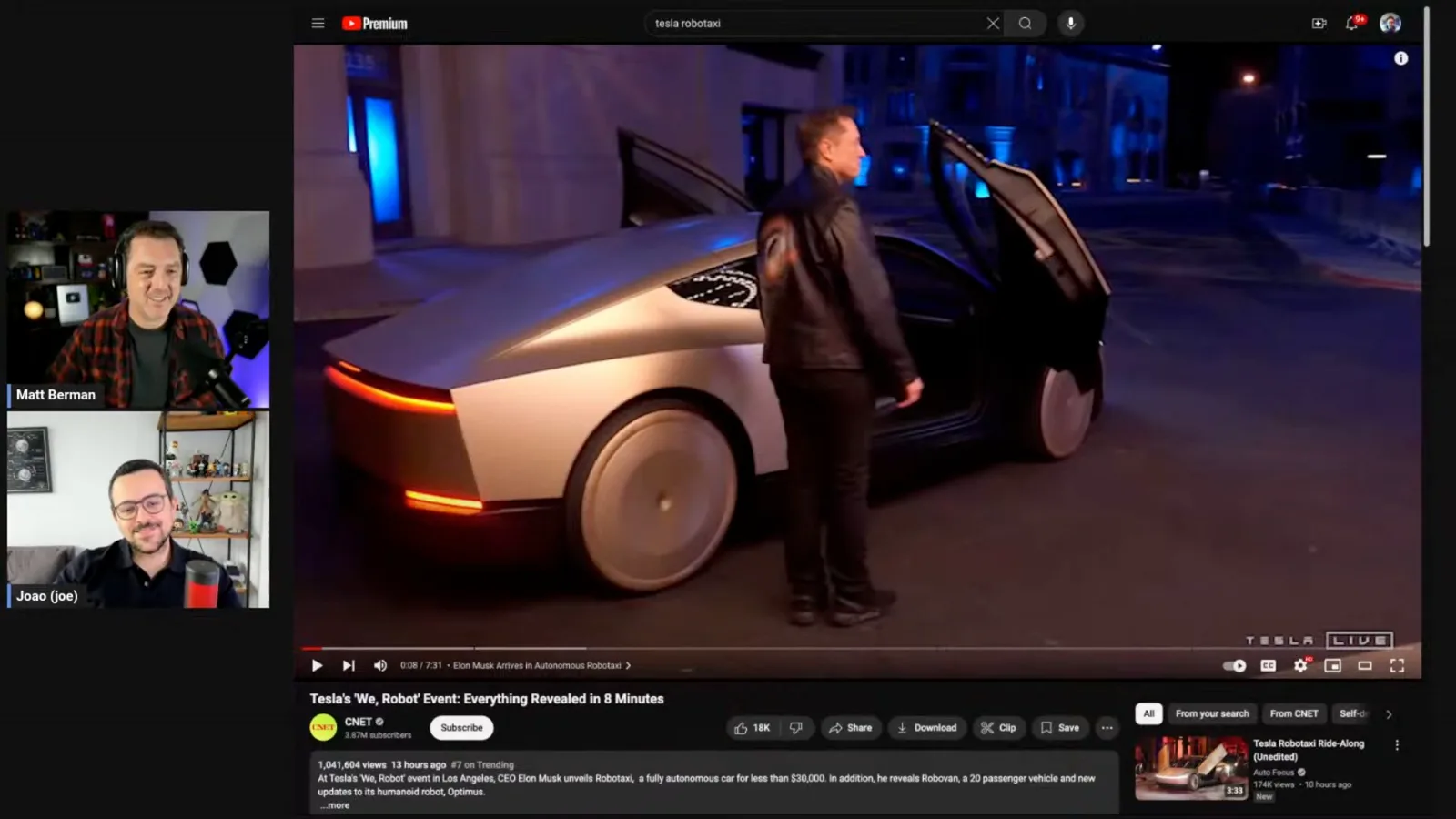
Berman describes the Cybercab prototype as a planned driverless vehicle without a steering wheel or pedals. Musk’s idea is that an owner might use it when needed and allow it to carry other passengers at other times. Both speakers find the prospect appealing, while the vehicle and the economics of such a network remain proposals at the time of the stream.
Moura likes the distinctive styling and says cars at his own home sit parked much of the time. If autonomous vehicles were deployed at scale, he imagines changes in traffic and transport costs. Those wider economic effects are speculative and depend on safe, practical deployment.
Cybercab design, timing and economics
The speakers consider retro-futuristic styling, announced timelines, price and whether a robotaxi network could make money.
Berman says the Cybercab’s angular design evokes the future imagined in 1980s films such as Blade Runner and Total Recall. Moura wonders whether nostalgia helps explain the appeal. Berman likes that the vehicle looks different from conventional cars and compares Tesla’s willingness to pursue an unusual design with concept cars that never ship.
Moura says it is notable for a large company to take an ambitious design risk. Berman points to the Cybertruck as a past example of Tesla producing a vehicle resembling a bold concept. They stress design ambition, although an attractive prototype does not settle questions about safety, manufacturing or delivery.
Asked about timing, Berman recounts Musk’s 2024 prediction of unsupervised driving in Texas and California in 2025 and Cybercab production in 2026. He acknowledges Musk’s history of optimistic timelines and describes a previous Tesla driving experience that included missed traffic signals. These were predictions, not guarantees of deployment.
A viewer asks how the upward-opening doors would work in a tight parking space. Berman and Moura speculate that an autonomous vehicle might position itself for pickup rather than require the passenger to enter in a tight space. Neither has verified how the final design would handle all such situations.
Musk’s announced price target for the Cybercab is below $30,000. Moura doubts a new vehicle could achieve that price at launch, even if it might be possible at scale later. Berman adds that he does not know whether owners would earn a profit by adding vehicles to a taxi network.
Moura notes a tension in the business case: autonomous operation could reduce transport costs by removing a paid driver, but low fares do not by themselves establish the owner’s return after expenses. The speakers do not have a detailed cost model, and treat profitability as an open question.
Vehicle computing, charging and operations
They speculate about spare vehicle computing and discuss Starlink, charging and cleaning. Many ideas remain projections.
Berman describes a further possibility raised in the discussion: using spare computing capacity in parked vehicles for AI inference, potentially as a service. Moura finds the idea interesting if hardware, energy and connectivity costs make it viable. They discuss it as a vision, not an operating service or demonstrated economic result.
The discussion briefly shifts to Starlink. Berman says he bought a larger unit as a home internet backup and a portable Mini, and describes setting up the latter in his yard. Moura likes the idea of connectivity during an outage, provided there is a way to power the equipment.
Berman recalls approximate speeds for the Mini but is uncertain of the specifications. The two imagine satellite connectivity, vehicle computers and inference working together, while acknowledging the discussion is conceptual. Real availability, throughput, power needs and pricing depend on the service and location.
The event footage returns to Cybercab. Musk describes driverless vehicles at the venue and imagines passengers using travel time for work or entertainment. Berman likes the pickup example: after shopping, a passenger could call a vehicle to the entrance instead of searching for a parking space.
In the clip, Musk estimates a long-run Cybercab operating cost of around 20 cents per mile, with a higher price after other costs. That is a projection offered at the event, not a measured operating result. Berman is interested in what such a price could mean for transport.
Musk presents inductive charging, with the vehicle positioned over a charger instead of plugging in. Moura is skeptical about the charging speed and the cost of installing the infrastructure. Berman compares it with phone charging; a viewer later points out that the earlier efficiency figure discussed in chat was wrong, and neither speaker establishes a validated vehicle charging specification.
Moura likes the idea of robotic cleaning between rides. If vehicles repeatedly return to a known location, he reasons, a standardized cleaning process could be automated. Berman imagines a fleet that drives, charges and cleans itself, while recognizing that these remain parts of a proposed system.
Robovan and Optimus
The speakers react to a larger vehicle and Tesla’s humanoid robot. Later evidence confirmed human assistance during the robot demonstration.
Tesla also shows the Robovan, a larger vehicle that Musk presents as able to carry around 20 people. Berman compares its covered wheels and streamlined form to Art Deco trains and 1930s visions of the future. The styling is visible in the demonstration; deployment and economics remain future claims.
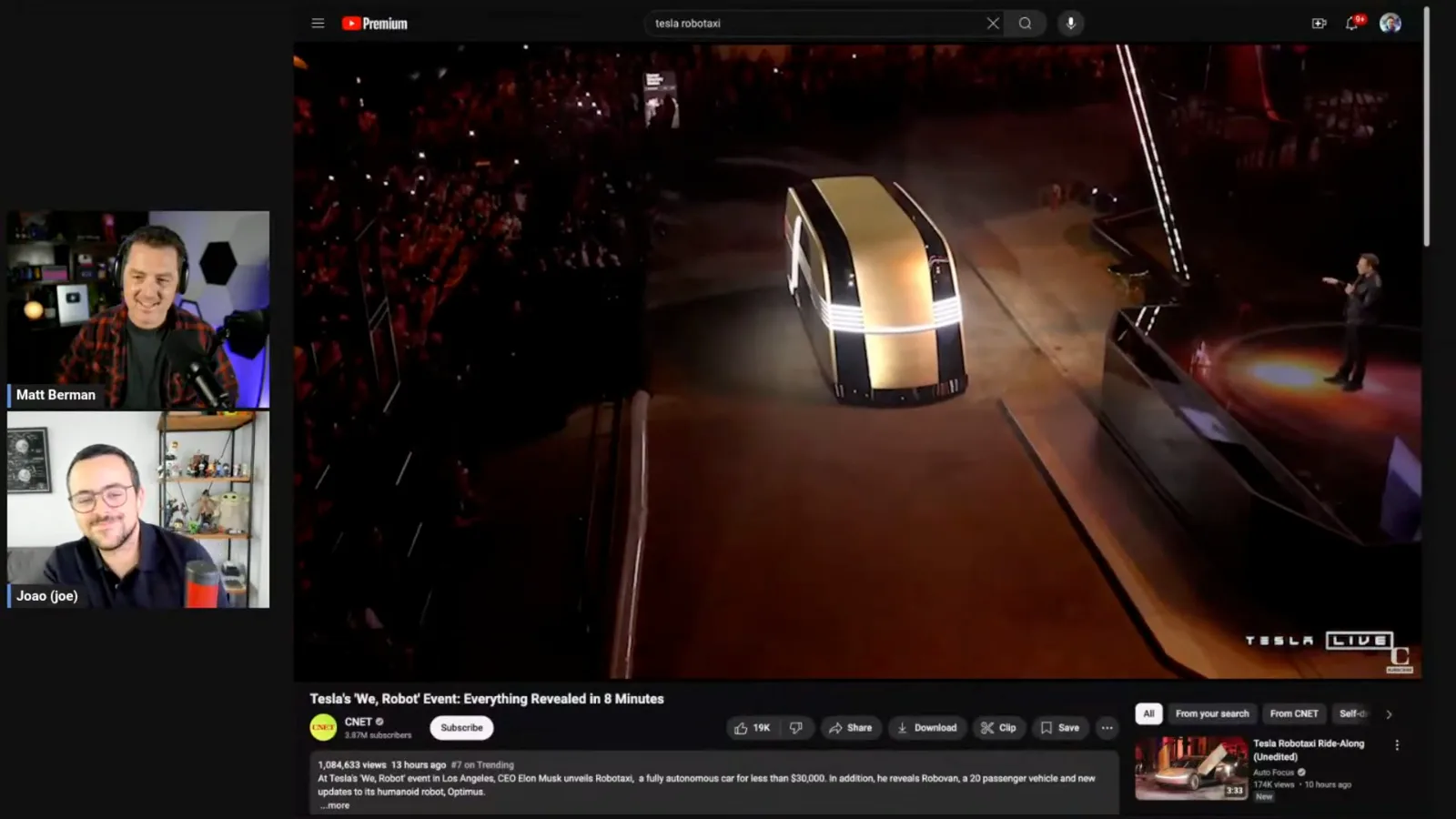
Moura suggests that a company could eventually use a vehicle of that size to move employees. Berman considers whether a bidirectional design would make maneuvering easier, though the displayed vehicle appears to have a front and rear. They are exploring possible use cases rather than describing an available service.
Berman pulls up images of Art Deco trains to illustrate the visual comparison. Both speakers say they appreciate the boldness of the Robovan design, even if viewers differ on whether they like its appearance.
They note Tesla’s share price fell after the event and speculate about how investors respond to ambitious long-term projects. Berman says he sees large potential opportunities in robotics, inference and autonomous transport; that is his opinion, not an established valuation or investment recommendation.
The video turns to Optimus, Tesla’s humanoid robot. Musk says robotics can reuse techniques from autonomous vehicles, and Berman recalls that an earlier Tesla presentation featured a person in a robot costume. Moura imagines a household robot taking over chores, conditional on the system achieving the capabilities described.
Berman speculates about a future of abundance if advanced AI and robotics develop safely and deliver the capabilities he imagines. Moura shares his optimism. Their discussion is a vision of a possible future, not evidence that household robots or an economy of abundance have already arrived.
The event footage shows Optimus interacting with attendees. Musk predicts an eventual price of roughly $20,000–$30,000 at scale; the speakers acknowledge that initial versions could be much more expensive. A long-term price prediction is not a current retail price.
The proposed tasks include serving drinks and household chores. Berman is less certain about Musk’s suggestion that a robot might look after children. The demonstration and future claims do not establish that a robot is safe or capable of unsupervised childcare.
Moura asks whether the event robots were autonomous or remotely controlled; Berman guesses they were not teleoperated but says he does not know. Later, Tesla Optimus engineer Milan Kovac [said the robots had human assistance to some extent](https://www.axios.com/2024/10/17/elon-musk-tesla-optimus-humanoid-robot). The event interactions therefore should not be treated as proof of fully autonomous performance.
The speakers watch examples of waving, playing rock-paper-scissors and serving drinks, and react to how humanlike the interactions appear. What they see is an event demonstration; it does not reveal how much of each interaction came from autonomous control versus human assistance.
CrewAI and enterprise agents
Moura describes the framework, the enterprise beta, common workflows and anticipated user interface.
With most of the hour spent on Tesla, Berman turns to CrewAI and questions from the audience. He asks why someone should use it. Moura says he created the framework after building agents separately and encountering repeated boilerplate and difficulty coordinating more of them.
Berman recounts meeting Moura through a mutual contact and being impressed by how much functionality he built in a short time. He says he asked to invest early. The account is personal endorsement from an investor, not an independent evaluation of CrewAI against other tools.
Moura introduces himself, explaining that he uses “Joe” because his Portuguese name can be difficult for some English speakers. He describes more than 20 years in technology and prior engineering leadership at Clearbit, which was acquired by HubSpot, before he left to start CrewAI.
Moura describes CrewAI as both a company and an open-source Python framework for building and orchestrating agents. He says the framework supports delegation, different models, custom tools, testing and training. The company also offers an enterprise version; he reports that about 150 companies were in its closed beta at the time.
Berman describes agents as language models connected to tools, memory and, potentially, other agents. He considers this useful for automating work. Moura says enterprise deployment adds requirements beyond the model itself, including evaluations, monitoring, compliance, permissions, access controls and cloud deployment choices.
Asked about a user interface, Moura says the team is already trying one internally and expects to release it later in October 2024. He says it is not simply a conventional node-based editor. This was a schedule and product description from the founder at the time, not verification of the later release.
On use cases, Moura mentions internal automation, marketing, sales, research and coding. He says a large consulting company is using agents to refactor and test legacy SAP code, though the customer and results are not independently documented in the conversation.
Moura identifies a recurring workflow across examples: collect information through research, analyze it, sometimes summarize it, and report the result in a format such as JSON or Markdown. The pattern is a way to organize tasks; it does not mean every agent application needs multiple agents.
Testing models in a crew
Moura shows a task-specific comparison of OpenAI models. The limited demonstration is not a general benchmark.
For the last question, Berman asks about OpenAI’s o1 models. Moura shares a CrewAI test screen comparing models on a particular crew and task, with quality scores, execution times and token totals. He does not supply a complete methodology or an independent benchmark, so the results should not be generalized to all tasks.
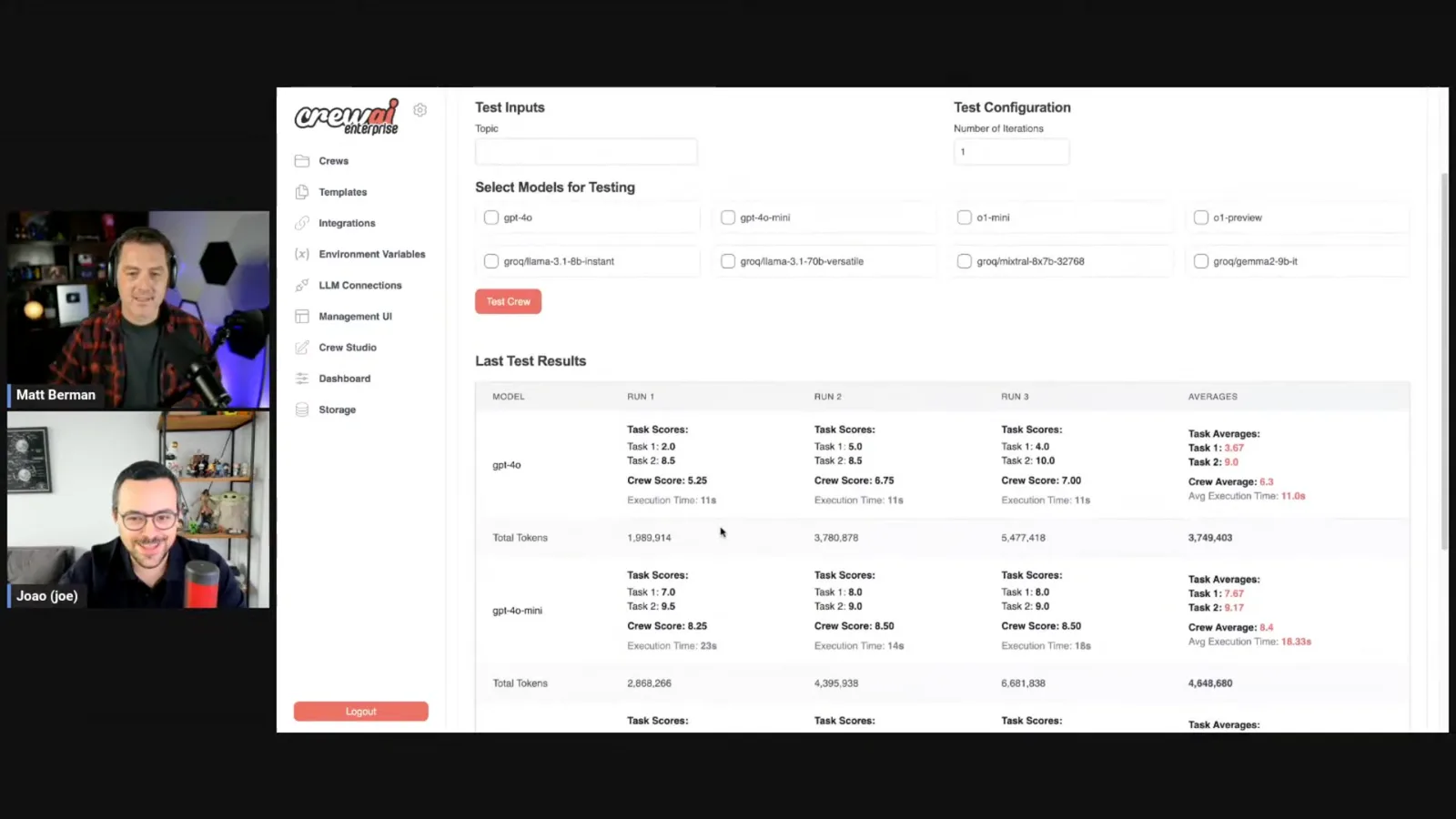
In the displayed test, the GPT-4o row shows an average quality score of 6.3 and an average execution time of 11 seconds; GPT-4o mini shows 8.4 and about 18 seconds. Moura says smaller models may sometimes need extra iterations. These are his interpretation and measurements for the shown configuration, not universal rankings.
The screen shows o1-mini at 8.4 and about 21 seconds on average. Moura reports o1-preview scoring 9.4 while taking about 74 seconds and more tokens. He considers GPT-4o mini the better trade-off for this example, illustrating why a team should test quality, latency and cost together for its own workflow.
Moura says he would like to compare additional models in a future demonstration. Berman thanks him and closes the stream after the audience questions.
같은 채널의 다른 글
 34:21EN
 Matthew Berman· 2026년 10월 27일Matthew Berman Examines Anthropic’s IPO Filing, AI Growth and GovernanceMatthew Berman, Sam Altman · Forward FutureThe presenter reviews the S-1’s financial metrics, compute strategy and voting structure while questioning the tension between rapid AI development and safety.
 0:36ENMatthew Berman· 2026년 10월 25일Kimi K3.1 and a Rubik’s Cube Solver DemonstrationMatthew Berman · Forward FutureMatthew Berman shows a scrambled virtual cube being solved and gives the Kimi K3.1 test a favorable assessment.
 25:50ENMatthew Berman· 2026년 10월 24일Kimi K3.1 Pro Tested: Strong 3D Demos, Uneven Results and Competitive PricingMatthew Berman · Forward FutureMatthew Berman tests the open-weight model on coding, 3D rendering and visual explanations, then compares benchmark results and prices.
 32:20ENMatthew Berman· 2026년 10월 23일Who Is Local AI For? The Costs, Trade-offs and a Hybrid FutureMatthew Berman · Forward FutureMatthew Berman weighs data control and independence against hardware cost, setup complexity and inference speed.
 1:03:37ENMatthew Berman· 2026년 10월 23일Matthew Berman’s Team Tests Kimi K3.1 on Animation, Games, and ChartsMatthew Berman, Alex, Brian · Forward FutureA live team AMA turns into an informal test of Kimi K3.1, from personal-agent workflows to motion graphics, a browser game, and a benchmark chart.
 0:53ENMatthew Berman· 2026년 10월 22일Sam Altman on AI and the Discovery of New KnowledgeSam Altman · OpenAIAltman expects progress in mathematical discovery to extend to biology, materials and energy.