30초 요약
Matthew Berman describes a visit to a Cerebras data center, where he says the company’s CEO showed him its infrastructure. He highlights the size of the wafer-scale chip, on-chip memory, liquid cooling and protection against tornadoes; the short video does not supply a benchmark for its speed claims.
- 1A dinner-plate-sized chipBerman introduces the Cerebras wafer-scale engine and says its size enables memory to be kept on the chip.
- 2A facility built around the chipsHe describes two large halls with hundreds of racks in each.
- 3Cooling and condensationA closed-loop system cools the racks, while water is warmed when necessary to avoid moisture forming on the chip.
- 4Concrete protectionBerman says the facility is protected with substantial concrete because of the region’s tornadoes.
핵심 정리
- Cerebras builds a wafer-scale chip that Berman says is about 50 times the size of a conventional chip.
- Berman attributes reduced latency to the chip’s on-chip memory and claims up to 30 times the speed of a traditional chip, without specifying a benchmark.
- The facility’s racks use a closed-loop cooling system, with water temperature controlled to prevent condensation.
- Berman says the building uses substantial concrete protection against tornadoes.
챕터별로 다듬은 전문 읽기
The wafer-scale engine
Berman introduces the large Cerebras chip and its on-chip memory. He makes a speed comparison without giving the benchmark or workload.
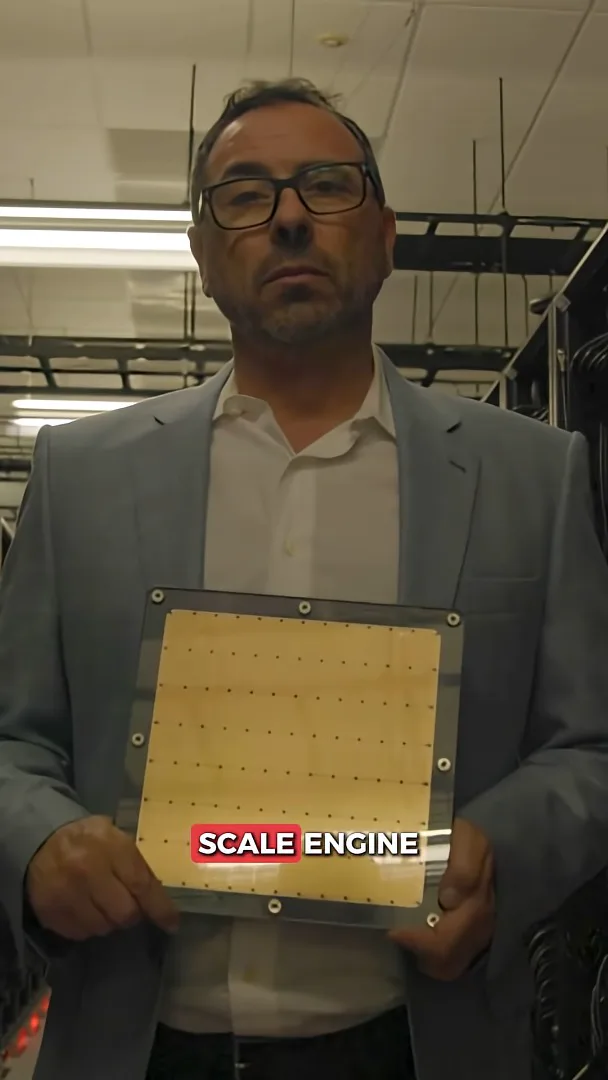
What if a chip were the size of a dinner plate? That is the idea behind the Cerebras wafer-scale engine. I say it is about 50 times the size of a traditional chip, with enough space to keep memory on the chip itself and reduce latency. I also say it can be up to 30 times faster than a traditional chip; this brief video does not specify the workload, baseline or benchmark behind that comparison.
Inside the data center
Berman describes a tour of the Oklahoma City facility and its two halls of racks. He highlights their AI inference use.
Cerebras built a data center in Oklahoma City to house these systems, and its CEO took me on a tour. I describe two enormous halls, each containing hundreds of racks equipped with wafer-scale chips for AI inference. The video calls the infrastructure extremely fast, but does not establish a universal ranking against other data centers.
Cooling and protection
He describes the closed-loop cooling system and the need to avoid condensation. The building also uses concrete protection against tornadoes.
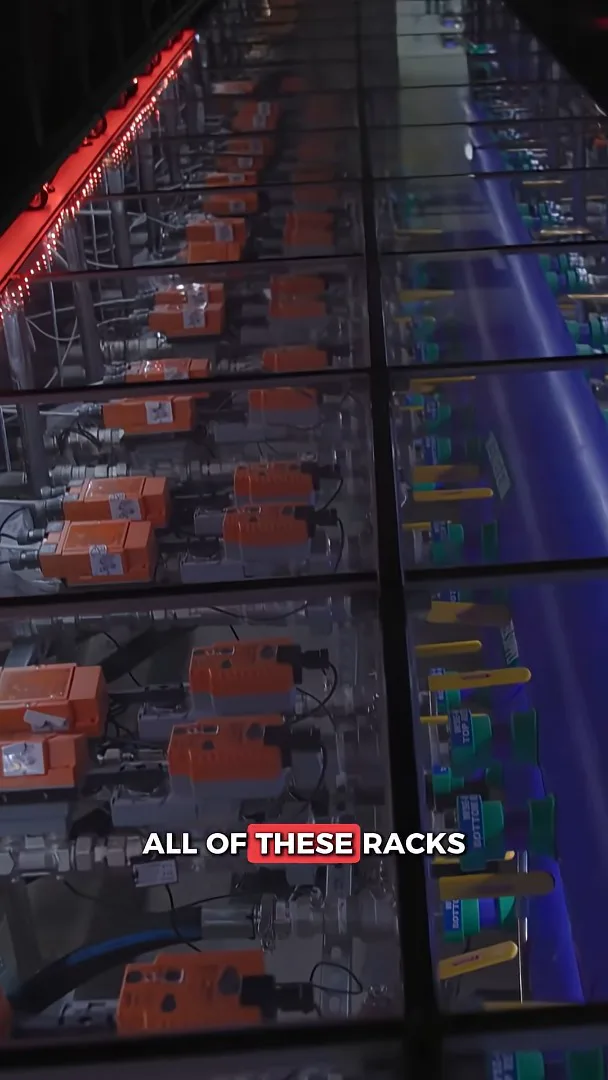
The racks are connected to a closed-loop cooling system. I say the system cools each chip to 70 degrees, although the clip does not state the temperature scale. The water must sometimes be warmed because the cooler could otherwise lead to moisture forming on the chip. The facility also uses substantial concrete protection against tornadoes common in the area.
같은 채널의 다른 글
 34:21EN
 Matthew Berman· 2026년 10월 27일Matthew Berman Examines Anthropic’s IPO Filing, AI Growth and GovernanceMatthew Berman, Sam Altman · Forward FutureThe presenter reviews the S-1’s financial metrics, compute strategy and voting structure while questioning the tension between rapid AI development and safety.
 0:36ENMatthew Berman· 2026년 10월 25일Kimi K3.1 and a Rubik’s Cube Solver DemonstrationMatthew Berman · Forward FutureMatthew Berman shows a scrambled virtual cube being solved and gives the Kimi K3.1 test a favorable assessment.
 25:50ENMatthew Berman· 2026년 10월 24일Kimi K3.1 Pro Tested: Strong 3D Demos, Uneven Results and Competitive PricingMatthew Berman · Forward FutureMatthew Berman tests the open-weight model on coding, 3D rendering and visual explanations, then compares benchmark results and prices.
 32:20ENMatthew Berman· 2026년 10월 23일Who Is Local AI For? The Costs, Trade-offs and a Hybrid FutureMatthew Berman · Forward FutureMatthew Berman weighs data control and independence against hardware cost, setup complexity and inference speed.
 1:03:37ENMatthew Berman· 2026년 10월 23일Matthew Berman’s Team Tests Kimi K3.1 on Animation, Games, and ChartsMatthew Berman, Alex, Brian · Forward FutureA live team AMA turns into an informal test of Kimi K3.1, from personal-agent workflows to motion graphics, a browser game, and a benchmark chart.
 0:53ENMatthew Berman· 2026년 10월 22일Sam Altman on AI and the Discovery of New KnowledgeSam Altman · OpenAIAltman expects progress in mathematical discovery to extend to biology, materials and energy.