30초 요약
In May 2025, Matthew Berman reviews OpenAI’s announcement that its nonprofit would continue to control the business while its existing for-profit arm would become a public benefit corporation. He connects the plan to funding demands, legal disputes with Elon Musk, and the company’s stated mission. OpenAI subsequently announced completion of the recapitalization in October 2025: the nonprofit OpenAI Foundation controls OpenAI Group PBC. Berman’s views about motives and regulatory pressure are interpretations, not established findings.
- 1Nonprofit control continuesOpenAI said the nonprofit would retain control, while its existing for-profit LLC would become a public benefit corporation and the nonprofit would hold a substantial equity stake.
- 2The earlier structureFounded as a nonprofit in 2015, OpenAI established a capped-profit entity in 2019 to attract investment. The parties dispute aspects of the founding history and their later conflict.
- 3Musk’s offer and litigationBerman interprets Musk’s $97.4 billion bid as an attempt to complicate restructuring; that motive and the legal allegations are contested, not proven.
- 4Compute and demandBerman highlights OpenAI’s argument that training and serving AI requires very large amounts of capital, alongside its claim that demand exceeded available capacity.
- 5Regulatory discussionsOpenAI said it reached its decision after hearing from civic leaders and consulting California and Delaware attorneys general. Berman speculates about the influence of outside pressure.
- 6A later outcomeThe May plan was subsequently implemented: OpenAI announced completion of its recapitalization in October 2025, with nonprofit control retained.
핵심 정리
- OpenAI already had a nonprofit-controlled for-profit arm when it announced its revised plan in May 2025.
- The announced plan kept nonprofit control while converting the for-profit entity to a public benefit corporation with a conventional equity structure.
- OpenAI cited the cost of compute, demand for its services and the desire to fund its mission as reasons to change its structure.
- Musk challenged OpenAI’s proposed restructuring; Berman’s account of the parties’ motives is opinion.
- In October 2025 OpenAI said it completed the recapitalization, with the nonprofit controlling OpenAI Group PBC.
챕터별로 다듬은 전문 읽기
What OpenAI announced
Berman explains the May 2025 plan for continued nonprofit control and a for-profit public benefit corporation. He offers his assessment of the structure.
OpenAI has announced a change to its restructuring plans. In May 2025, the board said its nonprofit would continue to oversee and control the organization, while the existing for-profit arm would become a public benefit corporation, or PBC. OpenAI was not abandoning all for-profit activity: that arm had operated under nonprofit control since 2019.
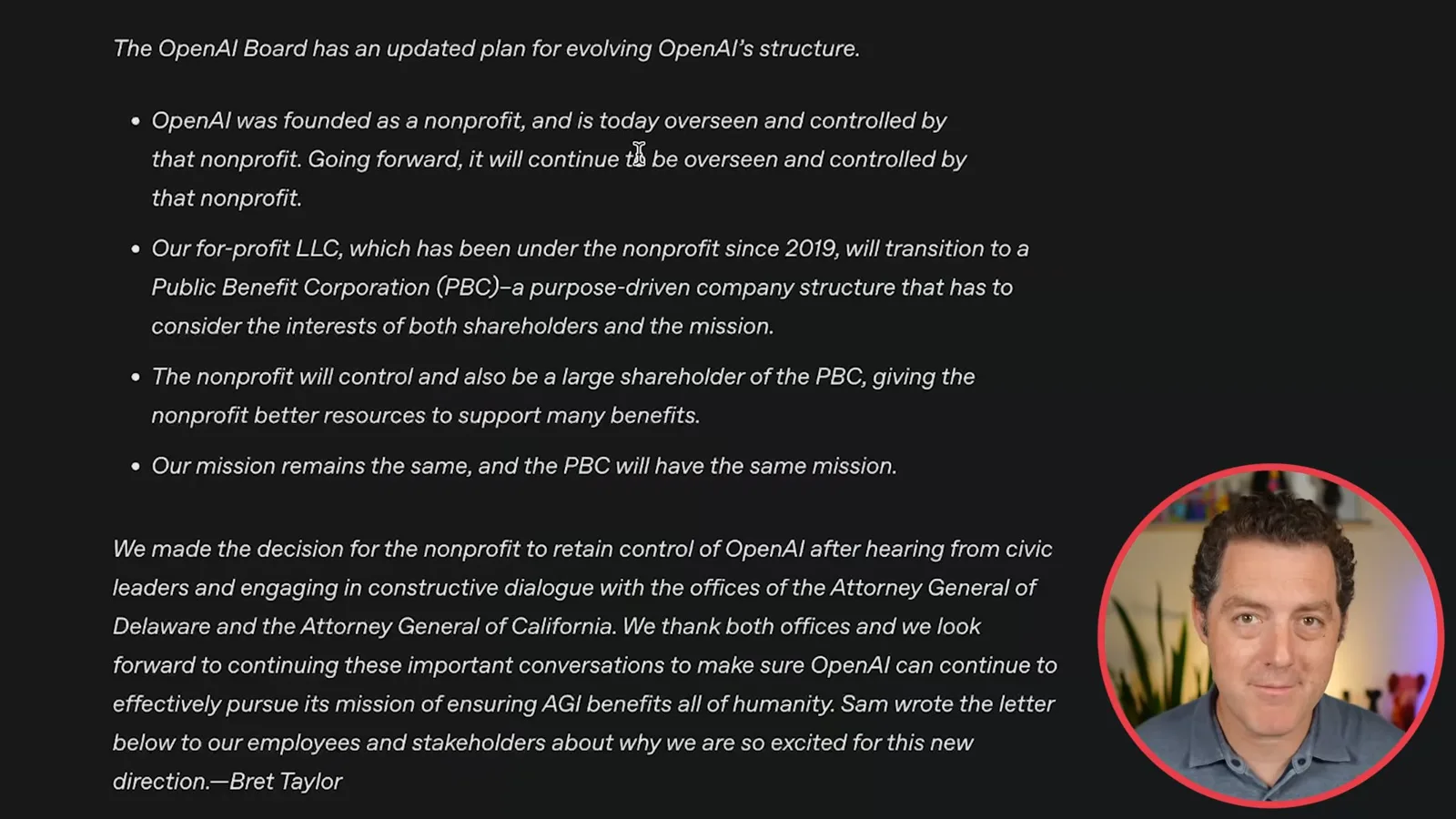
I think the PBC structure is a good change. OpenAI described it as a purpose-driven business that must consider shareholders and its mission. The nonprofit would control the PBC and hold a significant equity stake; both entities would retain the mission of ensuring artificial general intelligence benefits humanity.
Patagonia is an example that comes to mind when I think of a purpose-driven company. I mention its environmental mission and B Corp certification. A benefit corporation is a legal form, while B Corp certification is a separate designation; the two should not be treated as interchangeable.
History and conflict with Musk
He recounts OpenAI’s early nonprofit origins, the creation of a capped-profit arm and the disputes surrounding restructuring. His account of motives and the legal conflict should be read as commentary.
For background, OpenAI began as a nonprofit in 2015. Berman recounts disagreements over control and fundraising involving co-founder Elon Musk and other leaders, followed by Musk’s departure. The details and motivations of the early dispute are contested, so his account is not a settled factual finding.
In 2019 OpenAI created a capped-profit structure to attract investment and compensate employees while the nonprofit retained control. Berman says the later restructuring proposals prompted concern about the use and valuation of assets developed under nonprofit stewardship.
Musk sued OpenAI over its direction; after withdrawing an initial case he filed another that also raised antitrust claims. OpenAI later filed counterclaims. Berman believes both sides acted in bad faith, but those accusations and his characterization of their motives are disputed.
A Musk-led group offered $97.4 billion for the nonprofit’s assets. I suspect the bid was intended to complicate a restructuring by establishing a high valuation, rather than to complete an acquisition. That is my interpretation; an offer does not itself establish the nonprofit’s legal value or require an internal transaction at that price.
Altman’s letter and the cost of AI
Berman reviews the company’s stated mission, compute costs and demand for its products. He discusses why OpenAI says it needs substantial capital.
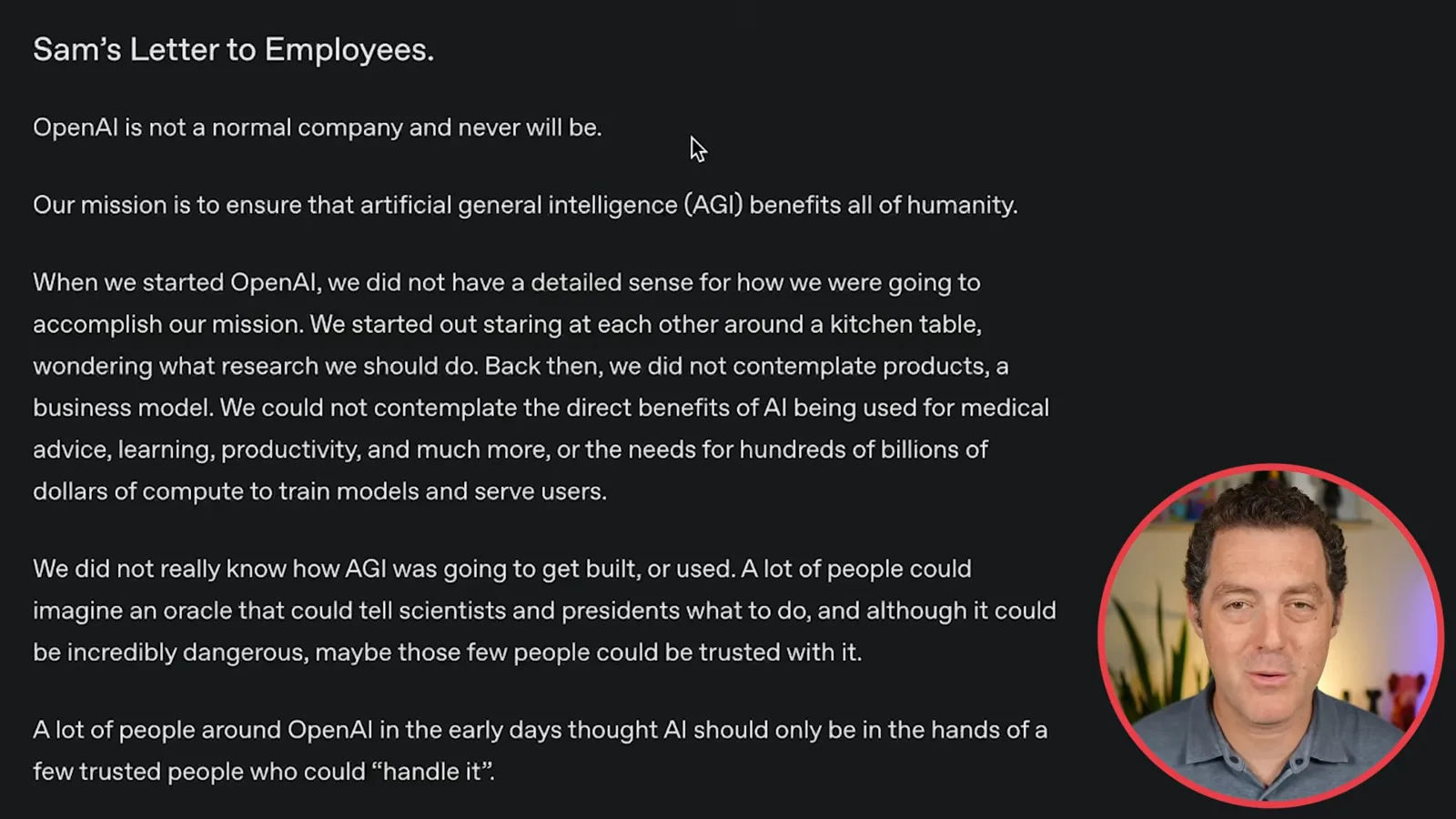
The board’s announcement includes a letter from Sam Altman describing OpenAI’s mission and its early uncertainty about how to pursue it. Altman says the founders did not initially anticipate today’s products, business model or the enormous computing resources needed to train models and serve users.
To me, the cost of compute is central to the desire for a more conventional fundraising structure. A nonprofit receives donations without ordinary investor returns, whereas a for-profit business can offer investors a financial stake. OpenAI’s earlier capped-profit arm already allowed investment, so the choice was not simply between donations and a first for-profit entity.
Altman also says demand for OpenAI’s services exceeded available capacity, requiring usage limits and slower systems. I connect this to Jevons paradox: if a unit of intelligence becomes cheaper, applications that once cost too much may become viable, increasing overall demand rather than necessarily reducing it.
OpenAI says its goals include making services broadly available, building a highly effective nonprofit and delivering beneficial AGI. Altman estimates that the required resources run into hundreds of billions of dollars and could eventually reach trillions. I see data centers, chips, training and inference as the major costs behind such ambitions; those amounts are projections, not guaranteed spending.
The letter also emphasizes safety and alignment. I wonder how the nonprofit will acquire and use its resources and how the revised arrangement will affect investors; the video does not establish those details.
Public pressure and the revised plan
OpenAI cites discussions with civic leaders and state attorneys general. Berman considers Musk’s objections and returns to the nonprofit-controlled PBC plan.
OpenAI says it decided to retain nonprofit control after listening to civic leaders and discussing the issue with the California and Delaware attorneys general. I suspect the pressure was consequential and wonder how much influence Musk had, but the announcement does not establish that he caused the decision.
I question a restructuring that could move value developed with charitable support into a more conventional commercial structure. The applicable tax and valuation rules are complex: nonprofit status does not mean every receipt or activity is automatically untaxed, and the video does not establish that a transaction would be unlawful.
Musk has publicly criticized OpenAI’s departure from his vision of an open nonprofit and called its restructuring a scam. Those are his allegations, not adjudicated facts. He also competes with OpenAI through xAI, and OpenAI has accused him of seeking to obstruct a competitor.
The company still needs ways to attract researchers and engineers and finance the chips and infrastructure used to train and run models. OpenAI’s revised May plan therefore kept nonprofit control while changing the existing for-profit entity into a PBC with a simpler stock-based capital structure. OpenAI described this as a restructuring, not a sale.
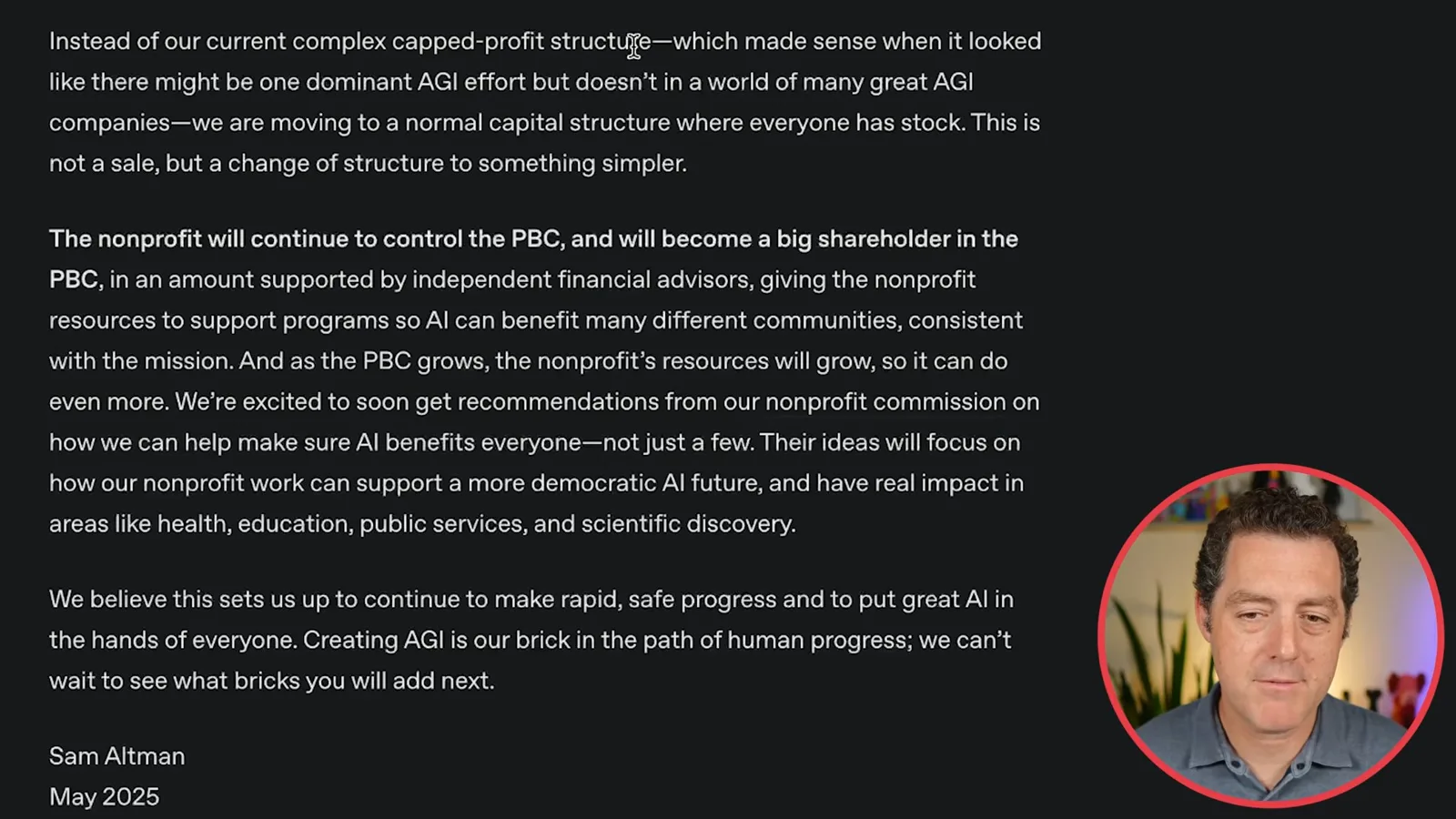
OpenAI said the nonprofit would become a substantial shareholder and that both organizations would pursue the same mission. In a later update, the company announced that the recapitalization was completed on October 28, 2025: the OpenAI Foundation controls the for-profit OpenAI Group PBC. See [the May announcement](https://openai.com/index/evolving-our-structure/) and [the October update](https://openai.com/index/built-to-benefit-everyone/).
같은 채널의 다른 글
 34:21EN
 Matthew Berman· 2026년 10월 27일Matthew Berman Examines Anthropic’s IPO Filing, AI Growth and GovernanceMatthew Berman, Sam Altman · Forward FutureThe presenter reviews the S-1’s financial metrics, compute strategy and voting structure while questioning the tension between rapid AI development and safety.
 0:26ENMatthew Berman· 2026년 10월 25일Sam Altman on Human Values and Problem-Solving in an AI WorldSam Altman · OpenAIIn a short interview excerpt, Altman considers the enjoyment of solving hard problems and the human role in interpreting results.
 0:36ENMatthew Berman· 2026년 10월 25일Kimi K3.1 and a Rubik’s Cube Solver DemonstrationMatthew Berman · Forward FutureMatthew Berman shows a scrambled virtual cube being solved and gives the Kimi K3.1 test a favorable assessment.
 0:21ENMatthew Berman· 2026년 10월 24일An AI-Generated Kimi Benchmark Chart Used Invented ScoresMatthew Berman · Forward FutureMatthew Berman asks for a graph of Kimi K3.1 Pro benchmarks, then discovers that the displayed figures are illustrative placeholders.
 25:50ENMatthew Berman· 2026년 10월 24일Kimi K3.1 Pro Tested: Strong 3D Demos, Uneven Results and Competitive PricingMatthew Berman · Forward FutureMatthew Berman tests the open-weight model on coding, 3D rendering and visual explanations, then compares benchmark results and prices.
 32:20ENMatthew Berman· 2026년 10월 23일Who Is Local AI For? The Costs, Trade-offs and a Hybrid FutureMatthew Berman · Forward FutureMatthew Berman weighs data control and independence against hardware cost, setup complexity and inference speed.