30초 요약
In April 2025, Matthew Berman tests Gemini 2.5 Flash by recreating visual demos from video, generating simulations and games, and answering detailed questions about a 16-minute cartoon. He finds the model fast and comparatively inexpensive, while observing failures, missing features and cases that required several iterations. These informal demonstrations reflect specific prompts and conditions, not a systematic benchmark; his comparisons and cost judgments are observations from the time of recording.
- 1Recreating a visualization from videoBerman uploads a video and asks Flash for a single-file Three.js recreation, supplying an import method to avoid earlier loading errors.
- 2The Rubik’s Cube testThe model produces a rotatable cube, but the scramble and solve buttons do not work in this first attempt.
- 3Bloodstream simulationA virus-and-cell demo runs in Canvas, although some requested virus types are not implemented and local loading required a correction.
- 4Iterating on a Galton boardBerman supplies both a text prompt and a reference video, then fixes missing bins and disappearing balls through follow-up prompts.
- 5Questions about a long videoFlash answers questions about lions, a sign and a barrel in a 16-minute Popeye cartoon; the test involves only a few selected questions.
핵심 정리
- Gemini 2.5 Flash recreated an interactive 3D visualization from a video, but Berman supplied a specific Three.js import workaround.
- The Rubik’s Cube looked convincing but its scramble and solve functions failed in Berman’s first attempt.
- Some demos required iteration, and a functioning interface did not mean every requested feature worked.
- A 16-minute cartoon used roughly 283,000 tokens in Berman’s test and produced correct answers to several visual questions.
- Berman sees a speed and cost advantage for Flash while judging Pro stronger on several examples.
챕터별로 다듬은 전문 읽기
Recreating a 3D animation from video
Berman uploads a video and asks Flash to generate a Three.js recreation. He explains a recurring import problem and compares Flash with Pro.
I start with a 3D demo originally made with Gemini 2.5 Pro. Rather than give Flash the original code, I download the demo video, upload it to Google AI Studio and ask it to recreate what it sees using Three.js in a single HTML file. The video uses about 10,500 tokens out of the one-million-token context shown.
Flash thinks for 22 seconds and produces code and an explanation. The result is not identical to the source, but I can rotate the shape, change its colors, zoom into its component squares and switch among a cube, pyramid, torus, plane and waveform.
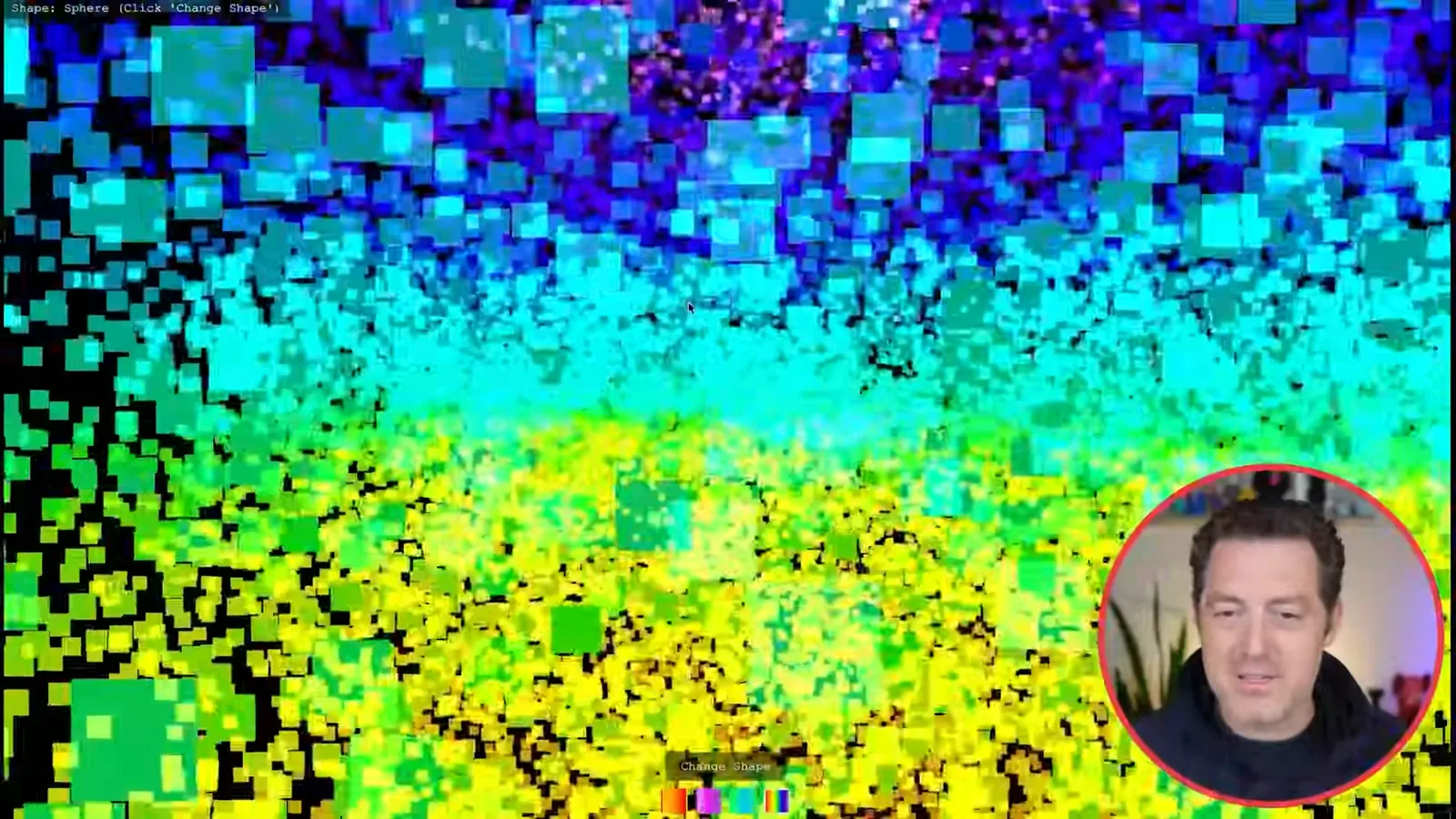
I included a specific import-map instruction because my earlier Flash generations repeatedly failed to load Three.js locally. With that instruction, these examples work for me; Gemini 2.5 Pro did not have the same problem in my earlier tests. Pro is slower and more expensive, but I find it more capable.
Rubik’s Cube and virus simulation
The cube looks plausible but key functions fail. The bloodstream simulation runs in Canvas with some requested features missing.
Next I reuse my Rubik’s Cube prompt. Gemini 2.5 Pro had produced a working version on its first try in my earlier test. Flash renders a cube that can be resized and rotated, with mostly correct colors, although the image appears darker than expected.
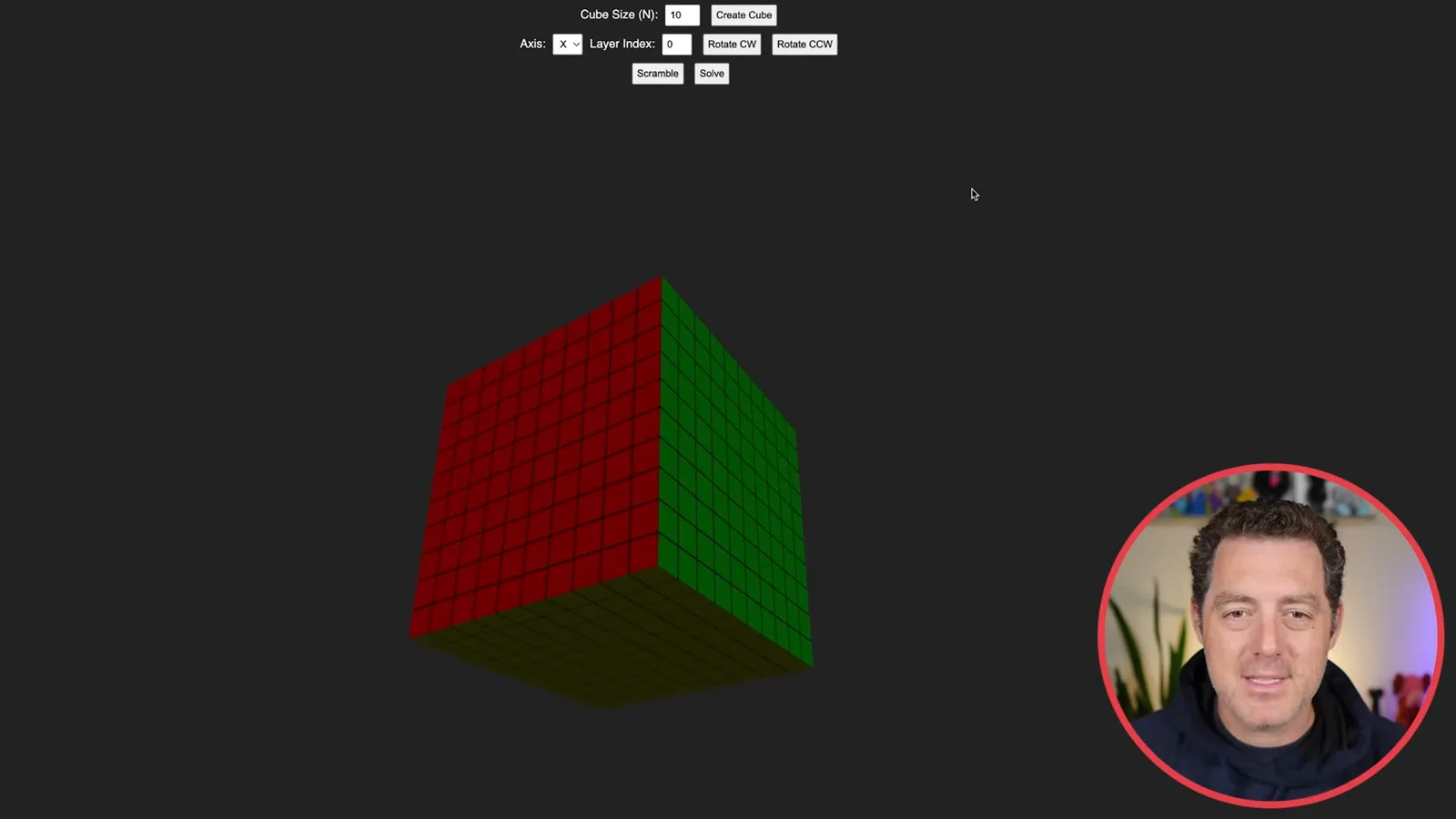
The first Flash attempt fails when I press scramble: the console reports that a scramble completed but records zero moves. Rotating individual faces also produces awkward color changes. I suspect a few more prompts might fix it, but I leave this example at the initial attempt.
The solve button also does not visibly solve the cube and produces an error. That matters because a convincing visualization is not the same as a working simulation. I contrast this with the earlier Pro result, which I say handled the task on its first try.
For the next test I ask for an interactive Three.js bloodstream containing red and white blood cells and viruses, with controls for virus counts, replication, white-cell behavior, flow and simulation speed. I use a single HTML file to make the demo easy to run.
The generated code produces a local Three.js reference error, which I copy back to the model; it did run in Canvas. I count it as a one-try pass in Canvas, while noting that the local setup required a correction.
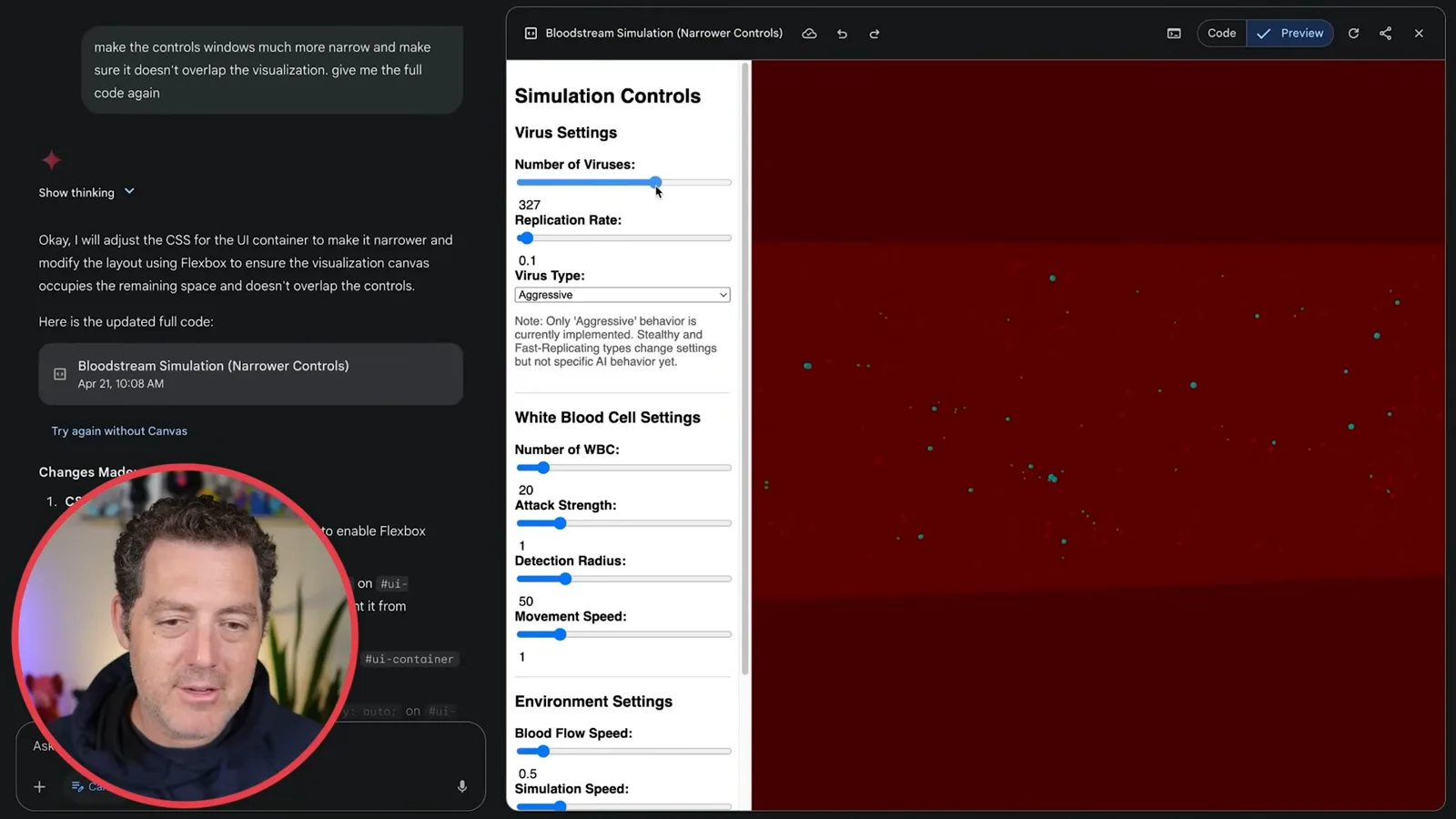
The simulation lets me rotate and zoom into the bloodstream, increase the number of viruses, and adjust replication and white-cell settings. Two requested virus types, stealthy and fast-replicating, are labeled as not implemented, so the result does not satisfy every part of the prompt.
Duck sorting and tower defense
A reference video guides a Python duck-sorting game, which needs several iterations. A producer’s tower-defense demo follows a detailed prompt.
I find a duck-sorting game on X and upload its video to Flash, asking for a single-file Python version with procedural animation. The objective is to move a white sorter and group ducks by color. The interface reports one token for the video, a figure I question rather than accept as the actual cost.
The model identifies elements such as the title and game screens, cursor-following movement, collisions and boundaries. I go back and forth several times to adjust settings before reaching a version that looks much like the video, although the sprites are less polished.
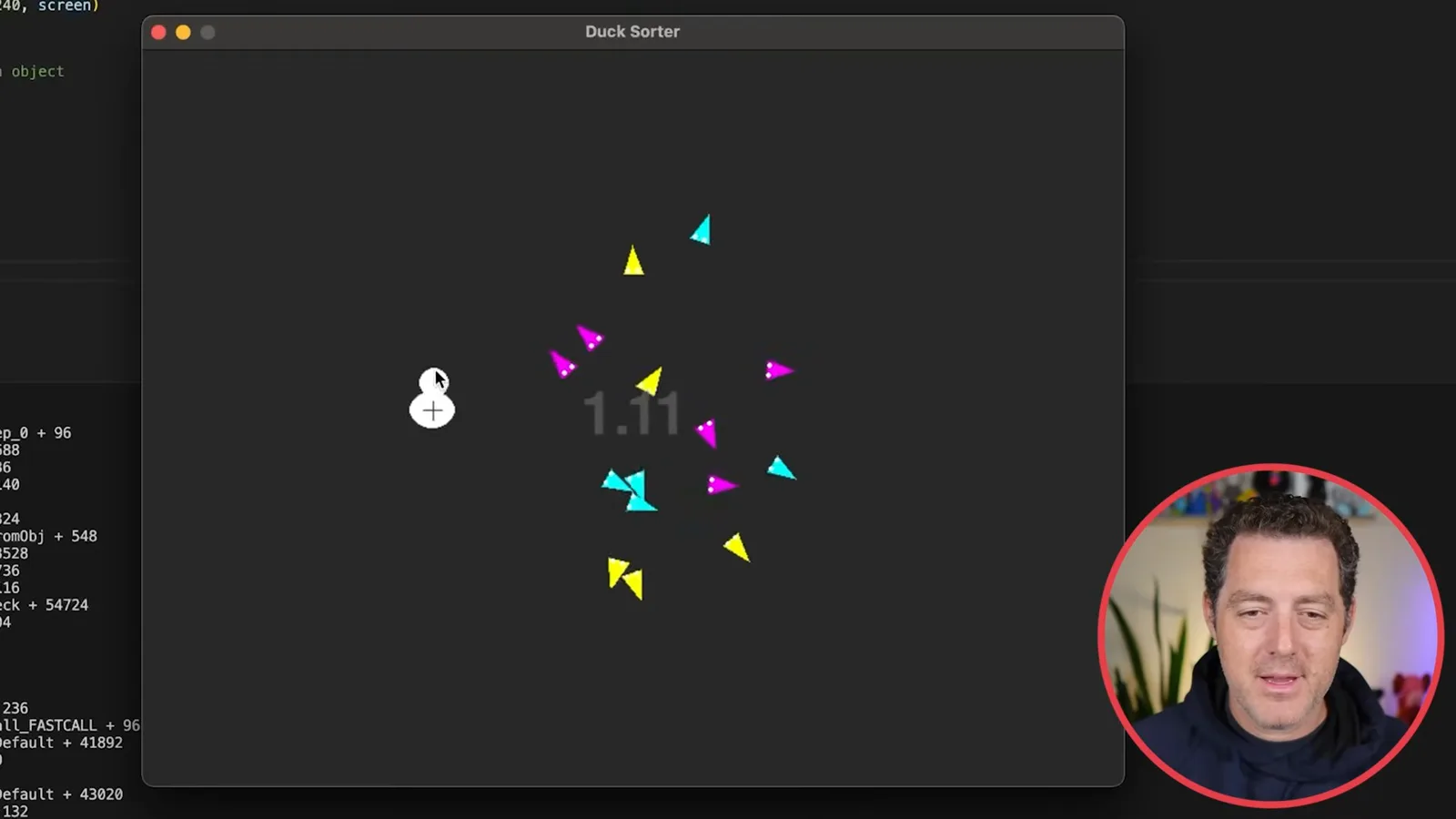
In the resulting game I can herd colored ducks and see them bounce back from the edge. The win condition had worked in an earlier iteration but is broken in the version shown. Despite that flaw, I find the video-based recreation impressive.
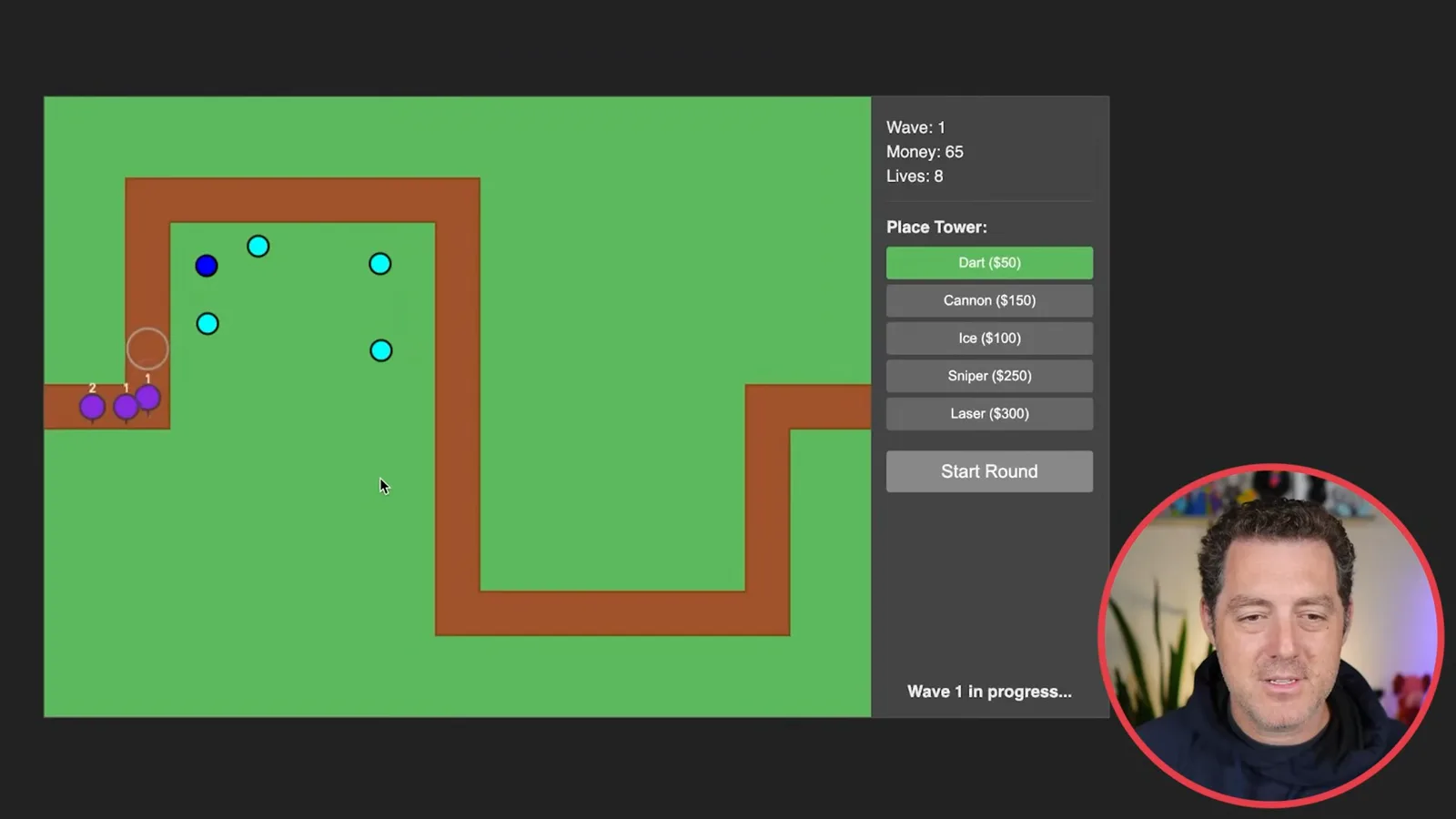
Producer Alex makes a tower-defense game using a detailed HTML5 Canvas prompt. He starts with a basic idea and uses an LLM to help write the specification, which calls for waves of color-coded balloons and five tower types with different attack behaviors.
The demonstration places ice towers to slow enemies and dart towers to attack them. The first wave completes, the player earns money and the next wave has stronger enemies. The basic mechanics work, though the presentation could use more visuals and complexity.
Snake and two-player Tetris
Berman compares Flash and Pro on a visually elaborate Snake game. The Tetris simulation requires several rounds of refinement in Flash.
I revisit a complex Snake prompt requesting Pygame, visual effects, different food types and a human-versus-AI contest. My earlier Pro version had striking visuals; Flash also produces a playable game with two snakes and effects, but I find it less visually impressive.
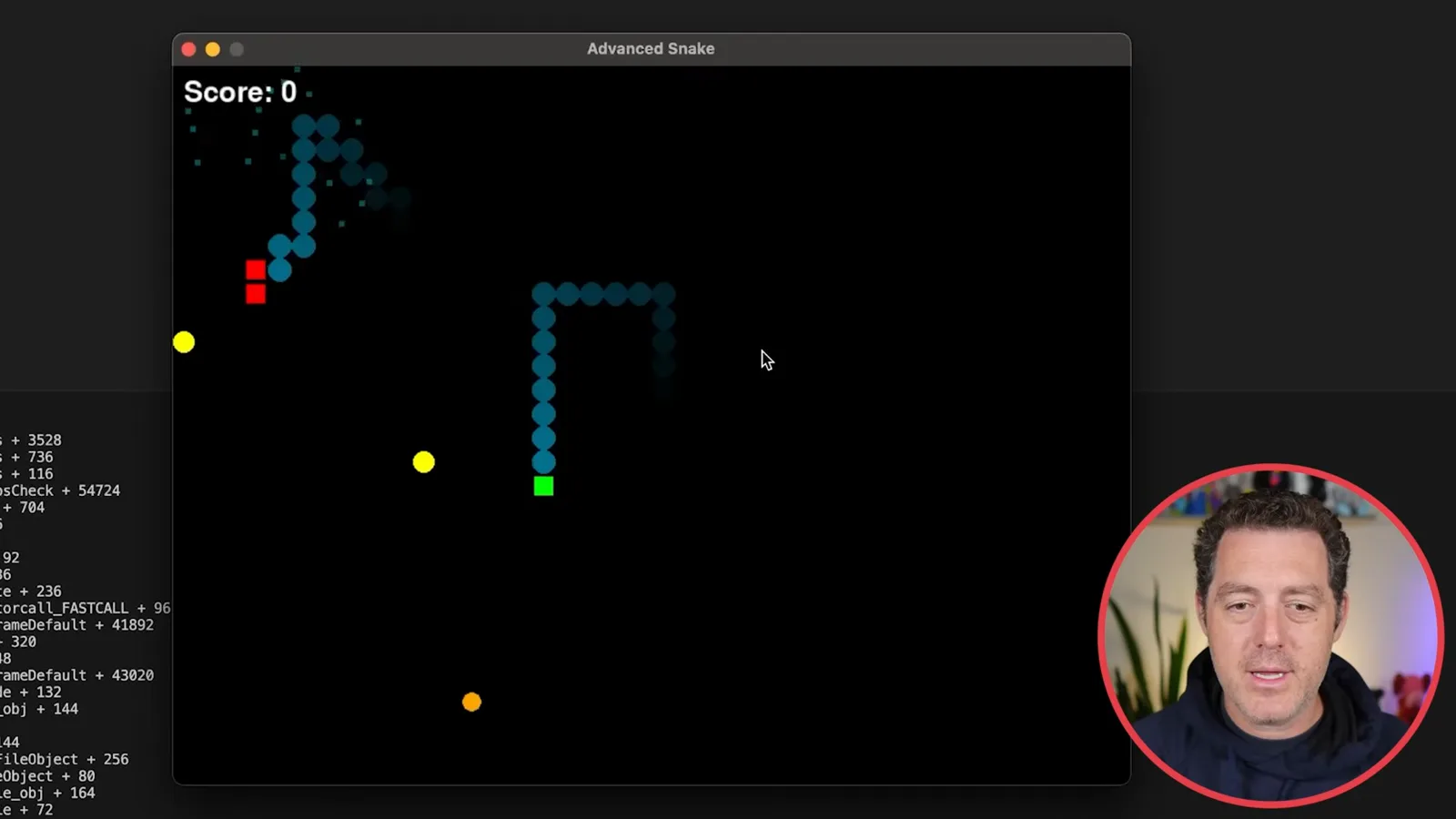
The Flash Snake program is 677 lines of code. I observe that both Gemini 2.5 models have produced unusually long outputs in my experience; this is my anecdotal comparison with other models, not a controlled test or a universal line limit. Flash is faster and cheaper in my assessment, so the right choice depends on the task.
Alex also asks Flash for two AI players competing at Tetris in Python and Pygame. The specification includes 10-by-20 grids, no hold or T-spins, and garbage lines sent to the other player when lines are cleared. The rule-based players aim to minimize holes and stack height while clearing lines.
Alex makes many follow-up changes before the Flash version works as shown. Both AI players place pieces and exchange garbage lines until one reaches the top. This final result is the product of iteration, not a single-shot generation.
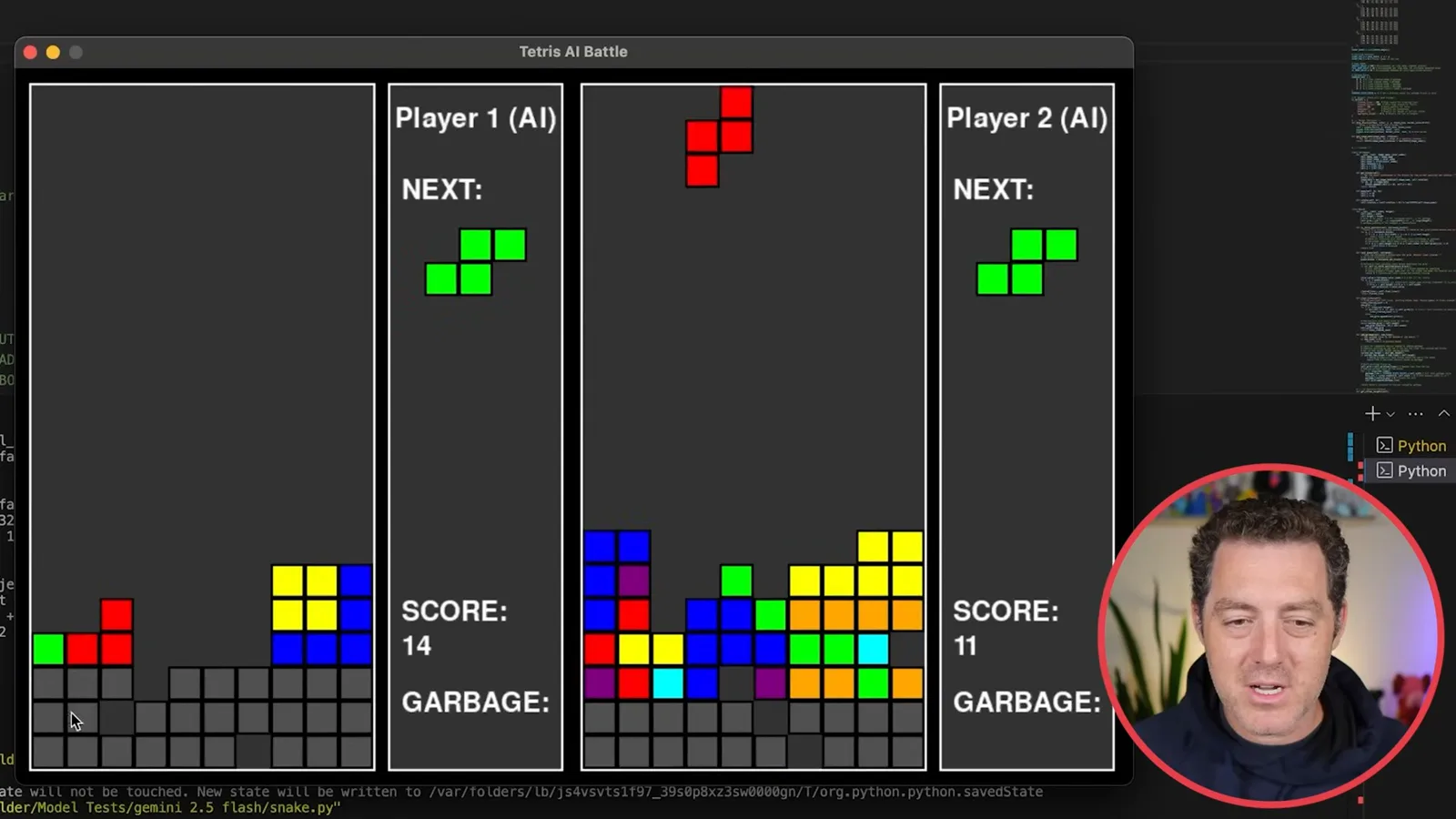
I then run the same Tetris prompt on Pro once. The result looks and behaves very similarly, including a display cutoff that also appeared in the Flash version; it runs more slowly in my demonstration. The comparison uses different numbers of iterations and is not a controlled benchmark.
Galton board and drawing app
A text prompt and reference video are used to create a probability simulation. A separate Python program simulates a drawing app.
Another creator shares a Galton board example: balls fall through a field of pegs and collect in bins, tending toward a bell-shaped distribution. I take the creator’s text prompt and also download the reference video to show Flash what the result should look like.
The first result is missing the bottom cups. I upload the video and ask the model to add them, then iterate on the width and fix another problem in which balls disappear after landing. I am struck by how quickly Flash regenerates the code after feedback.
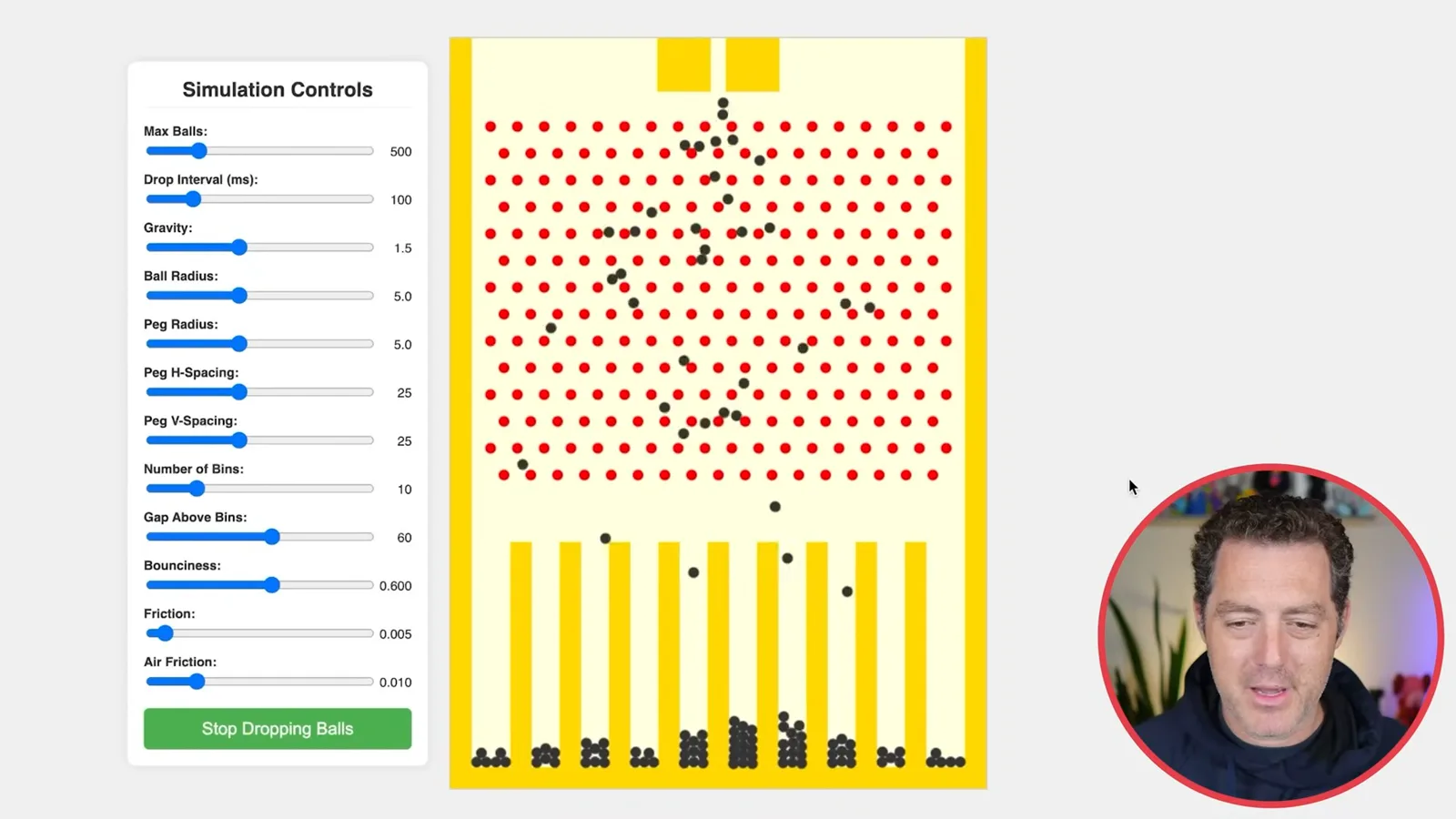
The finished simulation includes controls for the number and size of balls, drop interval, gravity, peg size and spacing, number of bins, bounce and friction. Some combinations cause balls to become stuck, and increasing the bin count runs out of space, so not every control behaves as intended.
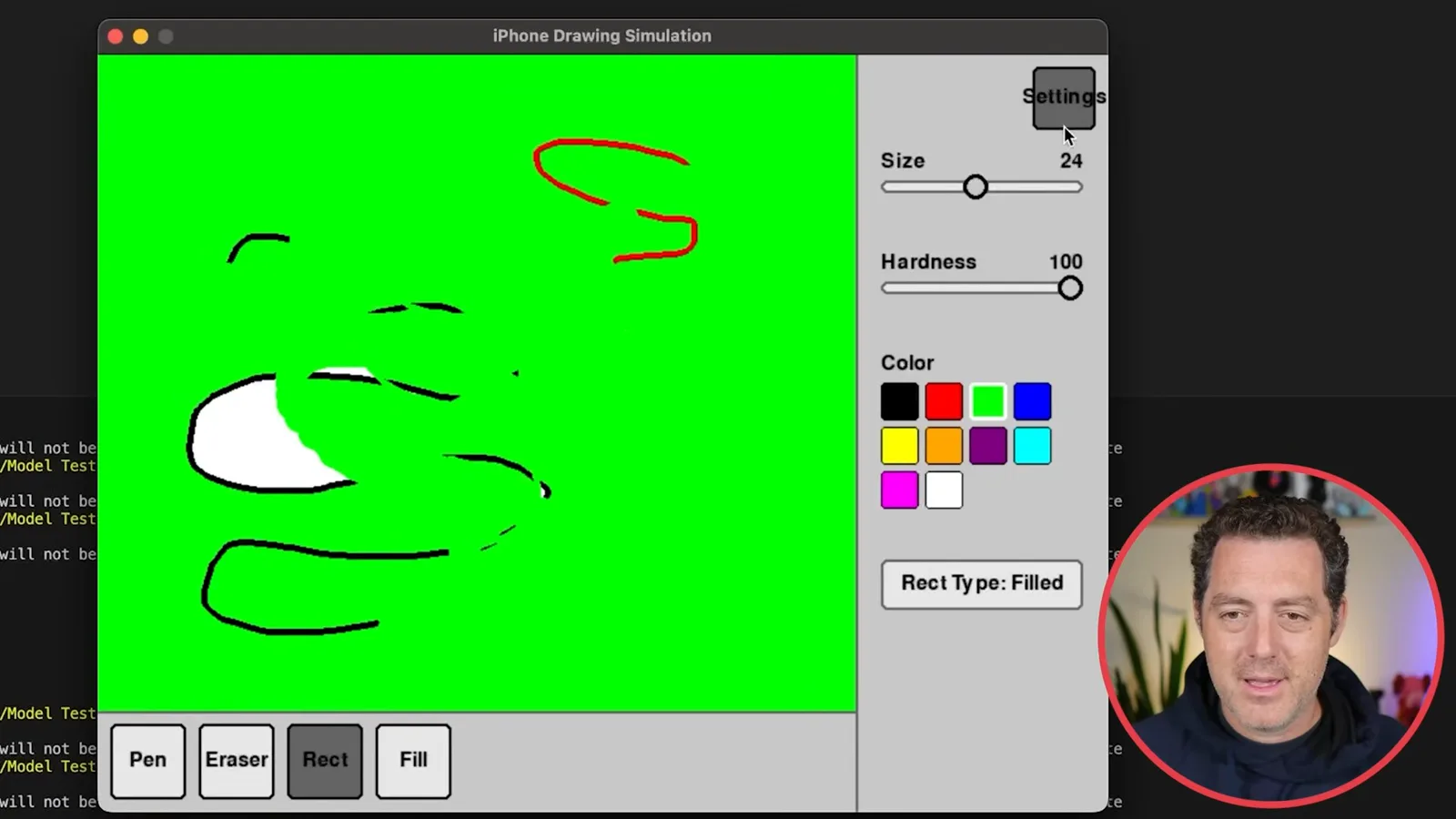
Alex’s next example is a drawing-app simulation. Although the discussion initially calls it an iPhone app, the prompt asks for a simulation and the output is a Python program. It offers pen settings, colors, an eraser, rectangles, fill and a way to save a PNG.
Understanding a 16-minute video
Berman asks Flash specific visual questions about a Popeye cartoon. He closes with a qualified comparison of Flash’s speed and cost against Pro.
For the final test I upload a 16-minute Popeye cartoon and ask detailed questions about visual moments. The upload uses approximately 283,000 tokens in the interface. I extrapolate that the million-token context could hold close to an hour, although the actual capacity depends on how video is processed.
I ask how many lions Popeye fights around the eight-minute mark. Flash answers two, and I check the video. It also identifies the text on a sign with two snakes near the beginning: “Isle of Sinbad — Beware,” along with the skull and crossbones.
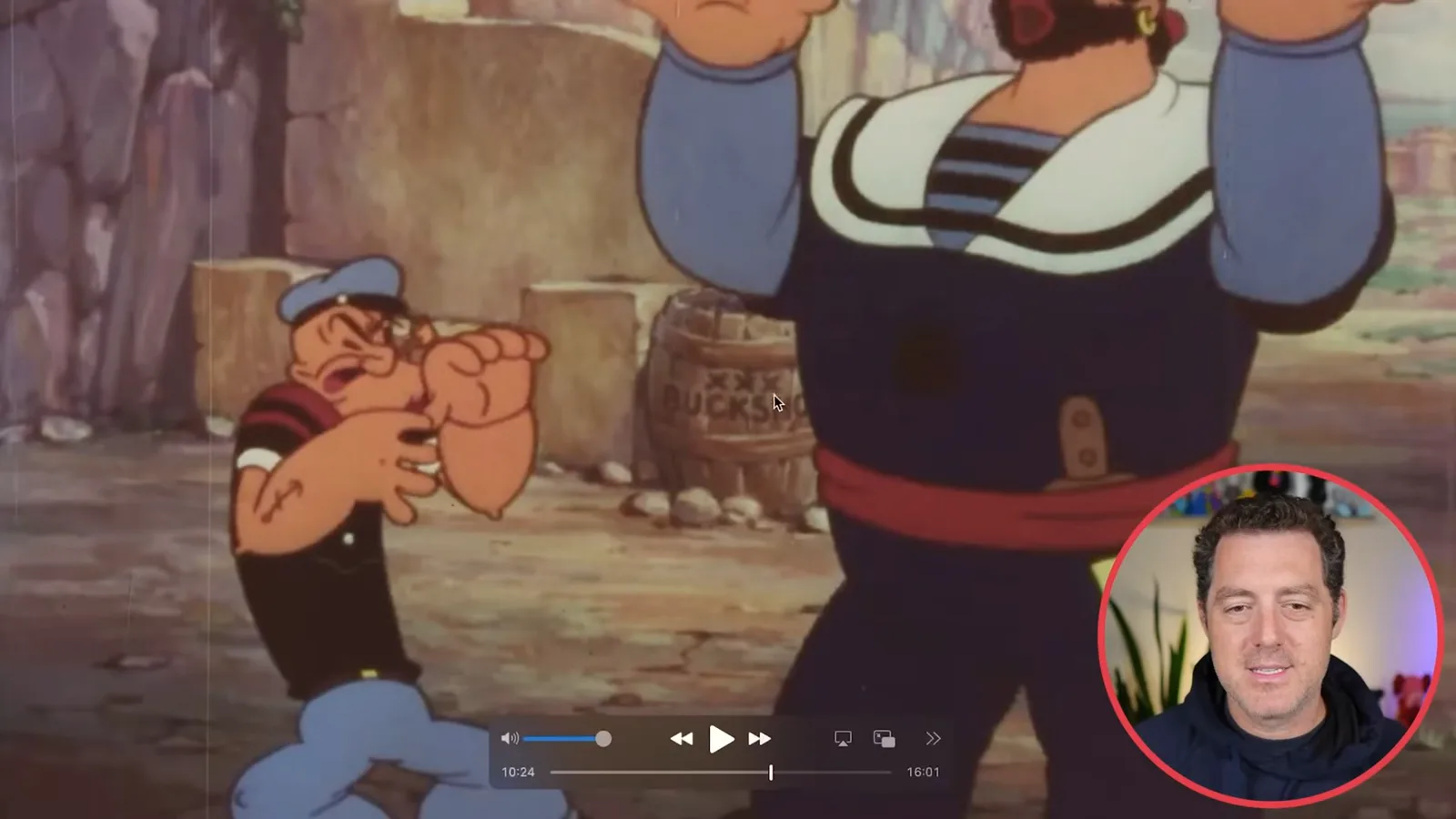
A harder question asks what is written on a barrel around ten minutes in. I check the footage, where the text is partly obscured for much of the scene, and find the answer includes “XXX” and “buckshot.” These examples show success on a few selected questions, not comprehensive video comprehension.
My conclusion is that Flash comes close to Pro on many of these examples while responding faster and costing less, though it is not as capable in every case. Many tasks do not need the most expensive frontier model, so I recommend choosing according to the actual job.
같은 채널의 다른 글
 34:21EN
 Matthew Berman· 2026년 10월 27일Matthew Berman Examines Anthropic’s IPO Filing, AI Growth and GovernanceMatthew Berman, Sam Altman · Forward FutureThe presenter reviews the S-1’s financial metrics, compute strategy and voting structure while questioning the tension between rapid AI development and safety.
 25:50ENMatthew Berman· 2026년 10월 24일Kimi K3.1 Pro Tested: Strong 3D Demos, Uneven Results and Competitive PricingMatthew Berman · Forward FutureMatthew Berman tests the open-weight model on coding, 3D rendering and visual explanations, then compares benchmark results and prices.
 32:20ENMatthew Berman· 2026년 10월 23일Who Is Local AI For? The Costs, Trade-offs and a Hybrid FutureMatthew Berman · Forward FutureMatthew Berman weighs data control and independence against hardware cost, setup complexity and inference speed.
 1:03:37ENMatthew Berman· 2026년 10월 23일Matthew Berman’s Team Tests Kimi K3.1 on Animation, Games, and ChartsMatthew Berman, Alex, Brian · Forward FutureA live team AMA turns into an informal test of Kimi K3.1, from personal-agent workflows to motion graphics, a browser game, and a benchmark chart.
 0:53ENMatthew Berman· 2026년 10월 22일Sam Altman on AI and the Discovery of New KnowledgeSam Altman · OpenAIAltman expects progress in mathematical discovery to extend to biology, materials and energy.
 0:22ENMatthew Berman· 2026년 10월 21일A Robot Bodyguard Video Shows Dramatic Rescue ScenariosMatthew Berman · Forward FutureMatthew Berman reacts to a short robot demonstration depicting fighting and vehicle-rescue scenarios.