30초 요약
Matthew Berman reviews ARK Invest’s 2024 analysis of a potential humanoid robotics market, including household labor, manufacturing productivity and differences between large and small firms. ARK models roughly $24 trillion in possible revenues if robots can operate at scale. The figures are scenario estimates based on assumptions, not current market size or assured outcomes. A full replacement of US manufacturing workers is explicitly described by ARK as unlikely, and its robot-provider revenue estimate assumes a 50% take rate.
- 1Potential marketARK models around $24 trillion in possible household and manufacturing revenues, contingent on deployment at scale.
- 2Household assumptionsThe estimate combines unpaid hours, population, wages and an assumed value of free time.
- 3Unlikely replacement scenarioARK models 5.9 million robots working twice the annual hours of human workers and assumes a 50% provider take rate.
- 4Price and productivityIts net-present-value model relates robot prices to the productivity uplift needed for economic viability.
- 5Size and specializationThe report contrasts large firms’ specialized automation with the potential value of general-purpose robots to small firms.
- 6Possible tailwindsARK points to supply-chain shocks, onshoring and labor shortages as potential drivers.
핵심 정리
- ARK’s roughly $24 trillion opportunity estimate depends on large-scale deployment and assumptions about household value and manufacturing productivity.
- Its household estimate uses 2.3 daily hours of unpaid work and values free time at half the weighted wage.
- The full-replacement manufacturing example is explicitly unlikely and assumes robots work twice the hours of people.
- ARK’s cost model estimates a little over 5% productivity uplift is needed at a $16,000 robot cost under its assumptions.
- The report argues flexible robots could benefit smaller manufacturers whose employees perform multiple tasks.
- Onshoring and labor shortages are proposed tailwinds, while the pace of capable AI and robot development remains uncertain.
챕터별로 다듬은 전문 읽기
ARK’s market thesis
Berman introduces the investment firm’s 2024 report and its $24 trillion opportunity estimate. He describes the household and manufacturing assumptions.
What might the economy look like if humanoid robots became widespread? I review ARK Invest’s September 2024 report, which considers household and manufacturing uses. ARK cites Elon Musk’s view that highly capable humanoids could expand the economy, but its own market figures depend on robots becoming capable and operating at scale.
ARK Invest, founded by Cathie Wood, invests in technologies it considers disruptive and publishes research openly. Its report discusses Tesla’s Optimus, Figure, Chinese robotics companies and Boston Dynamics in the context of a growing industry.
ARK estimates a potential $24 trillion in robot revenues, roughly split between household and manufacturing applications, if humanoids can operate at scale. This is a modeled opportunity, not current revenue or a guaranteed outcome. Possible household tasks include cleaning and dishes; manufacturing examples include factory work.
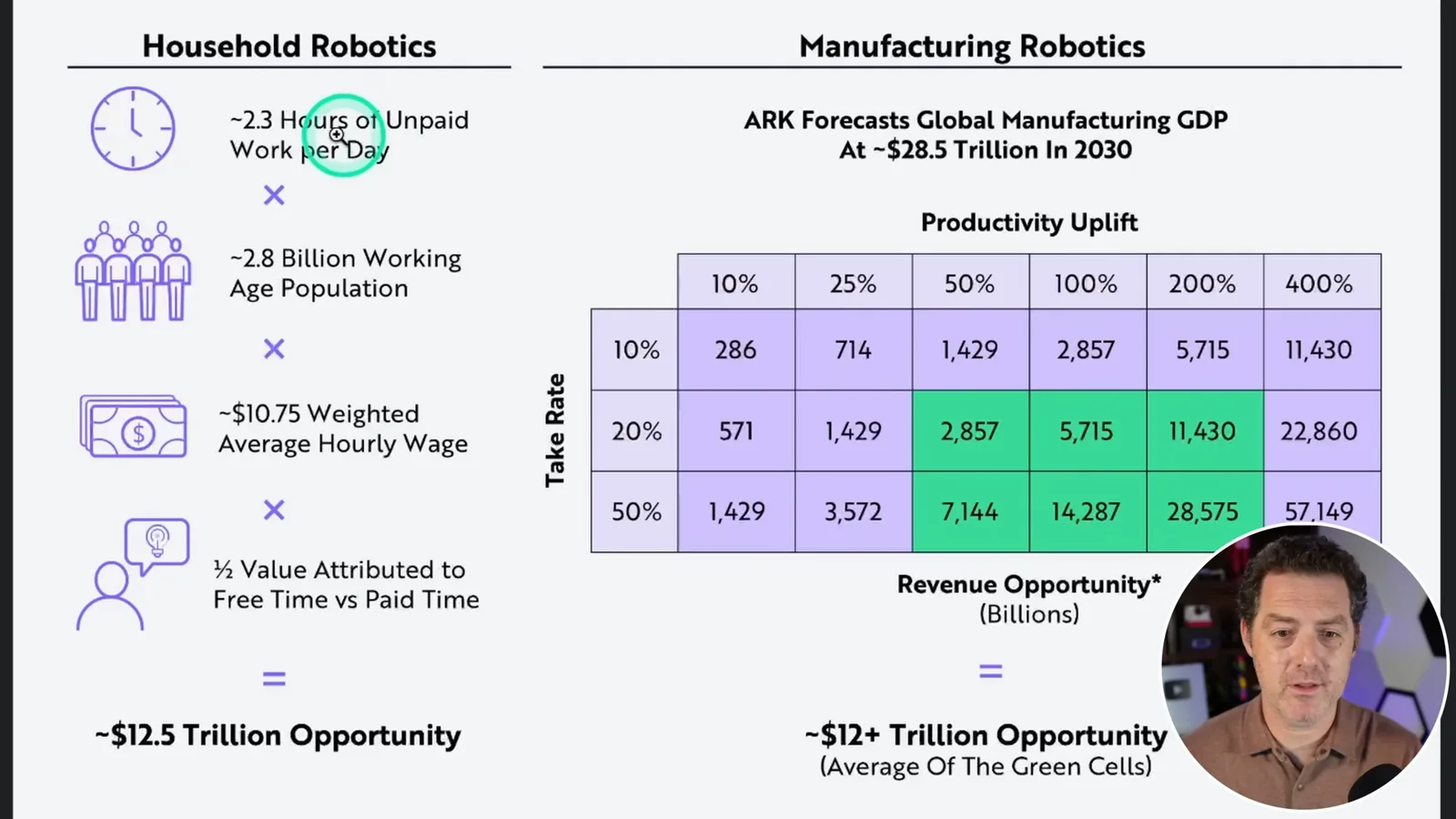
For the household estimate, ARK combines 2.3 hours of unpaid work per day, 2.8 billion working-age people, a $10.75 weighted average hourly wage and an assumption valuing free time at half of paid time. The resulting modeled opportunity is roughly $12.5 trillion. Its manufacturing estimate varies with productivity uplift and the share captured by robot providers.
Manufacturing scenarios and economics
ARK compares human labor with a hypothetical full robot replacement. It then models productivity thresholds at different robot prices.
ARK says US manufacturing employed nearly 12 million people who worked about 23 billion hours annually, received $785 billion in pay and produced $2.4 trillion in output. These are the report’s baseline figures, not measurements of robot production.
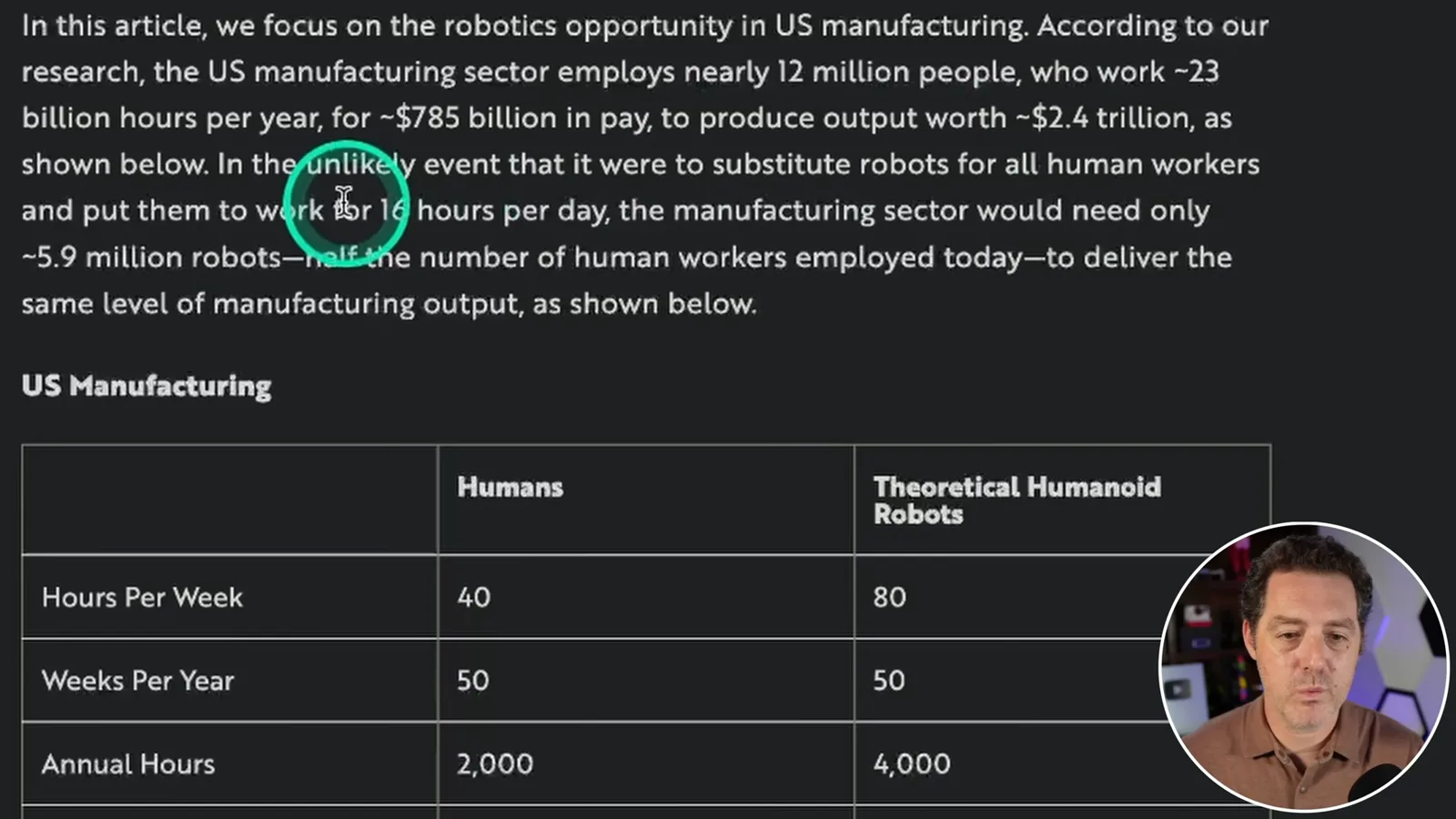
In a deliberately unlikely full-replacement scenario, ARK assumes robots work 80 hours a week for 50 weeks, versus 40 hours for humans. About 5.9 million robots could then supply the same total hours and output as 11.7 million workers, if equivalent productivity is assumed. The report puts robot-provider receipts at roughly $390 billion using a 50% take-rate assumption; this is a hypothetical calculation, not an observed payroll saving.
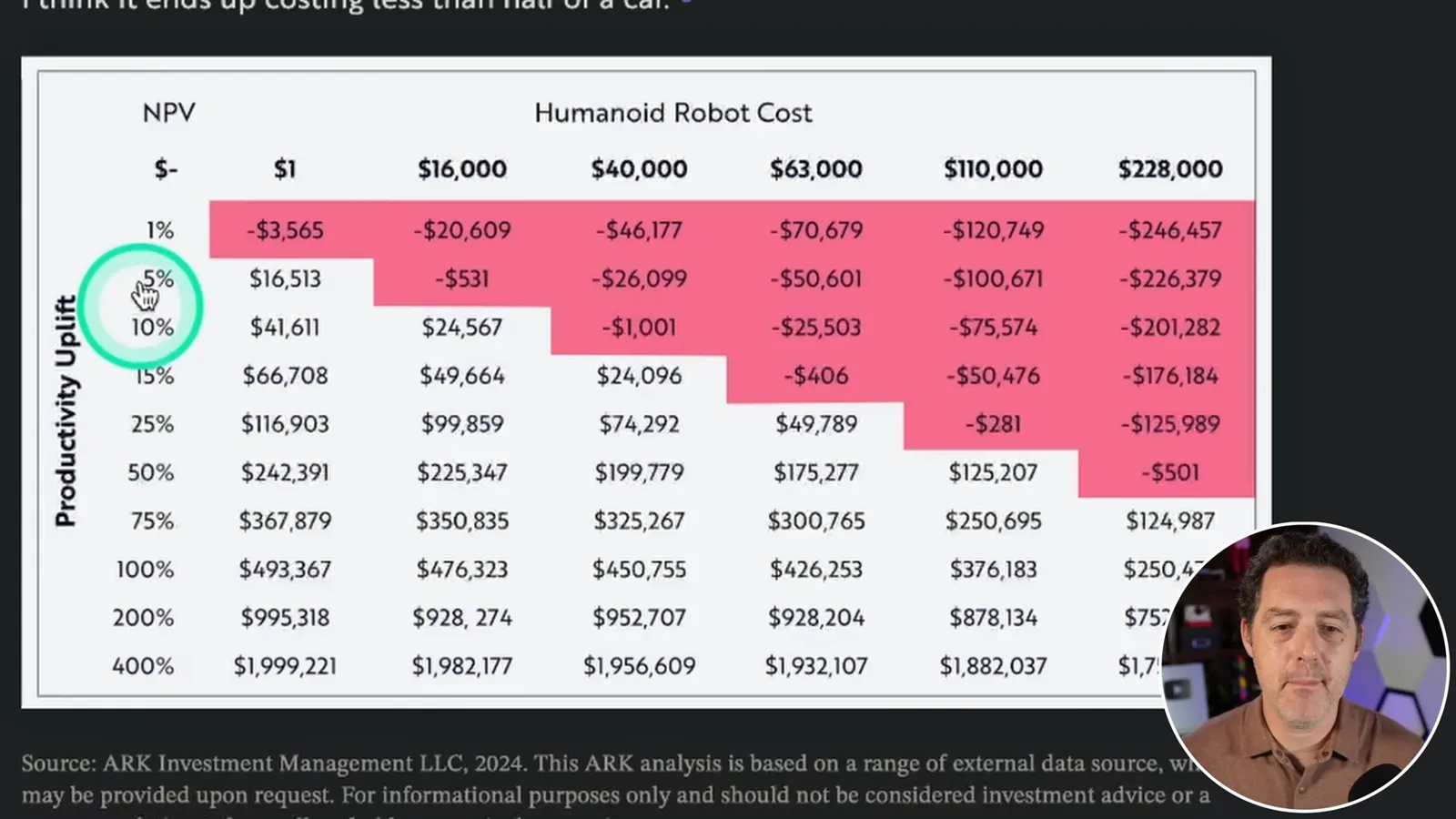
ARK considers a more likely early scenario in which humanoid robots are expensive and less capable than people. Its net-present-value model compares robot costs against productivity gains: at $16,000 per robot, it estimates that a little over a 5% productivity uplift would make the investment viable under its assumptions.
The chart shows higher robot prices require larger productivity gains. For example, the $40,000 column becomes positive at the 15% uplift row in the displayed model. I find that threshold promising, though whether actual robots achieve it depends on their capabilities and operating costs.
Company size and labor share
The report compares specialized large firms and less specialized small ones. Berman explains why general-purpose robots could appeal to smaller manufacturers.
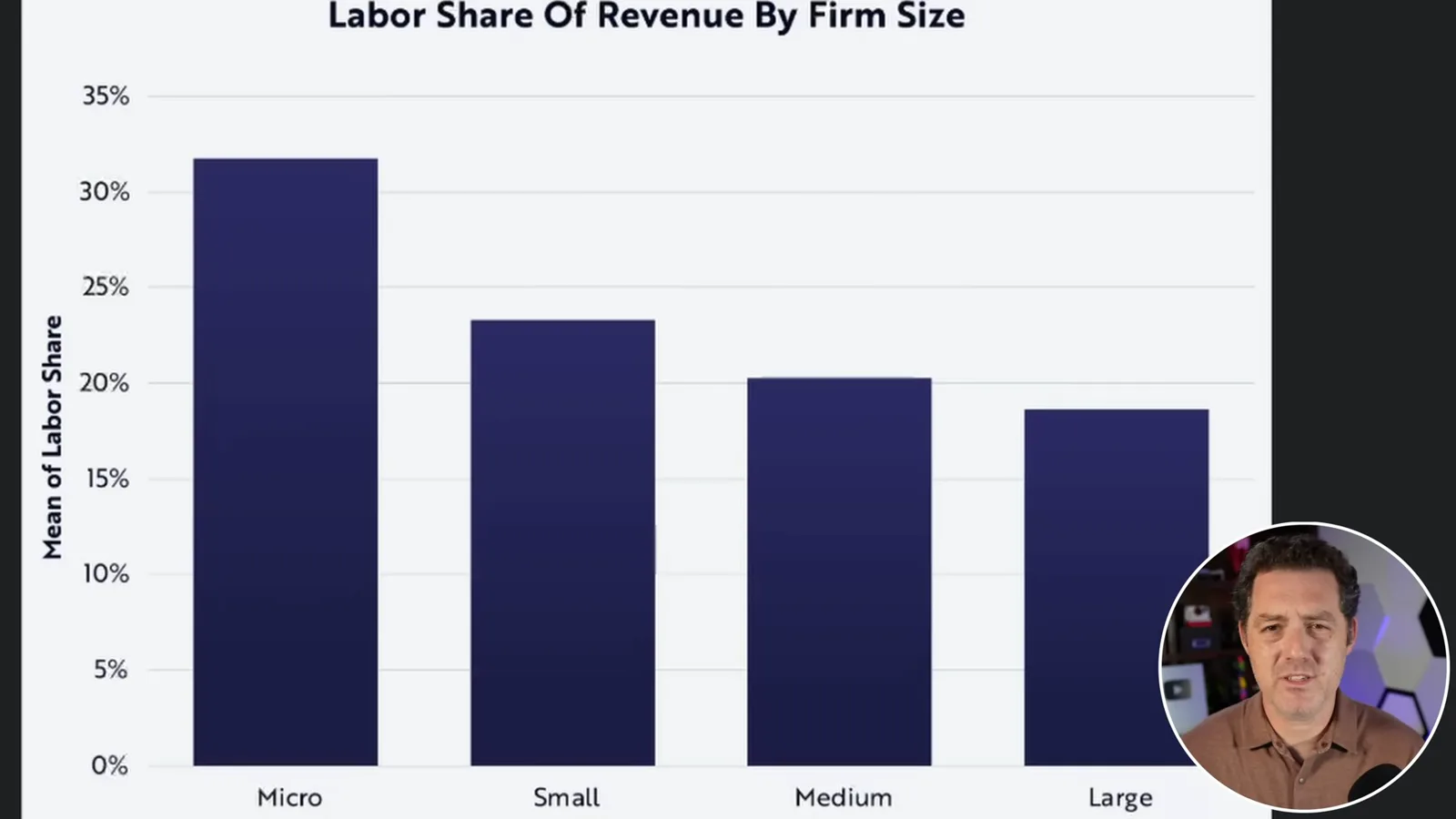
Company size and labor share matter. ARK argues that large manufacturers have more specialized jobs and have benefited from single-task automation, while workers at smaller firms often wear several hats. It says larger firms have historically achieved greater productivity and lower labor cost as a share of revenue, despite paying higher wages.
ARK illustrates this with hypothetical companies. A small firm with $1,000 revenue and 40% labor share assigns $200 per employee; a 25% productivity improvement in the illustration gives a $50 benefit. A larger firm with $5,000 revenue and 20% labor share assigns $250 per employee; a 50% improvement gives $125. These are illustrative assumptions, not measurements of a robot deployment.
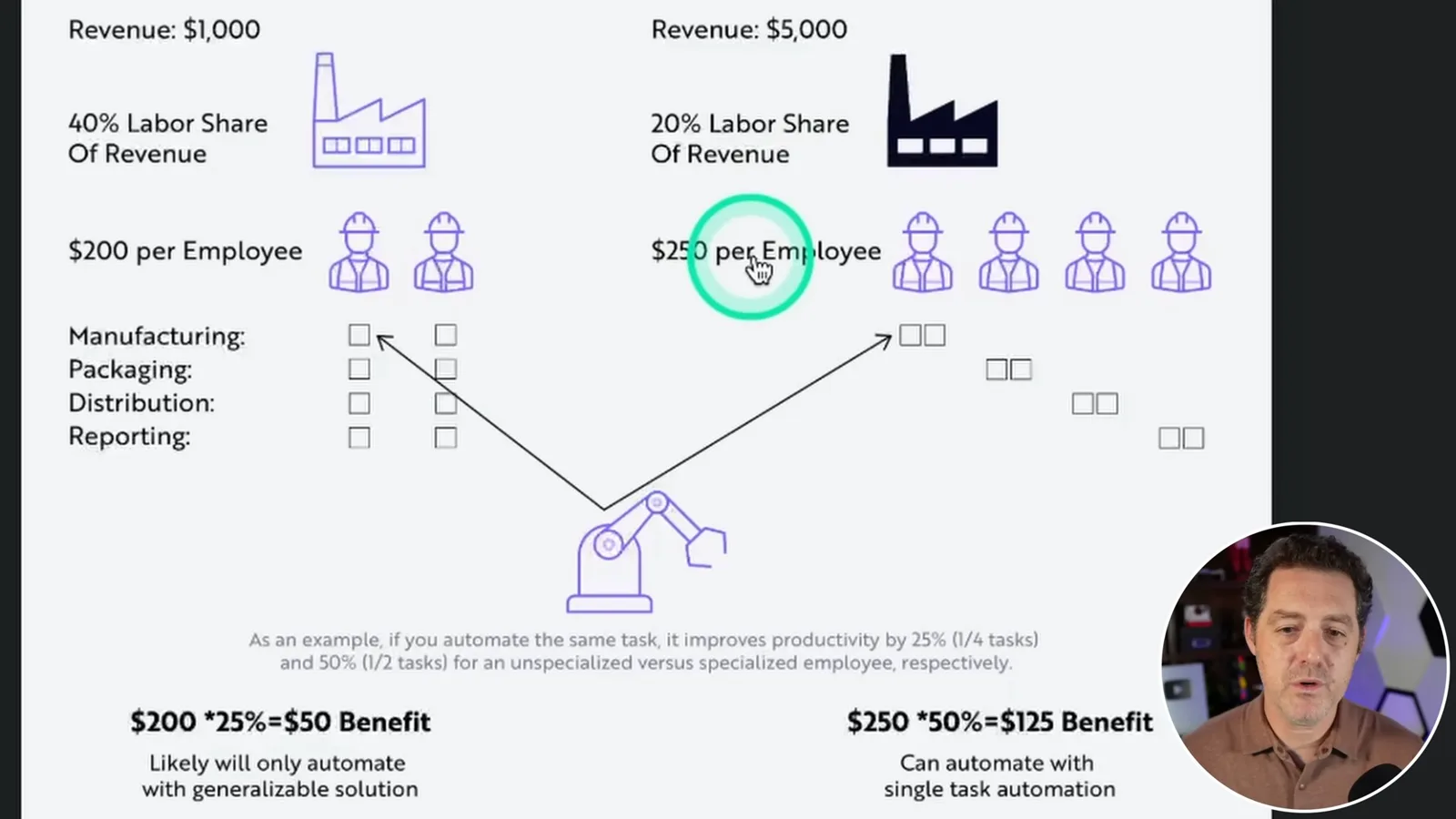
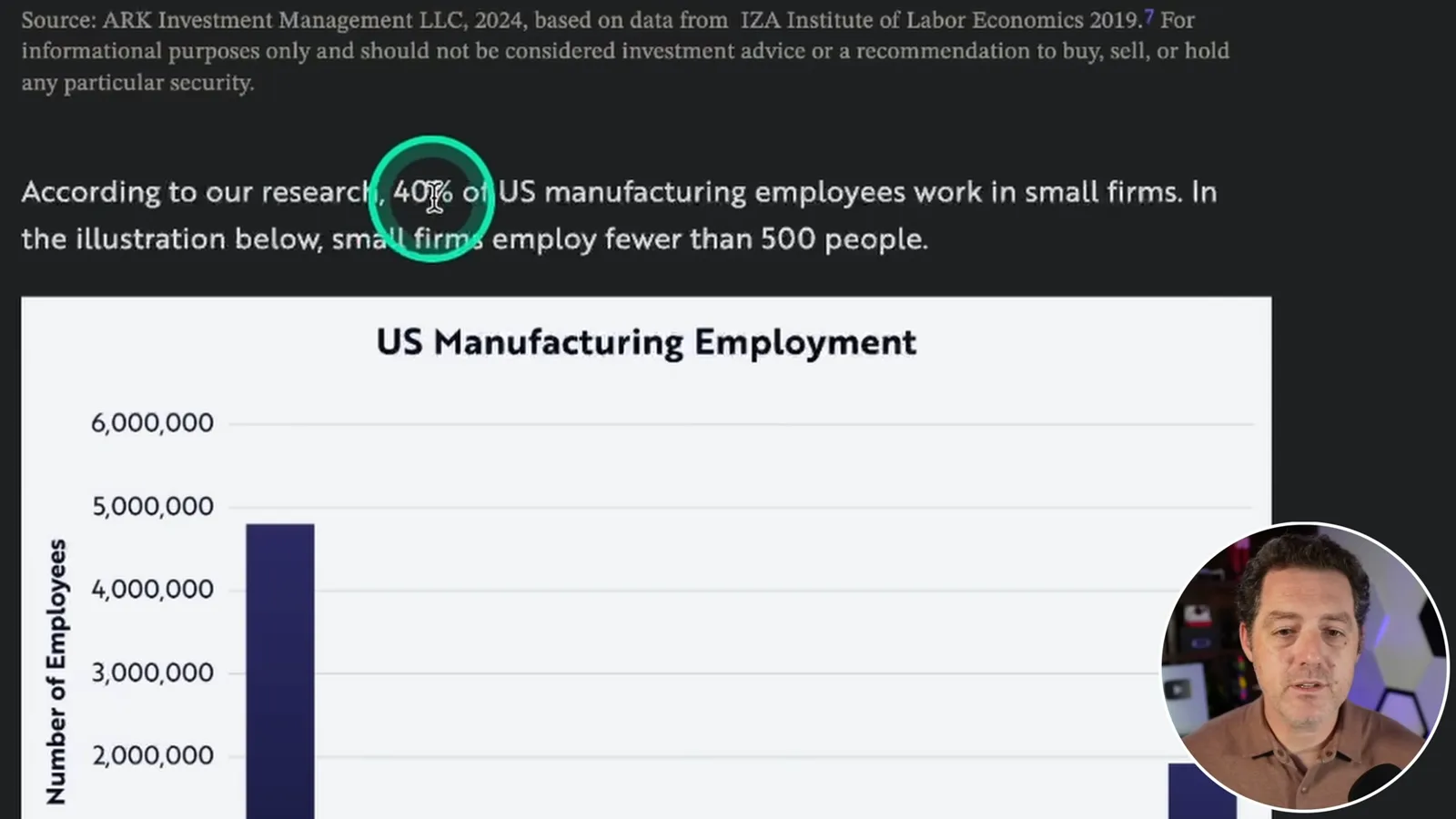
ARK argues that small firms may have more tasks that can be automated but have not yet been automated, because existing machines often specialize in one task. A flexible humanoid capable of multiple tasks could therefore be disproportionately useful to them. The report says 40% of US manufacturing employees work for firms with fewer than 500 people.
Potential tailwinds and outlook
ARK points to onshoring, labor shortages and supply-chain shocks. Berman closes with his view of progress among humanoid robot makers.
The report also identifies possible tailwinds: supply-chain shocks after COVID, onshoring and labor shortages. It argues these pressures could make managers less sensitive to robot prices. I see factory closures as an example of why firms might value alternatives, although robots would still require supporting infrastructure and maintenance.
At the start of 2024, I predicted this would be a major year for humanoid robots. By September, I see progress from Tesla Optimus, Figure 2 and Boston Dynamics. I intend to keep following the combination of hardware and AI software as these projects develop.
같은 채널의 다른 글
 34:21EN
 Matthew Berman· 2026년 10월 27일Matthew Berman Examines Anthropic’s IPO Filing, AI Growth and GovernanceMatthew Berman, Sam Altman · Forward FutureThe presenter reviews the S-1’s financial metrics, compute strategy and voting structure while questioning the tension between rapid AI development and safety.
 0:26ENMatthew Berman· 2026년 10월 25일Sam Altman on Human Values and Problem-Solving in an AI WorldSam Altman · OpenAIIn a short interview excerpt, Altman considers the enjoyment of solving hard problems and the human role in interpreting results.
 0:36ENMatthew Berman· 2026년 10월 25일Kimi K3.1 and a Rubik’s Cube Solver DemonstrationMatthew Berman · Forward FutureMatthew Berman shows a scrambled virtual cube being solved and gives the Kimi K3.1 test a favorable assessment.
 0:21ENMatthew Berman· 2026년 10월 24일An AI-Generated Kimi Benchmark Chart Used Invented ScoresMatthew Berman · Forward FutureMatthew Berman asks for a graph of Kimi K3.1 Pro benchmarks, then discovers that the displayed figures are illustrative placeholders.
 25:50ENMatthew Berman· 2026년 10월 24일Kimi K3.1 Pro Tested: Strong 3D Demos, Uneven Results and Competitive PricingMatthew Berman · Forward FutureMatthew Berman tests the open-weight model on coding, 3D rendering and visual explanations, then compares benchmark results and prices.
 32:20ENMatthew Berman· 2026년 10월 23일Who Is Local AI For? The Costs, Trade-offs and a Hybrid FutureMatthew Berman · Forward FutureMatthew Berman weighs data control and independence against hardware cost, setup complexity and inference speed.