30초 요약
In this Real Numbers episode, Sawyer solves the previous river-crossing puzzle: a boat that drifts 60 meters across a 100-meter-wide river should be aimed 75 meters upstream when sent back from the original dock. He derives the result using both the Pythagorean theorem and trigonometry. He then presents a new challenge in which the return trip begins at the landing point 60 meters downstream. The episode leaves that new problem for viewers to solve.
- 1The new starting pointWavey lands 60 meters downstream after the first crossing. The new challenge asks where to aim from that landing point to reach the opposite dock.
- 2Why 60 meters is not enoughA diagonal heading reduces the boat’s cross-river component, increasing crossing time and downstream drift.
- 3A 5:3 speed ratioDuring the initial crossing the motor contributes 100 meters while the current contributes 60 meters in the same time.
- 4Aim 75 meters upstreamA right triangle and the 5:3 ratio yield x = 75 meters for the previous problem; trigonometry confirms it.
핵심 정리
- A direct crossing with 100 meters of motor-driven movement and 60 meters of drift reveals a 5:3 boat-to-current speed ratio.
- Aiming 60 meters upstream is insufficient because the diagonal heading lengthens the time spent in the current.
- For a return from the original dock, the correct aim point is 75 meters upstream of the opposite dock.
- The same result follows from either the Pythagorean theorem or sine and tangent.
- Starting 60 meters downstream instead creates a new problem that the episode leaves open.
챕터별로 다듬은 전문 읽기
A new return trip
Sawyer introduces a constant-speed boat and current on a 100-meter-wide river. The new question starts the return trip 60 meters downstream.
Last time we took Wavey, our toy boat, to a river and asked how to chart a course across it. This week we have another navigation puzzle with the same river and boat.
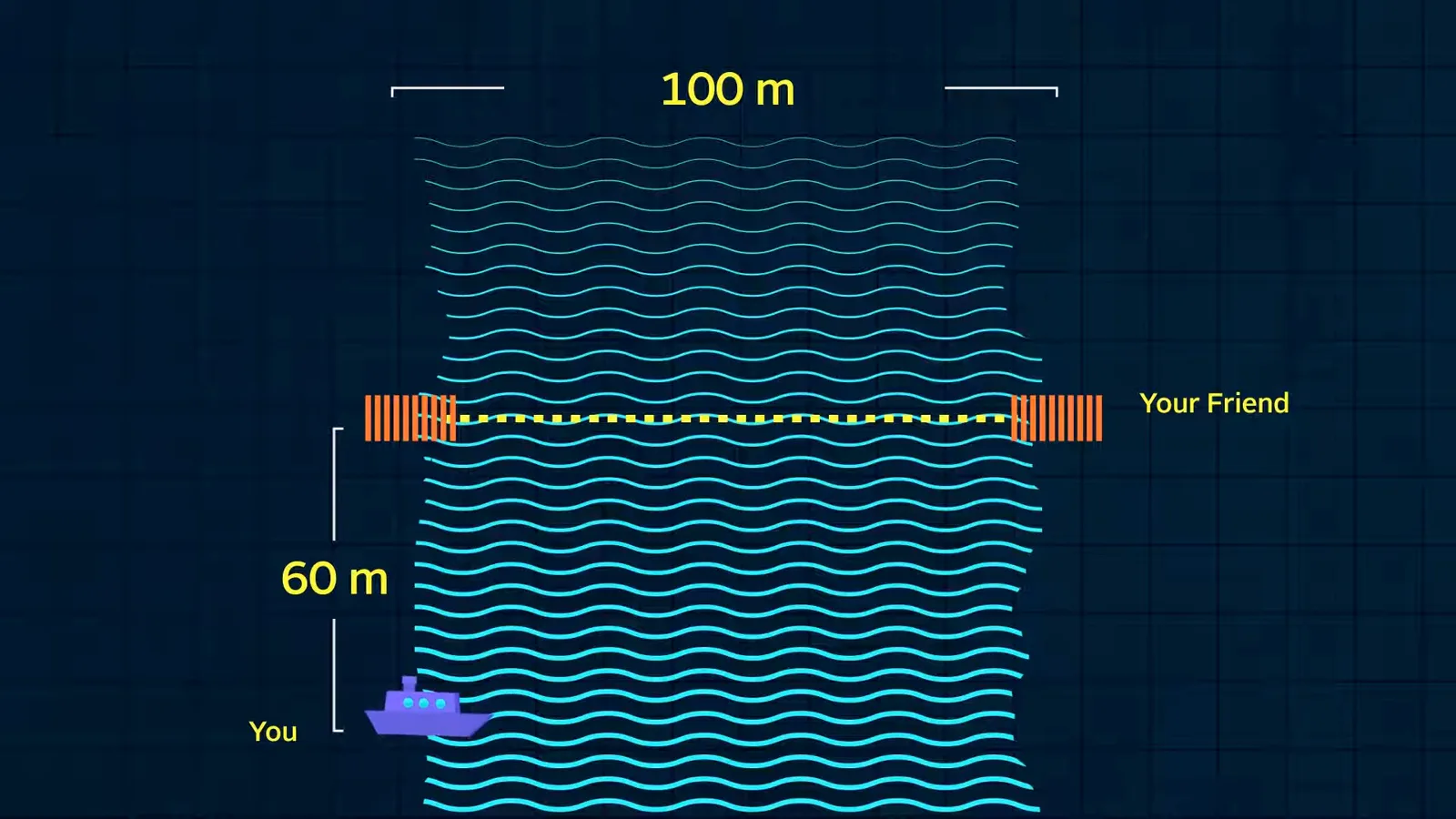
The riverbanks are parallel and 100 meters apart. The current flows downstream at the same constant speed everywhere. Wavey’s motor pushes the boat at another constant speed in whichever direction it faces. You and a friend stand at docks directly opposite one another.
Your friend points Wavey directly at your dock and launches it. By the time it reaches your bank, the current has carried it 60 meters downstream. You walk to retrieve it, but this time you want to send it back from that landing point rather than carrying it back to your dock.
Solving the previous crossing
The initial crossing gives a 5:3 speed ratio. A right triangle shows that the boat must be aimed 75 meters upstream when returning from the original dock.
Where on the opposite shore should you aim so that the boat reaches your friend’s dock? I will leave this week’s question open. First, let us solve the previous problem, where the return trip started from your original dock.
A tempting answer is to aim 60 meters upstream of the opposite dock, hoping the current cancels that displacement. But aiming diagonally gives the motor a smaller component across the river. The crossing takes longer, so the current carries Wavey more than 60 meters downstream.
The first trip gives us the ratio of the speeds. In the time the motor moved the boat 100 meters directly across, the current moved it 60 meters downstream. The motor speed relative to the water and the current speed are therefore in the ratio 100:60, or 5:3.
Let x be the distance upstream from the opposite dock at which we aim. If the boat lands at the dock, its motor-driven displacement runs along the hypotenuse of a right triangle. The current contributes x meters downstream, leaving a net displacement of 100 meters straight across.
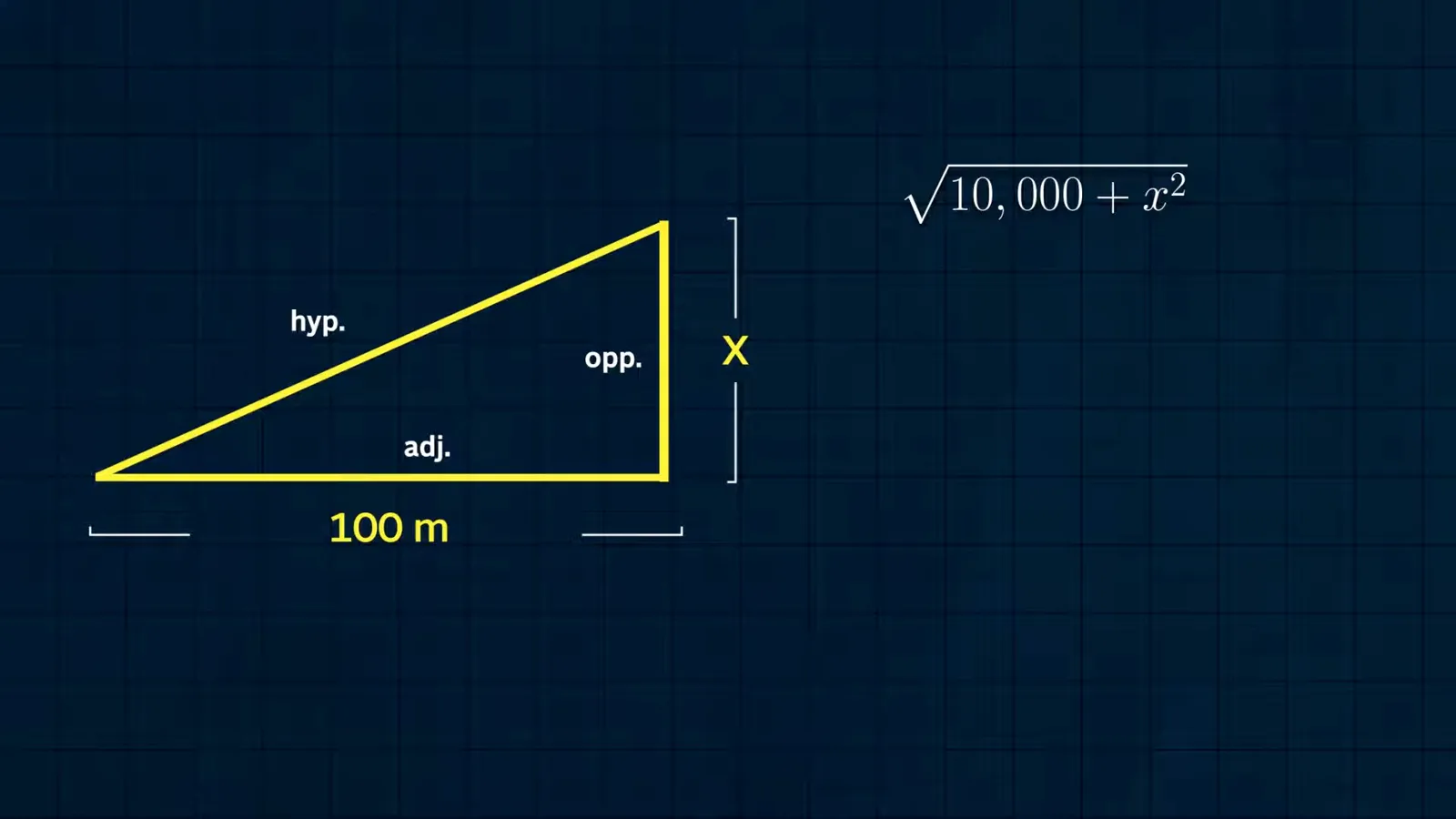
The motor-driven displacement has length √(100² + x²), while the current-driven displacement has length x. Both occur over the same time, so their ratio is 5:3. Clearing denominators and squaring gives x = 75 meters. We should aim 75 meters upstream, farther than the initial 60-meter guess.
A trigonometric check
Sine, cosine and tangent produce the same 75-meter result. Sawyer then restates the new challenge, which remains open.
Trigonometry gives the same result. Let θ be the angle between the aim direction and the straight-across path. The opposite-to-hypotenuse ratio is sin θ = 3/5, so cos θ = 4/5 and tan θ = 3/4.
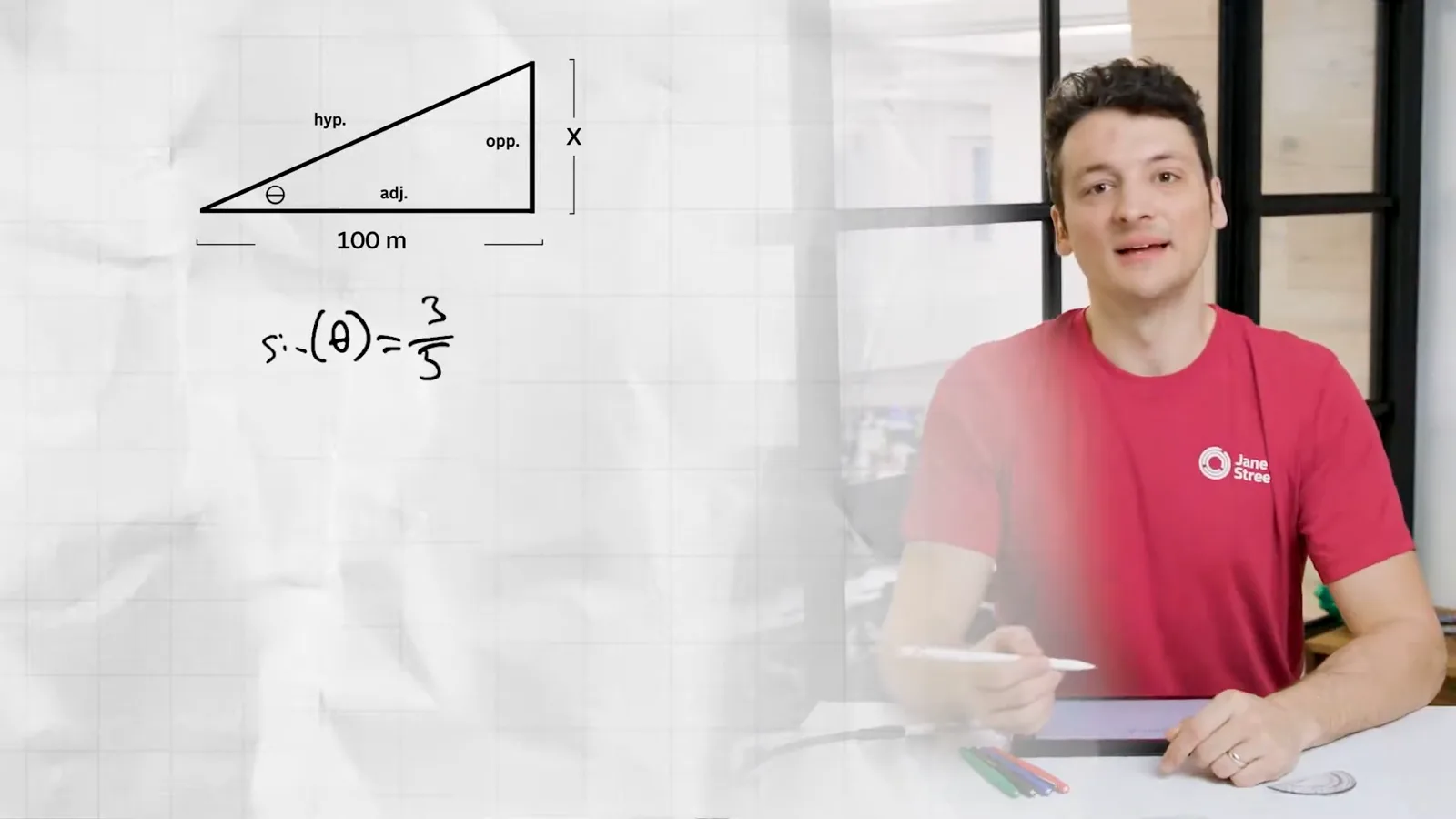
The adjacent side is 100 meters and the opposite side is x, giving tan θ = x/100. Thus x/100 = 3/4 and x = 75 meters, in agreement with the first method.
Now return to this week’s challenge: Wavey starts 60 meters downstream from your dock. At what point on the far bank should you aim so the combined motion brings the boat to your friend? Submit your answer with any maps or diagrams that helped you.
같은 채널의 다른 글
 15:33EN
 1:48:29EN
 1:36:37EN
 1:05:45EN
 1:25:00EN
 1:16:29EN