30초 요약
In a historical October 2024 roundup, Berman discusses OpenAI’s Realtime API, vision fine-tuning, caching and distillation, then covers reported leadership and governance changes, California’s AI bill, Pika, an open-source licensing dispute and Liquid AI. His predictions and the vendors’ benchmark claims are identified as such.
- 1Developer announcementsThe roundup covers speech, vision, caching and distillation.
- 2An uncertain restructuringBerman discusses contemporaneous reports and a denial.
- 3California vetoHe explains his view and notes contrasting positions.
- 4Liquid modelsThe company’s announced benchmarks and limitations are discussed.
핵심 정리
- The 2024 DevDay announcements included speech, vision fine-tuning, prompt caching and distillation.
- Prompt caching reuses input processing; it is not a guarantee of identical responses.
- The video reports a possible restructuring as uncertain at the time.
- Berman supported the California bill veto while noting that others supported the bill.
- Liquid AI’s benchmark results were company-reported and awaited independent testing.
챕터별로 다듬은 전문 읽기
OpenAI DevDay
Berman reviews speech, vision fine-tuning, caching and distillation.
In this early October 2024 roundup, I cover OpenAI DevDay announcements, organizational news, a California AI bill, Pika and new models. Prices, product availability and organizational plans in this video reflect that moment.
OpenAI announced a Realtime API for speech-to-speech applications using preset voices and discussed audio input and output in Chat Completions. I read the launch pricing, which should not be treated as current pricing.
The company also announced vision fine-tuning for image-understanding tasks. I discuss an example involving a road sign and describe potential applications; a promotional example is not a validation of safety-critical performance.
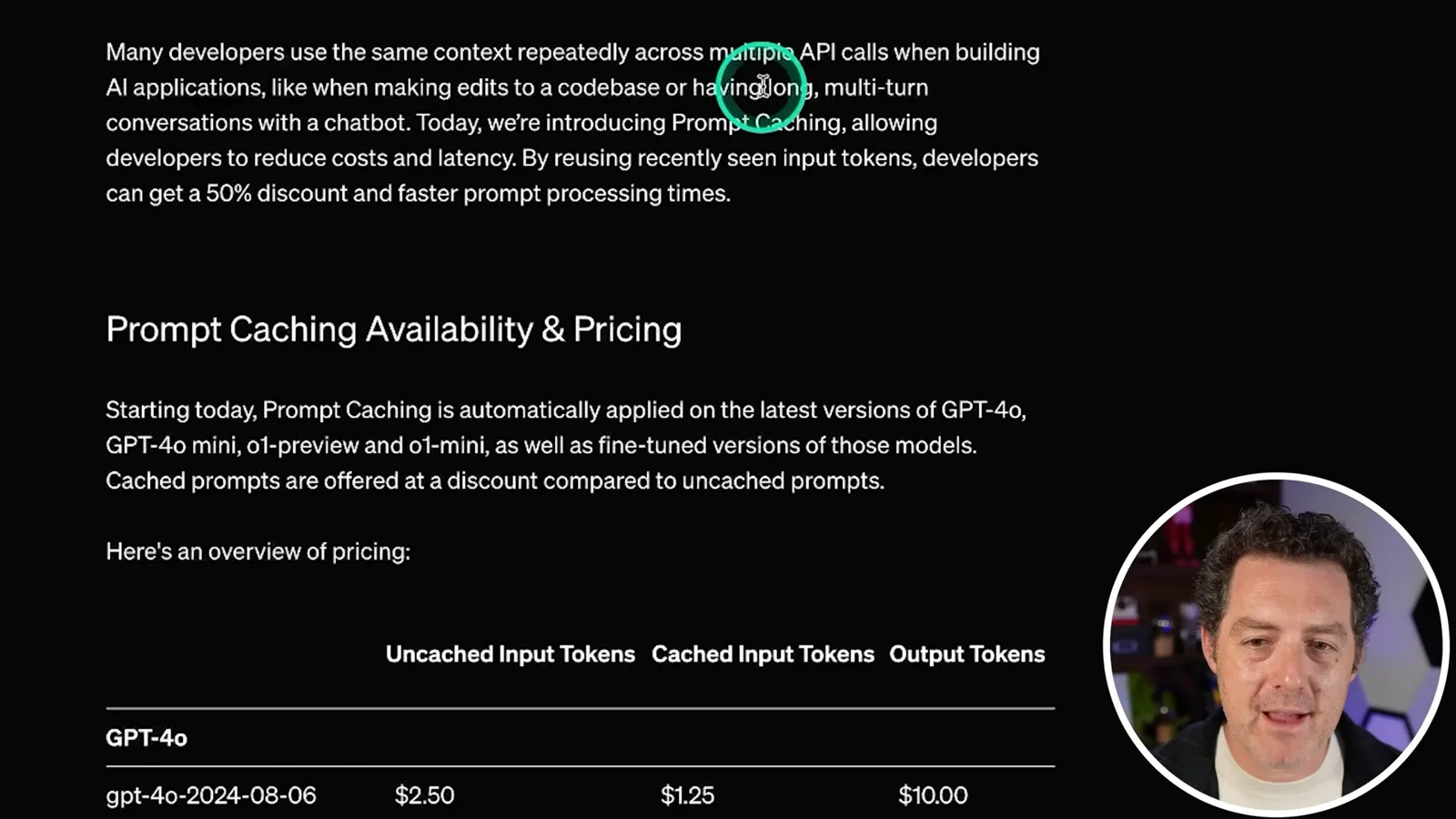
Prompt caching reuses previously processed input context to reduce cost and latency. The historical announcement described a discount and a limited cache lifetime; it does not mean that every repeated request necessarily returns the same response.
For model distillation, I describe using outputs from a larger model to train a smaller one for a specific task. OpenAI’s announced workflow included stored examples, evaluations and fine-tuning so developers could measure whether the resulting model met their needs.
OpenAI governance and departures
He discusses contemporaneous reporting and leadership departures.
I discuss a Reuters report about a possible OpenAI restructuring and reports about equity for Sam Altman, which he denied. I explicitly say the outcome is uncertain; these were reports and predictions at the time, not a statement of present corporate structure.
I offer an informal explanation of a public benefit corporation and compare it with Patagonia. The exact legal obligations depend on the jurisdiction and corporate documents; my description in the video is not a legal analysis.
I report that OpenAI CTO Mira Murati and other senior researchers had announced departures. I speculate about the implications while acknowledging that the reasons are not clear from the public statements.
Policy and creative tools
The roundup covers a California veto and Pika 1.5.
California governor Gavin Newsom vetoed the AI bill discussed in the video. I supported the veto because I thought the proposed rules were premature and broad; I also note that some prominent figures and Anthropic saw benefits in the bill.
Pika Labs released Pika 1.5 with examples of generated video and stylized effects. I react enthusiastically to the clips; these are selected promotional examples rather than a systematic comparison.
Open-source dispute and new models
Berman recounts the Pair AI licensing dispute and Liquid AI announcement.
I recount a dispute involving AI editor Pair AI, which forked Continue and VS Code. Its founder acknowledged problems with attribution and licensing and said the team would correct them.
Continue recommended starting from a proper fork, retaining the Apache 2.0 license and reapplying changes in compliance with it. Pair’s founder agreed publicly, according to the exchange shown in the video.
I ask for more communication about the earlier Reflection 70B controversy, noting that weeks had passed without a detailed update. This is a contemporaneous request for clarification, not a finding about the project’s later history.
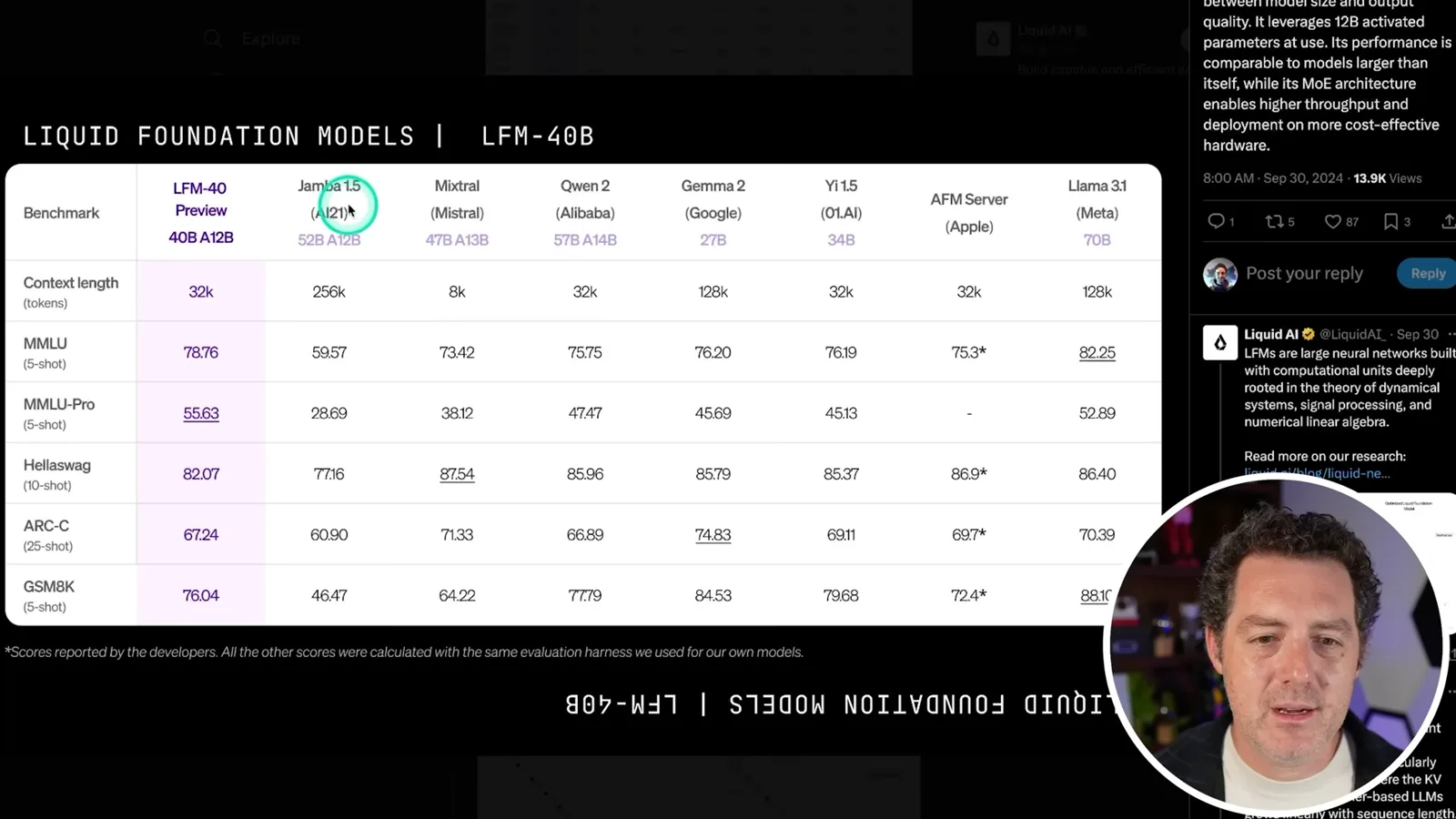
Liquid AI announced a family of Liquid Foundation Models, including 1B, 3B and a 40B mixture-of-experts model with 12B active parameters. I read the company’s benchmark comparisons and say I intend to test them; the scores are vendor-reported.
The company describes a non-Transformer architecture and lists strengths and limitations. I highlight its caveats around zero-shot coding, precise numerical calculations, current information and human-preference optimization, and plan to test those claims.
같은 채널의 다른 글
 34:21EN
 Matthew Berman· 2026년 10월 27일Matthew Berman Examines Anthropic’s IPO Filing, AI Growth and GovernanceMatthew Berman, Sam Altman · Forward FutureThe presenter reviews the S-1’s financial metrics, compute strategy and voting structure while questioning the tension between rapid AI development and safety.
 0:26ENMatthew Berman· 2026년 10월 25일Sam Altman on Human Values and Problem-Solving in an AI WorldSam Altman · OpenAIIn a short interview excerpt, Altman considers the enjoyment of solving hard problems and the human role in interpreting results.
 0:36ENMatthew Berman· 2026년 10월 25일Kimi K3.1 and a Rubik’s Cube Solver DemonstrationMatthew Berman · Forward FutureMatthew Berman shows a scrambled virtual cube being solved and gives the Kimi K3.1 test a favorable assessment.
 0:21ENMatthew Berman· 2026년 10월 24일An AI-Generated Kimi Benchmark Chart Used Invented ScoresMatthew Berman · Forward FutureMatthew Berman asks for a graph of Kimi K3.1 Pro benchmarks, then discovers that the displayed figures are illustrative placeholders.
 25:50ENMatthew Berman· 2026년 10월 24일Kimi K3.1 Pro Tested: Strong 3D Demos, Uneven Results and Competitive PricingMatthew Berman · Forward FutureMatthew Berman tests the open-weight model on coding, 3D rendering and visual explanations, then compares benchmark results and prices.
 32:20ENMatthew Berman· 2026년 10월 23일Who Is Local AI For? The Costs, Trade-offs and a Hybrid FutureMatthew Berman · Forward FutureMatthew Berman weighs data control and independence against hardware cost, setup complexity and inference speed.