30초 요약
This short 3Blue1Brown video introduces three geometric constructions of an ellipse and asks why they agree. It points to a longer companion video for the proof rather than presenting one here.
- 1Stretch a circleChanging the scale in one direction creates an ellipse.
- 2Use a stringTrace with a pencil while keeping a loop around two fixed points taut.
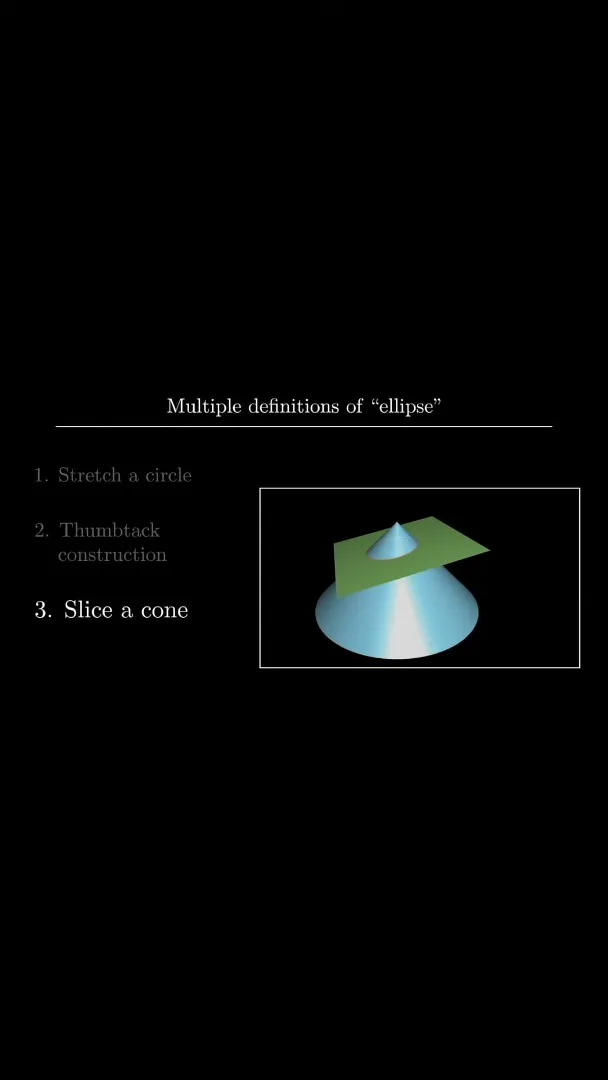
- 3Slice a coneA suitably angled plane intersects a cone in an ellipse.
핵심 정리
- Stretching a circle along one axis produces an ellipse.
- A taut string looped around two fixed points provides another construction.
- An appropriately angled plane cuts a cone in an ellipse.
- The short raises the equivalence question; the proof appears in the linked full video.
챕터별로 다듬은 전문 읽기
Three constructions
The presenter describes stretching a circle, using a string and cutting a cone.
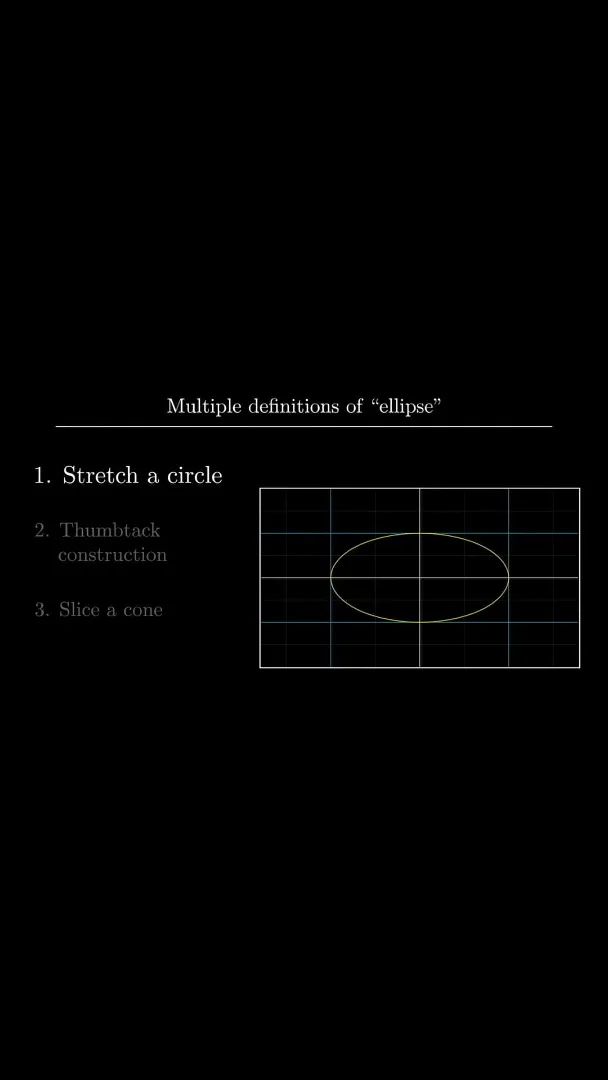
There are at least three geometric ways to define an ellipse. One is to take a circle and stretch it in one direction.
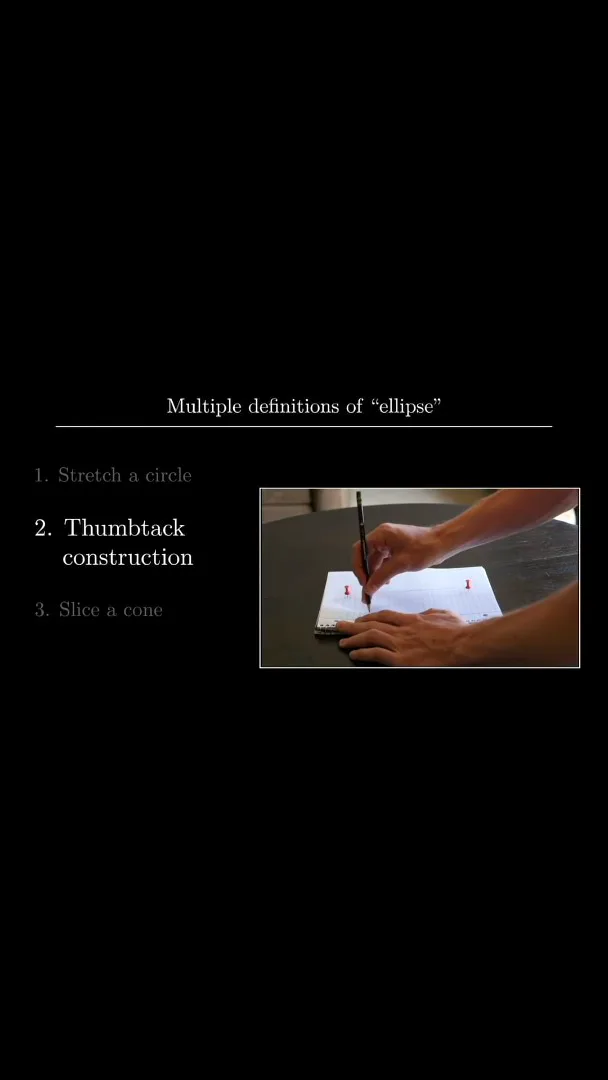
Another is the two-thumbtack construction: loop a string around two fixed thumbtacks and trace with a pencil while keeping the string taut. A third is to cut a cone with a plane at an appropriate angle.
Why do they agree?
The short asks why the same curves arise and refers viewers to a longer proof.
Why should these three very different constructions give precisely the same family of curves, rather than merely similar-looking ovals? This short poses the question; its description links to the full video, which explains the cone-and-string equivalence.
같은 채널의 다른 글
 40:44EN
 3Blue1Brown· 2026년 10월 16일Grant Sanderson: There's never been a better time to go into mathGrant Sanderson, Constantin Kogler · 3Blue1BrownStudents fear AI has solved mathematics. Grant Sanderson argues the opposite: even if machines prove theorems better than we do, the institution of math stays valuable—and this is a rare moment when newcomers can reshape it.
 51:55EN3Blue1Brown· 2026년 9월 18일The last IMO problem AI could not solveGrant Sanderson · 3Blue1BrownGrant Sanderson walks through IMO 2025 Problem 6 — a tiling puzzle that frontier models missed — and the visual patience it takes to prove a construction is optimal.
 0:55EN3Blue1Brown· 2026년 7월 24일The 64 Sugar Cubes Puzzle: Six Equal DistancesA 4×4×4 block has three colors; prove that six same-colored pairs share a distance.
 33:51EN3Blue1Brown· 2026년 7월 16일What Cross-Entropy Connects: Compression, Language Models and KL DivergenceGrant Sanderson · 3Blue1BrownGrant Sanderson builds cross-entropy from code lengths and uses it to explain next-token training and distillation.
 2:25EN3Blue1Brown· 2026년 6월 12일How Shannon Measured the Entropy of EnglishA guessing game helped Claude Shannon estimate how much information English text contains, and why prediction is central to compression.
 1:02EN3Blue1Brown· 2026년 6월 10일A Robot Walk and the Puzzle of Optimal Binary EncodingHow few bits does it take to send directions that occur with unequal frequencies?