30 秒でわかる
After a 1,000-day Duolingo streak, William Imoh wanted a patient partner that would keep speaking Norwegian and correct him. The Hackmamba founder used Codex to build Mural as a native app, specifying a simple voice interface and warm visual style despite never having written Swift. He estimates voice sessions cost $3–$5 per half hour. In conversation with Claire Vo, he also describes separate business-agent roles, their broad tool access and his concern about becoming dependent on them.
- 1A long learning streak did not provide the conversation he wantedImoh wanted a partner that would keep speaking Norwegian and correct his mistakes.
- 2A detailed design brief guided a native app in a language he had not writtenHe used Codex, gave concrete style references and revised the first dark-mode design.
- 3The app corrects a mistake and stays in NorwegianImoh demonstrates a live conversation and explains the transcript to Vo.
- 4He estimates voice practice at $3–$5 per half hourImoh says he open-sourced the project and provided an initial shared API budget.
- 5Role-based agents help organize company workHe uses separate agents for functions including sales, product, engineering and customer support.
- 6He gave agents broad access but excluded bank writesImoh describes his permissions choices and later acknowledges how dependent he has become on the agents.
ポイント
- Describe the user experience and visual references precisely, then correct the first result.
- Use real conversation and feedback to practice a specific learning goal.
- Budget for ongoing model usage; Imoh estimates $3–$5 per 30-minute voice session.
- Organize recurring business work into projects and explicitly defined responsibilities.
- Inspect access permissions and consider the operational consequences of depending on agents.
チャプターごとに整えた全文を読む
Why Imoh wanted a Norwegian conversation partner
Moving to Norway exposed the gap between a long learning streak and speaking practice.
Claire Vo introduces William Imoh, founder of developer marketing company Hackmamba and creator of Mural, a real-time voice app for practicing Norwegian. She asks why he built it and how he uses agents in his business.
Imoh says he tried an earlier version at a hackathon but the experience was poor. After moving from Dubai to Norway, he wanted to speak Norwegian, yet people often switched politely to English when he struggled. A 1,000-day Duolingo streak had not given him the conversation practice he wanted.
He wanted a nonjudgmental partner that would correct him and keep speaking Norwegian, like being immersed in a village where English was not an option. Vo relates this to the difficulty of getting useful reinforcement when a conversation partner switches languages.
Build and describe the native app
Imoh uses his product and design experience to direct Codex despite not knowing Swift.
Imoh studied chemical engineering and taught himself web development; he also spent four years as a product manager. He had not written Swift but wanted a native mobile experience and used Codex to build with Swift for iOS and Kotlin for Android.
His product experience helped him describe the intended user journey in epics and stories. He began with a long prompt requesting a beautiful Norwegian-learning app, a real-time voice model, a pulsating orb and an interface that felt like a phone call.
He specified warm autumn colors, minimalism, gradients and a design reference to Apple's visual style. The first result used dark mode, which he rejected; he asked for light, warm colors and a different treatment. He wanted unnecessary elements removed or hidden.
Vo argues that design vocabulary and concrete references help a person communicate taste to an agent. She suggests practicing by describing why two websites or brands feel different, and articulating a user journey clearly enough for either a human or AI engineer to follow.
Imoh originally built Mural for himself and hesitated to share it because supporting users would create obligations. He says other demos often had many features, while he wanted a simple conversation screen and captions to help a beginner understand.
A live conversation and the cost of practice
The app corrects Norwegian and stays in the target language. Imoh shares his estimated voice-model cost.
Imoh demonstrates a conversation. The app assesses his language level, speaks Norwegian and corrects a grammatical error. When he asks it to speak English, it stays in Norwegian. Vo asks what happened and he walks her through the transcript.
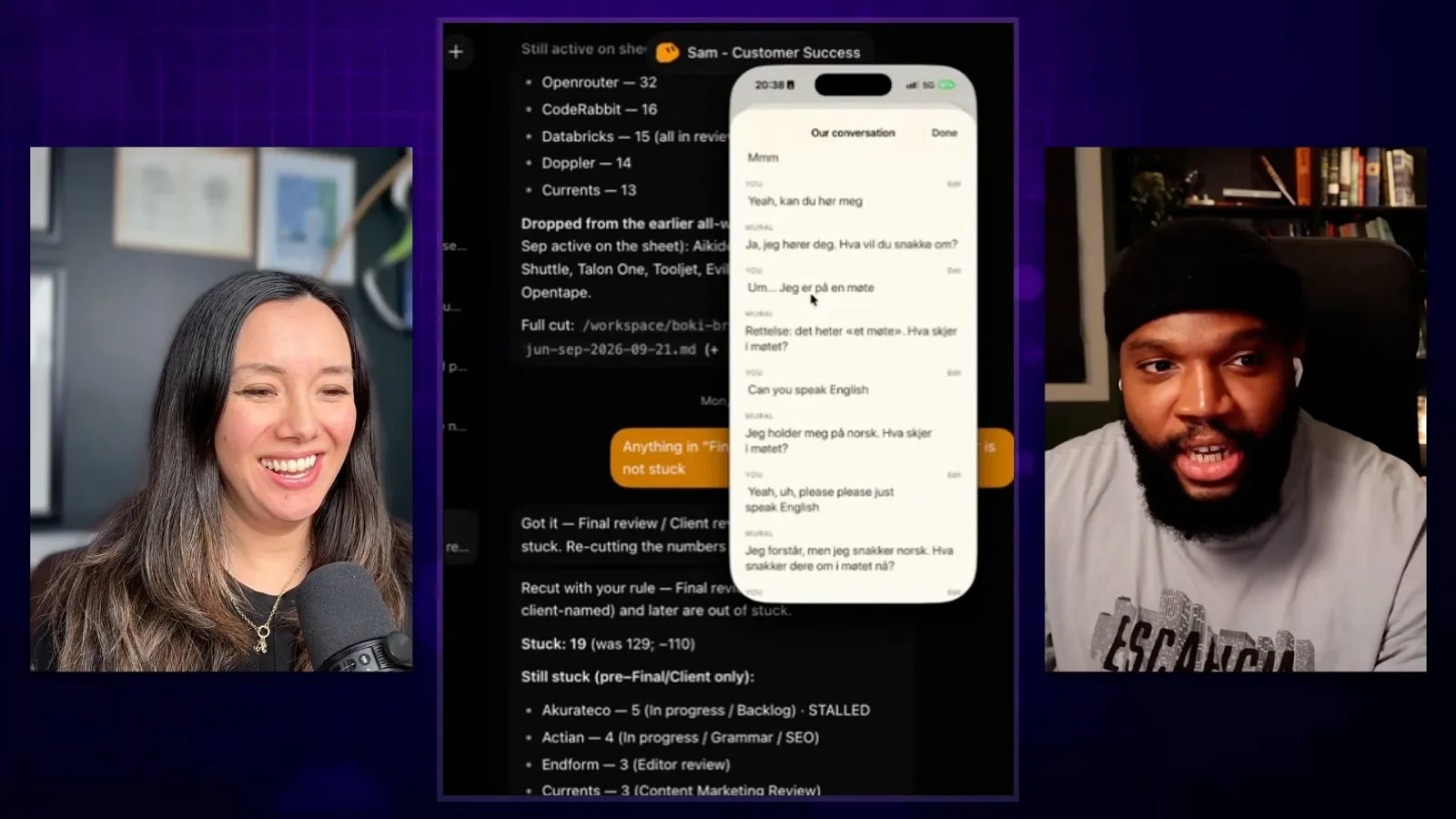
Imoh says that despite his long Duolingo streak, he previously could not hold that kind of conversation. He took a short grammar course, passed a Norwegian exam and later built Mural to practice conversations in different settings.
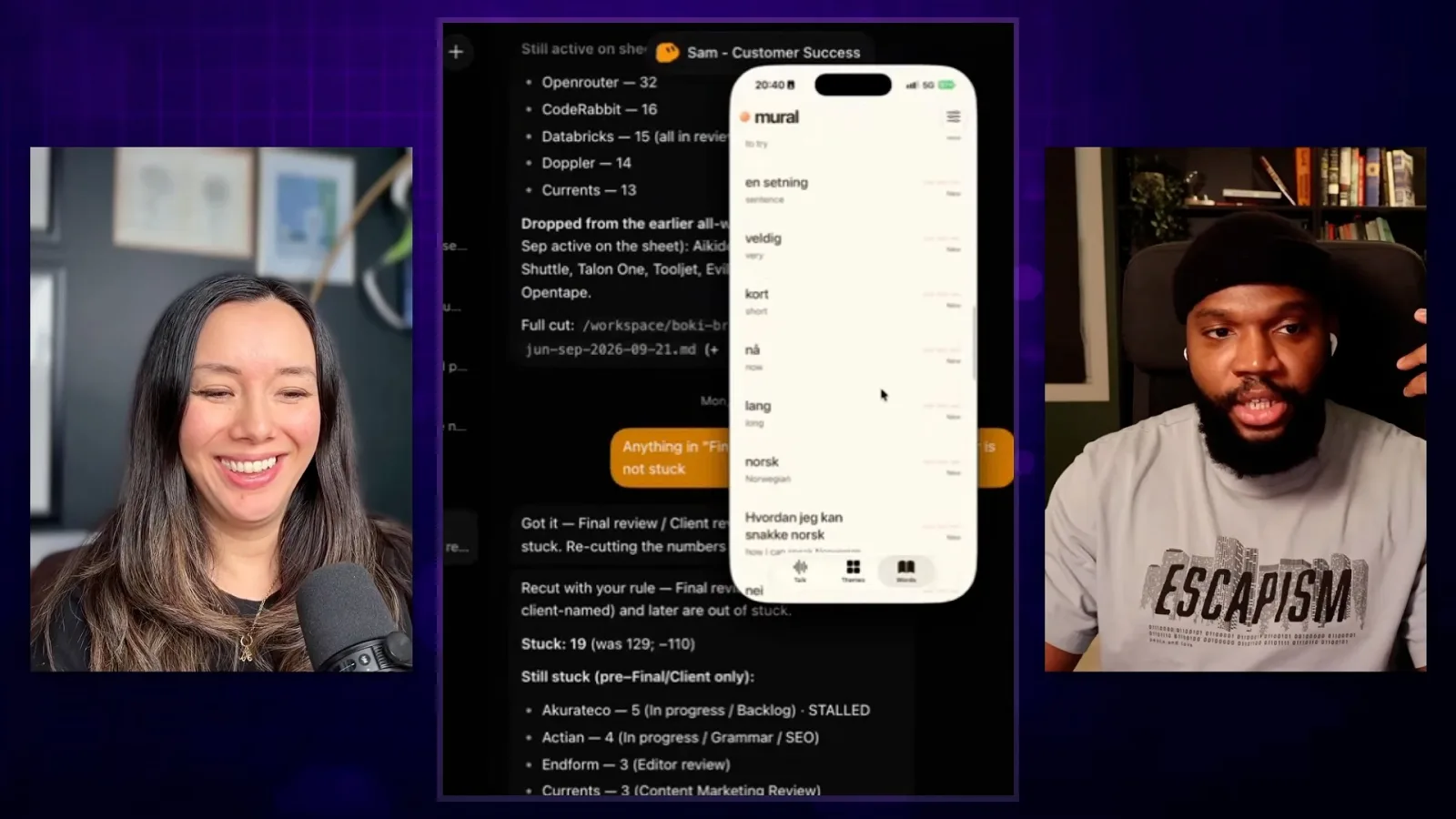
The app tracks learned words, offers flashcards and themes, and can find material for a conversation about a selected topic. Imoh says the central experience remains speaking, receiving corrections and trying again.
Vo sees a broader skill in Imoh's approach: treating unfamiliar problems as solvable, asking questions and accepting correction. She compares an AI tutor to a patient private teacher that lets a learner make mistakes without embarrassment.
Vo asks about the real-time voice model and cost. Imoh estimates that a 30-minute session costs about $3–$5. He says the project is open source and that he initially put $1,000 in an API budget for others to use; at the time of recording about $100 remained.
Organize a business with projects and agent roles
Imoh describes his team, recurring briefs, broad tool access and hiring workflow.
Turning to his company, Imoh describes a goal to grow revenue without a comparable increase in headcount, while keeping creative work with people. As solo founder of a roughly 25-person company, he handles sales, product, hiring, customer work and administrative tasks.
After a chief-of-staff hire fell through, he experimented with assistants and created separate Codex projects for operations, growth, sales, the website and other work. A recurring weekly brief suggests what to start, stop and continue and identifies high-impact activities.
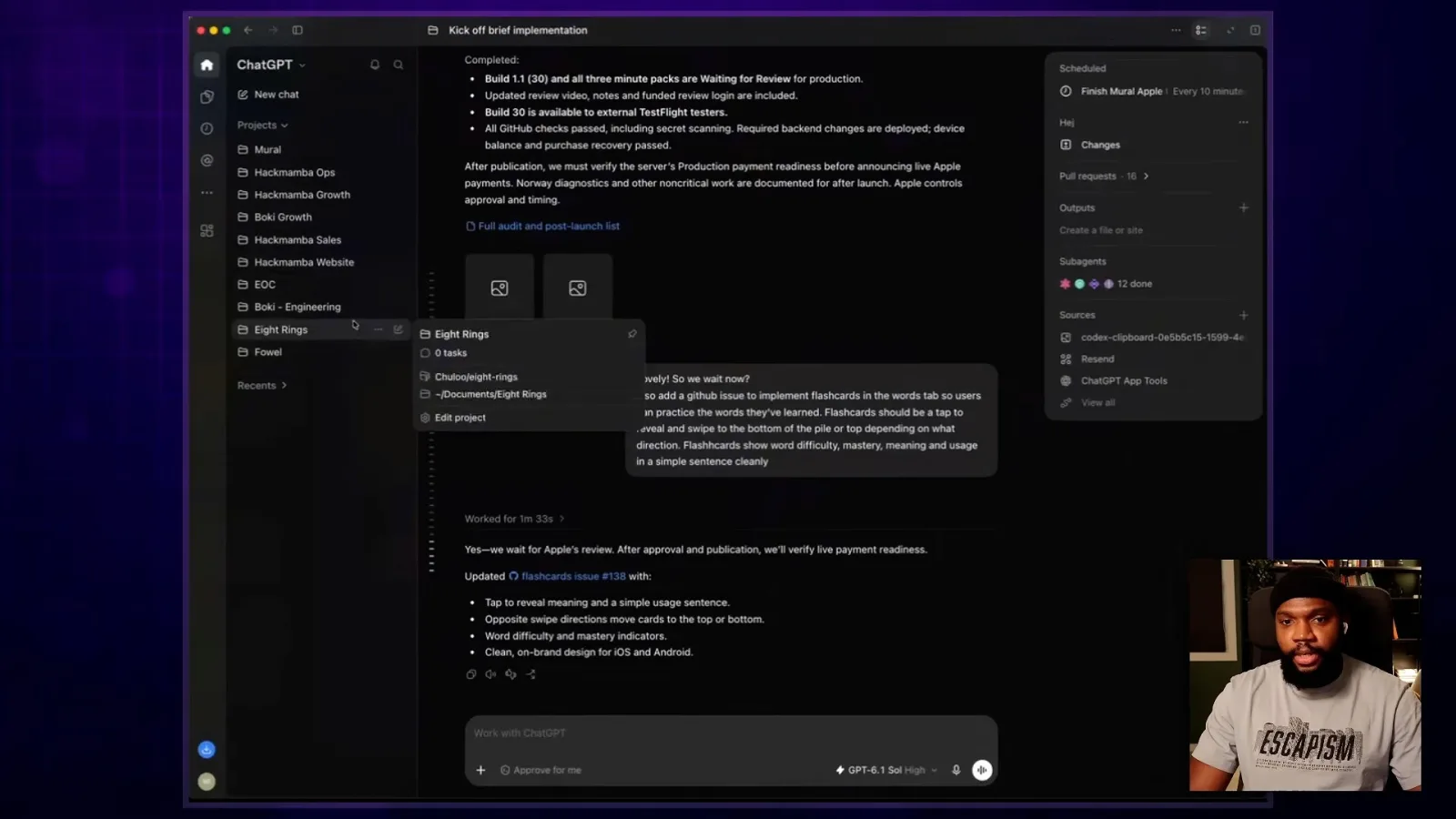
He reserves Codex for complex work such as Mural. For business functions he uses Grok Bot roles named after characters from The Lord of the Rings: Gandalf as chief of staff, with other agents covering engineering, marketing, accounts, sales, product and customer success.
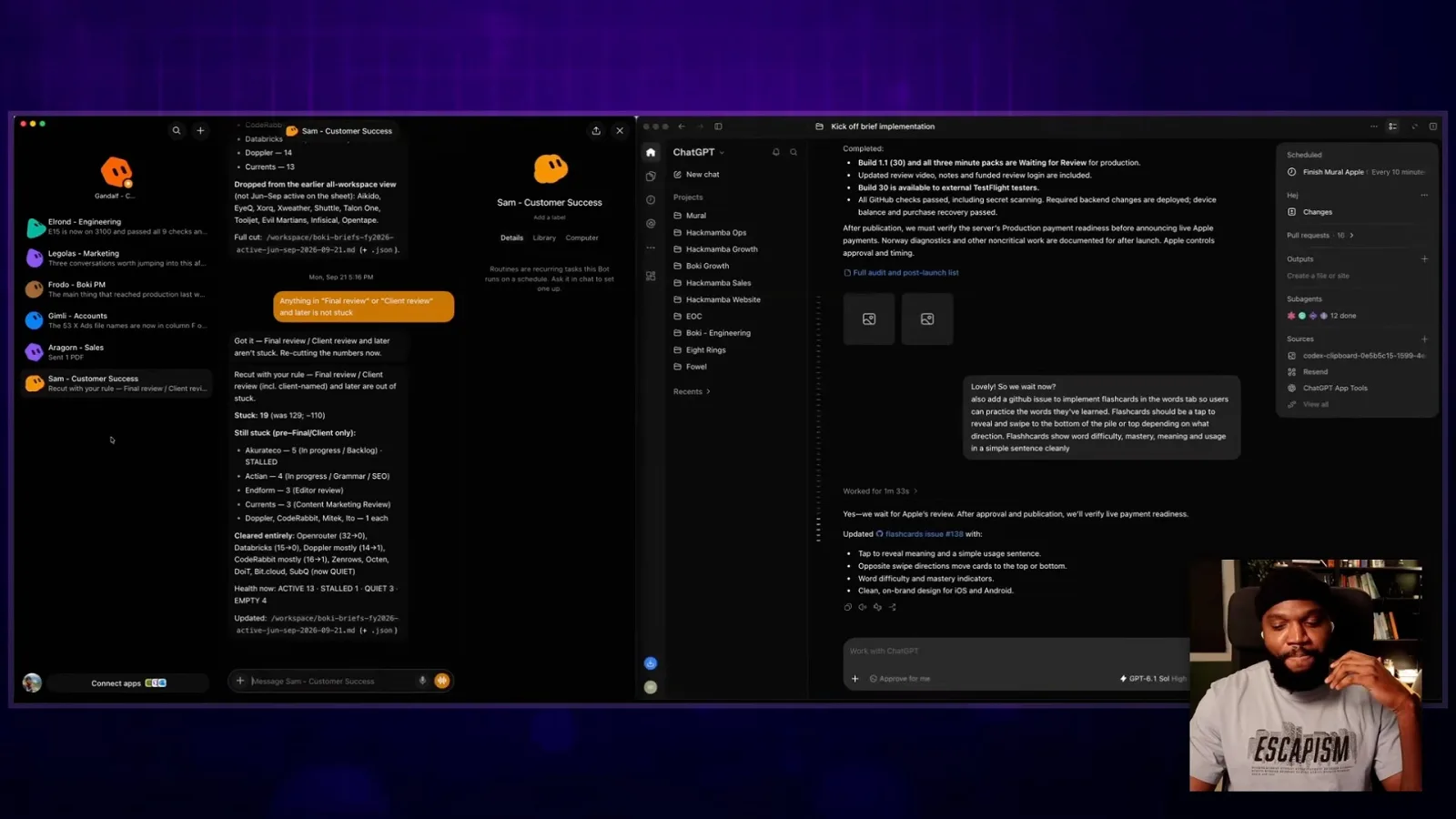
Imoh says he gave the agents broad access to his business tools and enabled computer and browser use. He says they do not have write access to the bank and that he does not have access to customer data. He describes this as his own choice despite concerns about permissions.
For hiring, he built an internal system of record called Three Pipes. After a candidate conversation, he asks an agent to gather information from email, calendar and meeting notes, create a record, summarize it and rank the candidate against others he has spoken with.
Imoh says he keeps a small number of focused skills for work such as growth and content strategy; as models improved, he found some older skills unnecessary. Vo summarizes his setup as complex work in Codex projects and separate role-based business agents.
When agents fail—and the cost of relying on them
He retries with more specific instructions and describes his concern about dependency.
When an agent does not do what he wants, Imoh restarts it, tries a more specific sequence of steps and asks it to test and review its work. He also describes using one agent to review the work of another or switching tools when needed.
Imoh says his main anxiety is dependency: if the agents disappeared, he wonders how he would manage many sales opportunities alongside hiring and calls. Vo closes by asking where listeners can find him and learn about Hackmamba.
同じチャンネルの記事
 42:30EN
 How I AI· 2026年11月2日ポッドキャスト · 2 人Inside Figma’s PM OS: Ezra Mechaber on Skills, Bug Bashes and Automated Experimentsゲスト Ezra Mechaber · ホスト Claire VoFigma growth PM Ezra Mechaber shows Claire Vo how a shared repository supports product work, browser testing and a human-reviewed experiment loop.
 35:10ENHow I AI· 2026年10月28日ポッドキャストFour Personal AI Agents on Nine Tasks: A User’s Testホスト Claire VoClaire Vo compares work and family workflows while acknowledging uneven access and subjective scoring.
 29:40ENHow I AI· 2026年10月26日ポッドキャスト · 2 人How Reddit Proto Connects Design, Live Data and Production Codeゲスト Blair Metcalf · ホスト Claire VoBlair Metcalf demonstrates Reddit’s internal prototyping harness and its design-system mapping for Figma and Cursor.
 16:22ENHow I AI· 2026年10月21日ポッドキャストClaire Vo: Claude Duet Is Beautiful, but It Is Not My Number One Agentホスト Claire VoAnthropic’s phone-based personal agent has the most polished launch Claire Vo has seen: thoughtful onboarding, task lists, first-class artifacts, and Slack-style channels. Polish is not enough when every other agent is competing for the same attention.
 36:33ENHow I AI· 2026年10月19日ポッドキャスト · 2 人How Brooke Lacey Uses Claude Code to Edit Short Videosゲスト Brooke Lacey · ホスト Claire VoA creator combines local media tools, timed cut lists and human feedback.
 24:05ENHow I AI· 2026年10月14日ポッドキャストA First Look at Meta Muse Wonder on Agent and Design Tasksホスト Claire VoClaire Vo reports strengths and weaknesses from her own small evaluation.