30 秒でわかる
Victor Davis Hanson says Republicans’ midterm losses reflected poor communication about inflation and a prolonged Iran conflict, while host Marissa Streit asks how immigration enforcement affected Hispanic support. Hanson proposes prioritizing certain removals and offering qualifying longer-term undocumented residents a route to a green card. Both criticize identity-based politics and favor assimilation, while Hanson uses Roman history to argue that internal cohesion matters.
- 1Hanson says Republicans failed to explain prices and inflationHe argues that slowing inflation did not erase earlier price increases and that the administration should have acknowledged the difference.
- 2Hanson thinks a shorter Iran campaign might have changed the electionStreit raises fuel prices and questions over the war; Hanson offers a counterfactual assessment of the political consequences.
- 3Both speakers criticize politics centered on group identityHanson favors assimilation into a shared civic identity, while Streit criticizes what she sees as identity-based education and voting.
- 4Streit asks why Republicans lost Hispanic supportShe says some Hispanic friends feel betrayed by the administration. Hanson discusses border concerns and the effects of enforcement.
- 5Hanson proposes legal status for some long-term undocumented residentsHe would prioritize some removals, then offer eligible people a green card subject to conditions and a fine; it would not automatically confer citizenship.
- 6Hanson reads Roman history as a warning about internal cohesionHe compares different periods of Roman history and argues for teaching civic history and shared responsibility.
- 7Hanson says political recovery requires clearer communicationHe cites past midterms and later presidential recoveries, and urges the administration to explain its policies on Iran, immigration and the economy.
ポイント
- Hanson thinks the administration did not clearly distinguish persistent high prices from the rate of inflation.
- He argues that the Iran conflict’s duration and communication, as well as fuel prices, hurt Republican support.
- His immigration proposal combines prioritized enforcement with a green-card option for some long-term residents who meet conditions.
- Streit raises concerns about how raids affected Hispanic communities; Hanson concedes officials may have overreacted while defending enforcement priorities.
- Hanson favors shared civic identity and interprets Roman history as a warning about internal cohesion.
チャプターごとに整えた全文を読む
Recovery and the midterm defeat
Hanson describes surgery and recovery before discussing Republican losses. He emphasizes messaging, inflation and the Iran conflict.
PragerU CEO Marissa Streit asks historian Victor Davis Hanson about Republican losses in the midterms, Iran, immigration and the future of the party. Hanson attributes much of the result to communication failures and the handling of the Iran conflict; both speakers also discuss their concerns about identity politics.
Before turning to politics, Streit asks about Hanson’s health. He says that after leaving the hospital in January he gradually increased his walking from fewer than 500 steps to 10,000 a day. He describes treatment for a rare cancer and complications after surgery.
Hanson says his cancer had initially gone undetected or been attributed to another illness. He recounts a lengthy operation followed by serious bleeding that required another procedure and blood transfusions.
He says his surgeon was optimistic about his recovery despite the complications. Hanson reports regular blood testing for recurrence and says the tests he had received so far were negative; he was awaiting another scan.
Hanson says his energy and heart rate improved in recent weeks after a period when exertion had been difficult. He credits his medical team and others who helped him through recovery.
He thanks his surgeon and other supporters for helping coordinate care. Streit says viewers have been hoping for his recovery.
Streit thanks those who supported him and says several prominent conservative figures have died or had health setbacks. She asks how the Republican movement can understand the midterm defeat.
Hanson says Vice President JD Vance offered several explanations, including the economy, Iran, Israel and the emphasis on America First. Hanson gives his own view: he does not think support for Israel by itself explains the result.
Hanson argues that Israel helped weaken Iranian air defenses and was an important ally. He says the conflict with Iran did contribute to higher fuel prices and dissatisfaction among parts of Trump’s political base.
In Hanson’s account, many supporters accepted the objective of preventing an Iranian nuclear threat but became frustrated with the conflict’s duration and uncertain messaging. His descriptions of the damage and remaining capabilities are his assessment.
He says repeated claims that the conflict was nearly over contrasted with continued attacks and made the administration appear inconsistent. He thinks the political effect was different from what supporters had expected.
Hanson describes the shorter campaign and subsequent security posture he believes the administration should have pursued, including a continuing US naval presence. He speculates that a shorter conflict would have reduced fuel-price pressure.
Comparing the 2022 and 2026 midterms, Hanson says Republicans performed worse than expected in both periods despite different economic conditions. He argues that the administration’s explanation of prices and inflation was a major weakness.
He cites his comparisons of gas prices, output, income, poverty and inflation between the two election periods. His conclusion is that economic conditions alone do not explain the different results.
Hanson distinguishes the level of prices from the rate at which prices rise. He says the administration should have more clearly explained that people were still paying higher prices accumulated earlier even when the inflation rate slowed.
He argues the administration should have acknowledged households’ continuing financial pressure while explaining changes in income and inflation. He also believes media coverage treated the two administrations differently.
Hanson says he perceives a contrast between how media discussed inflation under Biden and how they discuss prices under Trump. He still thinks the administration bears responsibility for explaining its record.
Iran, Israel and American foreign policy
Streit questions the connection between the conflict and domestic costs. Hanson defends action against Iran and compares US approaches to Israel and Ukraine.
Streit summarizes an argument she hears: that Israel drew the US into a conflict with Iran, which raised fuel prices and damaged the economy. Hanson says a shorter campaign might have improved Republicans’ chances, while stressing this is a counterfactual judgment.
He says he believes supporters wanted a defined mission and an end to the campaign rather than an open-ended sequence of negotiations. He presents this as his reading of political sentiment.
Hanson criticizes the administration’s alternating negotiations and military actions. He argues it should have defined its objective, acted and then left a limited security presence rather than repeatedly suggesting a deal was close.
He says sanctions and pressure could eventually weaken the Iranian government, but acknowledges uncertainty about what might happen. He does not believe negotiations with the current government would produce a reliable agreement.
He argues that economic sanctions, military pressure and a different approach to Iranian opposition could have changed incentives. His expectation about the eventual result remains speculative.
Streit asks why the US needed to act if some Americans see Iran mainly as a threat to Israel. Hanson responds by citing past attacks and threats he attributes to Iran and its partners, and argues that the security of shipping routes affects other countries too.
Hanson cites attacks on Americans and security concerns around the Strait of Hormuz to explain why he considers Iran a US concern, not solely an Israeli concern.
Hanson says Iran gained leverage through its influence across the region. He criticizes the Obama administration’s nuclear agreement and regional policy, which he believes strengthened Iran and its allies.
He criticizes the previous nuclear agreement as inadequate and believes Iran’s regional partnerships created security risks. His assessment is contested and is presented as his view.
On Israel, Hanson argues that its economy has changed substantially over time and that ending US aid could eventually benefit both countries. Streit agrees that restrictions attached to assistance are part of the debate.
Hanson compares US treatment of Israel and Ukraine, arguing that Washington applies different expectations to the two allies. He criticizes what he sees as unequal scrutiny over military conduct and political decisions.
He points to civilian harm and wartime restrictions in both conflicts to argue for a more consistent standard. These are his comparisons and judgments about the wars.
Hanson rejects the claim that Israel controls US policy. He says some Americans support Israel for religious reasons, while others, including him, support it because they view it as a Western democracy defending itself.
He recalls his own travel in the Middle East and a disagreement during a television appearance. He argues that people have different degrees of freedom to criticize governments or change religion across countries in the region.
Hanson uses a hypothetical television interview to contrast what he thinks could happen to government or religious critics in some Middle Eastern countries with what he expects in Israel. His examples express his assessment of those societies.
Hanson says he values the ability to criticize political leadership and discuss religious beliefs. He uses those freedoms to explain his support for Israel.
Assimilation and identity politics
Both speakers criticize group-based politics and favor shared civic identity. Hanson draws on political examples, teaching and his community to explain his view.
Streit and Hanson discuss pro-Palestinian slogans. They interpret those slogans as hostile to Israel and the West; their interpretation is their political view. Hanson then shifts to what he sees as problems with assimilation in the United States.
Hanson argues that some first- and second-generation immigrants and political figures give ethnic or religious identity too central a role in public life. He favors a “melting pot” model in which shared civic identity takes precedence.
He criticizes several named public figures and questions the consistency of their political arguments and personal circumstances. His comments include allegations about individuals and families that he presents in support of his view.
Hanson continues criticizing public figures over their statements about immigration, Israel and America. He argues that some political rhetoric emphasizes grievances while overlooking opportunities available in the United States.
He gives examples involving politicians and their families to support his argument about competing loyalties. These are his claims and interpretations of their statements, not findings established by the interview.
Hanson also criticizes a public figure of Indian ancestry and describes the history of the Indian community in Uganda. He uses that example to argue that critics should consider their own family histories when making claims about colonialism.
Streit argues that some political leaders use collective grievance to seek power. She says she has warned in classrooms that multicultural and ethnic-studies approaches can encourage students to view one another mainly through group identities.
She interprets the midterm results as a failure to teach a shared American identity. Hanson similarly objects to politicians foregrounding demographic firsts, while distinguishing his view of how a conservative candidate was discussed.
Hanson asks why high gas prices appear to have had different political consequences in California. He suggests that ethnic identification and partisan alignment can also influence how people vote.
He argues that contemporary left-wing politics shifted attention from economic class to race and identity. He attributes a role in that change to Barack Obama and portrays the shift as a durable division rather than a temporary policy dispute.
Hanson says categories based on race can persist even as people’s economic circumstances change. He questions approaches that assign an advantage or disadvantage primarily through group identity rather than individual experience.
He compares the US with other large multiracial democracies and argues that an emphasis on common citizenship has been important to the American model. His broad characterizations of other countries are part of his argument.
Hanson says he wants people assessed as individuals rather than treated as representatives of racial groups. He believes focusing on fixed group categories can encourage people in other groups to respond in kind.
As an analogy, he compares identity-based political competition to proliferation: once one group organizes around identity, others may do so as well. He is critical of diversity programs and separate identity-based activities.
Hanson recounts living in a predominantly Hispanic community and observing people he knows express their heritage differently over time. He interprets some of those changes as movement away from assimilation; Streit agrees with his concern.
He describes teaching Latin and Greek to students from diverse backgrounds and helping some apply to further study. He says he wanted them to receive the education and opportunities available to more privileged students.
Hanson recalls students later using language about racism and diversity that he says surprised him. He interprets their experiences differently and argues that institutions encouraged a stronger emphasis on group identity.
He describes interactions in local shops as an example of what he perceives as people recognizing one another through group identity. He worries this dynamic will deepen if different communities increasingly see themselves as separate tribes.
Hanson invokes conservative Black scholars he says influenced his thinking and criticizes what he views as inconsistency among some white liberals. He argues that support for diversity can become symbolic without close engagement across communities.
He contrasts political signs and institutional diversity commitments with the neighborhoods and schools where he says affluent people live and exercise influence. This is his critique of the behavior and motives of a segment of liberal voters.
Hispanic voters and immigration enforcement
Streit asks why Republican support among Hispanic voters changed. Hanson discusses border concerns, raids and their political consequences.
Streit turns to Hispanic voting and says some Latino friends feel betrayed by the Trump administration. She asks why support changed after Trump had attracted Hispanic voters who had not previously supported Republicans.
Hanson says concerns about border crossings, crime and pressure on services helped Trump win support among some Hispanic voters. He draws on conversations and experiences in his own community to explain that view.
He recounts an experience at an emergency room and describes residents’ frustration with access to services. He uses these anecdotes to argue that immigration and enforcement can affect established local communities.
Hanson says the administration initially emphasized removing people with criminal records and recent unauthorized arrivals. He argues that the number and geographic distribution of undocumented residents made enforcement difficult.
Hanson says immigration policy became more tense as the number of foreign-born and unauthorized residents grew. He believes this made the administration’s stated enforcement objectives difficult to carry out.
He describes daytime immigration raids and protests and poses a hypothetical in which agents pursuing suspects encounter other people without legal status. He says enforcement can produce politically damaging images even when agents are looking for particular individuals.
Streit says the operations appeared designed to frighten Hispanic communities. Hanson says they were intended to deter unauthorized entry but concedes that officials probably overreacted in some cases.
Hanson says he would prioritize people convicted of crimes and recent arrivals, then pause. He describes the difficulty of enforcement across many jurisdictions and criticizes jurisdictions that limit cooperation with federal immigration authorities.
He attributes some enforcement problems to the scale and distribution of the undocumented population and to disagreements between local and federal officials.
Hanson’s proposed immigration compromise
He proposes prioritizing removals and offering some long-term residents a conditional route to a green card. The speakers debate how communities might respond.
He says more discreet enforcement would be preferable. Hanson then offers a compromise that he acknowledges may anger some Trump supporters: continue certain removals while creating an option for some longer-term residents to obtain legal status.
Under Hanson’s proposal, eligible longer-term residents would have to meet conditions concerning work, criminal history and public assistance and pay a fine to obtain a green card. He says this would not automatically grant citizenship.
He says he has received criticism for similar proposals in the past. His stated reason for a legalization route is that he does not want to remove millions of long-term residents whom he believes have substantially assimilated.
Hanson recounts questions from critics who argue that unauthorized entry broke the law and therefore should not be regularized with a fine. He says his answer is pragmatic: he prefers a route to status for eligible long-term residents over mass removals.
Streit asks why Republicans would not listen to Hispanic voters who want a path to citizenship, including those concerned about people brought to the US as children. She distinguishes eligible voters from undocumented relatives and neighbors.
Hanson reiterates a two-tier approach: prioritize removal of criminals and recent unauthorized entrants, while offering qualifying longer-term residents a route to a green card. Streit argues that an offer would provide an incentive alongside enforcement.
They question how Hispanic communities would react if deportations continued under such a compromise. Hanson predicts continued objections; Streit thinks combining an opportunity for status with enforcement could produce a different response.
Citizenship, history and assimilation
Hanson describes his understanding of immigration history and American founding principles. He recounts family and community experiences to support shared citizenship.
Hanson then gives his interpretation of changes to US immigration law in the 1960s and the political motives behind them. He argues against judging prospective immigrants by racial solidarity and returns to his preference for shared citizenship.
Hanson argues immigration policy should be evaluated through a common national identity rather than racial or ancestral preferences. He uses his own experiences abroad to illustrate his view.
He recounts defending a Black American service member during an argument abroad as an example of identifying first with a fellow American. He contrasts that experience with what he sees as political appeals based on ancestry.
Hanson discusses American founding documents and argues that their equality principles created a framework later used to challenge racial exclusion. He cites Frederick Douglass as someone who held the country to those principles.
He acknowledges prejudice against successive immigrant groups but says he sees an arc toward judging people by character. He argues that contemporary group-based politics threatens that model.
Hanson recalls his Swedish family background and a grandfather who emphasized being American. He presents the story as an example of immigrants valuing a common identity while retaining a family history.
He recalls Mexican American acquaintances who expressed pride in their heritage and in military or civic service. In his telling, those identities did not prevent a sense of shared nationality.
Hanson describes attending a predominantly Hispanic school at his parents’ direction. He recalls both conflict and friendships, and says the experience shaped his view that people from different backgrounds can share a community.
He says his friendships across backgrounds influenced his belief in a shared community. Streit responds that she is concerned about the direction of multicultural education.
Roman history and political recovery
Hanson interprets Rome as a warning about internal cohesion and calls for more civic education. He and Streit close by discussing how Republicans could recover.
Streit asks what ancient history teaches about Western societies. Hanson shifts from her reference to Athens to Roman history, arguing that internal cohesion can matter more than external threats.
He compares Rome’s resistance to Hannibal during the republic with the later empire’s response to invasions. Hanson interprets the contrasting outcomes through civic commitment and internal conditions, rather than military strength alone.
He argues that later Roman prosperity and leisure weakened citizens’ commitment to their society. He uses the comparison to raise concerns about contemporary American education and civic knowledge.
Hanson says young people are more familiar with current identity debates than with some foundational events and documents. He argues that schools and universities should teach more history and civic responsibility.
He also worries that self-absorption and tribalism weaken a willingness to sacrifice for family and community. Streit agrees with his concern about the cultural direction he describes.
Hanson tells a story about a roofing worker whose skill he admired. He says the example shows why manual work deserves respect and argues that education should value work and family as well as academic credentials.
He criticizes modern universities as institutions he believes teach ideas contrary to American civic life. Streit asks whether there is a more hopeful ending to the conversation.
Hanson says the country can recover politically. He notes that the president’s party often loses seats in midterms and points to past presidents whose approval later improved, while acknowledging that he sees this defeat as unusually large.
He says the administration should communicate more clearly about Iran, immigration enforcement and the economy. Despite his criticisms, he believes the political situation can change if leaders listen and explain their policies.
Streit congratulates Hanson on his book about Trump. Hanson jokes that Trump’s political trajectory could be described as repeated falls and rises, depending on what happens after the midterms.
They compare Trump’s public persona to a larger-than-life or tragic figure. Hanson uses the image of a Western-film hero whom a community calls upon in a crisis but later finds difficult to accept.
Streit closes by saying Americans can recover from setbacks and return to work. Hanson agrees, and the conversation ends with both expressing hope despite their criticisms.
同じチャンネルの記事
 10:56EN
 PragerU· 2026年11月12日Melissa Chen links her free-speech concerns to US-China rivalryMelissa ChenRaised in Singapore, Chen describes campus self-censorship and argues that China poses a major strategic threat to the US.
 33:47ENPragerU· 2026年11月11日Jill Simonian: West Point changed its mission, not its mottoJill Simonian · PragerU KidsThe PragerU Kids host argues schools should teach service and sacrifice alongside kindness, using West Point’s words as an example.
 18:09ENPragerU· 2026年11月7日Owen Anderson Discusses His ASU Training LawsuitShabbos Kestenbaum, Owen Anderson · PragerUThe professor describes his challenge to diversity training and a separate dispute over his courses; ASU disputes his discrimination allegations.
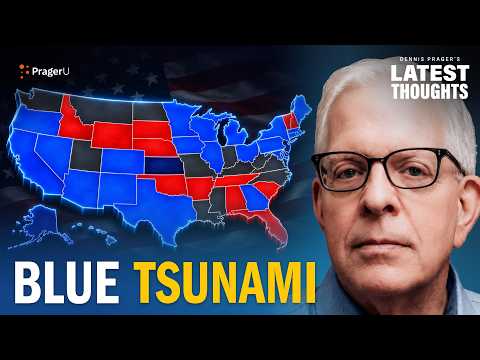 33:40ENPragerU· 2026年11月7日Dennis Prager Responds to the 2026 Midterm ElectionsDennis Prager · PragerUPrager and a host discuss the election result, the administration’s record, Iran and immigration enforcement from a conservative perspective.
 10:18ENPragerU· 2026年11月6日Midterm Results, Data Centers and Manufacturing: The Wrap UpPragerU reviews election results, local data-center concerns, manufacturing indicators and a toddler snack recall.
 45:00ENPragerU· 2026年11月4日Jill Simonian on children’s streaming videos and Illinois school ratingsJill Simonian · PragerU KidsThe Parent Alert host questions fast-paced children’s videos on Netflix and examines a new Illinois school rating system.