30 秒でわかる
Jill Simonian urges parents to inspect children’s entertainment as popular YouTube creators move onto Netflix. She criticizes fast edits and prank-based programming, and advocates family discussion and reading. She also questions Illinois school ratings and discusses parental consent for sensitive student surveys. Illinois’s new framework replaces a top-10% cap with fixed criteria; school ratings and individual subject proficiency are different measures.
- 1Popular YouTube formats are moving to NetflixSimonian examines Jordan and Salish Matter, the Stokes Twins and Cocomelon, urging parents to review the content their children watch.
- 2Fast editing and prank culture concern the hostShe argues rapid cuts and high stimulation can affect children’s attention and behavior; her stronger claims about widespread clinical addiction are not established in the episode.
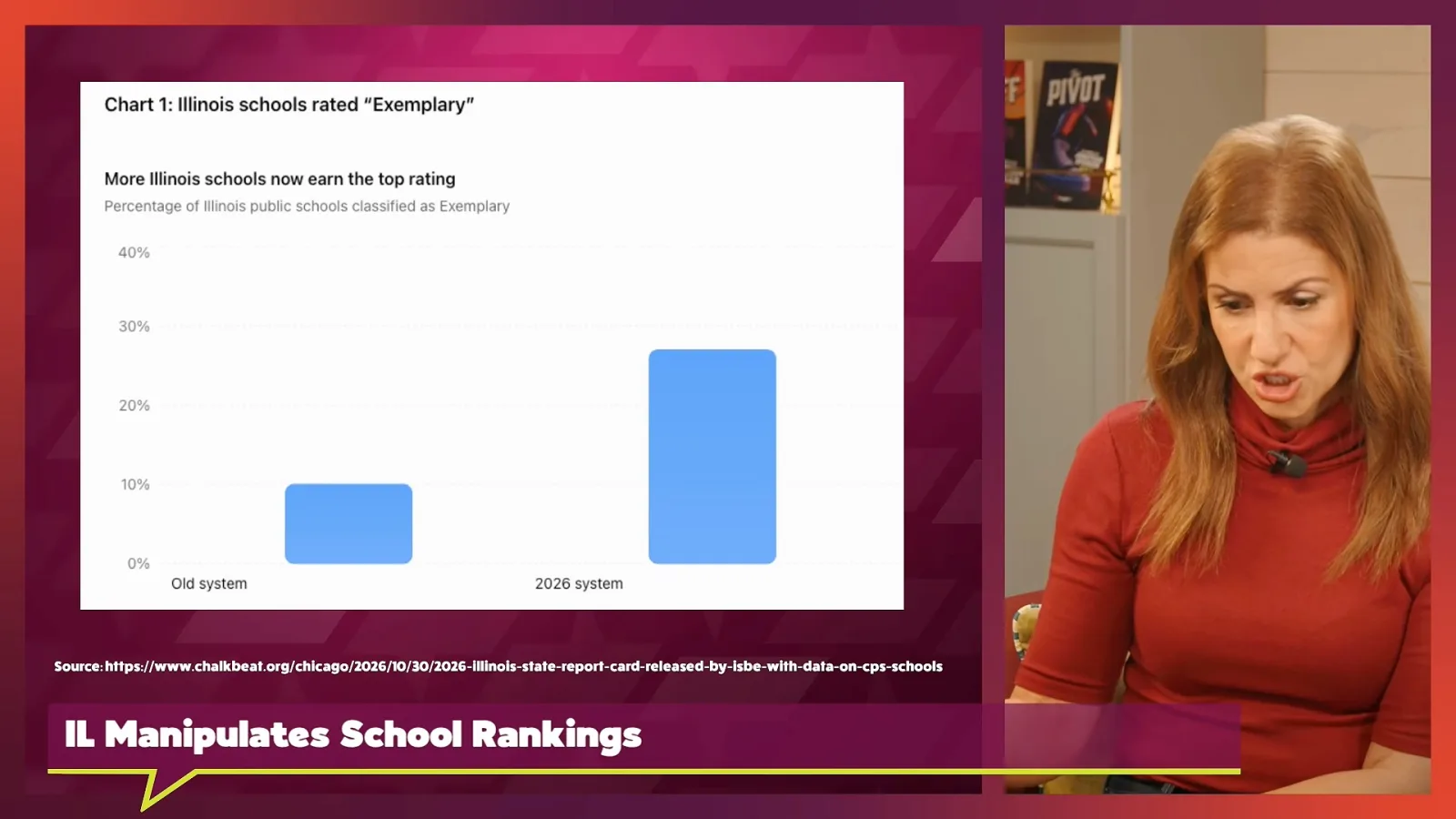
- 3Illinois changed how schools earn its highest ratingThe old system capped the top category at 10%; the new framework uses fixed criteria, and 27% earned exemplary status.
- 4A parent group recommends written consent for sensitive surveysSimonian describes a proposed policy and federal student privacy protections; requirements vary with the type of survey and its funding and administration.
- 5Co-viewing is part of her family’s approachSimonian says she watches and discusses questionable material with her teenagers instead of relying only on restrictions.
ポイント
- Simonian urges parents to examine individual programs rather than assume a streaming platform guarantees suitability.
- She favors co-viewing, conversation and reading alongside limits on screen use.
- Illinois changed from a capped school rating to fixed performance criteria, so the share of schools rated exemplary is not directly comparable.
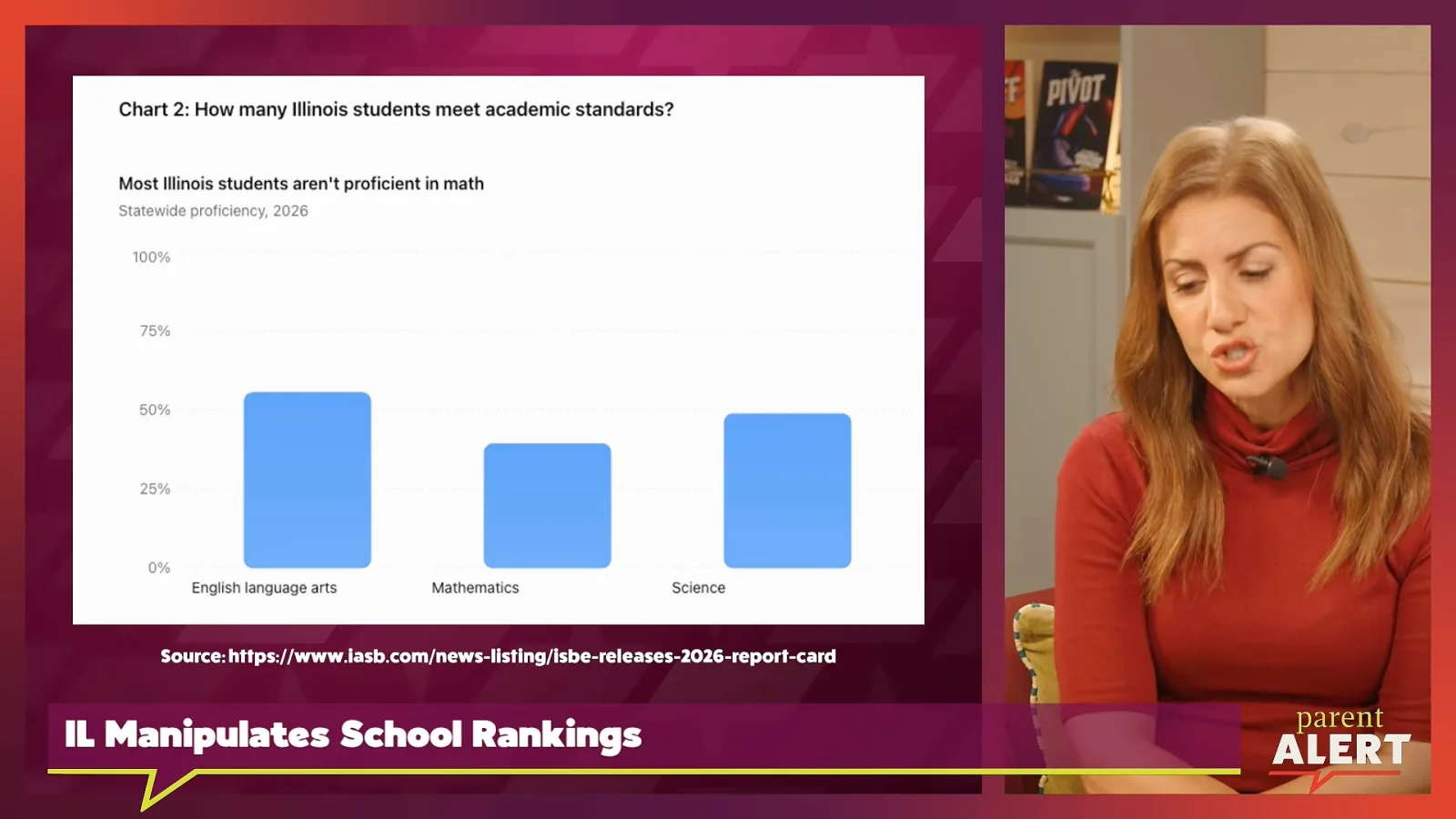
- The state reports 2026 proficiency of 39.2% in math, 55.4% in English language arts and 48.7% in science.
- Student survey consent rules depend on the survey and circumstances; families can consult the Education Department’s PPRA guidance.
チャプターごとに整えた全文を読む
A post-election message and the first clip
Simonian opens with encouragement for families and introduces a Jordan and Salish Matter video. She explains why it prompted this episode.
After the midterm elections, Jill Simonian opens with a biblical message of courage and urges families to teach children history and the values they hold dear. She introduces questions about children’s online entertainment and Illinois schools.
A clip shows Jordan Matter, his daughter Salish and others competing to choose a location for a sleepover in a Target store. Simonian uses it to introduce the fast-paced creator videos familiar to many preteens.
Simonian identifies Jordan and Salish Matter after the opening clip and says parents may recognize them through their preteen children. She chose the subject before election day because questions about children’s media had already been on her mind.
Simonian says she was unfamiliar with the Matters because her own teenagers grew up under strict household rules for YouTube and shared-device use. She allowed selected educational and family content, including PragerU Kids.
YouTube creators arrive on Netflix
She describes her family’s screen rules and discusses the Matters, the Stokes Twins and Cocomelon. Her critique focuses on pacing, pranks and children’s attention.
She recalls that her children did not have personal iPads: they borrowed a shared family device with permission. She says she was very strict about what YouTube content they could watch.
She describes Jordan Matter’s move from photography videos to family content featuring Salish. She questions the message of the channel’s playful subscription slogan and notes the channel’s large audience.
Simonian criticizes rapid edits, bright graphics and game-like challenges. She claims that such videos cause dopamine crashes in children; the episode does not establish that physiological claim or support its broader assertions of clinical addiction.
Simonian also mentions a teen makeup line associated with Salish and her father. She says she does not object to family businesses earning money, but asks parents to consider the values conveyed by the videos.
She says the Matters’ YouTube content is being repackaged for Netflix and mentions a reported original series. Her concern is that parents who avoided YouTube may now encounter similar creator content on a streaming service.
The show next plays a Stokes Twins clip about building secret rooms. Simonian criticizes what she sees as an emphasis on pranks, deception, risky behavior and crude jokes, and asks whether the material matches families’ values.
Discussing the Stokes Twins, Simonian says she has heard concerns about children copying lying, deception and inappropriate pranks. She presents those concerns as reasons to review episodes before allowing young children to watch.
A Cocomelon nursery-rhyme clip offers a contrast aimed at toddlers. Simonian calls it milder in subject matter but objects to rapid cuts, movement, bright colors and repetitive hooks.
The Cocomelon example features a familiar nursery rhyme. Simonian points to scene changes, panning, zooming and color as the features she finds concerning, even though the clip itself appears less provocative than the preceding example.
She argues that stimulating media can make transitions away from screens difficult and may affect attention and self-regulation. She invokes research and pediatricians, but the episode provides no evidence that most children are clinically addicted or that these specific shows cause brain damage.
Simonian worries that everyday activities such as reading, shopping and interacting with friends can seem less exciting beside fast-moving screen content. She asks parents to inspect programs instead of assuming a Netflix listing itself guarantees suitability.
She warns that parents may mistakenly assume a major streaming service has independently screened all children’s content for developmental quality. Her recommendation is to evaluate the actual show and its suitability for each child.
She says parents and educators sometimes use screens as a substitute for direct interaction. Her preferred alternatives are slower-paced stories, books and programs that she believes encourage good character.
Alternatives and reading
Simonian recommends slower storytelling and reading, including PragerU Kids programming and its book fair.
Simonian names several PragerU Kids shows as alternatives and promotes its book fair. She urges families to read together and choose stories consistent with their own values.
The proposed alternative includes reading together. Simonian describes books in PragerU Kids’ fair for children from pre-kindergarten through eighth grade, including stories about American history and landmarks.
Illinois school ratings and proficiency
The host reviews a change in school ratings and statewide test results. The new system replaced a capped ranking with fixed criteria.
Turning to Illinois, Simonian argues that a change to the school rating system makes it harder for parents to understand academic performance. She compares the former 10% share of exemplary schools with 27% under the new system.
Simonian presents the state’s redesign as a change in the way schools are classified. Her central concern is that families might mistake a higher number of schools receiving the top designation for a comparable increase in test proficiency.
The state changed the structure of the rating: the previous system reserved the top designation for a capped share of schools, while the new framework uses fixed criteria. The percentages therefore reflect different rules, not a direct measure of individual students’ test scores.
Simonian presents statewide 2026 proficiency figures: 39.2% in math, 55.4% in English language arts and 48.7% in science. She says parents should look beyond the headline school designation to underlying measures.
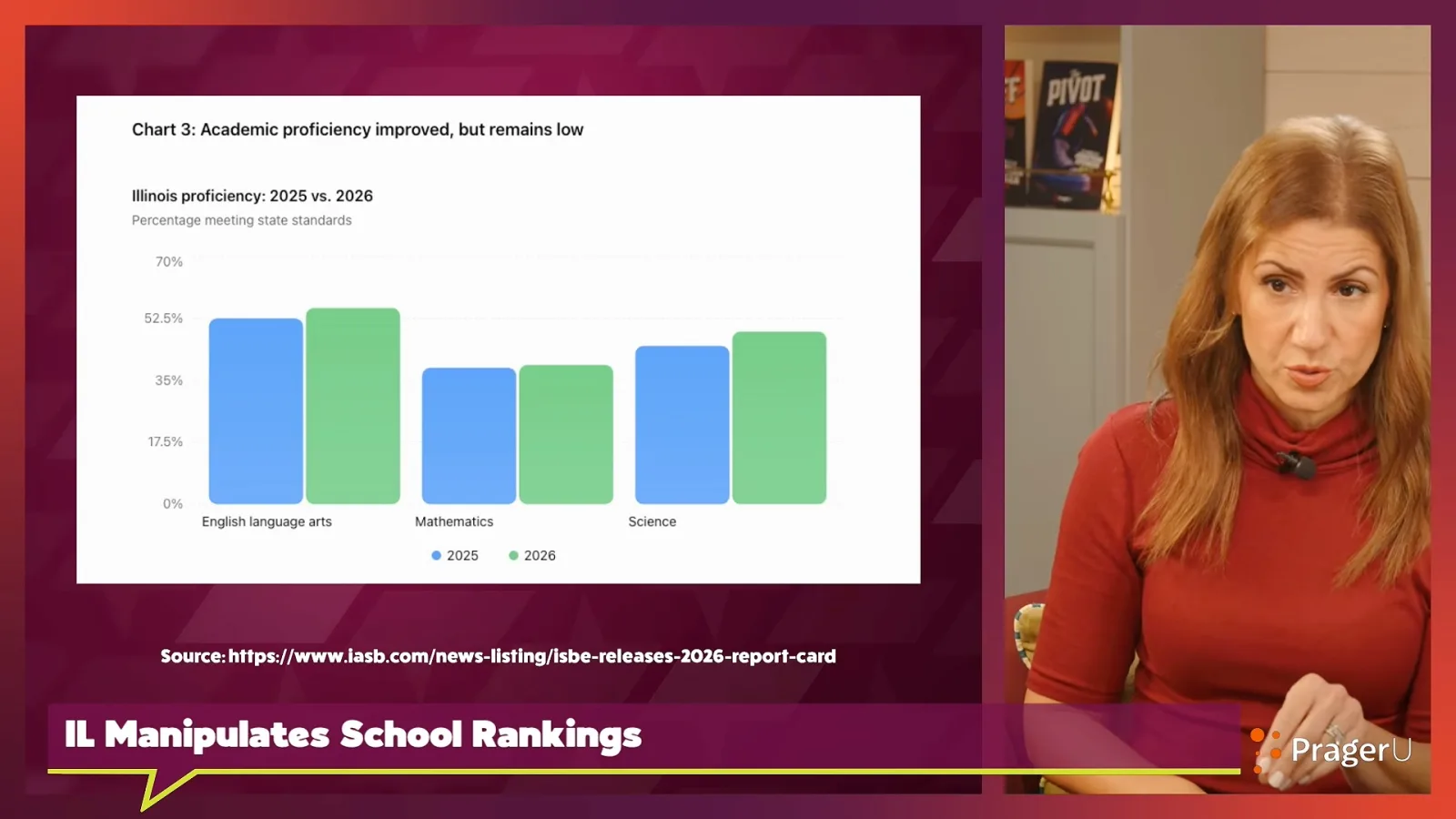
A second comparison shows that proficiency increased in all three subjects from 2025 to 2026. Math rose from 38.4% to 39.2%, a gain of 0.8 percentage points, according to the Illinois State Board of Education.
Simonian interprets the higher share of exemplary schools as an effort to give parents a misleading impression. The change itself does not establish the intent she attributes to officials; the state says it adopted fixed criteria after stakeholder engagement.
She also criticizes curriculum choices and argues that families should examine the books and standards used by their local schools. Her example of a California district is unnamed in the episode.
She cautions viewers against accepting general claims of improvement without examining details. She also criticizes diversity-focused curriculum changes, although she does not identify the California district she describes.
Student surveys and parental consent
Simonian describes a federal privacy letter and an Illinois parent organization’s proposed consent policy. The applicable protections depend on the facts of each survey.
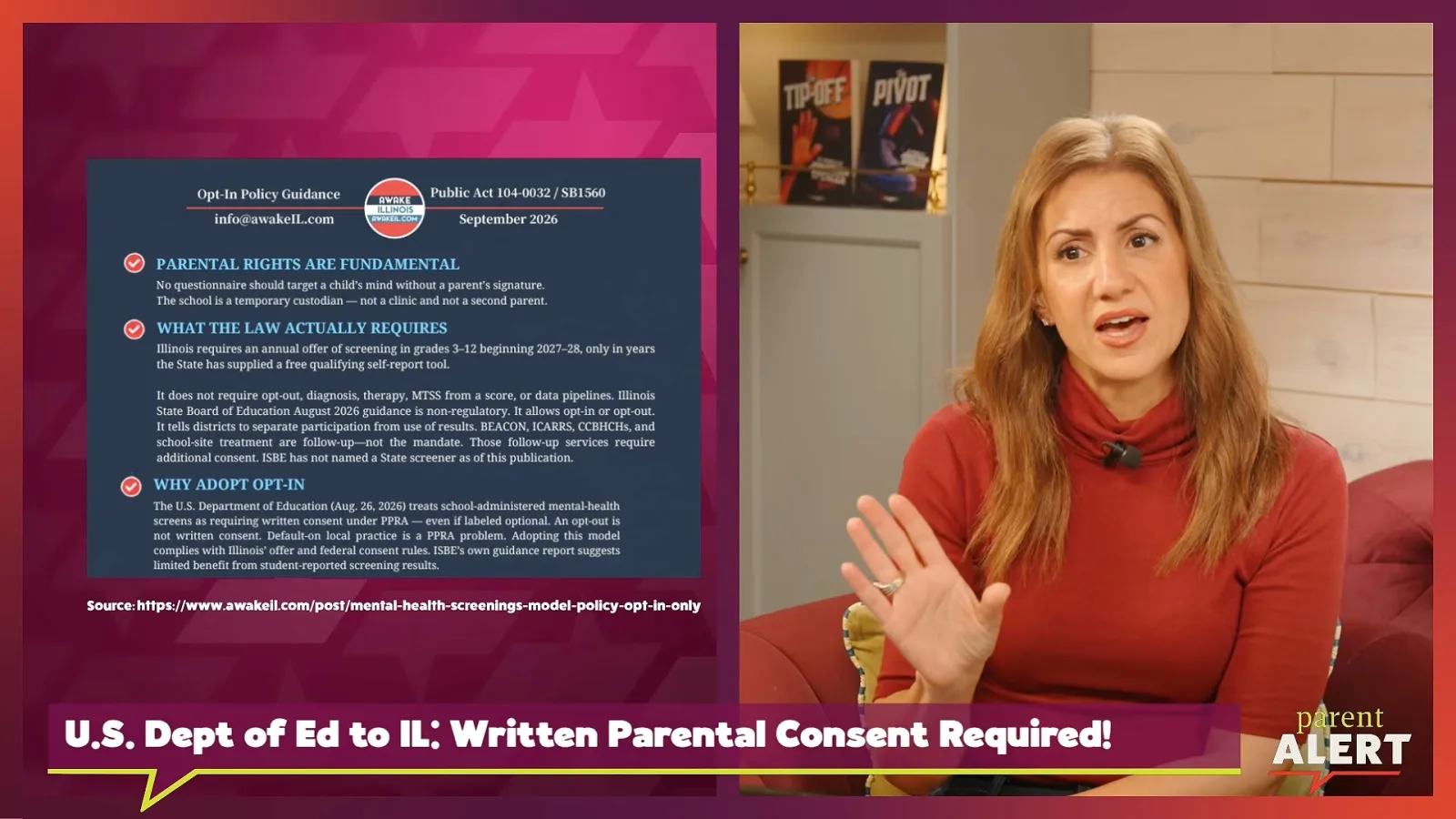
Simonian turns to student privacy and describes a federal Education Department letter concerning sensitive surveys. She says a parent-led organization, Awake Illinois, has prepared a model school-board policy favoring written parental consent.
She discusses the Protection of Pupil Rights Amendment and surveys asking about mental or psychological problems. Federal guidance distinguishes among survey types, funding and whether participation is required; it should be consulted for the specific case rather than assuming one rule covers every survey.
The host shows the organization’s model policy and encourages school boards and families to examine the proposal. The displayed handout presents the organization’s interpretation of Illinois requirements and federal consent protections.
Simonian notes that Awake Illinois drafted the proposal for Illinois school districts and suggests that families elsewhere review whether a similar policy fits their district. The handout is a proposal by an advocacy organization, not itself a legal ruling.
Parents’ questions and family media habits
Responding to viewers, Simonian describes watching and discussing videos with her teenagers. She encourages parents to research school information themselves.
Responding to viewer comments, Simonian considers when children should use YouTube without supervision. She describes the question as difficult and says she has spent years discussing values and media choices with her own children.
A viewer asks what age is appropriate for unrestricted use of adult YouTube. Simonian says her teenagers want access to social media and videos, but her family continues to discuss and monitor what they watch.
Her current approach is to watch some material with her teenagers, laugh together, and discuss both what they enjoy and what they find troubling. She sees those conversations as a long-term process rather than a rule that can be imposed overnight.
Asked when unsupervised viewing becomes appropriate, she offers her personal answer: when her children leave home and live independently. She acknowledges that parents cannot prevent children from encountering everything without their knowledge.
She says her approach draws on religious convictions and repeated family conversations. While she wants to prepare her children to make decisions independently, she recognizes that they will encounter content beyond a parent’s control.
Simonian asks viewers to research local school issues and read beyond the brief summaries on the show. She connects this to a broader argument about the responsibility of families to pass on their values.
Simonian relates her education concerns to the election and calls for renewed attention to religious belief, history and civic knowledge. Her remarks lead into a children’s history segment.
A children’s history clip introduces philosopher John Locke and his relationship with Lord Ashley. It presents ideas about civil liberties, religious tolerance and limits on government for a young audience.
Civics education
A children’s clip introduces John Locke and his political ideas. Simonian describes PragerU Kids’ civics resources.
Simonian describes a PragerU Kids civics challenge that sends families age-targeted videos about common concepts over ten days. She presents it as one resource for discussing government and history with children.
The civics challenge offers different videos for different age groups on the same daily concept. Simonian says its topics include government, consent and the social contract, and closes by encouraging families to use the organization’s educational resources.
同じチャンネルの記事
 18:09EN
 PragerU· 2026年11月7日Owen Anderson Discusses His ASU Training LawsuitShabbos Kestenbaum, Owen Anderson · PragerUThe professor describes his challenge to diversity training and a separate dispute over his courses; ASU disputes his discrimination allegations.
 33:40ENPragerU· 2026年11月7日Dennis Prager Responds to the 2026 Midterm ElectionsDennis Prager · PragerUPrager and a host discuss the election result, the administration’s record, Iran and immigration enforcement from a conservative perspective.
 10:18ENPragerU· 2026年11月6日Midterm Results, Data Centers and Manufacturing: The Wrap UpPragerU reviews election results, local data-center concerns, manufacturing indicators and a toddler snack recall.
 1:09:13ENPragerU· 2026年11月4日Katharine Birbalsingh on discipline, social media and the values schools teachMarissa Streit, Katharine Birbalsingh · PragerUThe Michaela Community School head discusses classroom habits, national belonging and parental authority with PragerU’s Marissa Streit.
 1:09:46ENPragerU· 2026年11月1日Rob McCoy and Shabbos Kestenbaum on the Ten Commandments, Family and FaithShabbos Kestenbaum, Rob McCoy · PragerUA Christian pastor and an Orthodox Jewish host discuss the religious meaning of the commandments and their application to family, community and public life.
 17:42ENPragerU· 2026年10月31日Tanya Tsikanovsky on Homelessness and Local Politics in West HollywoodShabbos Kestenbaum, Tanya Tsikanovsky · PragerUThe City Council candidate discusses housing, immigration and identity after a public comment at a Los Angeles council meeting.