30 秒でわかる
Sawyer presents a new challenge about sliding a rectangular painting through an arched window, leaving it open for viewers to solve. He then solves the previous toy-boat problem with a quadratic equation and a geometric argument using similar triangles and the tangent double-angle formula.
- 1An arched-window challengeThe window is a one-metre square topped by a semicircle; the framed paintings are three metres wide.
- 2Boat and currentThe original crossing gives a motor-speed-to-current-speed ratio of 100:60, or 5:3.
- 3A quadratic solutionSolving the distance ratio gives 127.5 metres upstream; the negative root is extraneous.
- 4A geometric alternativeSimilar triangles and the speed ratio imply an isosceles triangle, leading to the same result via a double-angle formula.
ポイント
- The new challenge asks for the tallest three-metre-wide framed painting that can pass through a specified arched window.
- The boat’s first crossing reveals a 5:3 ratio between its motor speed and the river speed.
- A quadratic calculation gives an upstream aiming point 127.5 metres from the friend’s dock.
- Squaring an equation can introduce an extraneous solution that must be checked.
- Similar triangles reveal an isosceles triangle and a second route using a double-angle identity.
チャプターごとに整えた全文を読む
A new museum puzzle
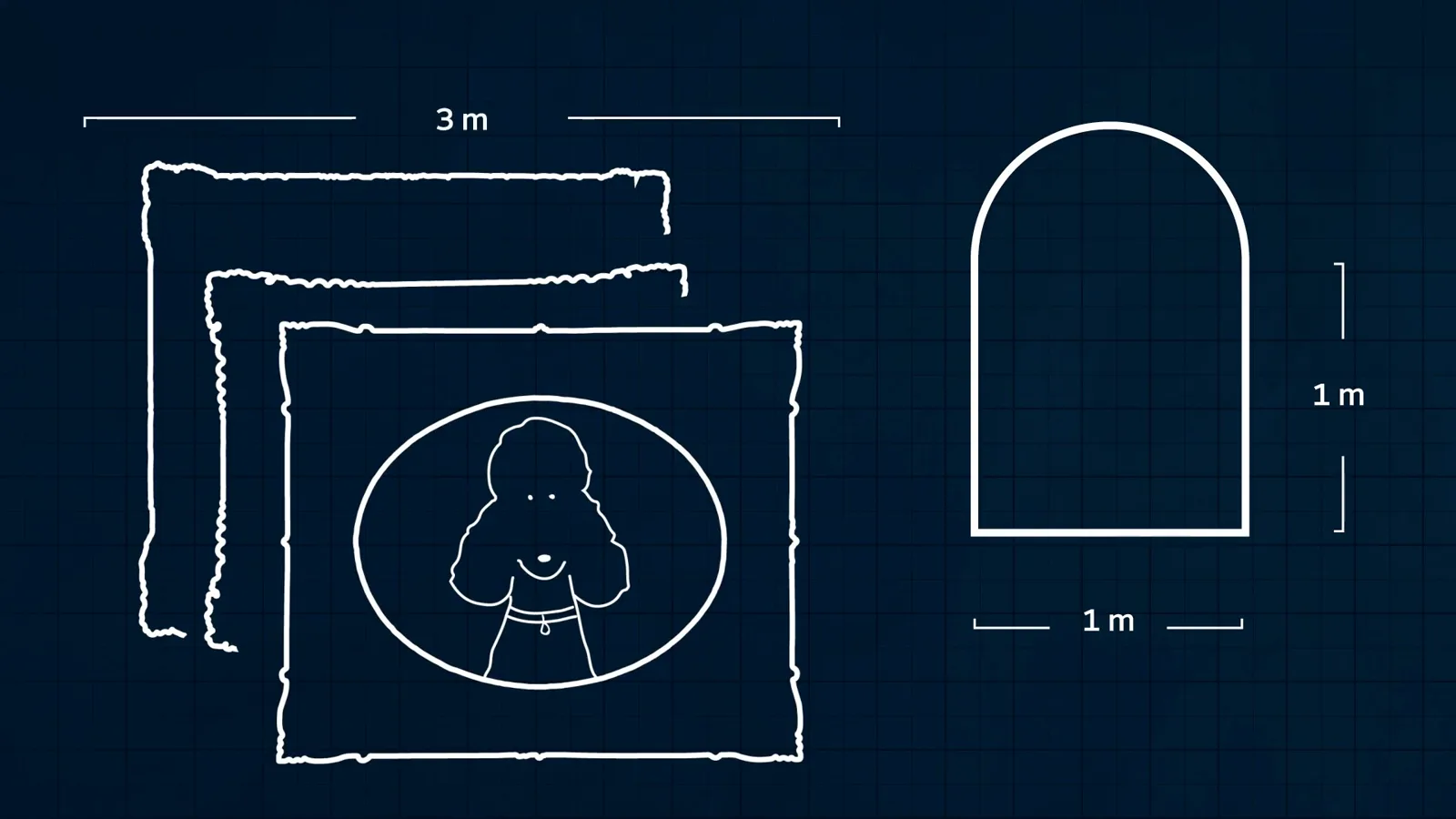
Sawyer presents a window made from a one-metre square and a semicircle. Viewers are asked to find the maximum height of a three-metre-wide painting that can pass through it.
Sawyer introduces a geometry challenge in Real Numbers: an art museum has a broken window lock, and the curator wants to know which paintings an art thief could slide through the open window.
The window is a square with one-metre sides, topped by a semicircle whose diameter is the square’s upper edge. The framed rectangular paintings are three metres wide and have different heights. Treat the frames as two-dimensional and assume the paintings cannot be removed, bent or folded. What is the tallest frame that can pass through the window? Sawyer leaves this week’s problem for viewers to solve.
The boat problem by algebra
Sawyer revisits the previous river-crossing problem and sets up a speed ratio. A quadratic yields the valid upstream aiming distance.
Before returning to that question, Sawyer solves the previous episode’s boat problem. Two parallel riverbanks are 100 metres apart. A friend points the toy boat Wavey directly across from their dock, but the current carries it to a point 60 metres downstream of your dock.
On the return trip the motor and current have the same respective speeds. The first trip combines 100 metres of motion across the river with 60 metres of downstream drift, so the motor speed is 5/3 times the current speed. The goal is to aim upstream so the current carries the boat exactly to the friend’s dock.
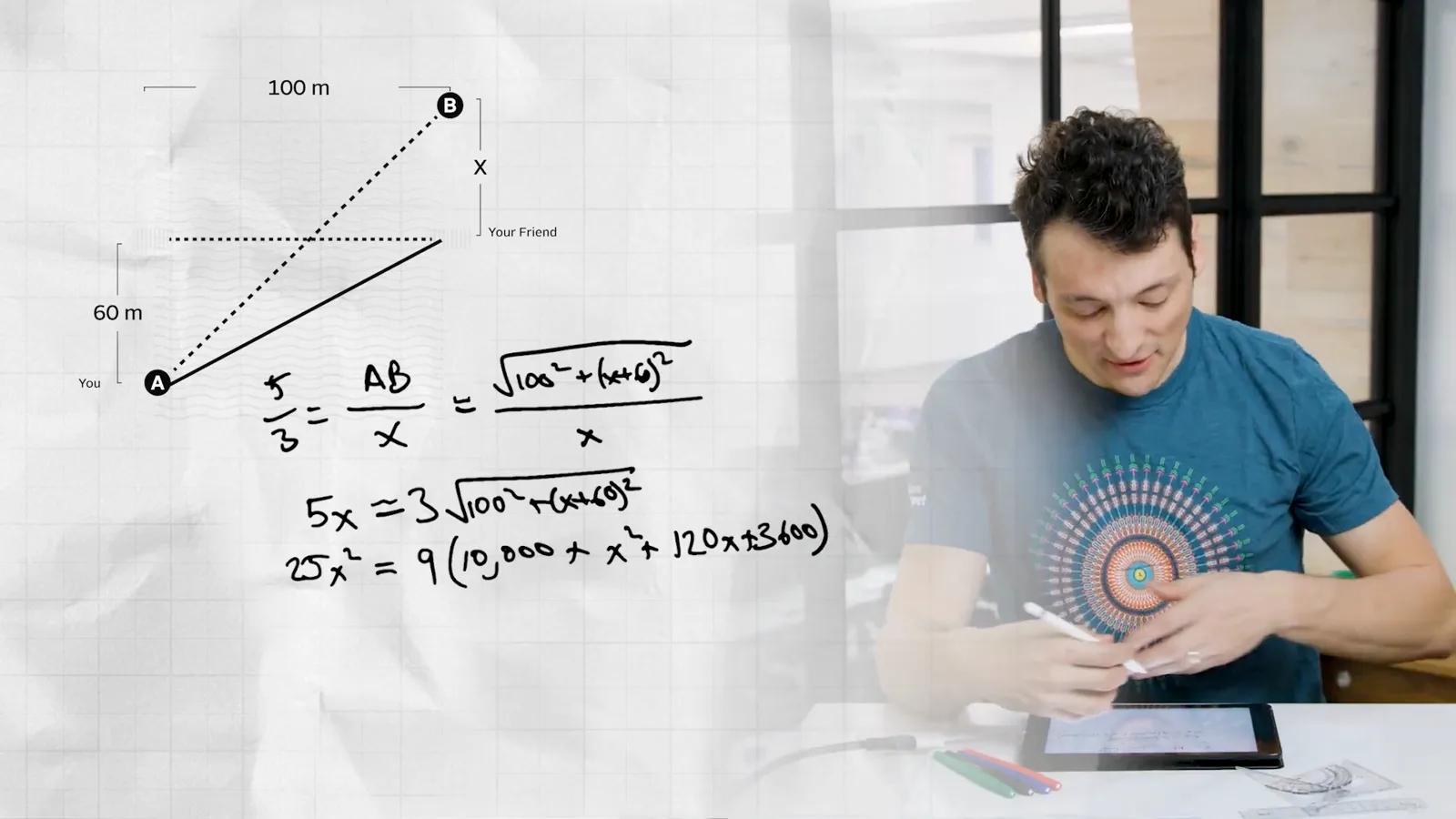
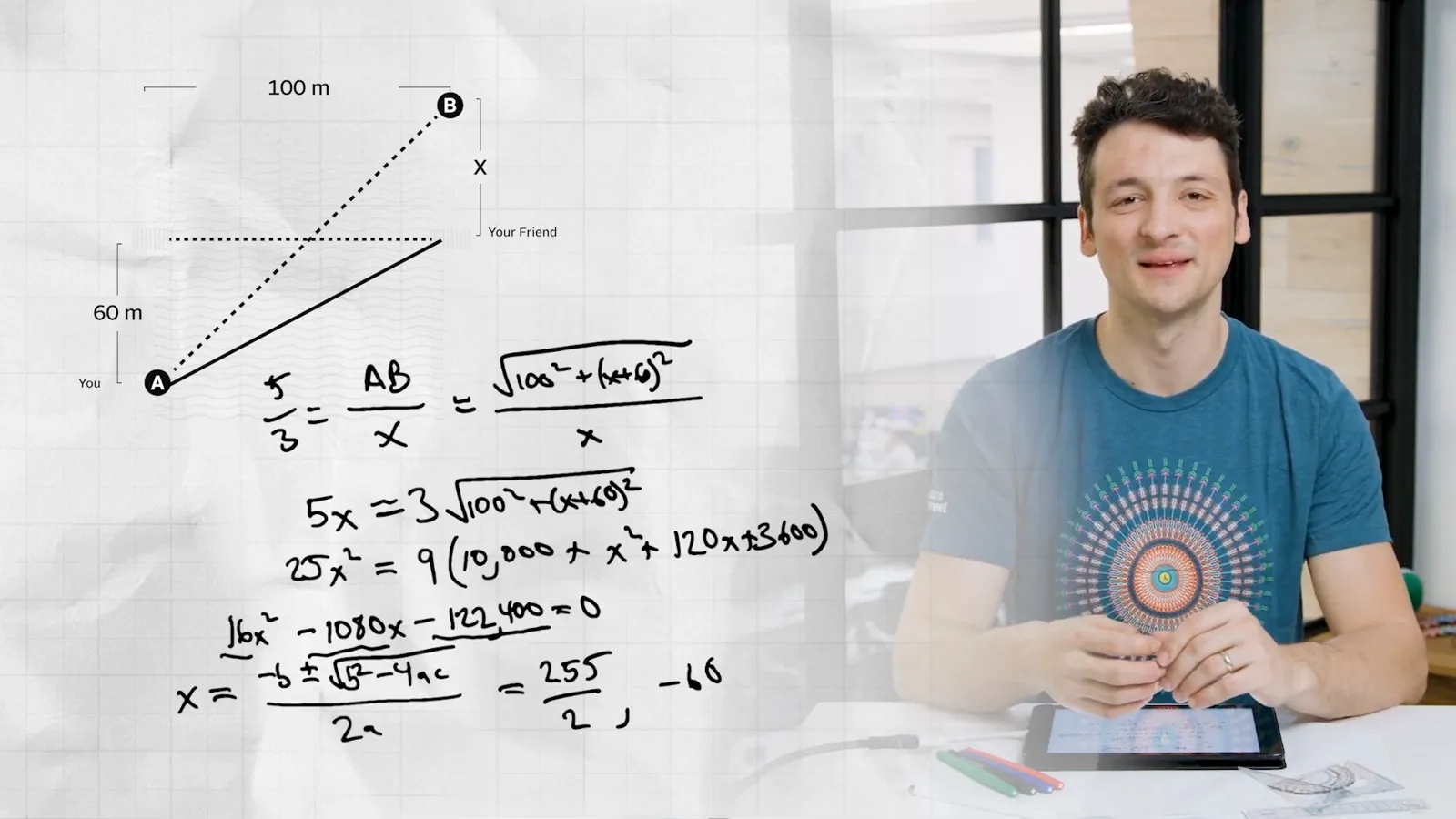
Call your location A and the aiming point B, which is x metres upstream of the friend. The motor would carry the boat along AB while the current carries it downstream by x. By the Pythagorean theorem, the speed ratio gives 5/3 = AB/x = √(100² + (x+60)²)/x.
Clearing denominators and squaring gives 25x² = 9(10,000 + x² + 120x + 3,600), or 16x² − 1,080x − 122,400 = 0. The quadratic formula yields x = 255/2 or x = −60. The negative root is extraneous: the relevant distance is positive, and squaring can introduce a solution that fails the earlier equation.
The valid answer is to aim 255/2, or 127.5 metres, upstream of the friend’s dock. Sawyer then looks for a geometric route that reveals more about the construction, without using the Pythagorean theorem.
A geometric solution
Similar triangles lead to an isosceles triangle and a double-angle calculation. Sawyer returns to the unsolved window challenge.
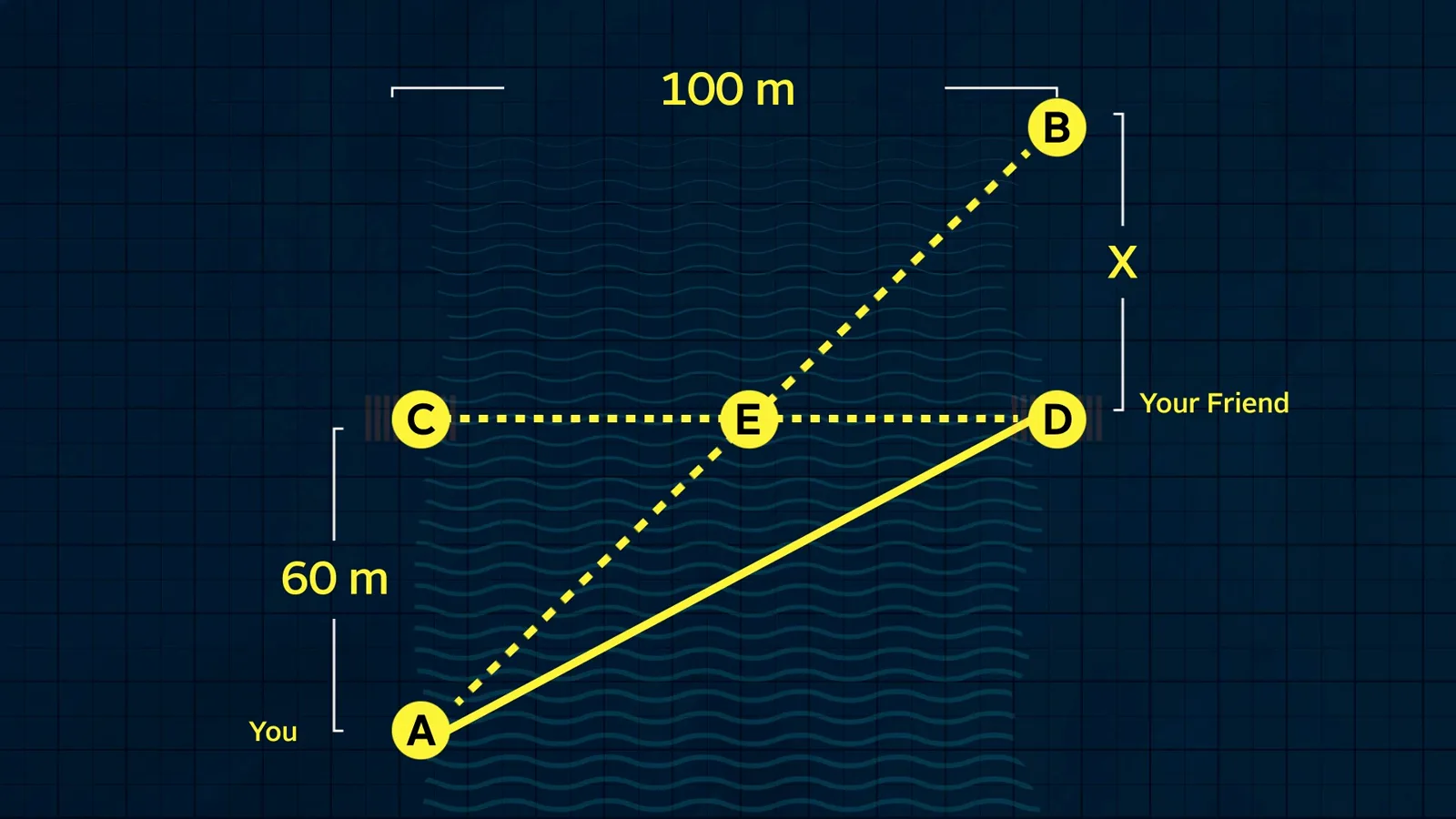
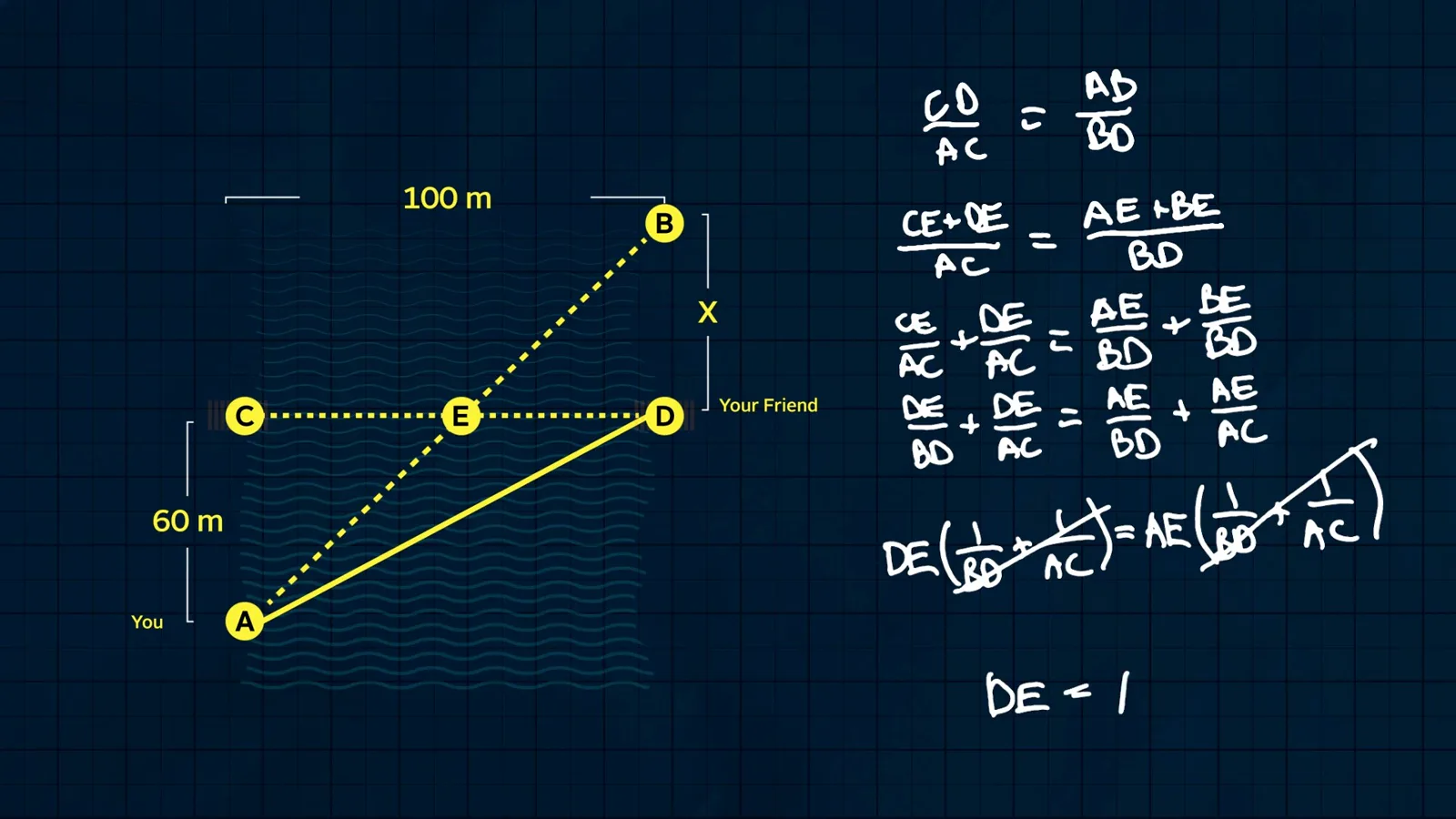
Label your dock C, the friend’s dock D, and the intersection of the motor trajectories E. Because the riverbanks are parallel, triangles ACE and BDE are similar. Thus CE/AC = DE/BD and AE/AC = BE/BD.
The motor-to-current speed ratio also gives CD/AC = AB/BD. Writing CD as CE+DE and AB as AE+BE, substituting the similar-triangle ratios and factoring shows DE = AE. Triangle ADE is therefore isosceles, so angles EAD and EDA are equal; call each θ.
Draw AF perpendicular to the bank, with F directly across from A. Parallel lines show angle DAF is also θ, so angle BAF is 2θ. Since tan θ = AC/CD = 60/100 = 3/5, the double-angle formula gives tan(2θ) = 15/8.
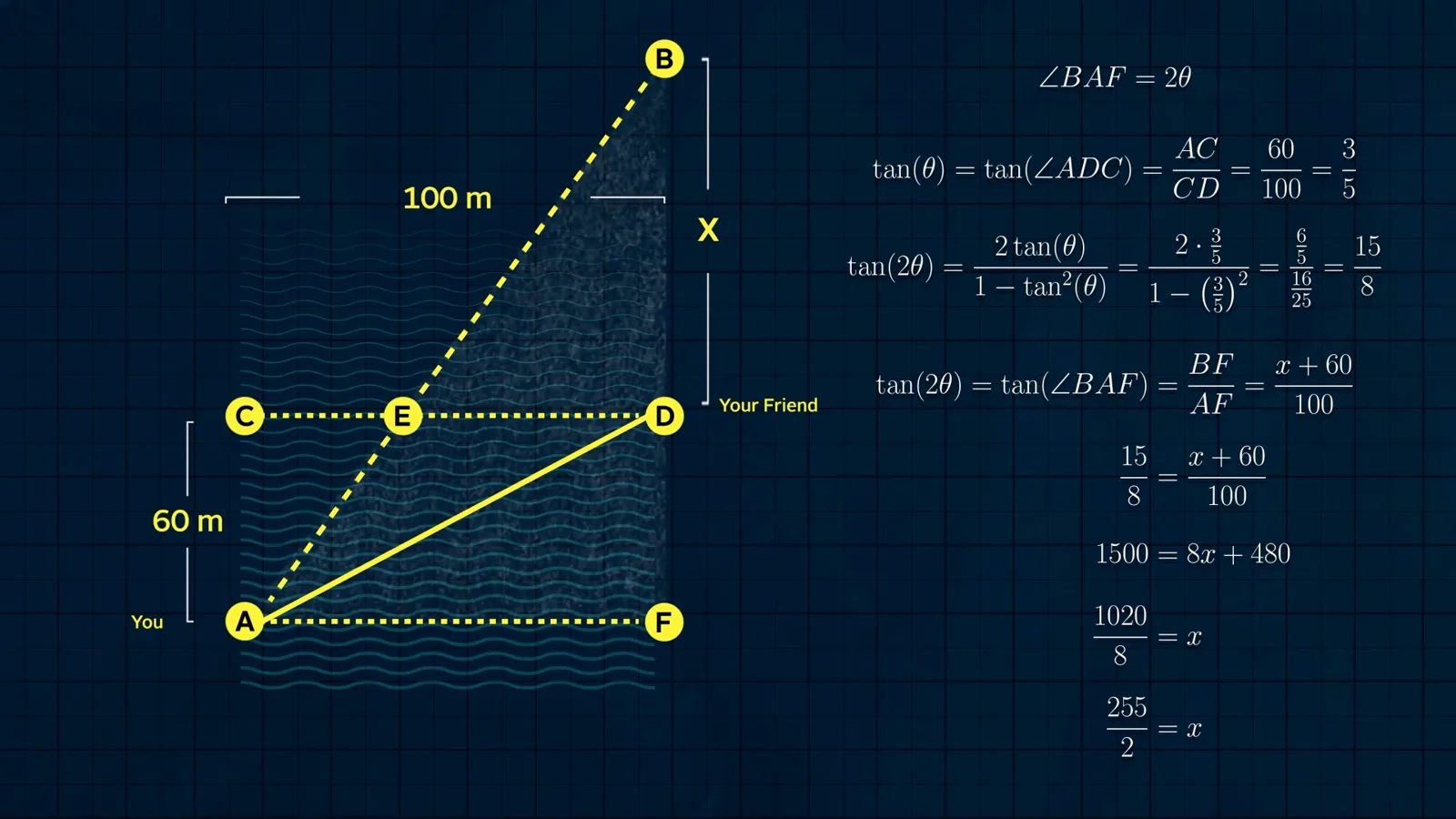
In right triangle ABF, tan(2θ) = (x+60)/100. Equating this to 15/8 again gives x = 255/2 = 127.5 metres. Sawyer closes by returning to the arched-window puzzle and inviting viewers to submit their solutions.
同じチャンネルの記事
 15:33EN
 1:48:29EN
 1:36:37EN
 1:05:45EN
 1:25:00EN
 1:16:29EN