30 秒でわかる
Matthew Berman recalls Boston Dynamics' viral BigDog footage and sketches the company's history through Spot, Handle, Stretch and electric Atlas. He describes the new Atlas's mobility and predicts widespread factory use; possible household adoption is his speculation.
- 1BigDog goes viralBerman recalls the 2008 footage of BigDog maintaining its balance after being kicked on ice.
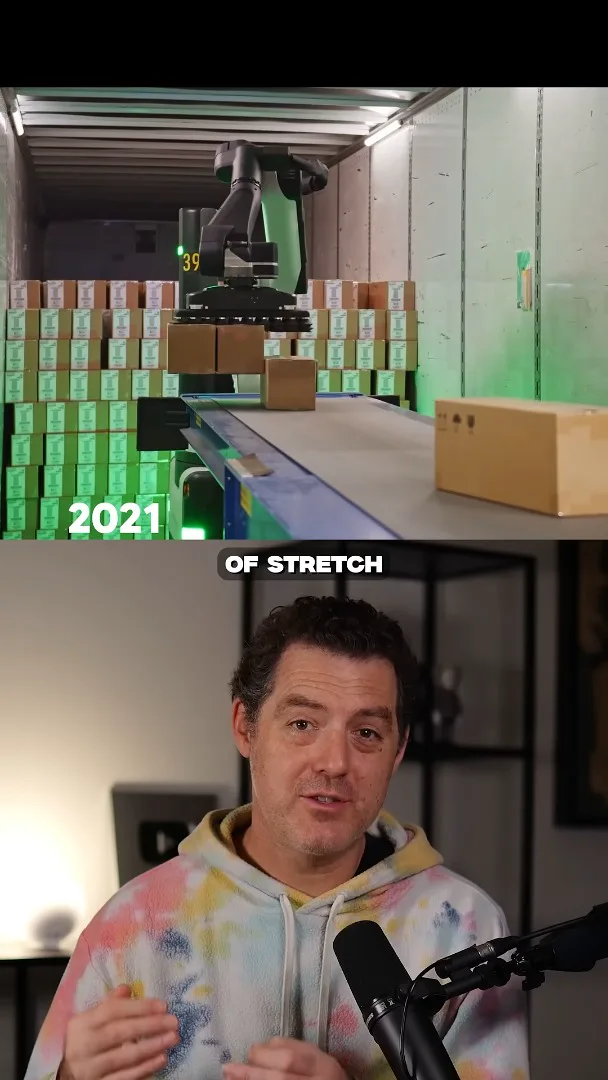
- 2From Spot to StretchHe describes Spot and SpotMini, followed by the wheeled Handle and the warehouse robot Stretch.
- 3Electric AtlasHe says the newer Atlas uses batteries, electronics and actuators instead of hydraulics, with a wider range of movement.
ポイント
- BigDog became widely known through footage of the quadruped recovering its balance on ice.
- Berman traces a progression from BigDog and Spot to the wheeled Handle and warehouse robot Stretch.
- The newer Atlas is electric rather than hydraulic, and Berman highlights its range of motion.
- Widespread factory and home deployment are Berman's predictions, not established outcomes.
チャプターごとに整えた全文を読む
From BigDog to Stretch
Berman recalls an early viral BigDog video and traces Boston Dynamics' robot history. He moves from quadrupeds to a wheeled robot and a warehouse machine.
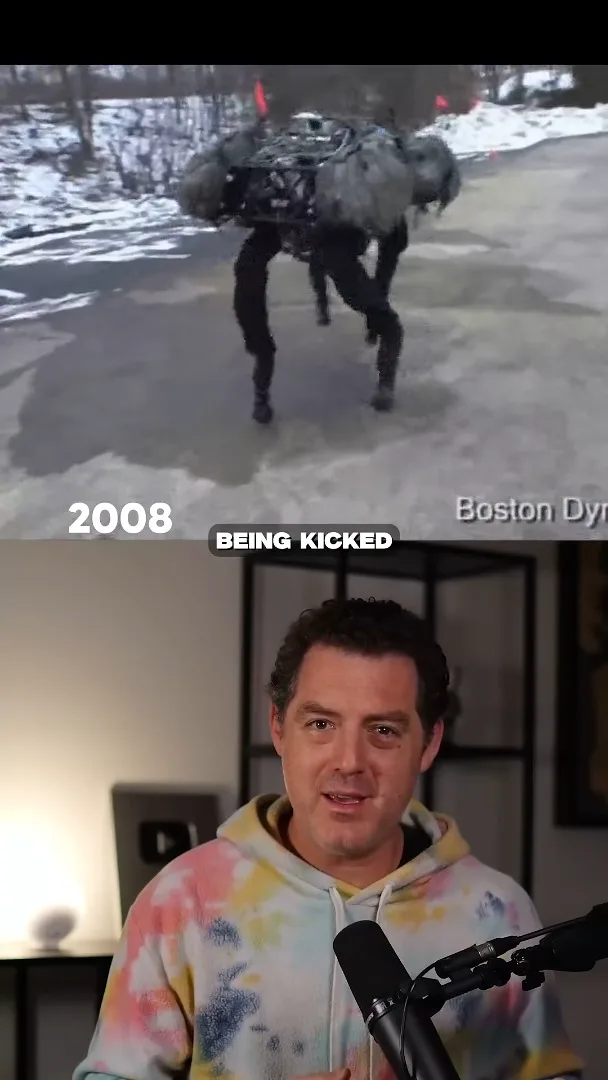
Boston Dynamics' BigDog shocked the world in 2008 in what was one of the early viral robot videos. You might remember the robot dog being kicked on ice and recovering its balance. Boston Dynamics itself was founded in 1992, and Berman says it worked on the large quadruped BigDog from 2005 to 2013.
Berman traces the company's humanoid work to Atlas, then turns to Spot, a smaller and more agile dog-shaped robot released in 2015, and the still smaller SpotMini the following year. He describes Handle as a wheeled balancing robot and says its work led to Stretch, a warehouse robot for handling heavy objects.
The electric Atlas
Berman describes the newer electric humanoid's motion and speculates about factory and home use. He argues that greater freedom of movement could save time in factory tasks.
That brings us to the next-generation electric Atlas. Berman predicts mass production and use in factories around the world, and speculates that it could eventually appear in homes. Unlike the previous hydraulic version, he says, it runs on batteries, electronics and actuators.
Berman describes the new Atlas as stronger and more agile, with a wider range of movement. He points to hands rotating 360 degrees and a torso that can turn without moving the legs. Some movements may look alien, he argues, but could be more efficient for a machine than human movement.
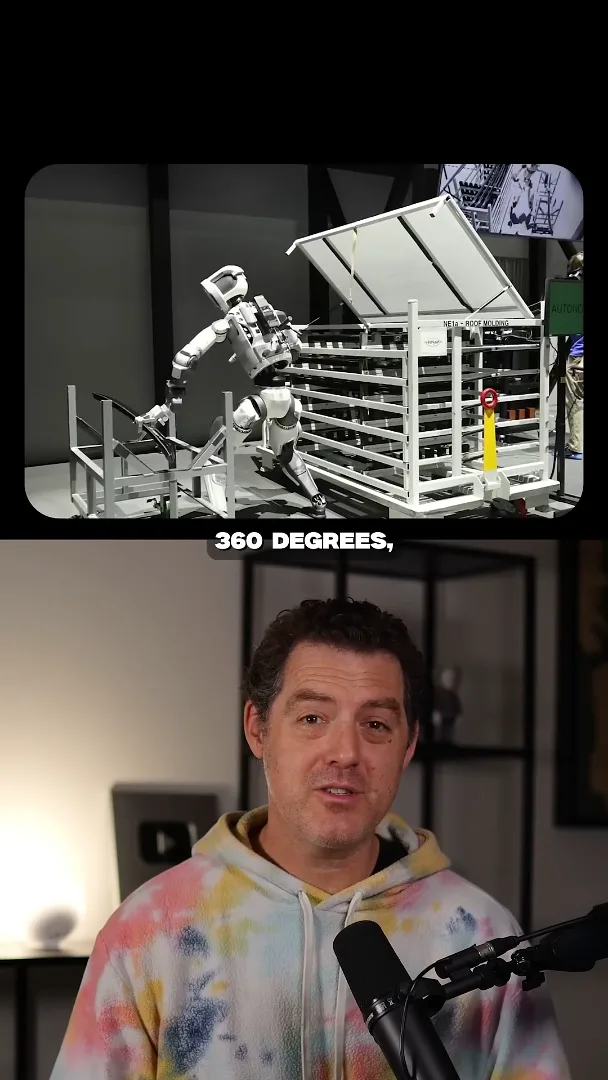
That efficiency matters, he says, when a factory can save seconds on each task.
同じチャンネルの記事
 14:45EN
 Matthew Berman· 2026年10月29日Matthew Berman Examines Google’s Gemini 4 Carbon AnnouncementMatthew Berman · Forward FutureMatthew Berman reviews Google’s reported benchmark results, staged rollout and pricing for Gemini 4 Carbon, while noting he has not yet used the model.
 21:11ENMatthew Berman· 2026年10月28日Matthew Berman tests DeepSeek V4.1 Flash: coding, vision and local appsMatthew Berman · Forward FutureA hands-on tour of visual coding, image reasoning, local applications and provider economics reveals both impressive results and visible flaws.
 34:21ENMatthew Berman· 2026年10月27日Matthew Berman Examines Anthropic’s IPO Filing, AI Growth and GovernanceMatthew Berman, Sam Altman · Forward FutureThe presenter reviews the S-1’s financial metrics, compute strategy and voting structure while questioning the tension between rapid AI development and safety.
 0:26ENMatthew Berman· 2026年10月25日Sam Altman on Human Values and Problem-Solving in an AI WorldSam Altman · OpenAIIn a short interview excerpt, Altman considers the enjoyment of solving hard problems and the human role in interpreting results.
 0:36ENMatthew Berman· 2026年10月25日Kimi K3.1 and a Rubik’s Cube Solver DemonstrationMatthew Berman · Forward FutureMatthew Berman shows a scrambled virtual cube being solved and gives the Kimi K3.1 test a favorable assessment.
 0:21ENMatthew Berman· 2026年10月24日An AI-Generated Kimi Benchmark Chart Used Invented ScoresMatthew Berman · Forward FutureMatthew Berman asks for a graph of Kimi K3.1 Pro benchmarks, then discovers that the displayed figures are illustrative placeholders.