30 秒でわかる
Matthew Berman follows online speculation sparked by Sam Altman’s strawberry photograph and tests anonymous models on Chatbot Arena. He contrasts their answers to decimal comparison, a killers puzzle and a marble-in-a-glass problem. Subsequent reporting by xAI identified sus-column-r as an early Grok-2, while the separate anonymous-chatbot cannot be identified from that disclosure.
- 1A strawberry photo fuels speculationA garden photo and anonymous Arena listings prompted predictions of an imminent OpenAI launch. The claims remained unconfirmed at recording.
- 2A measured view of math progressAlphaProof and AlphaGeometry 2 solved four of six 2024 Olympiad problems for 28 of 42 points; this did not solve general mathematical reasoning.
- 3One mystery model later identifiedSus-column-r correctly compared 9.11 and 9.9. On August 13, xAI identified that model as an early Grok-2.
- 4Testing the killers puzzleThe displayed sus-column-r and GPT-4 answers each count three living killers under the ordinary interpretation.
- 5A physical reasoning promptIn the marble scenario, the separate anonymous-chatbot puts the marble in the microwave; a shared sus-column-r answer places it on the table.
ポイント
- Altman’s strawberry photo and online release predictions did not establish a model identity or launch date.
- xAI later confirmed that sus-column-r was an early version of Grok-2; that says nothing by itself about the separate anonymous-chatbot.
- A correct answer to a decimal or logic puzzle is useful anecdotal evidence, not a complete evaluation.
- DeepMind’s 2024 Olympiad result was a specific silver-medal-level achievement, not a general solution to mathematical reasoning.
チャプターごとに整えた全文を読む
Strawberry speculation and anonymous models
Berman reviews a strawberry post and online claims about OpenAI’s rumored reasoning project. He distinguishes the two unidentified Arena names and describes the claims around planning and post-training.
On August 7, 2024, I’m looking at the rumors building around OpenAI’s supposed next model. Sam Altman posted a picture of strawberries in a garden with the caption “I love summer in the garden.” The timing excited people following the rumored Strawberry or Q* project, though a photograph is not a product announcement.
Two anonymous model names have appeared in Chatbot Arena, bringing back memories of earlier anonymous model tests. I initially couldn’t find them myself, so I’m looking at reports and screenshots from other users. One listing is called anonymous-chatbot, while another has a different name; they should not automatically be treated as the same model.
One user asked anonymous-chatbot what it was and received a claim that it was based on GPT-4 architecture. A model’s own description is not proof of its identity. The same user reported very limited personal testing, with no obvious reasoning improvement and perhaps some improvement in math.
A social media thread collected the claims about Q* and Strawberry, including a possible new frontier model and a connection between the two project names. These were reports and speculation, not confirmed details about a release. The proposed improvement is better planning and reasoning, potentially helping with math and logic.
Other rumored capabilities include navigating the web to perform deeper research and completing long sequences of actions. Berman also discusses post-training and the possibility of continued learning after pretraining. Those are distinct concepts: post-training can change a model without establishing that a deployed system continuously learns from every interaction.
People also circulated an alleged jailbreak of anonymous-chatbot. The example does not establish which company made it. Bindu Reddy offered a different competitive prediction: other labs were making progress in reasoning and synthetic data, so she questioned how much advantage Strawberry might have over future competing models.
Math reasoning and a decimal test
Berman discusses competing labs and a decimal-comparison answer. A later xAI disclosure resolved one model’s identity.
I point to Google DeepMind’s recent Olympiad work as evidence of progress. My suggestion that math reasoning was nearly solved goes too far: [DeepMind reported](https://deepmind.google/blog/ai-solves-imo-problems-at-silver-medal-level/) that AlphaProof and AlphaGeometry 2 solved four of six 2024 IMO problems, scoring 28 out of 42 with problems translated into formal language. That silver-medal-level result did not establish general mathematical reasoning as solved.
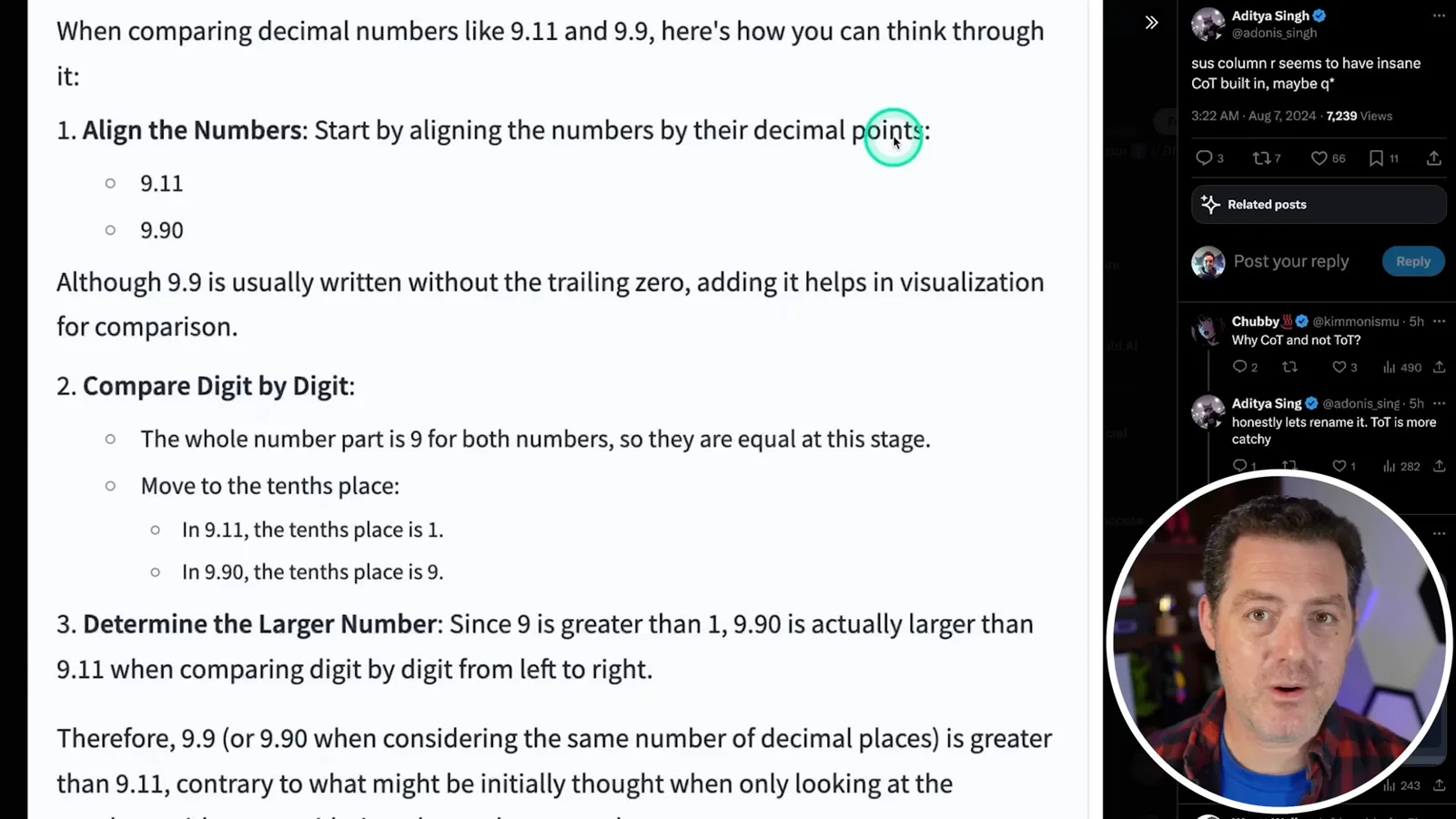
The other model was called sus-column-r. A screenshot shows it answering which is larger, 9.11 or 9.9: it writes 9.9 as 9.90, compares the tenths digits and correctly chooses 9.9. Some users speculated that the explanation revealed a new reasoning method or an OpenAI project, but a visible explanation alone does not establish either.
We can now add an important historical correction: on August 13, 2024, [xAI said](https://x.ai/news/grok-2) sus-column-r was an early version of its Grok-2 model. That confirmation does not identify the separately named anonymous-chatbot. OpenAI later introduced [o1-preview on September 12](https://openai.com/index/introducing-openai-o1-preview/), but that release does not prove an anonymous Arena identity.
Another social media account was enthusiastically predicting an imminent Strawberry launch. I don’t know who operates it or whether it has inside information, and its claims should be treated accordingly. At the time I felt competitive pressure from releases such as Llama 3.1 405B could push OpenAI to make an announcement.
Arena tests: killers and a marble
Berman explains how blind battles reveal models after voting, then inspects answers to two puzzles. He closes by calling for a fuller test.
After recording the first part, Shaun Ralston explained why I couldn’t locate the models directly. They appeared in Arena’s blind battle mode: users submit prompts to two anonymous models and learn their names after voting. Getting a particular model therefore required repeated trials.
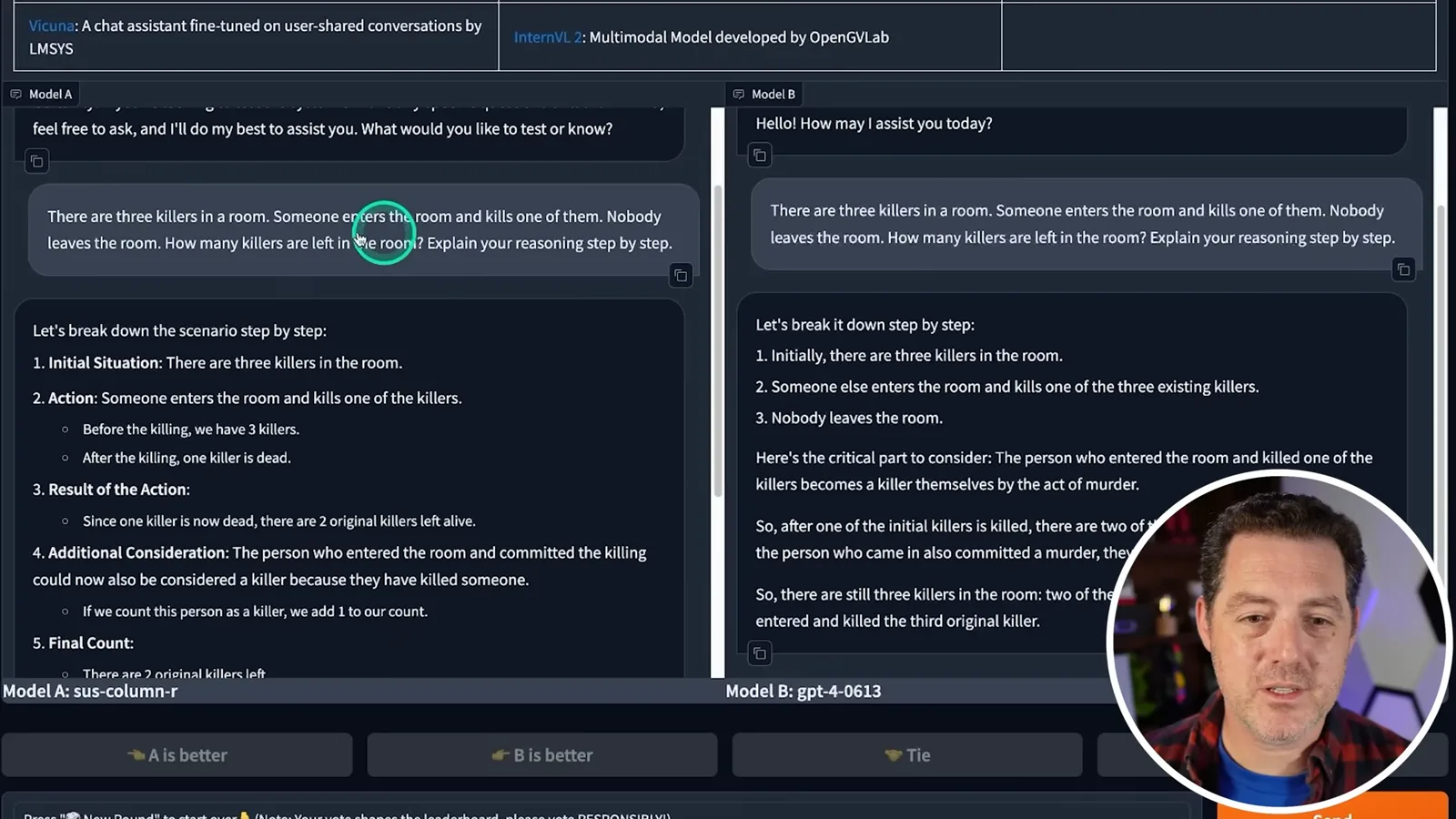
For my first test, three killers are in a room and someone enters and kills one of them. Nobody leaves: how many killers remain? The GPT-4-0613 response says three, because two original killers are alive and the person who entered is also a killer. The ordinary answer counts living people and assumes the entrant is a distinct person.
The sus-column-r response breaks the situation into initial state, action, result and final count. It gives three when counting the entrant and two when counting only the original killers. The explanation is more elaborate in this instance, but one sample cannot establish broad superiority or expose a model’s hidden internal reasoning.
My harder test puts a marble in a glass, turns the glass upside down on a table, and then moves the glass to a microwave. Where is the marble? Under the ordinary interpretation, it stays on the table when the inverted glass is lifted. Two initial responses put it in the microwave; neither was one of the mystery models.
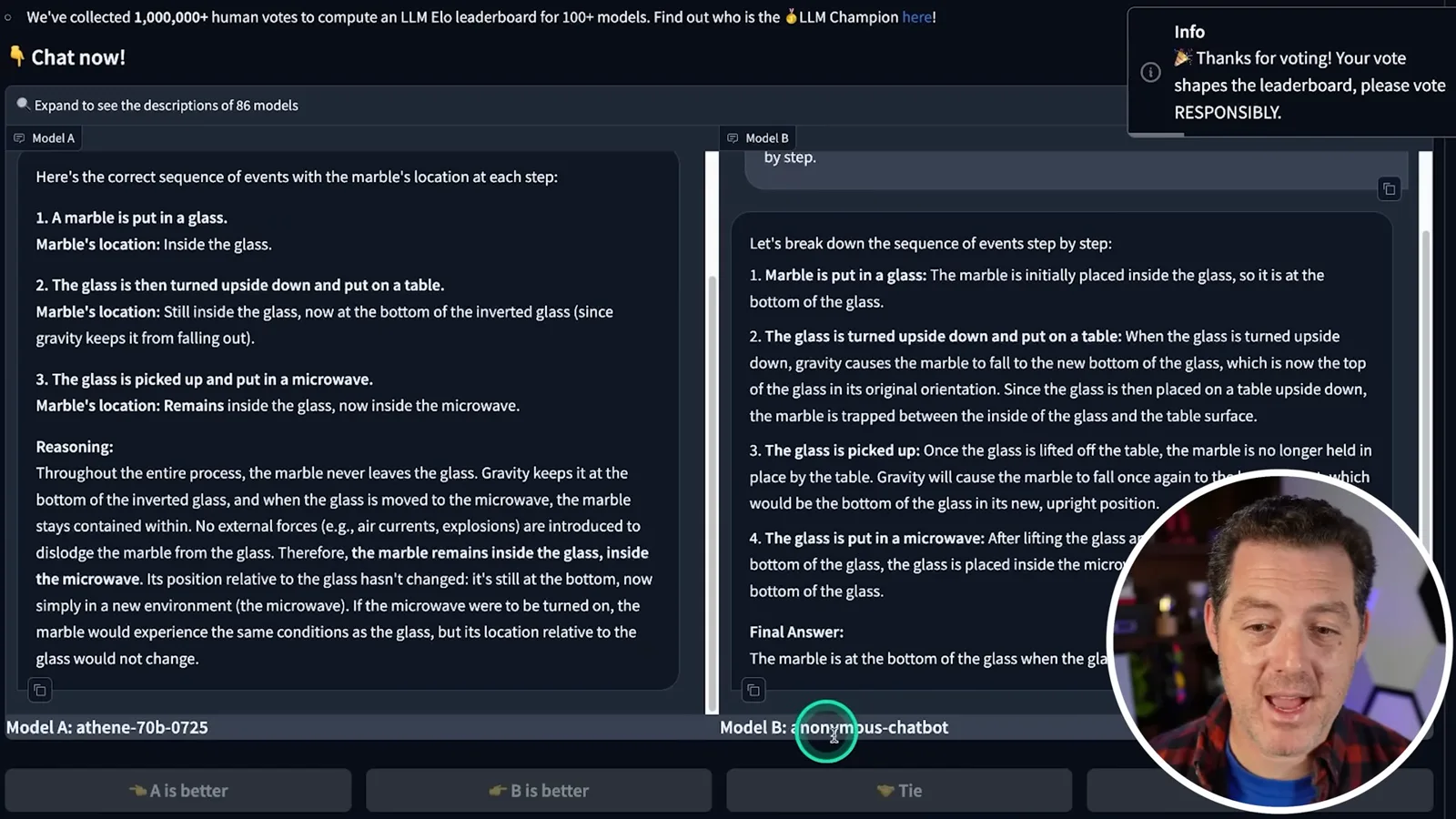
A second trial reveals anonymous-chatbot, and it too says the marble ends up in the glass in the microwave. I consider that wrong under the intended physical setup. As with many short puzzles, the answer depends on assumptions about how the glass is turned and lifted.
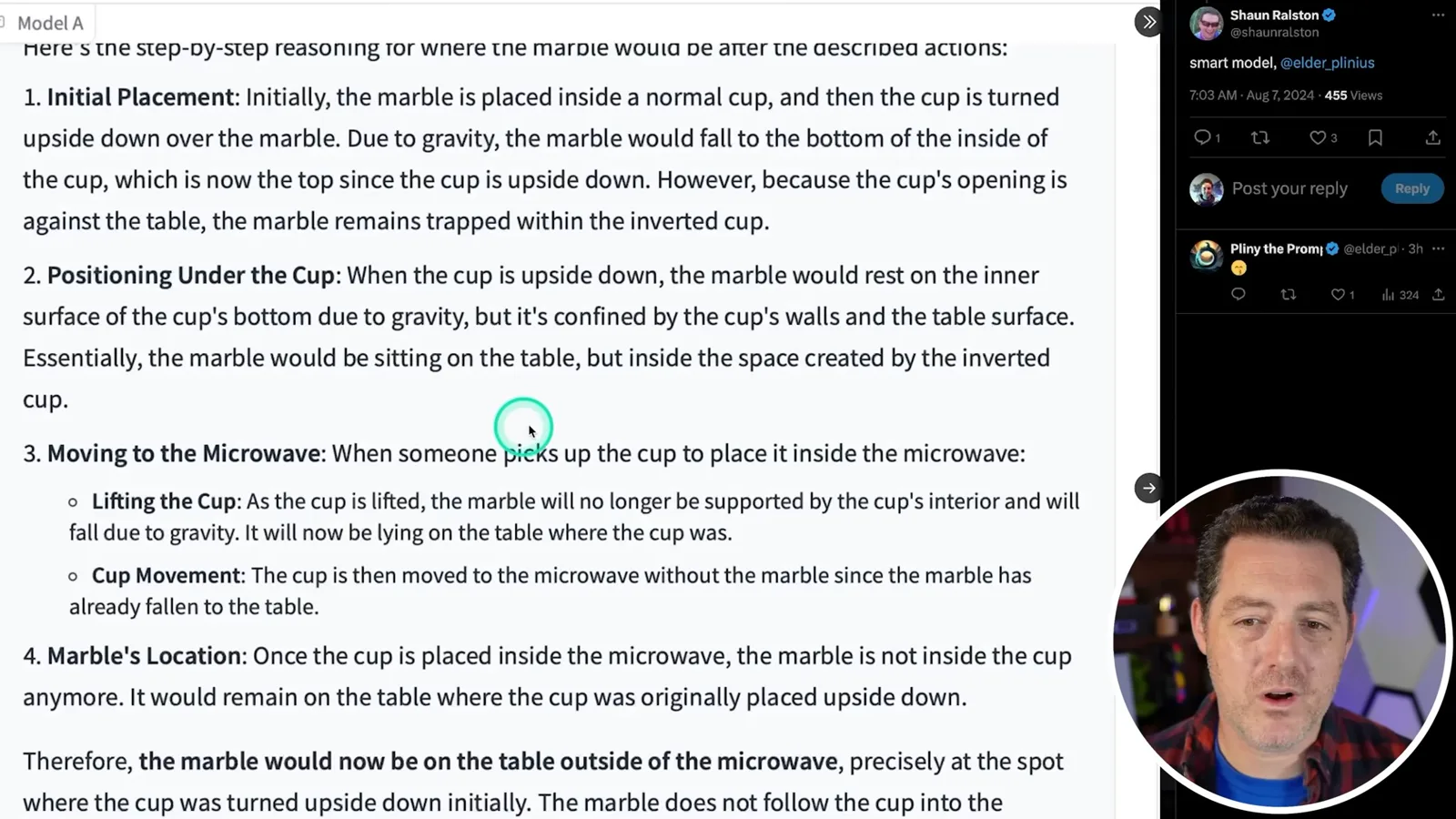
Ralston also shared a sus-column-r response to the same prompt. Its final answer places the marble on the table, outside the microwave, which matches the intended outcome. Some of its intermediate physical explanation is awkward, so a correct final answer should not be mistaken for a fully coherent explanation.
These are a few demonstrations rather than a full evaluation. I plan to run a broader test and ask viewers whether the rumored release is close or whether the strawberry post was simply teasing. The later identification of sus-column-r shows why an anonymous model’s name and output are weak evidence of its provider.
同じチャンネルの記事
 34:21EN
 Matthew Berman· 2026年10月27日Matthew Berman Examines Anthropic’s IPO Filing, AI Growth and GovernanceMatthew Berman, Sam Altman · Forward FutureThe presenter reviews the S-1’s financial metrics, compute strategy and voting structure while questioning the tension between rapid AI development and safety.
 0:26ENMatthew Berman· 2026年10月25日Sam Altman on Human Values and Problem-Solving in an AI WorldSam Altman · OpenAIIn a short interview excerpt, Altman considers the enjoyment of solving hard problems and the human role in interpreting results.
 0:36ENMatthew Berman· 2026年10月25日Kimi K3.1 and a Rubik’s Cube Solver DemonstrationMatthew Berman · Forward FutureMatthew Berman shows a scrambled virtual cube being solved and gives the Kimi K3.1 test a favorable assessment.
 0:21ENMatthew Berman· 2026年10月24日An AI-Generated Kimi Benchmark Chart Used Invented ScoresMatthew Berman · Forward FutureMatthew Berman asks for a graph of Kimi K3.1 Pro benchmarks, then discovers that the displayed figures are illustrative placeholders.
 25:50ENMatthew Berman· 2026年10月24日Kimi K3.1 Pro Tested: Strong 3D Demos, Uneven Results and Competitive PricingMatthew Berman · Forward FutureMatthew Berman tests the open-weight model on coding, 3D rendering and visual explanations, then compares benchmark results and prices.
 32:20ENMatthew Berman· 2026年10月23日Who Is Local AI For? The Costs, Trade-offs and a Hybrid FutureMatthew Berman · Forward FutureMatthew Berman weighs data control and independence against hardware cost, setup complexity and inference speed.