30 秒でわかる
Matthew Berman describes Jev as a tool for fast structured decisions and demonstrates examples including page cleanup, email prioritization, fuzzy search, dynamic UI assembly and video clips. He distinguishes these tasks from open-ended text or code generation and includes a sponsored Zapier example.
- 1Structured decisionA JSON example supplies criteria and produces a scored answer to a classification question.
- 2Page cleanupA demo classifies page elements for removal according to user-supplied criteria.
- 3Email prioritizationAn example sorts messages by apparent importance rather than chronology.
- 4Dynamic interfacesThe tool selects from prebuilt components instead of writing a page from scratch.
- 5Video clippingA demo selects clips from a long video quickly; its internal implementation is not established in the video.
ポイント
- Jev is presented as a tool for structured choices rather than open-ended writing or coding.
- Clear context and criteria shape decisions; a model’s classification is not proof of an underlying fact.
- Low latency can make many small decisions useful in interactive search, sorting and UI workflows.
- Pricing and credits quoted in the video are time-specific.
チャプターごとに整えた全文を読む
Structured decisions
Berman explains how Jev uses criteria and context, and contrasts it with open-ended generation.
Jev is a decision-oriented AI tool that I find exciting because it can make large numbers of structured decisions quickly and cheaply. I will explain how it differs from a text-generation model and show examples people have built with it.
In a simple example, a JSON request asks whether a hot dog is a sandwich and supplies criteria for true and false. The demo returns 73% true. Berman says Jev works best when a decision is clearly described, with context and structured questions; the score is a model output, not an objective definition.

It is not intended as an open-ended writing or coding assistant. Instead, it can choose among defined options—for example, selecting components from a prepared UI library to assemble a page. Speed can change which tasks are practical, even when a slower general model may reason better on an individual decision.
Filtering and automation
He shows page cleanup and a sponsored automation example, then introduces email prioritization.
One demo classifies website content for signs of generic AI writing and explains its judgments. Another project, Unclutter, sends page elements and criteria to Jev to identify ads, banners and other clutter for removal. These classifications are judgments made by the tool, not proof of how content was created.
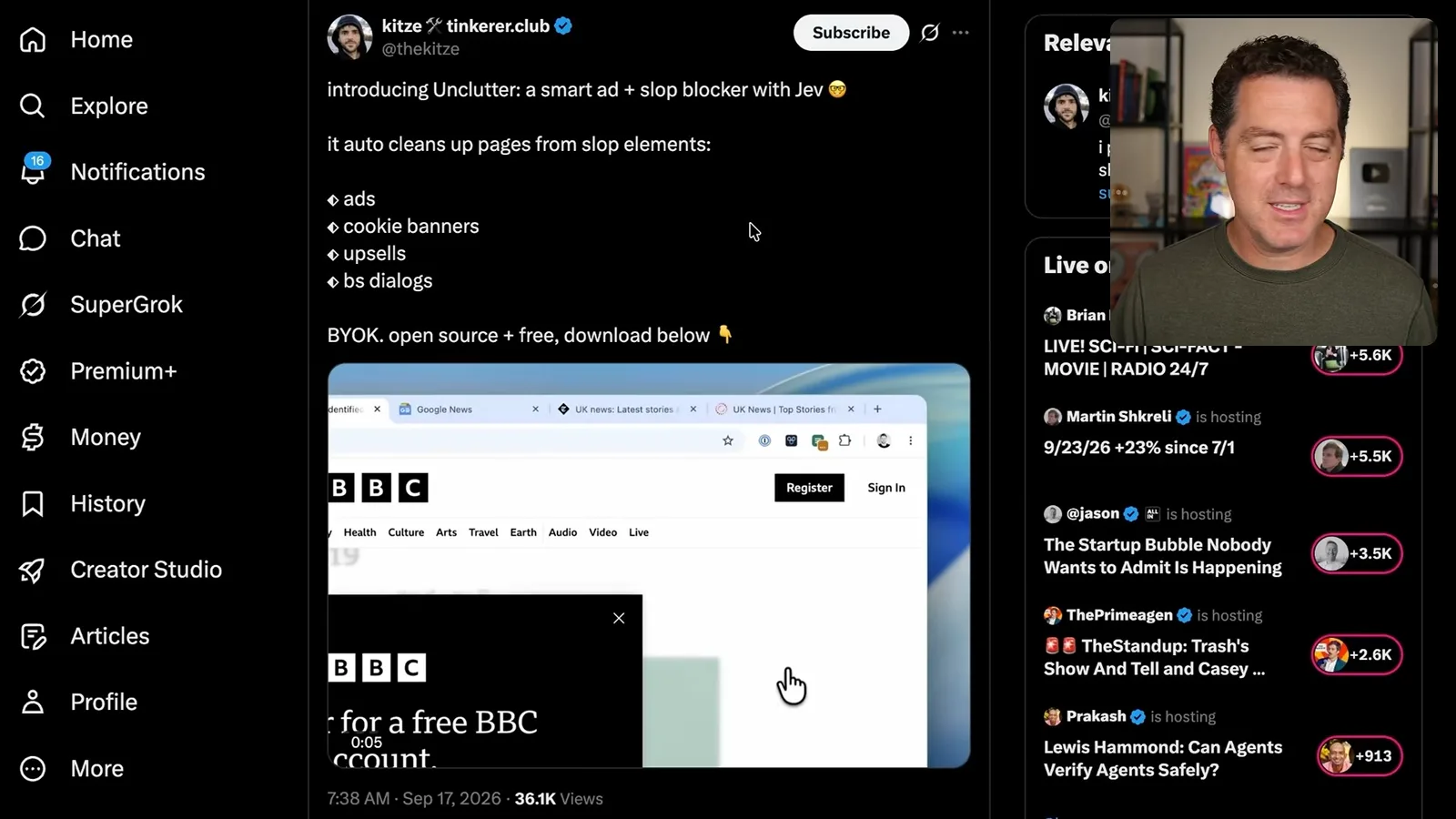
At the time of the video, Berman quotes a price of 4.2 cents per million input tokens and no output-token charge. Unclutter uses a user-supplied key. The low price and speed make many small decisions feasible in an interactive workflow; the quoted pricing reflects the video’s point in time.
Video sponsor Zapier has added Jev to its automation platform. Berman illustrates a workflow that evaluates calendar invitations against specified criteria, with a decision between connected applications. This is the sponsored example and the usefulness of the decision depends on the criteria supplied.
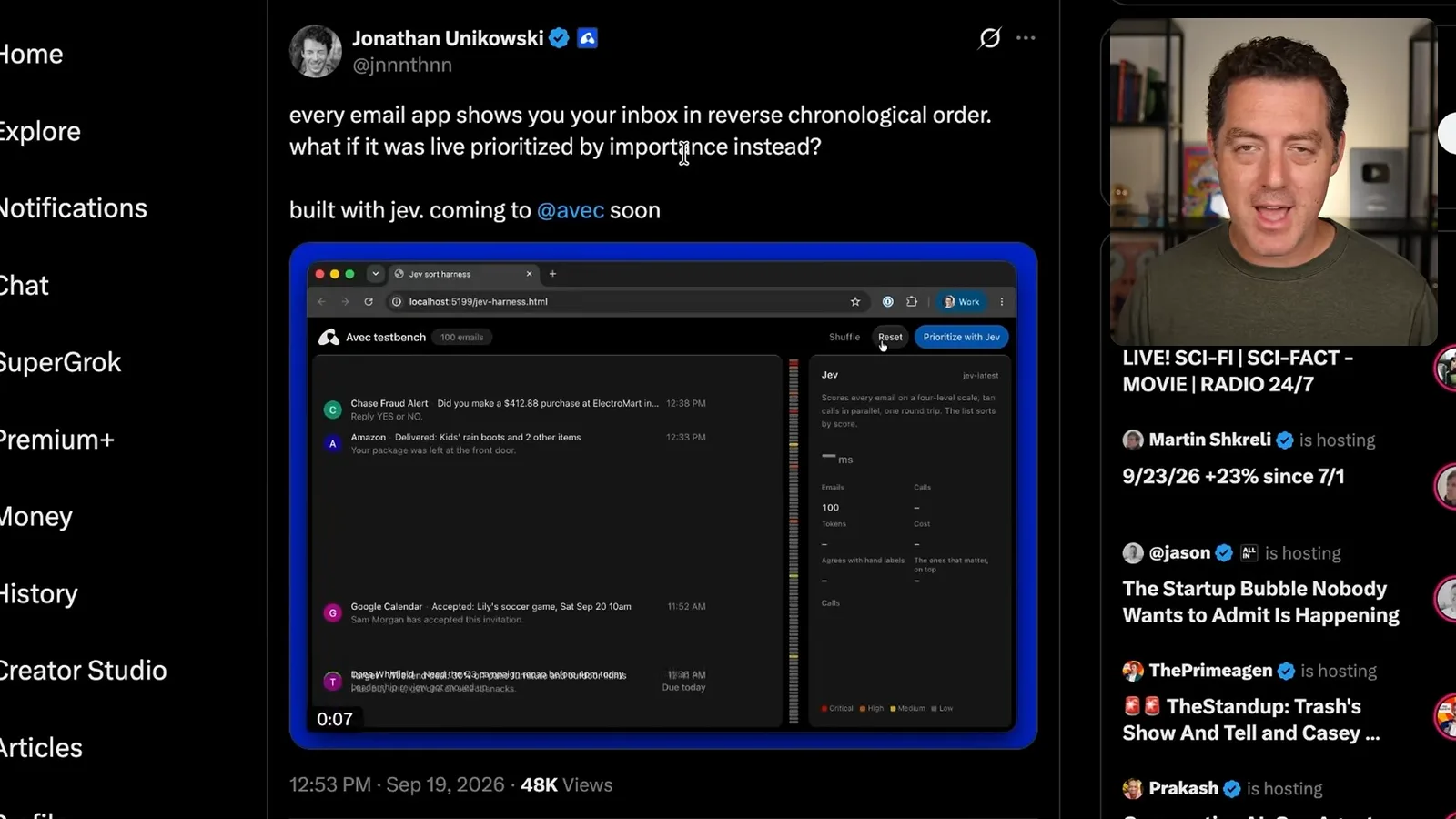
An email demo prioritizes messages by apparent importance instead of arrival time. Berman shows a test sorting 100 emails in under half a second. Such a system can help surface items quickly, though its ranking reflects the supplied rules and model judgments.
Interactive demos
Examples cover fuzzy search, prebuilt UI components, clipping, color palettes and emoji selection.
A browser search demo performs fuzzy, meaning-based matching rather than requiring an exact phrase. It highlights relevant parts of the page even when the user’s words differ. The example is open source and uses the user’s own key.
For dynamic interfaces, Jev selects from a preconfigured library of buttons, fields and other components. It can choose a form or sign-in element based on the user’s request and assemble the page quickly. It is choosing available building blocks, not writing an entire application from scratch.
Clipfast demonstrates selecting clips from a video longer than 90 minutes based on a typed request and returning results in under two seconds. Berman suggests the system probably scans the transcript; the video does not establish its implementation. A user can then download a selected clip.
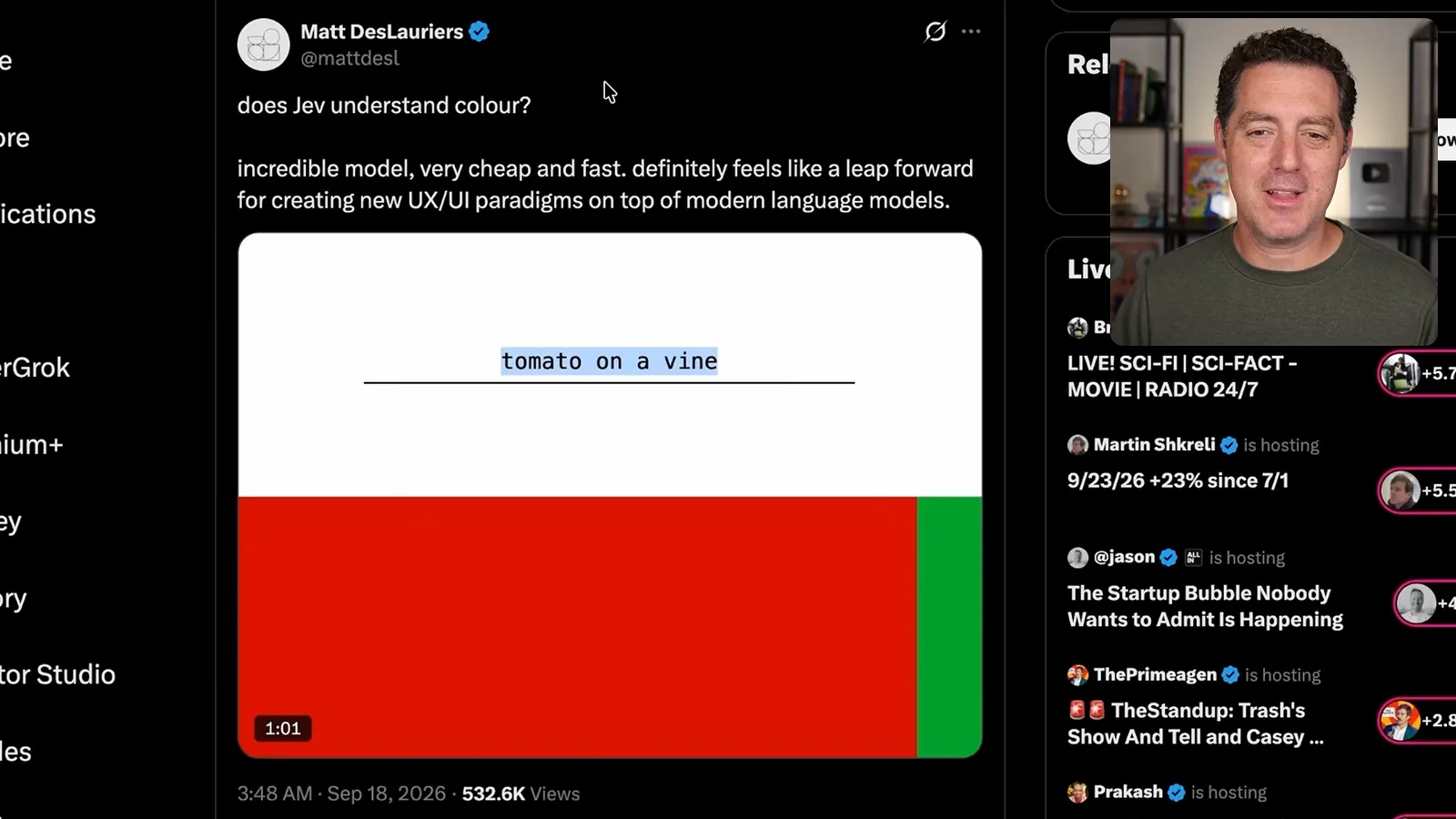
Other demos map phrases to color palettes and pick relevant emoji as someone types. They are playful examples of many fast choices: the model associates concepts such as a beach or a character with colors or symbols.
Berman encourages viewers to experiment with the tool and says it offered $5 in starting credits at the time. His main point is that structured, low-latency decisions can support interfaces and automations that would feel slow if each choice required a long text response.
同じチャンネルの記事
 34:21EN
 Matthew Berman· 2026年10月27日Matthew Berman Examines Anthropic’s IPO Filing, AI Growth and GovernanceMatthew Berman, Sam Altman · Forward FutureThe presenter reviews the S-1’s financial metrics, compute strategy and voting structure while questioning the tension between rapid AI development and safety.
 0:26ENMatthew Berman· 2026年10月25日Sam Altman on Human Values and Problem-Solving in an AI WorldSam Altman · OpenAIIn a short interview excerpt, Altman considers the enjoyment of solving hard problems and the human role in interpreting results.
 0:36ENMatthew Berman· 2026年10月25日Kimi K3.1 and a Rubik’s Cube Solver DemonstrationMatthew Berman · Forward FutureMatthew Berman shows a scrambled virtual cube being solved and gives the Kimi K3.1 test a favorable assessment.
 0:21ENMatthew Berman· 2026年10月24日An AI-Generated Kimi Benchmark Chart Used Invented ScoresMatthew Berman · Forward FutureMatthew Berman asks for a graph of Kimi K3.1 Pro benchmarks, then discovers that the displayed figures are illustrative placeholders.
 25:50ENMatthew Berman· 2026年10月24日Kimi K3.1 Pro Tested: Strong 3D Demos, Uneven Results and Competitive PricingMatthew Berman · Forward FutureMatthew Berman tests the open-weight model on coding, 3D rendering and visual explanations, then compares benchmark results and prices.
 32:20ENMatthew Berman· 2026年10月23日Who Is Local AI For? The Costs, Trade-offs and a Hybrid FutureMatthew Berman · Forward FutureMatthew Berman weighs data control and independence against hardware cost, setup complexity and inference speed.