30 秒でわかる
A company selling AI can be billed for expensive model calls even when the person making them never becomes a customer. ChatPRD founder Claire Vo says trial farming, resold promo codes and relayed requests cost her bootstrapped business tens of thousands of dollars in a year. She ended free trials, set spending and model limits, and uses automated checks to flag abuse. Those controls also block or inconvenience legitimate customers, so she stresses monitoring false positives and making operational trade-offs explicit.
- 1Seat pricing leaves the business exposed to runaway model billsVo says ChatPRD prices by seat while paying model providers by token. Trial and promotion abuse has cost her bootstrapped business tens of thousands of dollars over the past year.
- 2Trial farming and promo-code resale closed free accessFraudsters repeatedly signed up and used expensive models or resold promotional access. Vo ended free trials despite losing an important source of enterprise and product-led leads.
- 3Relays can turn an AI product into someone else’s model serviceVo describes people sending outside requests through authenticated sessions and installing a custom MCP server that drove a continuous worker. She also saw a reseller charge its own customers by the hour.
- 4Fraud controls impose a real cost on growthHer business measures include hard account limits, upfront billing and blocking some countries or VPNs. She acknowledges that these choices can exclude genuine users and remove a sales pipeline.
- 5Control allowed models and monitor spend at least hourlyVo uses an AI gateway, a model allowlist, spending caps and alerts. She says checking spend frequently matters because an exploit can accumulate costs quickly.
- 6Use AI to classify suspicious activity, with limits on support actionsFlagged activity is classified into suspected abuse categories and can trigger a ban, downgrade or human review. She keeps her support agent from reversing bans or giving out promotional access.
- 7Authentication alone does not prove a request is legitimateVo says to verify the client as well as the session and to monitor false positives. A single mistaken ban in a recent sweep had to be corrected.
ポイント
- Measure and cap model spending in dollars, not just the number of requests.
- Review every free trial, promotion and other zero-cost access path for abuse.
- Restrict which models the application can call and set spend alerts and failovers.
- Verify requests are coming through the intended client as well as an authenticated session.
- Keep support agents from unbanning users or issuing promo codes without authorization.
- Account for false positives and the lost legitimate users caused by restrictions.
チャプターごとに整えた全文を読む
Why token fraud hits a seat-priced AI business
ChatPRD pays for model use while charging per seat. Vo says unauthorized use has caused substantial losses and consumed engineering attention.
Token fraud has taken more and more of my time and almost all of our engineering energy over the last year. I run ChatPRD, a bootstrapped AI platform for product managers, as a solo founder. People trying to use its model access outside the service’s terms have made me reconsider the business.
ChatPRD makes calls to language models through providers such as Anthropic and OpenAI, which charge for tokens. We price by seat, not usage, and our pricing assumes an average level of model cost across customers. Someone abusing a trial or promotion can consume model calls without paying enough to cover them.
I estimate the losses have reached tens of thousands of dollars over the past year. Because there is no venture funding absorbing that cost, it comes directly out of my business. After I spoke publicly, people at both large companies and technical startups told me they were dealing with similar problems.
Trials, promo codes and relays create openings
Vo describes repeated free signups, promo resale, card abuse, proxy services and custom MCP servers. She distinguishes commercial abuse from people seeking inexpensive access.
One recurring pattern is free-tier farming. People repeatedly sign up for free access and use expensive models for work unrelated to the product. Trials had been valuable for product-led growth and enterprise leads, but I could not find a cost-effective free tier that would avoid this abuse, so I turned them off.
Promo codes were another opening. We gave partners codes so people could try the product and perhaps become customers; some codes were stolen, resold or used at scale to operate other AI businesses. I am getting rid of them, even though I would prefer to support people who need the product.
We also saw bad or prepaid cards and chargebacks. I had more controls for this category because of previous online business experience. More surprising were relays: someone authenticated to ChatPRD in a browser, sent requests from a separate product through it, and returned the answers to their own customers.
We allow custom MCP servers so customers can connect their business data. In one case, someone installed a custom server that drove a worker around the clock and bypassed message-level controls. I also saw accounts probing models and asking about training cutoffs; I do not know whether that was distillation, farming or another purpose.
Separating legitimate usage from abuse is difficult when we promise enterprise customers that we do not retain or examine their data. Extreme examples can prompt an investigation, but sophisticated users can combine techniques and stay beneath individual thresholds.
One group repeatedly used trials and promo codes, then tunneled through our agent to build Roblox and Fortnite maps. Another wrapped the app in a proxy and sold access to its own customers by the hour. We also saw signup farms with sequential names and people treating trials as a general-purpose chatbot.
The commercial operators trying to exploit the business concern me most. Some trial users come from countries where the price of AI is high relative to local incomes; I have more sympathy for them, but my small business cannot subsidize that usage either.
The business cost of closing access
Vo ended trials and added hard limits and billing controls. Geographic restrictions and tighter access reduce fraud but also shut out genuine customers.
I had initially wondered whether I had simply been naive, even though the product had undergone penetration testing, compliance work and vulnerability scans. Hearing that large companies and technical startups face similar abuse helped. I also used suggestions shared by Gareth Wham at Atlassian to rethink our controls.
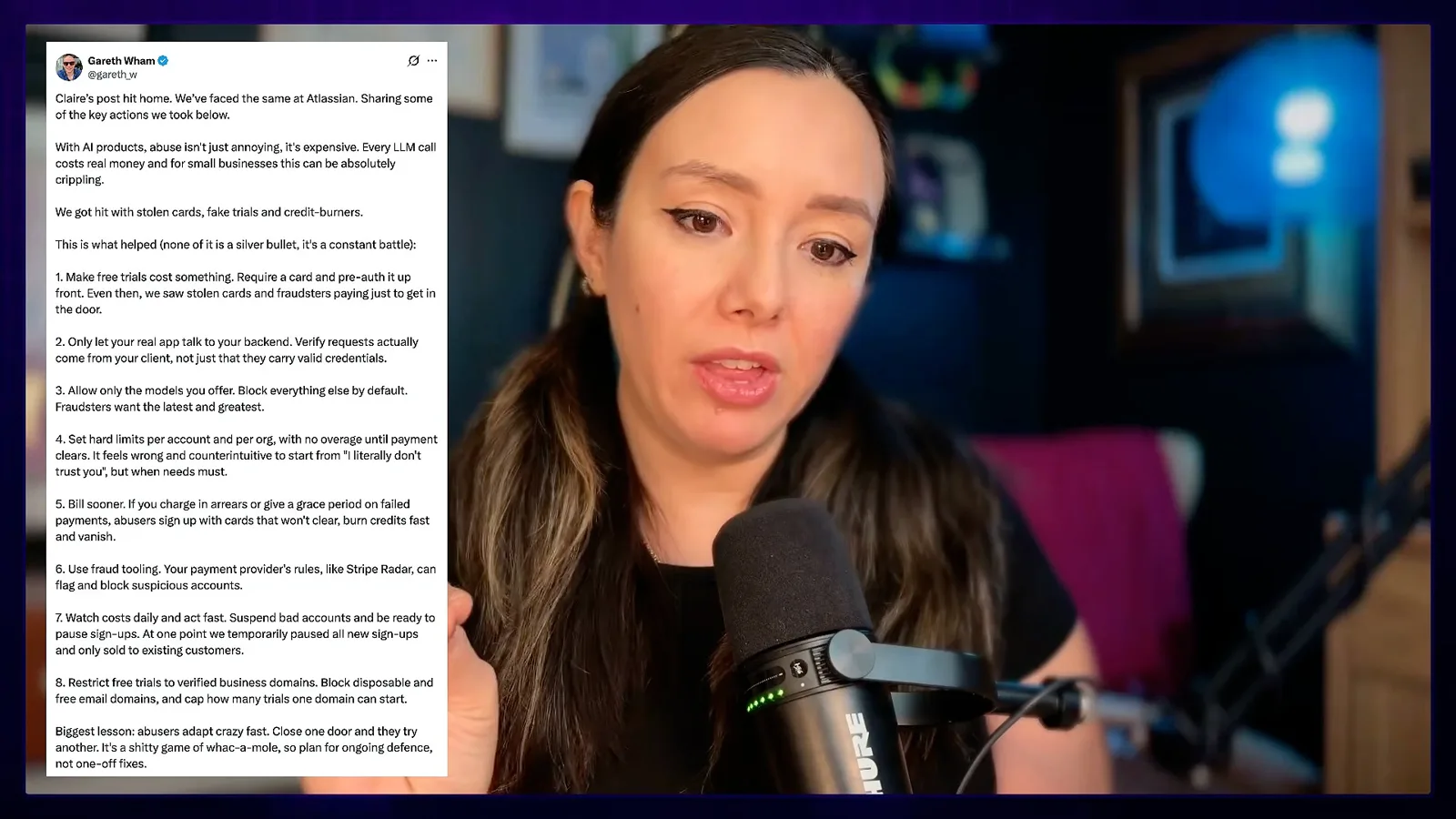
I have ended trials, including trials backed by credit cards: people cycle cards, use bad cards or initiate chargebacks. I am also treating promo codes as a major risk. These decisions remove ways for honest prospects to experience the product and force us to rethink how we acquire customers.
Charge upfront and avoid grace periods on failed payments, one recommendation goes. I now also enforce hard limits per account and organization. We used to keep caps high because we wanted to learn from customers’ usage; as a bootstrapped company, I cannot afford to lose money on every account.
Other business controls include restricting trial access to business email domains, using feature flags to turn access off quickly, and ensuring the terms of service allow action against suspected abuse. The right policy must be something the team can actually enforce when patterns change.
I am reconsidering international access. Blocking whole countries through a firewall reduced fraud in our case, but it also prevents legitimate product leaders and engineers in those places from using the service. It is a blunt instrument, and the lost opportunity is part of the cost.
For what looked like coordinated attempts to bypass security and defraud the business, I filed cybercrime reports. I also chose to talk about the problem publicly. In the activity I investigated, I saw signs that some operators were routing similar proxies through other well-known AI products.
Founders should share patterns with one another. A larger company may be able to absorb losses that threaten a small business, but that does not make the activity genuine growth. Discussing what we see gives us a better chance of responding to it.
Every business control has a trade-off. Restricting countries shuts out good users; ending trials removes a source of leads. Those choices may still be necessary, but they have costs beyond the fraud itself.
Cap spending and verify requests
Vo describes model allowlists, gateway spend controls, payment fraud tools, client verification and hosting firewalls. She also limits risky custom MCP hosts.
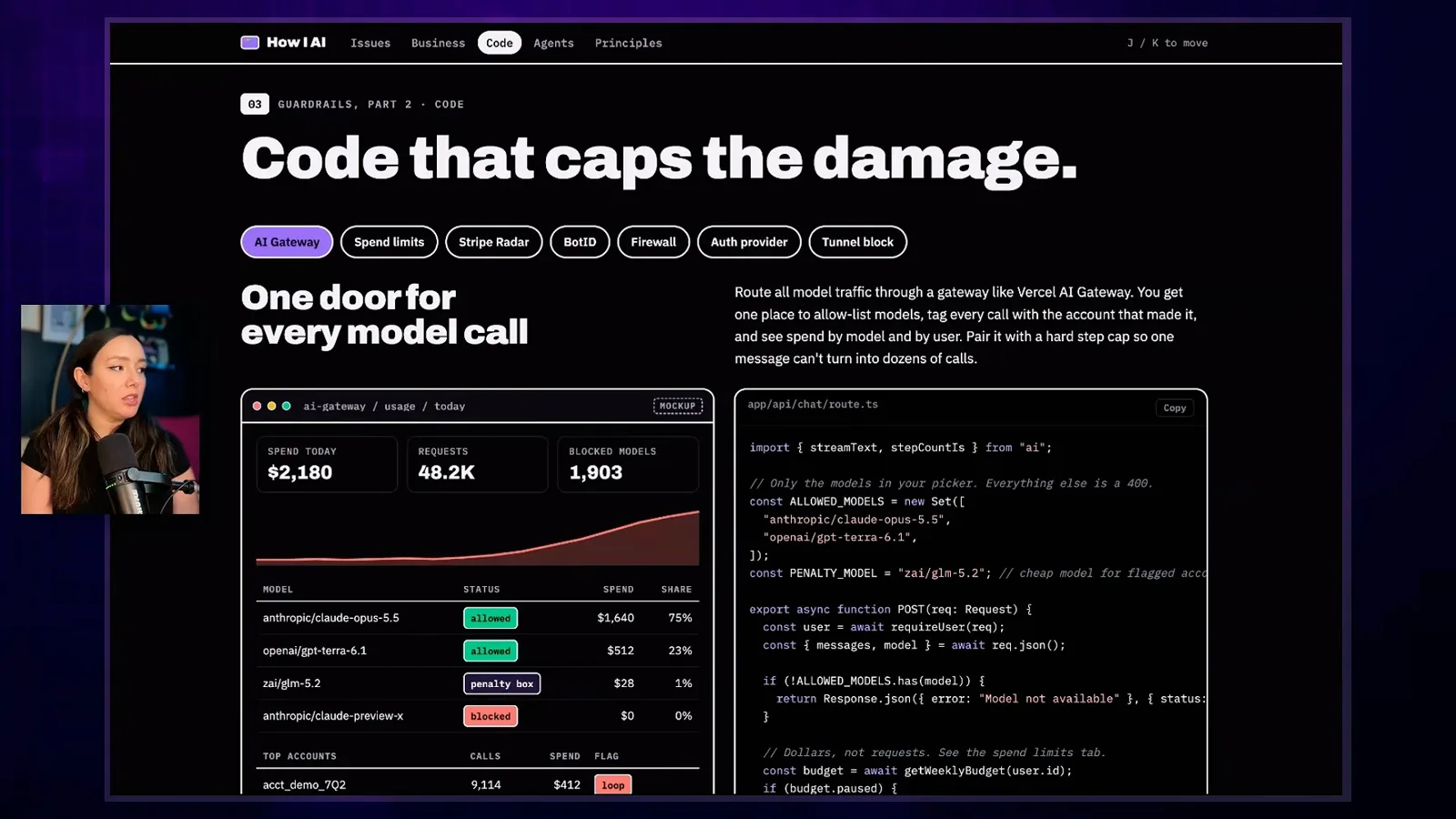
An AI gateway can route calls to providers and put limits on spending. We use Vercel AI Gateway in part because it also controls which models can be requested. An application that exposes a general model endpoint should enforce an allowlist, so a caller cannot switch from an inexpensive model to a costly one.
A suspected abusive request can also be routed to a cheaper model as a penalty. Set spend caps, alerts and automated failovers to fit the business, and inspect spend hourly or live. My mistake was not realizing how quickly an exploit could accumulate a large bill.
I use Stripe Radar for payment fraud. Its rules can be evaluated against historical transactions to see which payments they would block. I initially adopted it for card testing after seeing roughly $200,000 in attempted purchases, mostly failed transactions involving suspicious cards.
I use a coding agent to help write complex Radar rules, then review and enable them in Stripe. One rule combines code and payment signals to fingerprint cards and identify the same card being used across multiple trials.
Client verification is separate from having valid credentials. We added Vercel Bot ID to chat request routes to check whether requests appear to come through the intended app. I recommend observing the traffic first, tuning the control, and then deciding when to enforce it.
Our hosting firewall provides country and VPN blocks, IP blocks and rate limits. I have used these aggressively because, for my business, some geographic blocks sharply reduced abuse. That decision reflects a trade-off: it also excludes legitimate users.
Authentication providers have their own controls, including bot protection. Check what is available and ask the provider for help tuning it. We also now watch the MCP hosts users connect: free tunnels and hosts that do not appear to be real organizations are a concern because custom connections can be used to route outside workloads.
Automated classification and a protected support desk
Flagged requests and account activity enter AI-assisted review workflows. Support agents receive playbooks but cannot restore access or issue promotions.
Technical guardrails are only part of the response. We also need operational loops that identify unusual activity quickly and apply the lessons back to the product. AI tools have made this possible for a small team, though the same tools are also available to people attempting abuse.
When a chat’s metadata crosses an abuse threshold, we use a zero-data-retention Jev classification loop to assess whether it looks like a real customer, trial or promo abuse, card fraud, resale or agent farming. Depending on the result and severity, we ban an account or silently route it to a cheaper model.
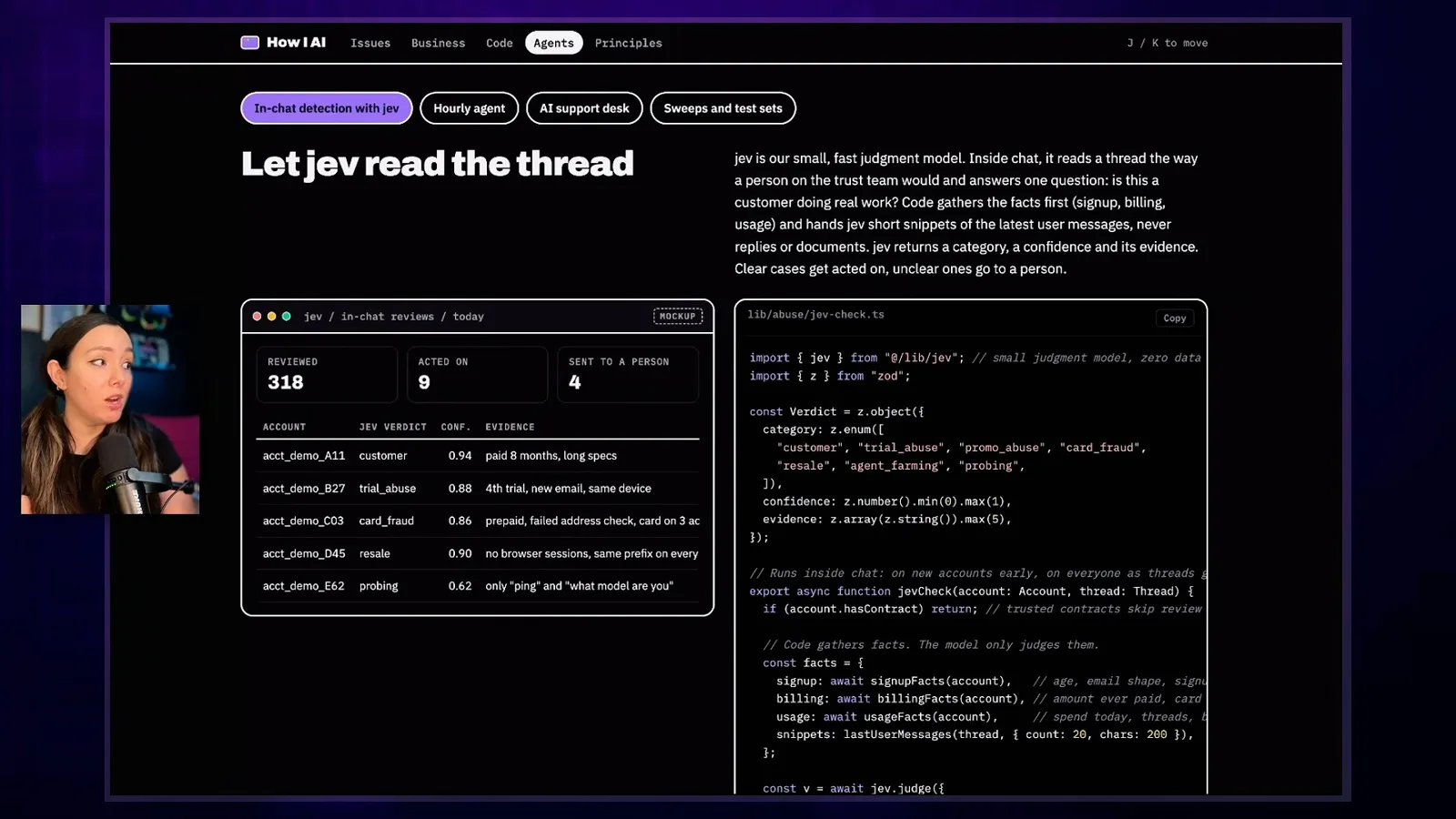
A separate hourly agent reviews recent signups and unusual threads for abuse signals. High signals can lead to an automatic ban; uncertain cases are sent to me or to our AI support desk. Support needs fraud lists, allowlists and playbooks so it can respond to users who ask why access was removed.
Responses after a ban vary: some are terse or garbled, and others are polite and provide detailed explanations. The support system needs to handle those requests, but it must not be allowed to unban accounts, ban users or issue promo codes on its own. Otherwise support itself can become an attack route.
Each new pattern should feed back into rules, operations and agent playbooks. The work has at times felt like 80% or 90% of the job, and the easiest ways to stop abuse can also damage the business. My hope is that these feedback loops make a small operation more resilient.
Treat AI sales as selling compute
Vo closes with spending monitoring, client verification and correction of false positives. She says sustaining the business requires balancing abuse prevention with the needs of real users.
If you sell AI, you are selling compute. Watch the model bill and count dollars rather than only requests, because model prices vary substantially. I found that when we stopped offering a premium model in a few countries, the token theft there stopped, suggesting that the expensive model itself was the target.
A product’s own AI can be used to plan abuse against it: we saw people writing product requirements for ways to exploit ChatPRD. Verify the client as well as the login, keep policies enforceable and account for false positives. I mistakenly banned one legitimate user in a sweep and corrected it.
This has been painful and expensive, even with a technical background and years of experience. Other founders and teams tell me they face the same problem. I want to keep building useful AI products while finding ways to ensure their creators and legitimate users can sustain them.
同じチャンネルの記事
 34:15EN
 How I AI· 2026年11月11日ポッドキャスト · 2 人Scott Farrar’s AI household system keeps its memory in filesゲスト Scott Farrar · ホスト Claire VoA shared folder helps a family track repairs, insurance and next steps across AI conversations.
 38:34ENHow I AI· 2026年11月9日ポッドキャスト · 2 人A founder used Codex to build the Norwegian tutor he wantedゲスト William Imoh · ホスト Claire VoWilliam Imoh describes a voice app built around conversation, then shows how role-based agents support his company.
 24:47ENHow I AI· 2026年11月9日ポッドキャストClaire Vo: Fable 5.2 excels at creative builds, but not every designA marketing animation, furniture guide and 3D typewriter impressed Vo; independently generated website designs did not.
 42:30ENHow I AI· 2026年11月2日ポッドキャスト · 2 人Inside Figma’s PM OS: Ezra Mechaber on Skills, Bug Bashes and Automated Experimentsゲスト Ezra Mechaber · ホスト Claire VoFigma growth PM Ezra Mechaber shows Claire Vo how a shared repository supports product work, browser testing and a human-reviewed experiment loop.
 35:10ENHow I AI· 2026年10月28日ポッドキャストFour Personal AI Agents on Nine Tasks: A User’s Testホスト Claire VoClaire Vo compares work and family workflows while acknowledging uneven access and subjective scoring.
 29:40ENHow I AI· 2026年10月26日ポッドキャスト · 2 人How Reddit Proto Connects Design, Live Data and Production Codeゲスト Blair Metcalf · ホスト Claire VoBlair Metcalf demonstrates Reddit’s internal prototyping harness and its design-system mapping for Figma and Cursor.