30 秒でわかる
Jordan Nanos and Daniel Nishball discuss SemiAnalysis’s forecast of AI infrastructure spending and the credit structures used to finance it. They examine NVIDIA’s commitments, GPU rental prices, model-serving economics and the limits of corporate backstops; the large figures are the analysts’ estimates and forecasts.
- 1The funding forecastThe $11.3 trillion figure is cumulative projected AI IT and data center spending over 2024–2029.
- 2NVIDIA commitmentsThe episode’s snapshot groups about $497.5 billion of disclosed gross off-balance-sheet commitments into several categories.
- 3Credit and executionA strong customer’s offtake reduces some credit risk but does not guarantee timely construction or delivery.
- 4Older GPU prices riseThe survey chart shows one-year H100 rental pricing rising as supply of newer accelerators remains constrained.
- 5How a backstop worksNVIDIA’s rental commitment can support financing while a neocloud seeks its own customers.
ポイント
- SemiAnalysis forecasts $11.3 trillion in cumulative AI IT and data center capital expenditure from 2024 through 2029.
- Long-term contracts and investment-grade backstops can help projects borrow, but they do not eliminate execution risk.
- H100 rental prices rose in the analysts’ data despite the arrival of newer, faster hardware.
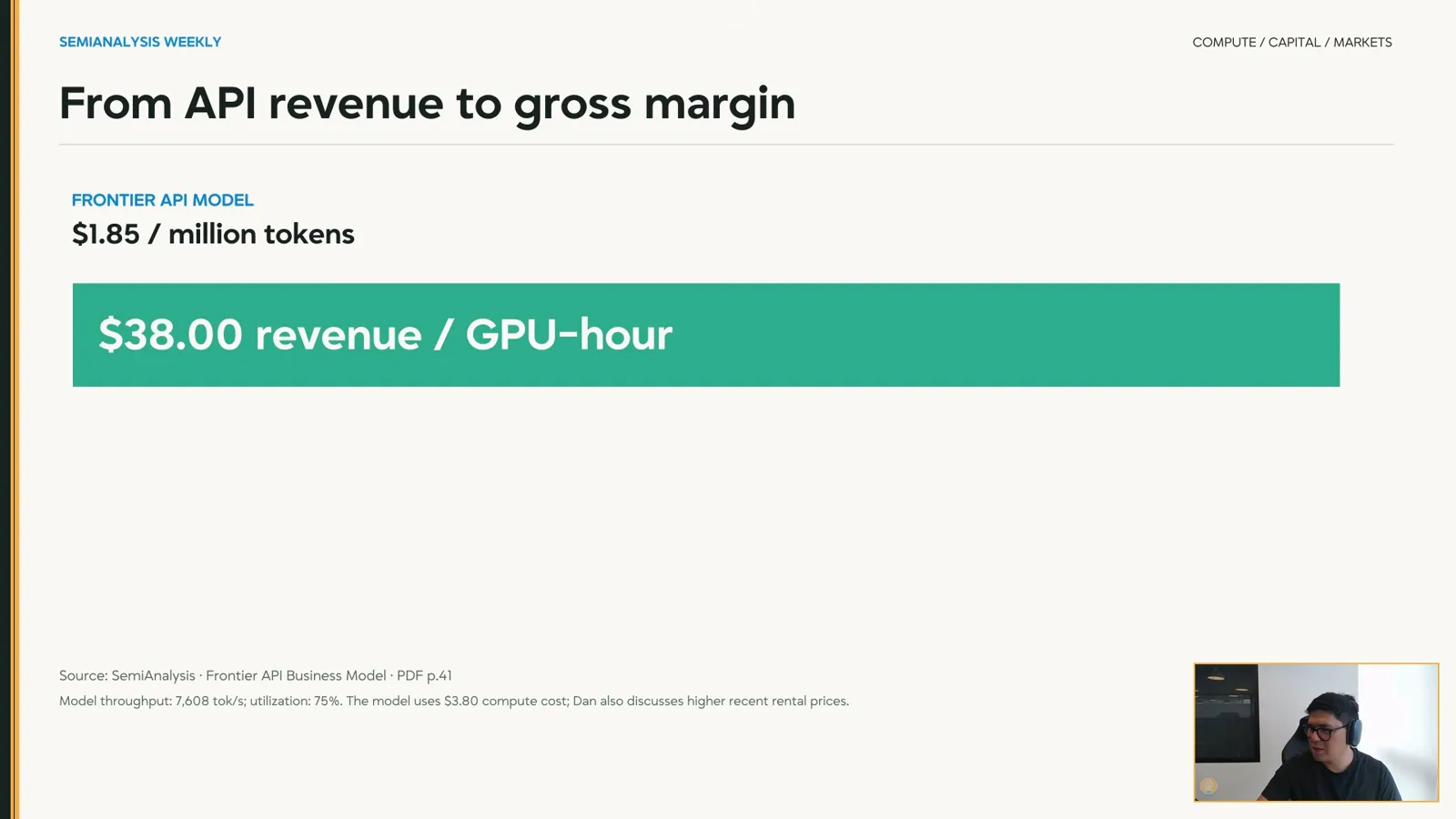
- Their model of high API margins depends on throughput, price, utilization and cost assumptions.
- The analysts expect lenders to need better tools to assess GPU residual value and customer risk.
チャプターごとに整えた全文を読む
Capital needs and constraints
The analysts explain their spending forecast and how financing joins chips and data centers as a constraint.
SemiAnalysis host Jordan Nanos welcomes Daniel Nishball to discuss the financing behind AI infrastructure. Their conversation draws on a September 2026 analysis of NVIDIA’s commitments and the estimated scale of the build-out.
Nishball says capital requirements have grown rapidly and asks whether corporate balance sheets can support the guarantees needed by borrowers. The discussion separates the willingness to spend from the ability to raise financing.
He describes an “AI project trinity”: capital, an offtake customer and a data center. Hardware availability also matters, but he believes the binding constraints have shifted over time from chips toward facilities and financing.
The speakers discuss memory shortages and a reduction in some proposed accelerator memory specifications. Nishball says cost and availability both influenced the change, which he sees as a way to relieve a hardware bottleneck.
For data centers, Nishball points to new powered sites, refurbished facilities and on-site generation. He expects the supply balance to improve by 2027–2028, a forecast rather than an established outcome.
SemiAnalysis estimates $11.3 trillion in cumulative AI IT and data center capital expenditure from 2024 through 2029. The figure includes projected spending across multiple years and buyers, not a single year of hyperscaler spending.
Nishball says the model combines projected accelerator shipments with rack and system costs, including networking and CPUs, and adds data center construction. The speakers say other upstream spending, such as power plants and semiconductor fabs, is outside this particular total.
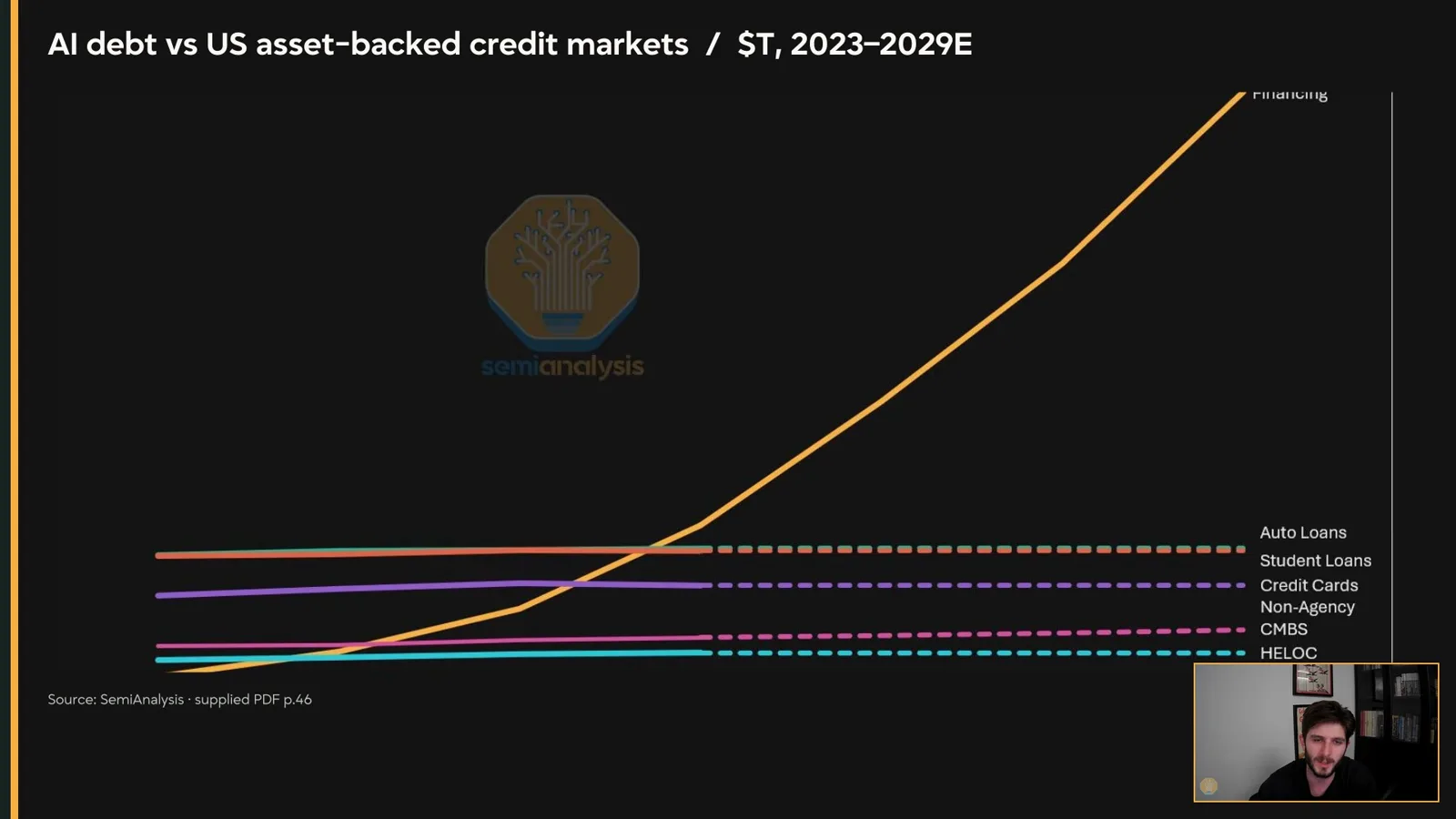
The analysts project roughly $7 trillion in outstanding debt by 2029 and about $1 trillion of new funding in the year discussed. Nishball notes that repayments and future capacity assumptions affect the estimate.
He compares the need with investment-grade and high-yield bond markets and leveraged loans. Different types of borrowers have different credit profiles, and a growing pool of projects must compete for financing.
Nishball cites announced or reported deals involving data center projects, neoclouds and model companies. He distinguishes capital already raised from reported transactions that had not yet been documented.
Nanos emphasizes that financing supports more than GPU purchases: buildings, power and other infrastructure must be available before accelerators can be installed.
Nishball distinguishes total cost of ownership from upfront capital expenditure. Servers and facilities have different assumed useful lives, so their shares look different depending on the measure and depreciation period.
Nanos asks what happens after a GPU’s modeled five-year life. Nishball says many projects are underwritten to generate returns over the contracted period without relying on residual value; any later value would be additional, though deal structures vary.
Balance sheets and credit risk
Long-term offtake and guarantees help projects obtain capital. Accounting treatment and project execution still matter.
The episode presents a snapshot grouping approximately $497.5 billion of NVIDIA’s disclosed gross off-balance-sheet commitments. The categories include cloud agreements, leases, guarantees and supply commitments; a separate prospective residual-value category was not sized in the chart.
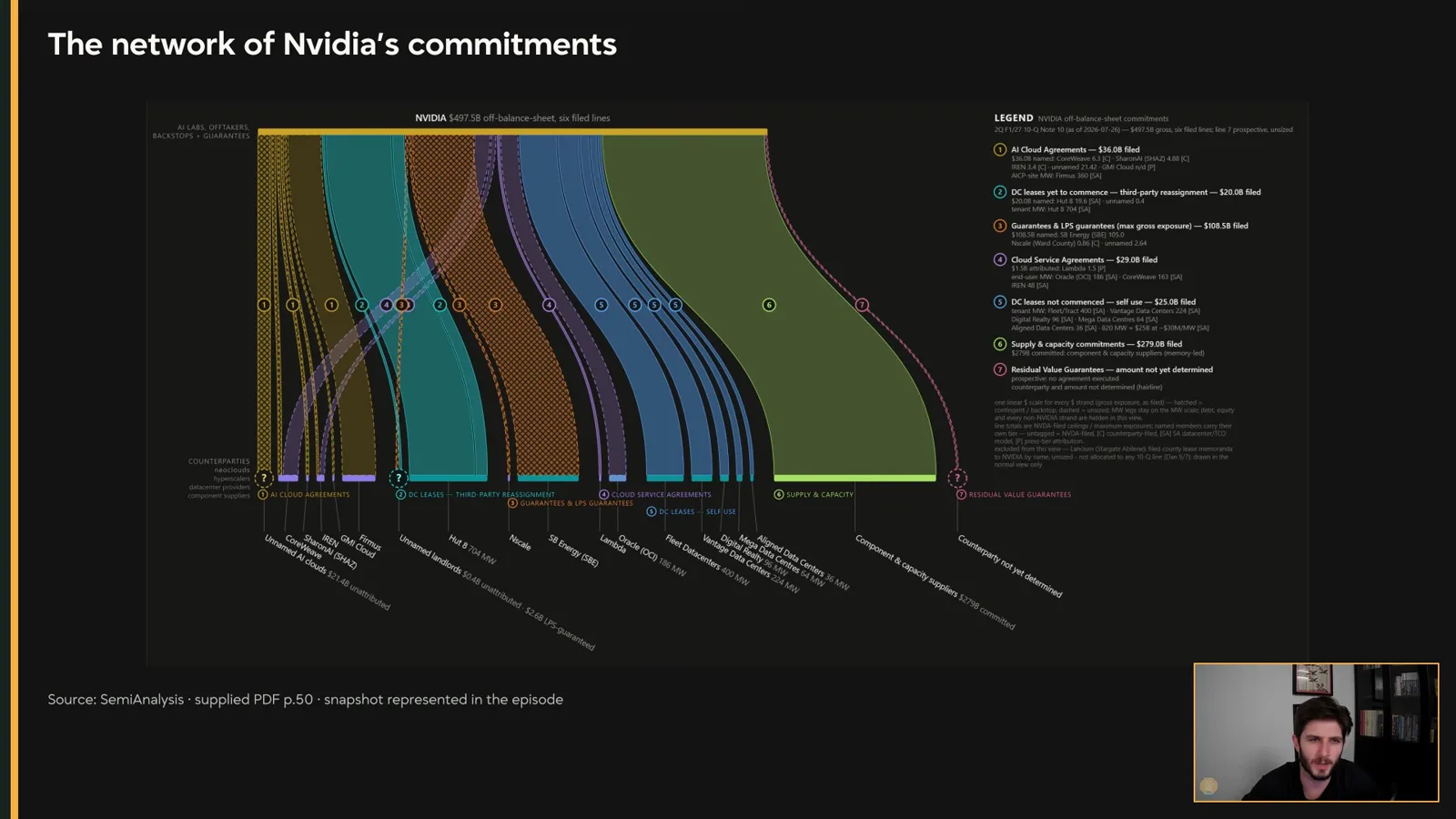
Nishball cautions that the reason for a backstop matters. A guarantee can help a project find financing or capacity, but the exposure still needs to be identified and assessed rather than assumed away.
He describes a structure in which a highly rated hyperscaler commits to take capacity from a neocloud and then serves an AI customer. The hyperscaler’s commitment can make lenders more comfortable with a construction loan.
A service contract and a lease may receive different accounting treatment. The speakers say obligations that do not appear as debt on a balance sheet can still matter economically and require attention in disclosures.
Nishball calls the practice “balance sheet as a service”: large companies support projects with their credit. He argues that this capacity is finite, because lenders and rating agencies can eventually question the scale of the commitments.
He points to widening credit spreads for some large issuers as a market signal. His examples are observations from the recording date and should not be treated as current yields.
A lender funding a CoreWeave project with a Meta offtake can consider both the customer’s credit and the project’s execution. Nishball uses the difference between selected spreads as an illustration of the latter risk.
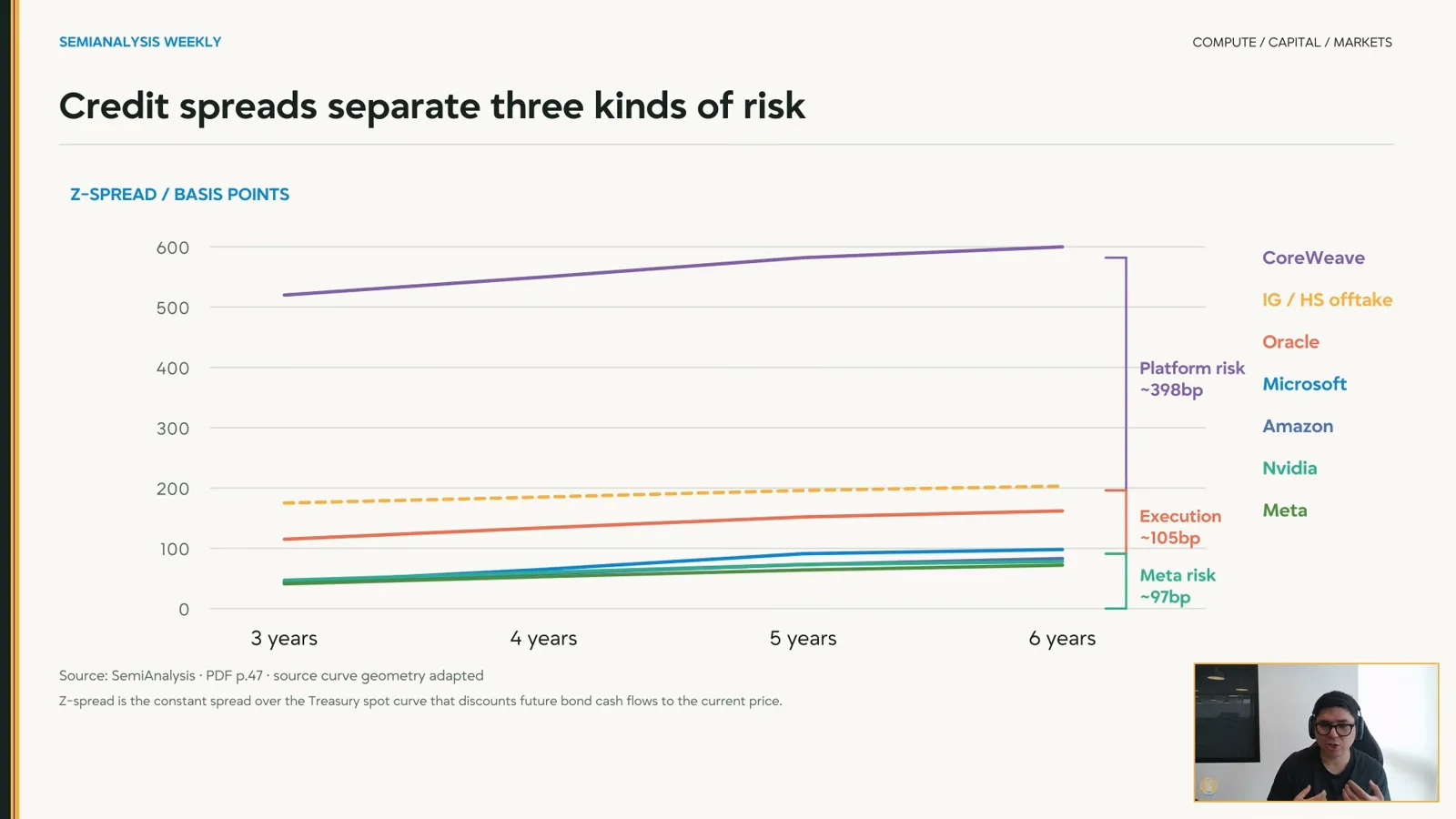
Nishball suggests cluster-quality assessments can provide one operational signal. Nanos cautions that a managed-cluster rating is not a credit rating or a guarantee that a particular bare-metal data center will be delivered on time.
Different sites can have different teams, locations, financing and execution risks even within the same company. The hosts agree that an individual project needs its own assessment.
GPU rental prices
The speakers discuss supply shortages, H100 pricing and the difficulty of modeling residual value.
Nanos says GPU buyers once could compare providers through short proofs of concept. In the market he describes, buyers may need to commit months before delivery and make substantial prepayments.
The cost of capital can accumulate across layers: an AI lab raises funding, pays a provider, and indirectly bears the provider’s financing cost. This can motivate a shift from renting toward self-building.
Self-building has its own balance-sheet limits. The speakers describe a cycle in which companies seek external partners and guarantees when they need more infrastructure than they can finance alone.
Nishball says lenders often prefer investment-grade counterparties because newer neocloud business models and GPU residual values are harder to underwrite. He wants better operating and market data to help them assess risk.
GPU residual value depends partly on what an accelerator can earn, rather than a simple straight-line depreciation schedule. Nanos says scarce supply and uncertain future demand make the theoretical curve difficult to observe.
Newer systems can be much more efficient for inference, so an old H100 might look unattractive in a comparison where both are freely available. In practice, he says, the newest hardware may be sold out or months away.
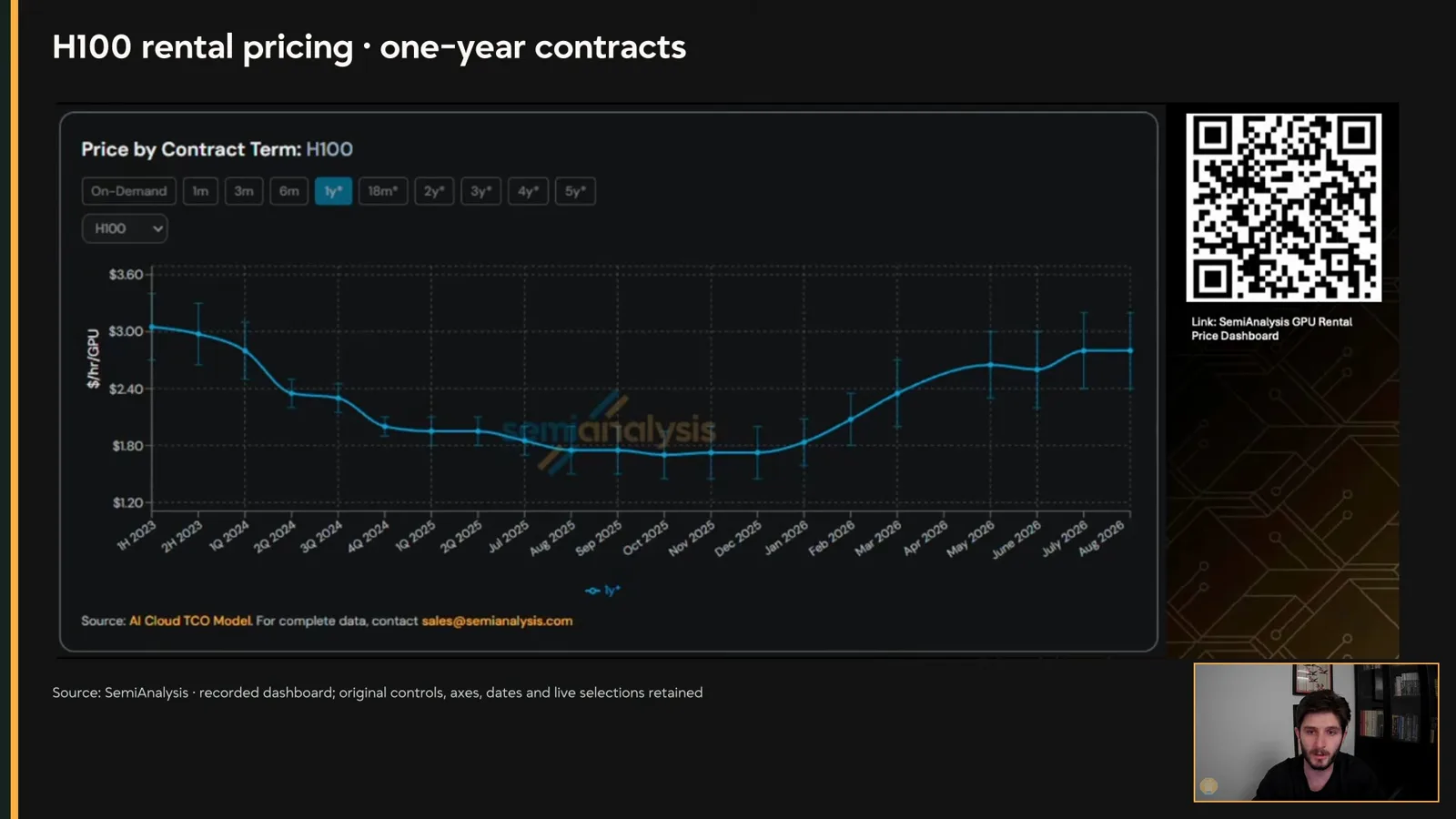
The episode’s survey chart shows one-year H100 rental prices rising toward earlier levels. Nanos attributes much of the rise to customers bidding for available capacity when newer GPUs cannot be obtained promptly.
He adds that some researchers prefer familiar H100 systems for productivity or numerical stability, rather than optimizing solely for inference throughput. These needs can sustain demand even when newer hardware is faster.
The speakers recall lower offers around the previous year and subsequent renewals at much higher prices. Nanos expects demand and possible data center delays to support pricing, while acknowledging these are forward-looking judgments.
Nishball says their earlier depreciation model used the relative performance of new GPUs and initially tracked prices reasonably closely. The divergence from that curve led the team to examine what rental prices might imply about supply and demand.
Token economics
They examine assumptions about API margins, subscription use and demand. Their figures are model estimates.
Nanos connects demand to model efficiency: new architectures can produce more useful output per unit of compute. He argues that model providers and GPU renters may both benefit under particular pricing and utilization conditions.
He says even sophisticated labs may have underestimated demand and profitability, prompting expensive capacity commitments. This is his interpretation of the market, not verified financial reporting from each provider.
Nishball returns to two questions: whether customers want enough compute to justify spending, and whether they can obtain the capital to pay for it. Strong modeled margins address the first question only under their assumptions.
He offers a high-utilization scenario in which a megawatt of frontier inference capacity generates substantial revenue relative to its construction cost. He acknowledges that utilization assumptions may be optimistic; actual results depend on demand, pricing and expenses.
Their illustrative API model uses a blended token price, throughput and utilization to estimate revenue per GPU-hour. Comparing it with an assumed rental cost produces a high gross margin, but it is not a company-wide audited margin.
Subscriptions are different: a flat fee’s profitability depends on how much each customer uses the service. The speakers discuss an estimated average utilization rate and acknowledge that they do not directly observe the whole subscriber base.
Power users may use the full allowance while enterprise subscribers use much less. Nanos compares this incentive to a gym membership, while distinguishing it from per-token pricing, where revenue grows with consumption.
Nishball asks how token prices will evolve. The speakers argue that headline prices, cache-hit rates and changes in the mix of models can lead to different conclusions about effective prices.
Nanos says task difficulty and token efficiency complicate comparisons over time: users may attempt larger problems as models improve. His view is that demand will continue to grow, but he notes that different model and serving choices could change the economics.
Nishball says AI tools helped a small group build a database of debt facilities faster than he expected. This is an internal productivity anecdote, not a controlled comparison.
Demand and lenders
The hosts discuss adoption, investor understanding and the size of projected financing needs.
Nanos describes personal uses including travel changes, email and scheduling. Both speakers see value in the tools, though their enthusiasm is not proof that every potential customer will adopt them.
Nishball distinguishes early AI users from larger enterprises, where he sees more uncertainty about discovery, organizational change and willingness to deploy. Individual leaders can make very different choices.
Nanos expects AI-native companies to grow and potentially attract capital from investors accustomed to other infrastructure. He presents this as a possible future, not a certain replacement of incumbent firms.
The discussion returns to lenders’ ability to evaluate projects. Nishball says many currently rely on the credit of a large guarantor while they learn how neocloud customers, equipment and operating risks behave.
He compares projected AI financing with selected US asset-backed credit markets. The chart combines the team’s estimates and projections; the comparison does not mean all categories have identical definitions or risks.
NVIDIA backstops
Nishball explains rental guarantees and an illustrative risk-tranching structure. The company’s capacity to provide guarantees is finite.
Nishball explains an NVIDIA rental-backstop program. In his description, NVIDIA offers to rent capacity at a specified floor if a neocloud cannot find a customer, giving lenders a more recognizable counterparty.
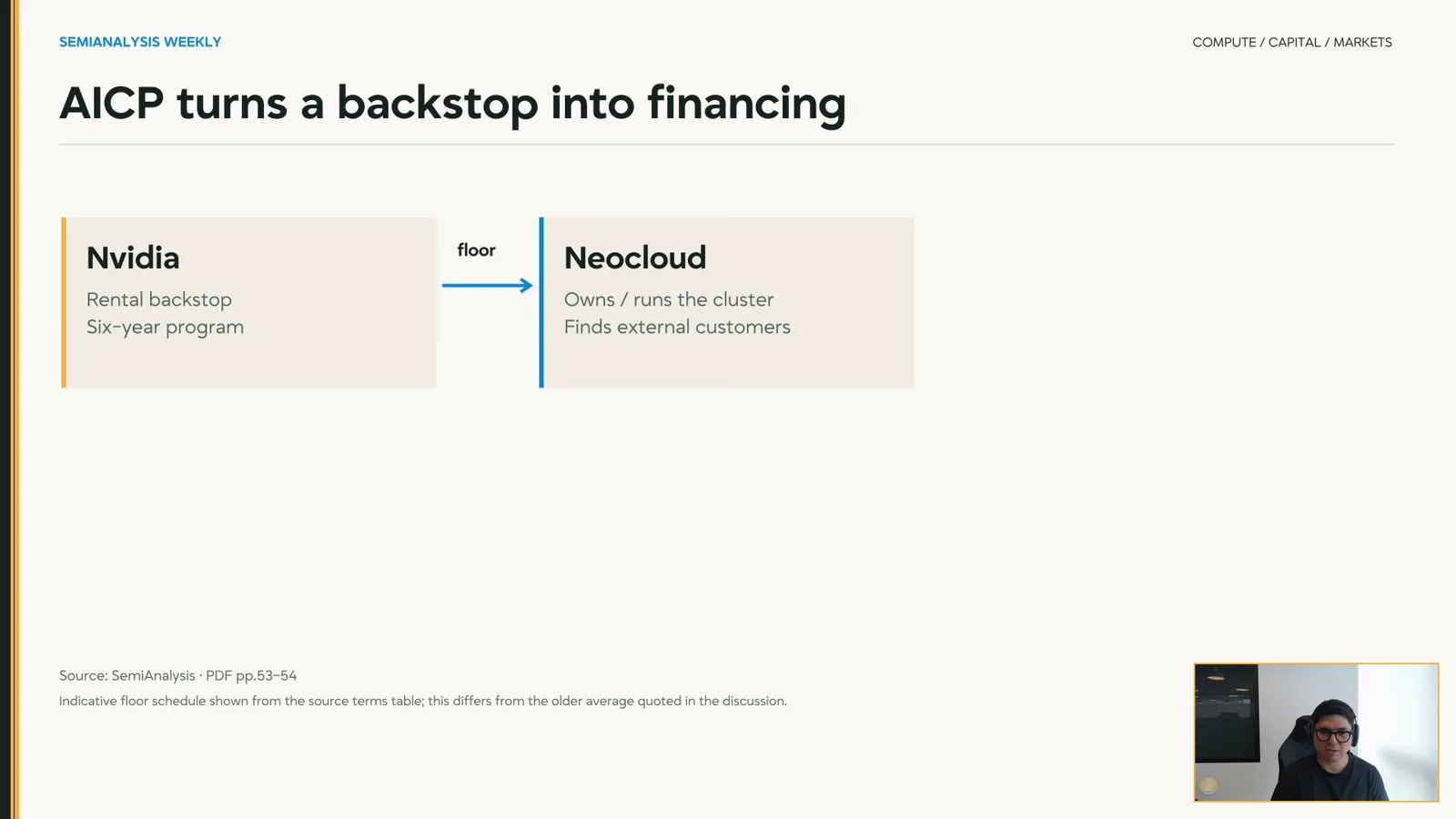
The guarantee can help the operator borrow to build the cluster while seeking its own customers. Nishball describes a six-year arrangement with a schedule of minimum prices; the episode’s graphic notes that its indicative schedule differs from the older average quoted aloud.
He says the mechanism also gives lenders time to observe the neocloud’s customer base, churn and execution. It does not remove platform or construction risk, and the terms depend on the particular agreement.
Nishball describes a revenue-sharing provision in exchange for the guarantee and other structures supporting specific projects. These are the speakers’ descriptions of deal terms, not a universal rule for all backstops.
He sketches a hypothetical $500 billion capital partnership with different risk tranches. Equity and junior pieces would absorb losses before senior pieces, and a residual-value guarantee could be attached to a selected tranche; the graphic explicitly labels this as illustrative rather than signed terms.
The team estimates NVIDIA could support a certain amount of capacity under its modeled balance-sheet assumptions, but Nishball says that would not cover the entire projected market. He argues lenders will eventually need to evaluate risks beyond corporate backstops.
Nanos identifies two needs: educate lenders about deal structures and customers, and recognize how much additional capital the team forecasts. Both forecasts and the availability of funding remain uncertain.
Closing reflections
The speakers describe the need for technical and financial due diligence as new lenders enter the market.
The speakers reflect on the work required to explain technology, returns and risks to lenders. Nanos recalls realizing that pension investors can ultimately be among the people exposed to these financing decisions.
They close by emphasizing the learning curve for new investors and the importance of technical and financial due diligence. Recruitment and other housekeeping follow the discussion.
同じチャンネルの記事
 55:06EN
 SemiAnalysis· 2026年10月27日ポッドキャスト · 4 人Anthropic's S-1: Revenue, Compute Costs and the Race to ScaleThe SemiAnalysis panel examines Anthropic’s filing, from improving compute economics to customer concentration and competition.
 34:35ENSemiAnalysis· 2026年10月23日ポッドキャスト · 3 人SemiAnalysis on ASML's Hybrid-Bonding Patents, HBM Economics and the Next Tool Ecosystemゲスト Sherry Zhang, Howie · ホスト Jordan NanosJordan Nanos, Sherry Zhang and Howie examine a track-based bonding design that brings the wafer to the die, then explain why adoption depends on precision, cleanliness, economics and a changing supply chain.
 34:47ENSemiAnalysis· 2026年10月20日ポッドキャスト · 3 人Why SemiAnalysis Raised Its 2027 Data Center Forecastゲスト Jeremie Ontiveros, Reyk Knuhtsen · ホスト Jordan NanosJeremie Ontiveros and Reyk Knuhtsen explain their project-level model, construction risks and the possibility of a future capacity imbalance.
 44:12ENSemiAnalysis· 2026年10月14日ポッドキャスト · 3 人GLM 5.3, Sparse Attention and the Cost of Inferenceゲスト Kimbo Chen, Wenyao Gao · ホスト Jordan NanosSemiAnalysis examines memory bottlenecks, AMD and NVIDIA serving results, post-training and support for Chinese chips.
 50:13ENSemiAnalysis· 2026年10月7日ポッドキャスト · 3 人How SemiAnalysis Compared AI Subscription Limitsゲスト Max Kan, Andrew Megalaa · ホスト Jordan NanosA snapshot of token accounting, cache-heavy workloads and the assumptions behind API-equivalent subscription values.