30 秒でわかる
SemiAnalysis host Jordan Nanos speaks with Jeremie Ontiveros and Reyk Knuhtsen about their forecast of roughly 50 gigawatts of data center capacity in 2027. They defend the estimate against more cautious views, explain how they account for delays and discuss modular construction, power and chip supply.
- 1A forecast raised, not cutThe team now projects roughly 50 gigawatts for 2027, above its earlier 43-gigawatt estimate.
- 2Project-level trackingPermits, power allocations and satellite imagery help the team assess individual buildings.
- 3Delays in the modelThe analysts say they often add one to three quarters to developers’ delivery targets.
- 4Modular constructionPrefabrication can reduce on-site work and shorten construction schedules.
- 5A possible reversal in 2028Ontiveros sees a risk that data centers could outpace chip supply, rather than a settled prediction.
ポイント
- SemiAnalysis raised its 2027 forecast from 43 to roughly 50 gigawatts, while some critics expect about 25.
- The analysts track projects at building level and say their model already incorporates delays.
- Moratoriums, power and labor constraints matter, but their effects differ across projects.
- Modular construction can shorten schedules and reduce on-site labor, according to the analysts.
- The team sees a risk that data center capacity could outpace chip supply in 2028.
チャプターごとに整えた全文を読む
The forecast dispute
SemiAnalysis raises its 2027 forecast even as critics question its earlier estimate. The analysts describe the history of their model.
Jordan Nanos welcomes Jeremie Ontiveros and Reyk Knuhtsen of SemiAnalysis to discuss their 2027 data center forecast. Brad Gerstner had called their earlier 43-gigawatt estimate too aggressive; the team has raised its forecast to about 50 gigawatts instead.
Nanos says critics point to moratoriums, grid connections and other constraints and suggest a figure closer to 25 gigawatts. He asks the analysts to explain their model, the risks and why they remain confident in their higher forecast.
Ontiveros says SemiAnalysis launched its model nearly three years earlier and published its initial results in March 2024. Its forecasts were higher than many competitors’ and anticipated acceleration in 2025 and 2026, he says.
The team triangulates information from chips, data centers and energy rather than relying on one source. Ontiveros says its forecasts have remained broadly consistent across revisions, while acknowledging some upward changes.
Knuhtsen says objections span construction bans, electricity, labor, equipment and financing. In his view, the concern is often applied to the whole market from headlines about individual canceled or delayed projects.
What the model tracks
The team discusses moratoriums, site-level construction and potential delays. It says the forecast already accounts for many risks.
The team says it tracks individual buildings, permits and power allocations, using satellite images to follow construction and estimate when projects may come online. Knuhtsen argues that physically observed construction provides a basis for the forecast.
To assess moratoriums, the analysts mapped more than 400 restrictions against data center locations and jurisdictions. Knuhtsen says roughly 10% were actually affected; grid headroom and on-site generation also vary from project to project.
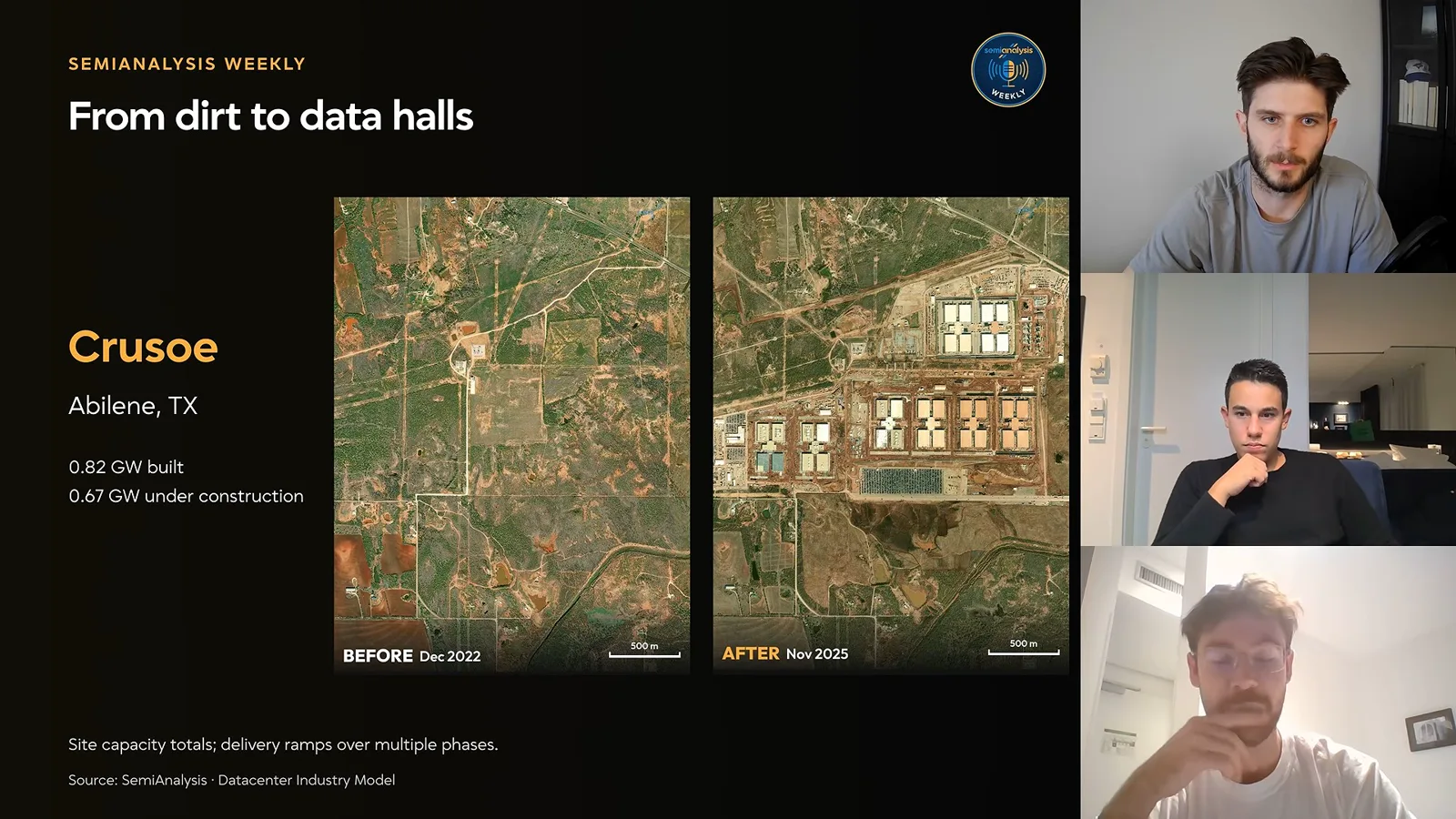
Nanos asks whether many projects could slip by quarters or a year and move capacity from 2027 into 2028. Knuhtsen says winter storms, equipment failures and overly optimistic project schedules can all produce delays.
A 12-month construction schedule is already aggressive by historical standards, Knuhtsen says. A new developer with unclear permits, power or tenants raises additional questions, so the model does not simply accept every short timeline.
Ontiveros argues that applying a further blanket reduction to their forecast risks counting delays twice. Some projects already under construction contribute only part of their capacity in 2027, and others contribute none that year.
The analysts also speak with developers on the ground. Ontiveros says they hear about community opposition and labor shortages, but also increasingly ambitious delivery targets; the model often adds one to three quarters of delay to those targets.
The largest projects
The analysts distinguish an initial delivery from a full campus ramp. They explain assumptions for projects in New Mexico and Childress.
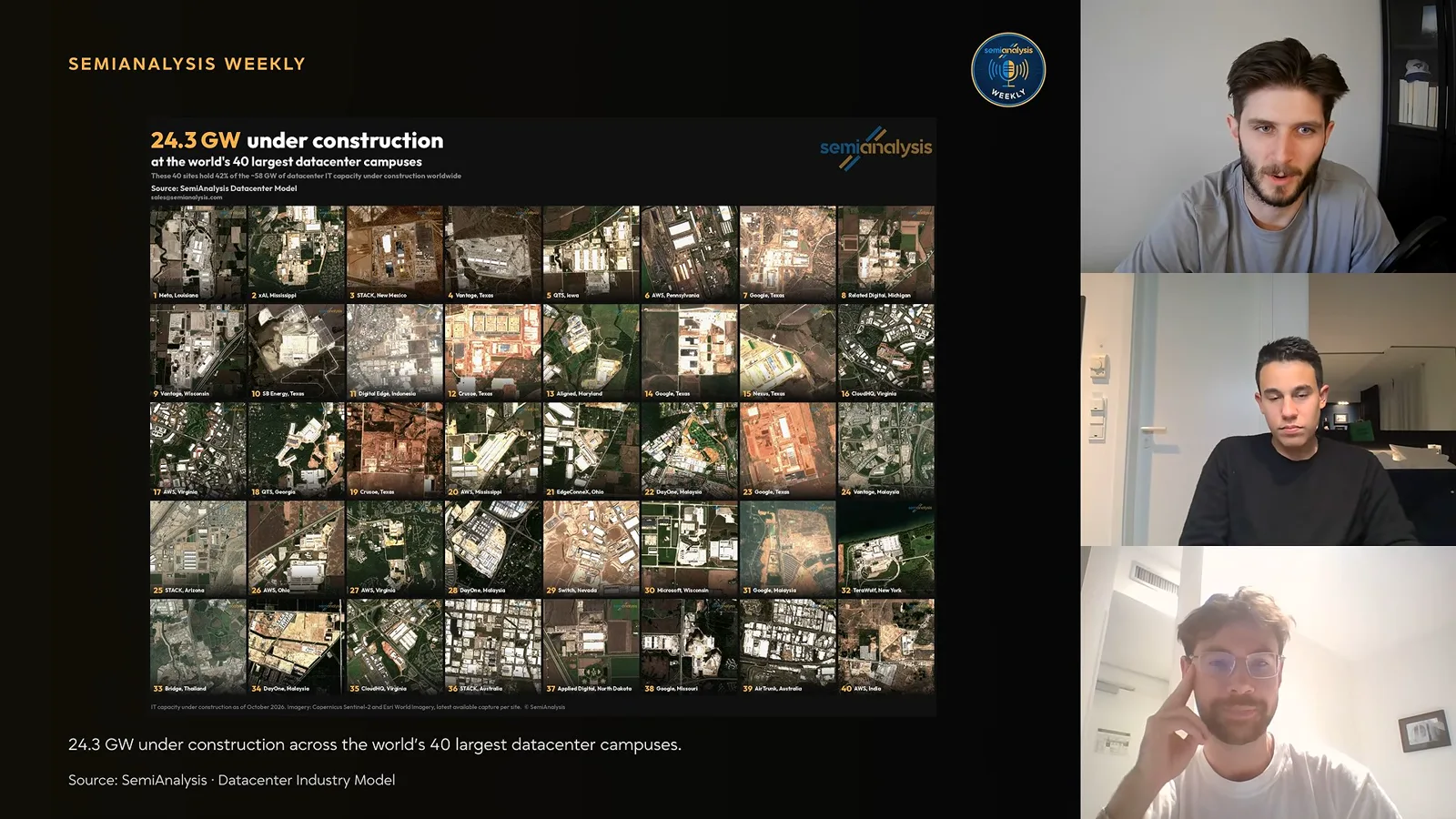
Nanos points to 40 large sites shown in a chart and says they represent less than half the data center capacity under construction worldwide. Not every megawatt at these campuses is assumed to arrive in 2027.
Ontiveros distinguishes the date of a site’s first phase from the speed at which the campus reaches full capacity. He says the model applies a slower ramp to Oracle’s New Mexico project because of power challenges.
As another example, he says the latest model includes less than 200 megawatts in 2027 for Crusoe’s Childress site, not the full gigawatt that some critics had attributed to it. Large facilities ramp over time rather than appearing at full capacity overnight.
Leading indicators
Leasing, construction starts and supplier orders offer signals at different stages. Energy equipment and financing affect delivery.
Nanos asks how the team tracks projects from early forecasts through construction. Ontiveros says the data center, energy and industrials models follow suppliers exposed to different phases of a project.
Site-work contractor Sterling is one early indicator: ground preparation comes before the buildings. Electrical and cooling equipment suppliers provide later signals, including both accelerated deliveries and supply-chain delays.
Energy equipment offers another view of timing. Gas turbines have multiyear lead times, Ontiveros says, while alternatives such as reciprocating engines can be available sooner. The team combines these signals to assess schedules.
Two indicators receive particular emphasis: construction starts for self-built facilities and pre-leases signed by hyperscalers, neoclouds or AI labs with data center operators. Leasing can occur at different points in a project, but often precedes financing and construction.
Nanos asks about more than $1 trillion in signed data center leases. Ontiveros says estimating the total requires tracking individual contracts, prices and escalation terms across both public companies and private operators whose agreements receive less attention.
Modular construction
Prefabrication can reduce labor and construction time. The team assesses ambitious developer schedules cautiously.
Nanos turns to modular construction. Knuhtsen says standardized, prefabricated components can make building faster and reduce the on-site labor needed compared with a traditional, piece-by-piece electrical fit-out.
He contrasts traditional timelines around 18 months with shorter examples cited by operators, including roughly nine months at DayOne and six months at Bright Ray. He expects wider adoption of modular designs to reduce construction times, though the examples are company-specific.
A prefabricated power module, for example, can be inserted into a data hall and connected instead of assembling the whole system on site. Knuhtsen says the team is examining whether the available labor can support the 2027 build-out.
Ontiveros says newer sites are designed to speed construction, ramp-up and commissioning. Developers may promise six-month schedules, but the analysts deliberately discount many such assumptions when building their forecast.
Knuhtsen argues that competitive pressure will push more developers toward modular construction: a provider offering delivery in eight or nine months may be more attractive than one needing 12 to 14. He sees demand for larger prefabricated data halls as well as smaller modules.
Power, chips and capacity
Power can constrain deployments even with buildings and GPUs available. The analysts discuss the possibility of a future imbalance.
Nanos asks whether data centers or accelerators will be in oversupply. He notes that even when buildings and GPUs are available, the power envelope can constrain deployment, leading operators to cap GPU power.
Ontiveros says data center supply is somewhat easier to forecast from infrastructure indicators, while chips can be more volatile. At the time of the conversation, he sees GPUs as easier to obtain than ready data center capacity.
Looking further ahead, Ontiveros identifies the risk that data center capacity could outpace chips, particularly in 2028. He frames that as a risk to watch, not a formal prediction that oversupply is certain.
How quickly semiconductor supply expands matters to that balance. Ontiveros says the prospect supports investment in semiconductor fabrication and equipment, a theme the team has been discussing with clients.
Responding to critics
The conversation returns to why forecasts differ. The team defends its methodology while awaiting actual 2027 results.
Returning to Gerstner’s criticism, Nanos asks why the lower forecast has resonated. Ontiveros says today’s shortage of land, power and available data center space is visible, while the situation 12 to 15 months ahead is harder to see.
Ontiveros suggests Jensen Huang’s emphasis on securing supply fits a long history of aggressive supply-chain planning. He notes that semiconductor markets can be cyclical, citing the earlier crypto-mining build-out as an example.
Knuhtsen agrees that moratoriums, grid connections, labor and equipment constraints are real. His objection is to drawing a market-wide conclusion without measuring how those issues affect specific projects.
Ontiveros says many alternative forecasts are substantially lower, but questions the quality and coverage of some underlying data. He thinks current shortages also shape sentiment about future capacity.
Nanos says the team welcomes specific critiques, but objects to its forecast being dismissed without a detailed explanation. Ontiveros adds that the broader purpose was to explain a frequently questioned forecast to a wider audience.
The analysts close by reiterating their view that 2027 will be a very large year for infrastructure deployment. They regard construction, leasing and supply-chain signals as strong evidence, while recognizing that actual delivery and timing remain to be tested.
同じチャンネルの記事
 55:06EN
 SemiAnalysis· 2026年10月27日ポッドキャスト · 4 人Anthropic's S-1: Revenue, Compute Costs and the Race to ScaleThe SemiAnalysis panel examines Anthropic’s filing, from improving compute economics to customer concentration and competition.
 34:35ENSemiAnalysis· 2026年10月23日ポッドキャスト · 3 人SemiAnalysis on ASML's Hybrid-Bonding Patents, HBM Economics and the Next Tool Ecosystemゲスト Sherry Zhang, Howie · ホスト Jordan NanosJordan Nanos, Sherry Zhang and Howie examine a track-based bonding design that brings the wafer to the die, then explain why adoption depends on precision, cleanliness, economics and a changing supply chain.
 44:12ENSemiAnalysis· 2026年10月14日ポッドキャスト · 3 人GLM 5.3, Sparse Attention and the Cost of Inferenceゲスト Kimbo Chen, Wenyao Gao · ホスト Jordan NanosSemiAnalysis examines memory bottlenecks, AMD and NVIDIA serving results, post-training and support for Chinese chips.
 1:23:18ENSemiAnalysis· 2026年10月9日ポッドキャスト · 2 人Who Will Finance the AI Infrastructure Build-Out?ゲスト Daniel Nishball · ホスト Jordan NanosSemiAnalysis examines projected capital needs, GPU rental economics and the guarantees supporting data center financing.
 50:13ENSemiAnalysis· 2026年10月7日ポッドキャスト · 3 人How SemiAnalysis Compared AI Subscription Limitsゲスト Max Kan, Andrew Megalaa · ホスト Jordan NanosA snapshot of token accounting, cache-heavy workloads and the assumptions behind API-equivalent subscription values.