30 秒でわかる
In this September 2026 short, Matthew Berman describes a newly mapped fruit-fly nervous system, shows virtual flies performing human-like activities and asks whether a fully simulated animal would be real or could suffer. Those are philosophical and scientific questions, not conclusions established by the clips. Google Research, HHMI Janelia and collaborators published a male fruit-fly brain and central-nervous-system connectome. It is a map of anatomical connections, not a complete physiological reproduction; demonstrations may add software-defined inputs, outputs and controls.
- 1A mapped nervous systemThe 2026 male fly map was produced by a collaboration, not Google alone. A connectome records neural connections rather than a fully functioning animal.
- 2Online demonstrationsBerman shows animated flies in games and human activities; the video does not establish their biological fidelity or control methods.
- 3The ethical questionBerman asks whether future full simulations could be real or suffer. Neither consciousness nor suffering is demonstrated by these clips.
ポイント
- The 2026 male fruit-fly connectome is a collaborative anatomical map involving Google Research, HHMI Janelia and other researchers.
- A wiring diagram alone does not reproduce every biological state, sensory process or behavior of a living fly.
- Virtual blackjack, driving and other clips are demonstrations; the video does not verify how each is controlled or whether it reproduces real fly behavior.
- Whether any particular simulation could have subjective experience or suffer remains an open question.
チャプターごとに整えた全文を読む
A fly map and simulated behavior
Berman introduces a fruit-fly connectome and shows a montage of virtual-fly activities. A map and a simulation are different objects, and each demo requires its own validation.
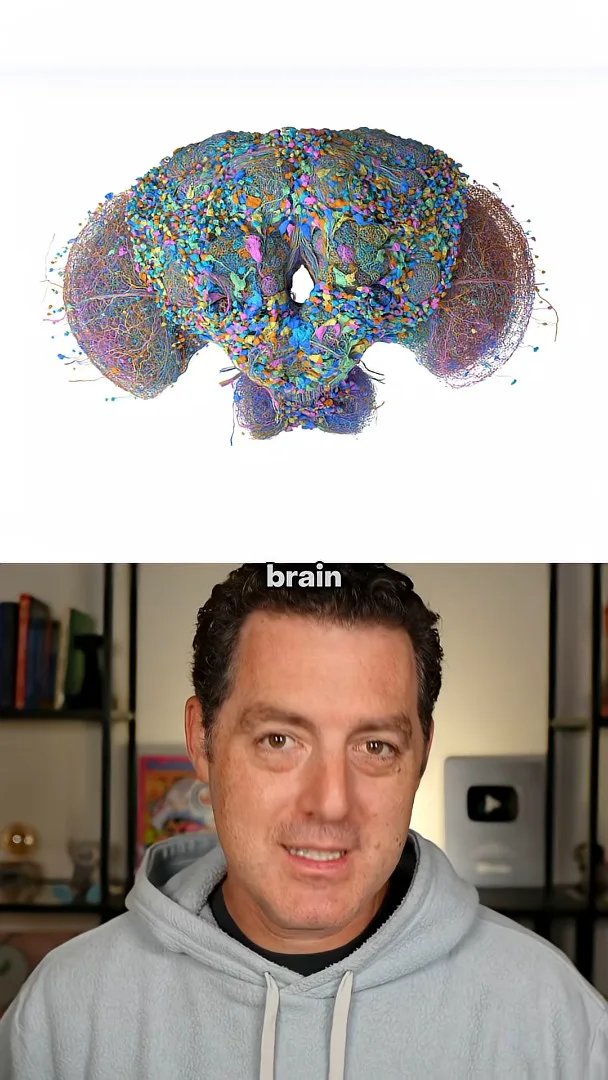
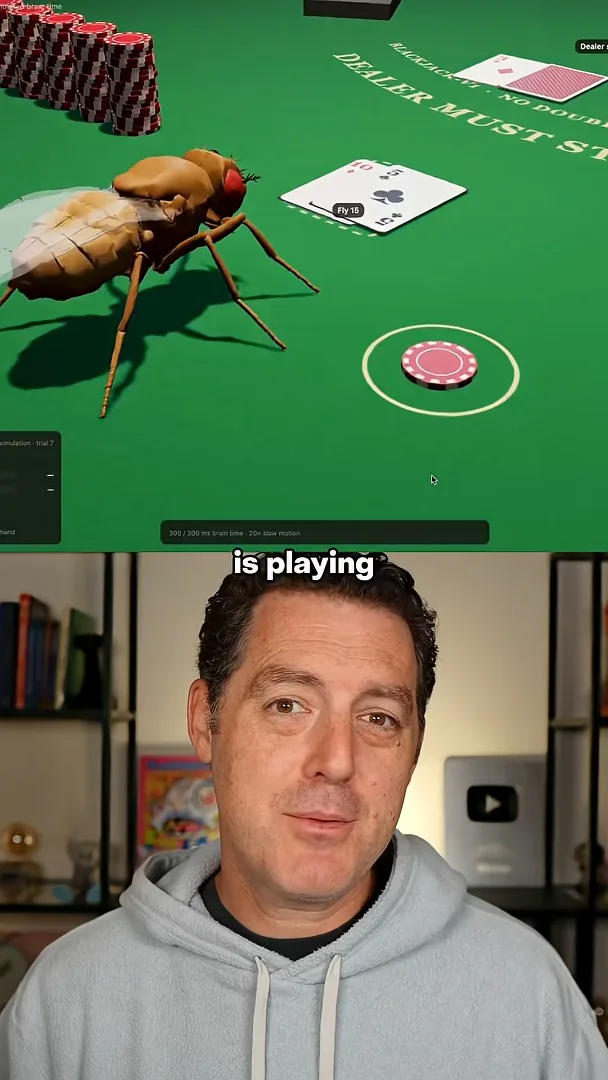
Matthew Berman shows virtual fruit flies in playful online demonstrations and connects them to a newly mapped nervous system. In September 2026, [Google Research described a collaboration with HHMI Janelia, researchers in Cambridge and others](https://blog.google/innovation-and-ai/technology/research/male-fruit-fly-brain-map/) mapping the brain and central nervous system of an adult male fruit fly, with more than 166,000 neurons. It is a collaborative connectome, not work by Google alone.
A connectome is an anatomical wiring map of neurons and their connections. It does not by itself specify every neuron’s physiology, the animal’s body and environment, or a complete reproduction of its behavior. The male nervous-system map discussed here is distinct from the earlier [FlyWire adult female brain connectome](https://www.nature.com/articles/s41586-024-07968-y); a simulation using one should not automatically be described as using the other.
Berman’s montage depicts flies playing blackjack, smoking a hookah, cutting a kebab, driving, solving a Rubik’s Cube and playing a video game. These are virtual scenes, not evidence that a biological fruit fly can perform those human tasks. Implementations can use developer-designed mappings between game inputs, simulated neural activity and controls; the short does not document or validate the mechanism behind each clip.
Could a simulation have experience?
Berman asks whether a hypothetical fully simulated animal or human would be real and whether a fly simulation could suffer. These questions remain unresolved.
Berman asks whether a hypothetical fully simulated fly—and, further in the future, a simulated cat, dog, monkey or person—would be real, and whether such a fly might be suffering. The current wiring map and entertaining animations do not establish a complete simulation or show subjective experience. Whether a particular simulation could be conscious or suffer is an open scientific and philosophical question.
同じチャンネルの記事
 34:21EN
 Matthew Berman· 2026年10月27日Matthew Berman Examines Anthropic’s IPO Filing, AI Growth and GovernanceMatthew Berman, Sam Altman · Forward FutureThe presenter reviews the S-1’s financial metrics, compute strategy and voting structure while questioning the tension between rapid AI development and safety.
 0:26ENMatthew Berman· 2026年10月25日Sam Altman on Human Values and Problem-Solving in an AI WorldSam Altman · OpenAIIn a short interview excerpt, Altman considers the enjoyment of solving hard problems and the human role in interpreting results.
 0:36ENMatthew Berman· 2026年10月25日Kimi K3.1 and a Rubik’s Cube Solver DemonstrationMatthew Berman · Forward FutureMatthew Berman shows a scrambled virtual cube being solved and gives the Kimi K3.1 test a favorable assessment.
 0:21ENMatthew Berman· 2026年10月24日An AI-Generated Kimi Benchmark Chart Used Invented ScoresMatthew Berman · Forward FutureMatthew Berman asks for a graph of Kimi K3.1 Pro benchmarks, then discovers that the displayed figures are illustrative placeholders.
 25:50ENMatthew Berman· 2026年10月24日Kimi K3.1 Pro Tested: Strong 3D Demos, Uneven Results and Competitive PricingMatthew Berman · Forward FutureMatthew Berman tests the open-weight model on coding, 3D rendering and visual explanations, then compares benchmark results and prices.
 32:20ENMatthew Berman· 2026年10月23日Who Is Local AI For? The Costs, Trade-offs and a Hybrid FutureMatthew Berman · Forward FutureMatthew Berman weighs data control and independence against hardware cost, setup complexity and inference speed.