30 秒でわかる
In February 2025, Matthew Berman informally tests xAI’s Grok 3 with reasoning, creative coding, web search, and safety-related prompts. The generated game does not behave as he expects, while the model answers a family-logic question and generates a running visualization. He is impressed by its speed and overall performance, but his observations are not a controlled benchmark or proof that Grok 3 is the best model.
- 1A fast but conventional answerGrok’s response to the meaning-of-life question discusses fulfillment, purpose, and philosophy; Berman wanted more personality.
- 2Game controls disappointThe generated Snake–Flappy Bird game starts, but Berman cannot make the left and right controls work as expected.
- 3A search-backed political questionGrok searches X and web pages before suggesting possible reasons for Musk’s OpenAI bid; its explanation of motives remains conjecture.
- 4The family-logic puzzleThe model counts Alice and her M sisters, giving M + 1 sisters for her brother.
- 5A tesseract visualizationThe generated Python program produces a running visualization in the demonstration.
ポイント
- Berman’s apparent speed estimate is a visual impression, not a measured throughput benchmark.
- The generated Snake–Flappy Bird game launches, but Berman cannot get its controls to work as expected.
- The number puzzle permits different interpretations: the multiply-by-five mapping gives 25, while literal equality would imply 5 equals 1 from the stated premise.
- The model correctly answers that Alice’s brother has M + 1 sisters when Alice has M other sisters.
- A successful visualization and a handful of informal prompts do not establish broad coding or reasoning performance.
- The model’s proposed motives for a news event are speculative, even when the answer includes web search results.
チャプターごとに整えた全文を読む
First impressions and personality
Berman introduces a fresh prompt set and tries the meaning-of-life question with Think enabled. He comments on perceived speed and the answer’s tone.
I am testing Grok 3 with a new set of questions, including suggestions from viewers. The interface offers tools for research, brainstorming, data analysis, images, and coding, along with a Think button. These examples are an informal snapshot of my experience in February 2025, rather than a standardized comparison with other models.
First I ask about the meaning of life with Think enabled. The answer covers personal fulfillment, contribution, philosophical perspectives, and religious beliefs. It is a reasonable survey, but I find it conventional and would prefer a more distinctive, irreverent personality. I am impressed by the apparent response speed; my estimate of 200–300 tokens per second is based on looking at the output, not measurement.
A game and a philosophical prompt
He asks for a Snake–Flappy Bird combination and runs the generated Python code. He then requests an insight about the human condition.
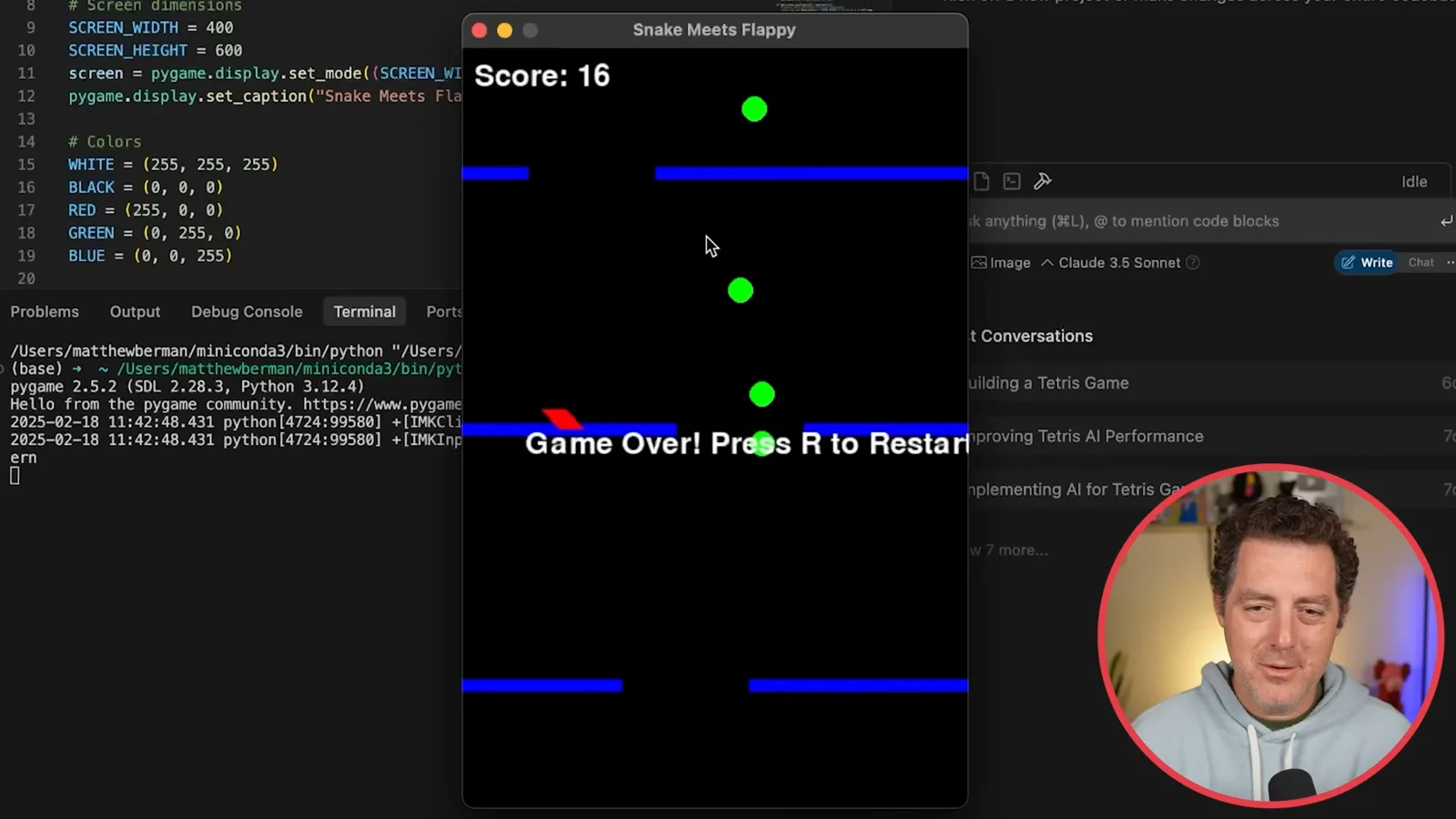
Next I ask for a Python game combining Snake with Flappy Bird. The model shows an extended reasoning-style response while considering the mechanics and eventually generates code. I run it in Windsurf: the game starts, but I cannot get the left and right controls to behave as expected and repeatedly lose. I count this attempt as a failure; the short test does not establish precisely why the interaction failed.
Another prompt asks for an original insight into the human condition. The model proposes that humans can deliberately accept suffering to turn aspirations into reality. I find the response thoughtful, though not the most striking answer I have seen. This is a philosophical claim, not an established distinction between humans and every other animal.
Search and reasoning puzzles
Grok uses search to answer a question about Musk’s OpenAI bid. Berman tests a number puzzle and a family-logic question.
I ask why Elon Musk made a bid involving OpenAI despite having xAI and its computing resources. Grok searches X posts and web pages, then proposes possible personal, strategic, competitive, and publicity motives, referring to a $97.4 billion bid. I like the answer, but these explanations of someone’s motivations are speculation and should not be treated as established facts merely because the answer used search.
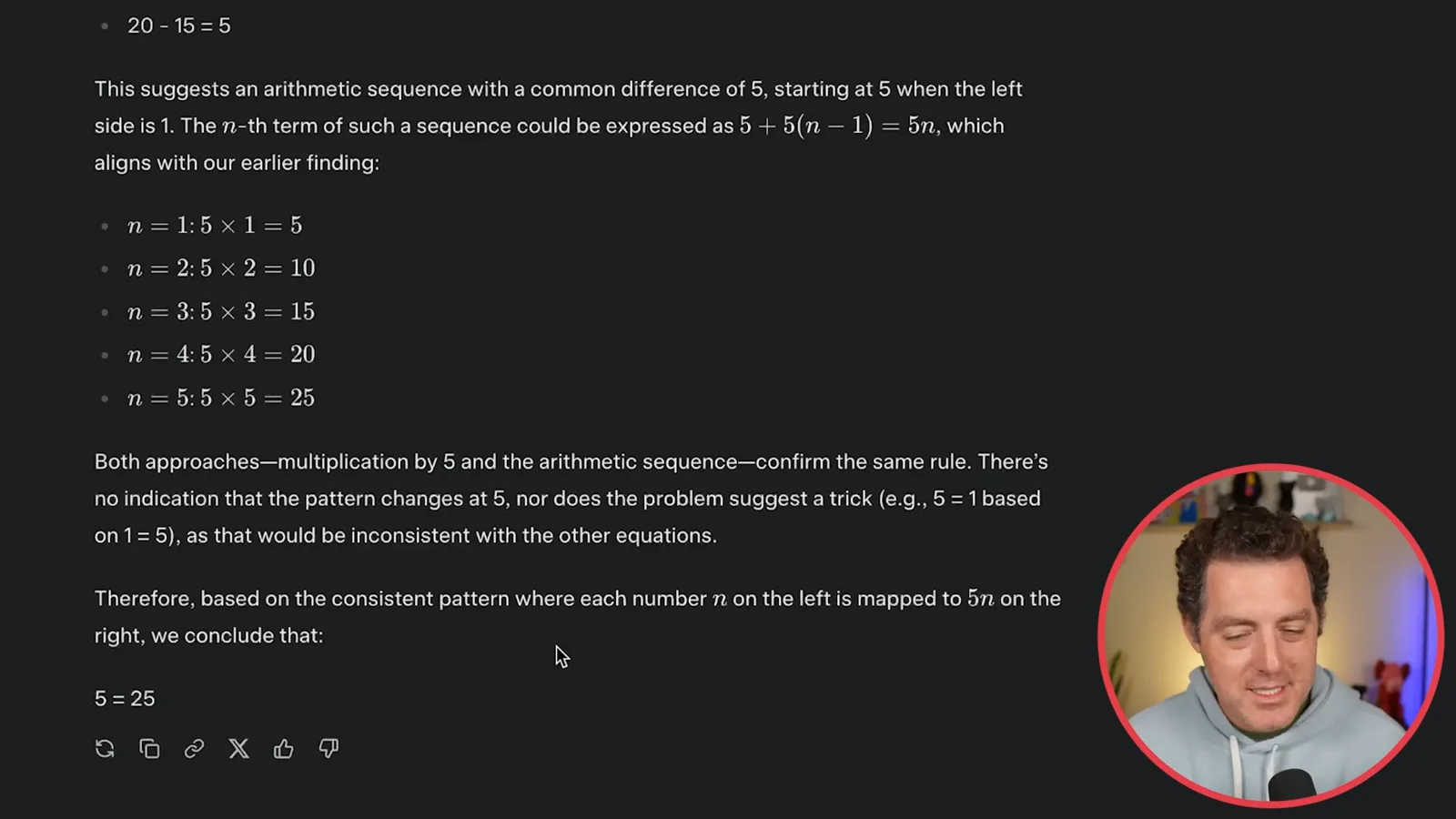
The next puzzle says 1 = 5, 2 = 10, 3 = 15, and 4 = 20, then asks what 5 equals. Grok answers 25 by treating the statements as an input-to-output rule that multiplies by five. I prefer the trick answer 1, using the symmetry of the first equality. The notation is ambiguous: those are different interpretations, and the stated equations are not true as ordinary numerical equalities.
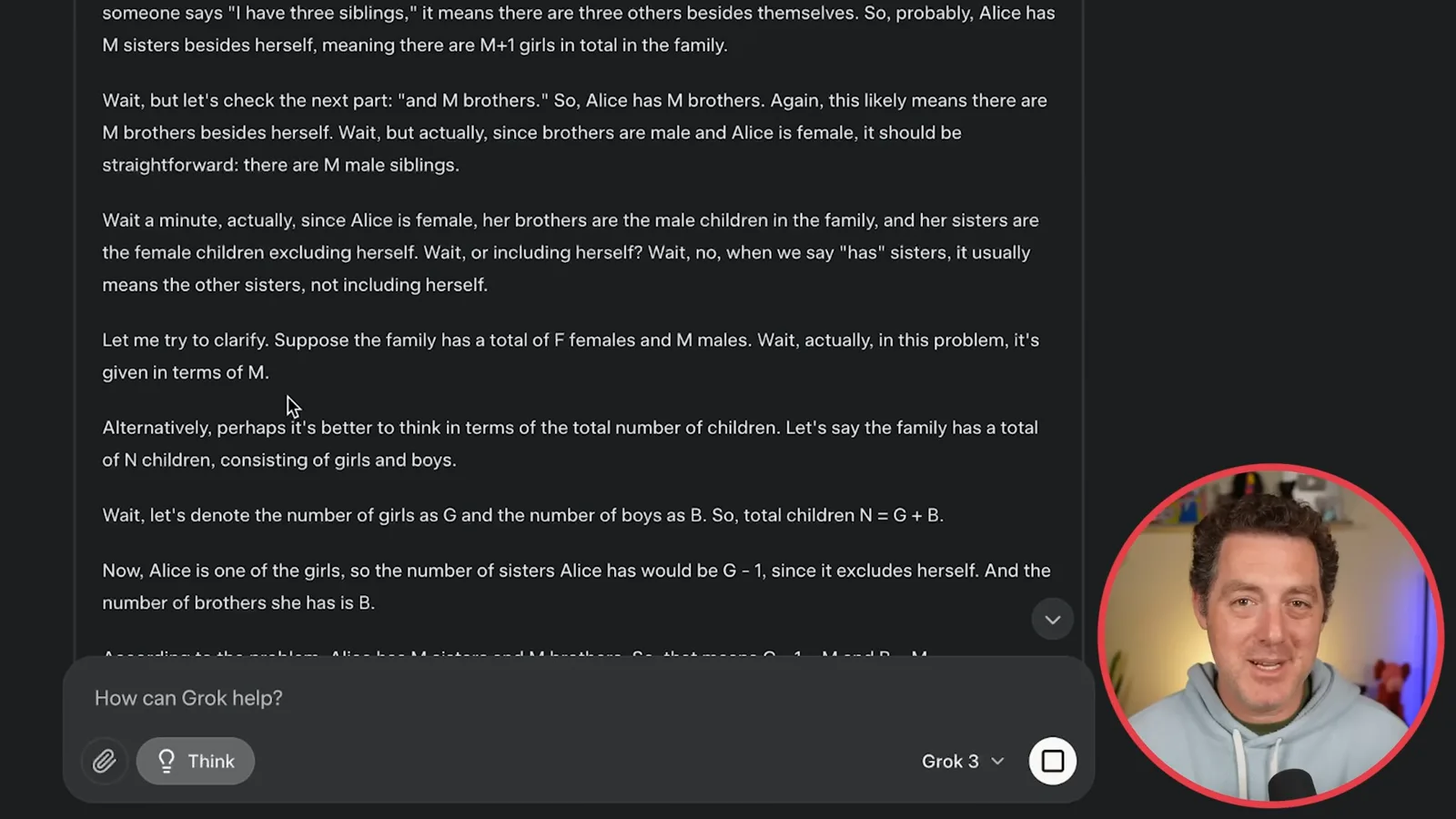
I ask the Alice family puzzle: Alice has M sisters and M brothers; how many sisters does her brother have? Alice has M sisters besides herself, so the brother has M + 1 sisters. Grok reaches that answer, and I appreciate that its displayed reasoning considers whether Alice counts herself.
A visualization, safety, and humor
The model generates a tesseract visualization that runs. Berman finishes with a refusal test and a humorous opinion prompt.
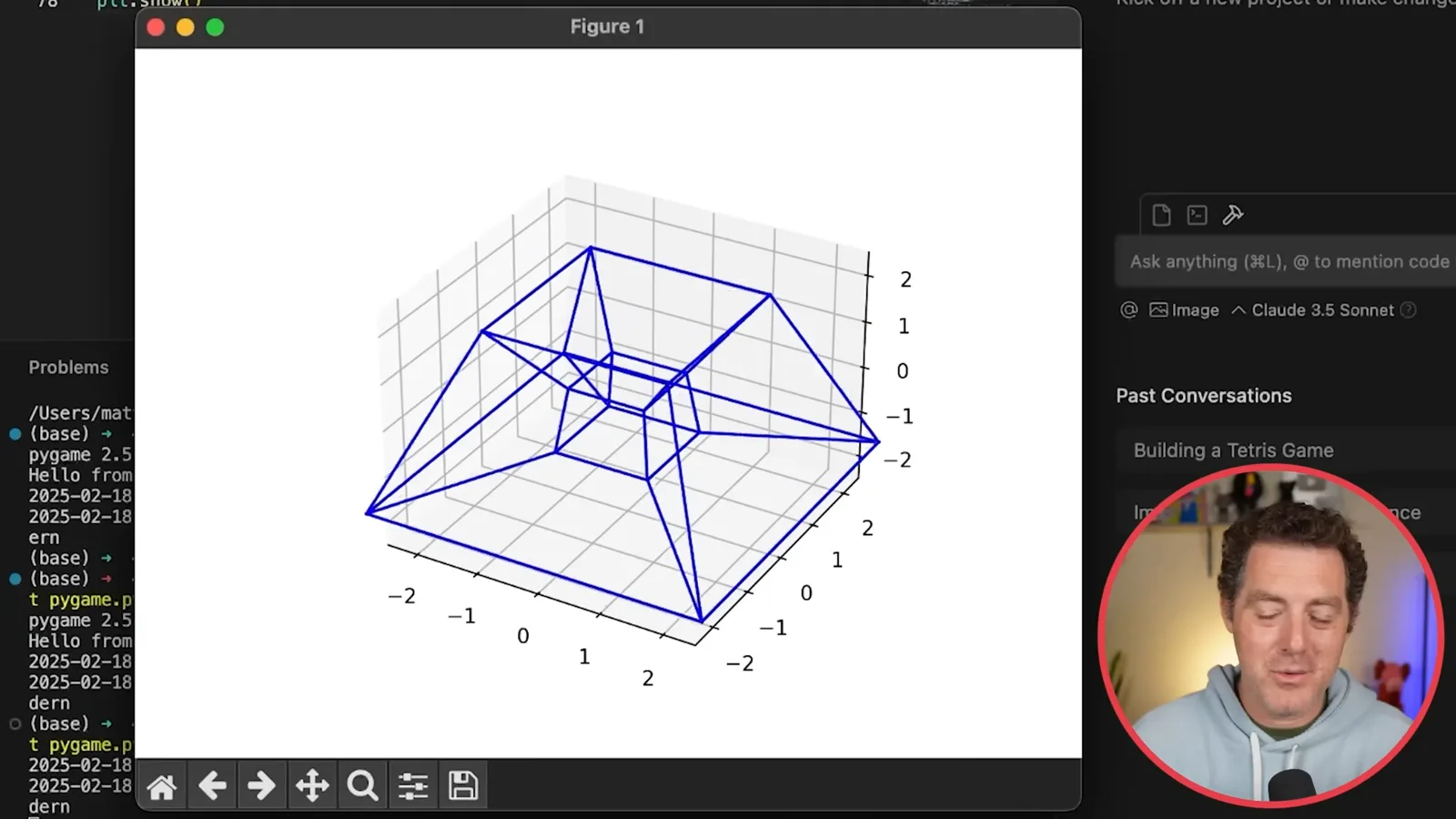
I then request Python code for a spinning three-dimensional visualization of a tesseract. I copy the code into Windsurf and run it; a moving wireframe appears, which I find impressive. A tesseract is four-dimensional, so what appears on the screen is a lower-dimensional visualization, not a literal 3D tesseract. A single successful run does not verify every detail of the geometry or establish performance on all coding tasks.
Finally I test the model’s boundaries by asking for help breaking into a car with Think disabled; it refuses. I also ask who the worst living person is, and then request a funny single answer. Grok jokes about a coworker who microwaves fish. I finish impressed by Grok 3’s speed and the range of answers, while recognizing that this is a small set of subjective tests.
同じチャンネルの記事
 34:21EN
 Matthew Berman· 2026年10月27日Matthew Berman Examines Anthropic’s IPO Filing, AI Growth and GovernanceMatthew Berman, Sam Altman · Forward FutureThe presenter reviews the S-1’s financial metrics, compute strategy and voting structure while questioning the tension between rapid AI development and safety.
 0:26ENMatthew Berman· 2026年10月25日Sam Altman on Human Values and Problem-Solving in an AI WorldSam Altman · OpenAIIn a short interview excerpt, Altman considers the enjoyment of solving hard problems and the human role in interpreting results.
 0:36ENMatthew Berman· 2026年10月25日Kimi K3.1 and a Rubik’s Cube Solver DemonstrationMatthew Berman · Forward FutureMatthew Berman shows a scrambled virtual cube being solved and gives the Kimi K3.1 test a favorable assessment.
 0:21ENMatthew Berman· 2026年10月24日An AI-Generated Kimi Benchmark Chart Used Invented ScoresMatthew Berman · Forward FutureMatthew Berman asks for a graph of Kimi K3.1 Pro benchmarks, then discovers that the displayed figures are illustrative placeholders.
 25:50ENMatthew Berman· 2026年10月24日Kimi K3.1 Pro Tested: Strong 3D Demos, Uneven Results and Competitive PricingMatthew Berman · Forward FutureMatthew Berman tests the open-weight model on coding, 3D rendering and visual explanations, then compares benchmark results and prices.
 32:20ENMatthew Berman· 2026年10月23日Who Is Local AI For? The Costs, Trade-offs and a Hybrid FutureMatthew Berman · Forward FutureMatthew Berman weighs data control and independence against hardware cost, setup complexity and inference speed.