30 秒でわかる
Matthew Berman surveys IBM's Granite 3.0 language and mixture-of-experts models, Guardian safety models, and InstructLab, a project for collaboratively adapting models with curated and synthetic data. He reviews IBM's benchmark charts and discusses enterprise applications. IBM invited Berman to its event and partnered on the video. The claims and comparisons reflect the 2024 release. InstructLab uses alignment tuning and training; it is not a guarantee that previous knowledge will always be preserved.
- 1IBM partnershipBerman discloses that IBM invited him to New York and partnered on the video.
- 2Granite model familyIBM announced 8B and 2B base and instruction models, as well as small mixture-of-experts and Guardian models.
- 3Vendor-reported benchmarksBerman reviews IBM charts covering a leaderboard, RAG, cybersecurity and tool calling. Results apply to the models and tests shown.
- 4InstructLab adaptationThe project uses curated examples and synthetic data with alignment training to adapt models; its techniques aim to limit forgetting but do not guarantee zero loss.
ポイント
- Granite 3.0 included 8B and 2B dense models and smaller mixture-of-experts variants under Apache 2.0.
- The 3B-A800M and 1B-A400M names distinguish total parameters from parameters active during inference.
- IBM positioned Granite for enterprise tasks such as retrieval, summarization, classification and tool use.
- InstructLab combines curated examples, synthetic data generation and model training to add skills and knowledge without pretraining from scratch.
- IBM's historical benchmark charts are vendor-reported comparisons for specific models and tests, not a universal ranking.
- The video was produced in partnership with IBM, which also invited Berman to visit.
チャプターごとに整えた全文を読む
Granite and the enterprise data opportunity
Berman discloses IBM's partnership and introduces Granite 3.0. He discusses why private enterprise data may be valuable for adapting models.
IBM invited me to New York to see its AI projects and partnered with me on this video. Two announcements caught my attention: the Granite 3.0 models and InstructLab. IBM released the Granite family under the Apache 2.0 license, and InstructLab is an open-source project.
Granite 3.0 is a family of relatively small general-purpose models that IBM positions for enterprise use. Berman is particularly interested in supplementing a model with private or domain-specific knowledge. Whether a model can run on a particular laptop or phone depends on its memory, software and configuration.
Berman argues that useful data can lie behind authentication or within enterprises, and sees it as an opportunity alongside synthetic data and additional test-time computation. His claim that essentially all public internet data has already been used is his assessment, not a verified inventory of training data.
An insurance company, for example, might want to adapt a model with information that is not public. Berman sees Granite and InstructLab as a way to work with such domain data. The quality of the result depends on the data, training process and evaluation rather than following automatically from adding data.
Model sizes and benchmarks
He reviews dense, mixture-of-experts and Guardian models, then looks at IBM's benchmark comparisons and deployment claims.
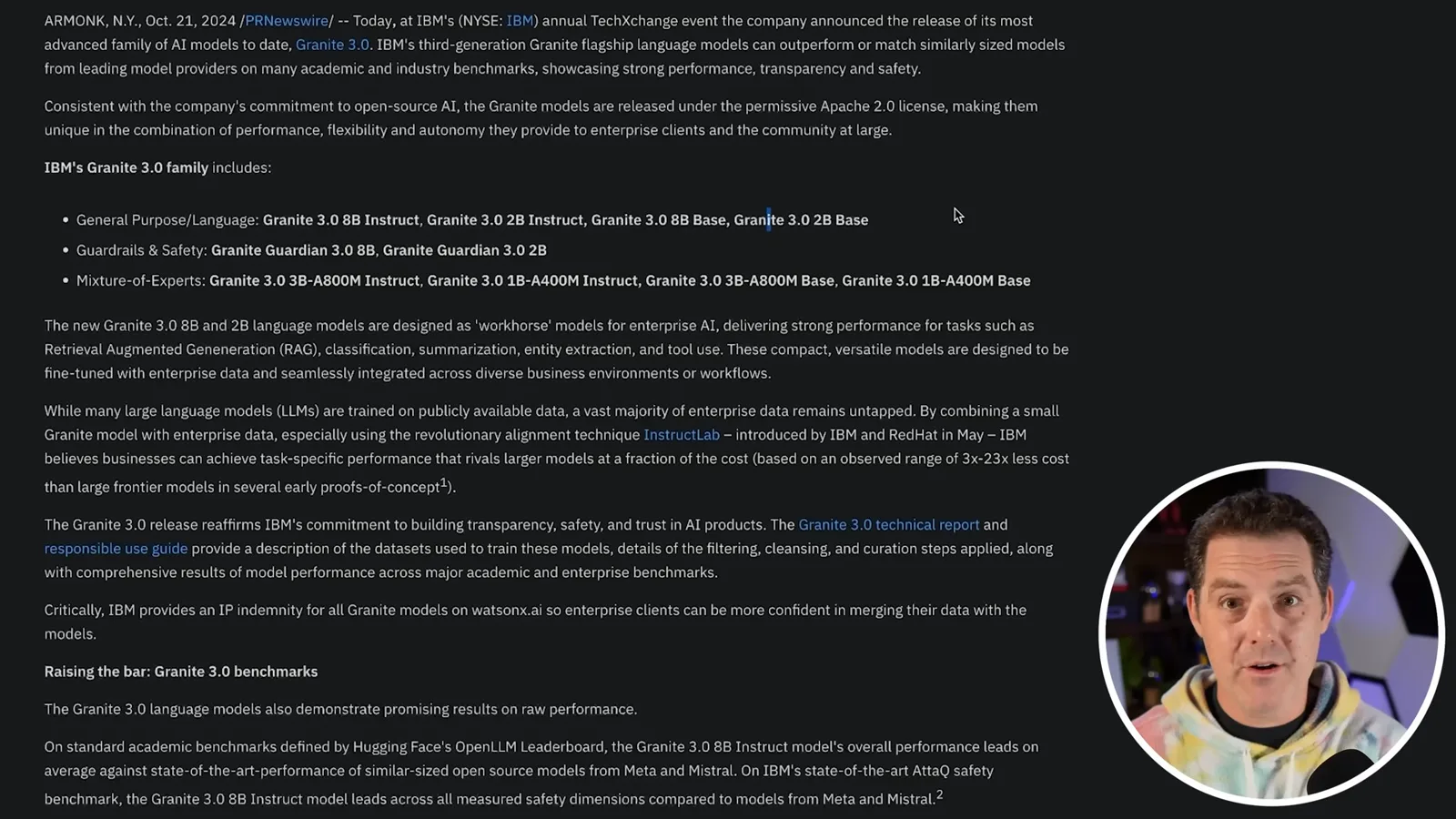
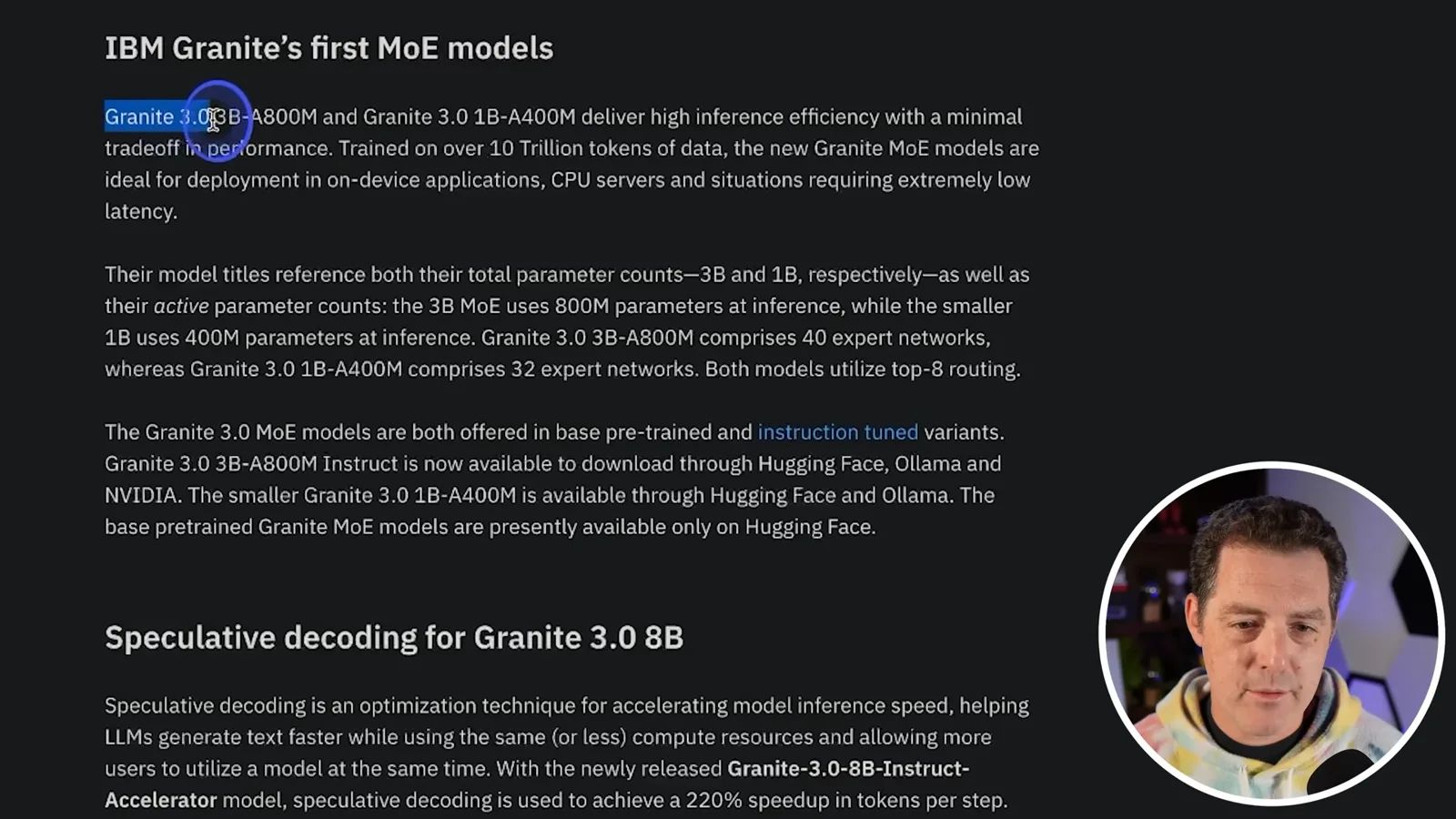
The dense family includes Granite 3.0 8B and 2B in base and instruction-tuned versions. IBM also announced small mixture-of-experts models: 3B-A800M and 1B-A400M. The names indicate three billion or one billion total parameters, with 800 million or 400 million active during inference, respectively.
IBM presents the dense models as workhorses for retrieval-augmented generation, classification, summarization, entity extraction and tool use. Berman also points to Granite Guardian, a separate family intended to help detect risks and support guardrails in business applications.
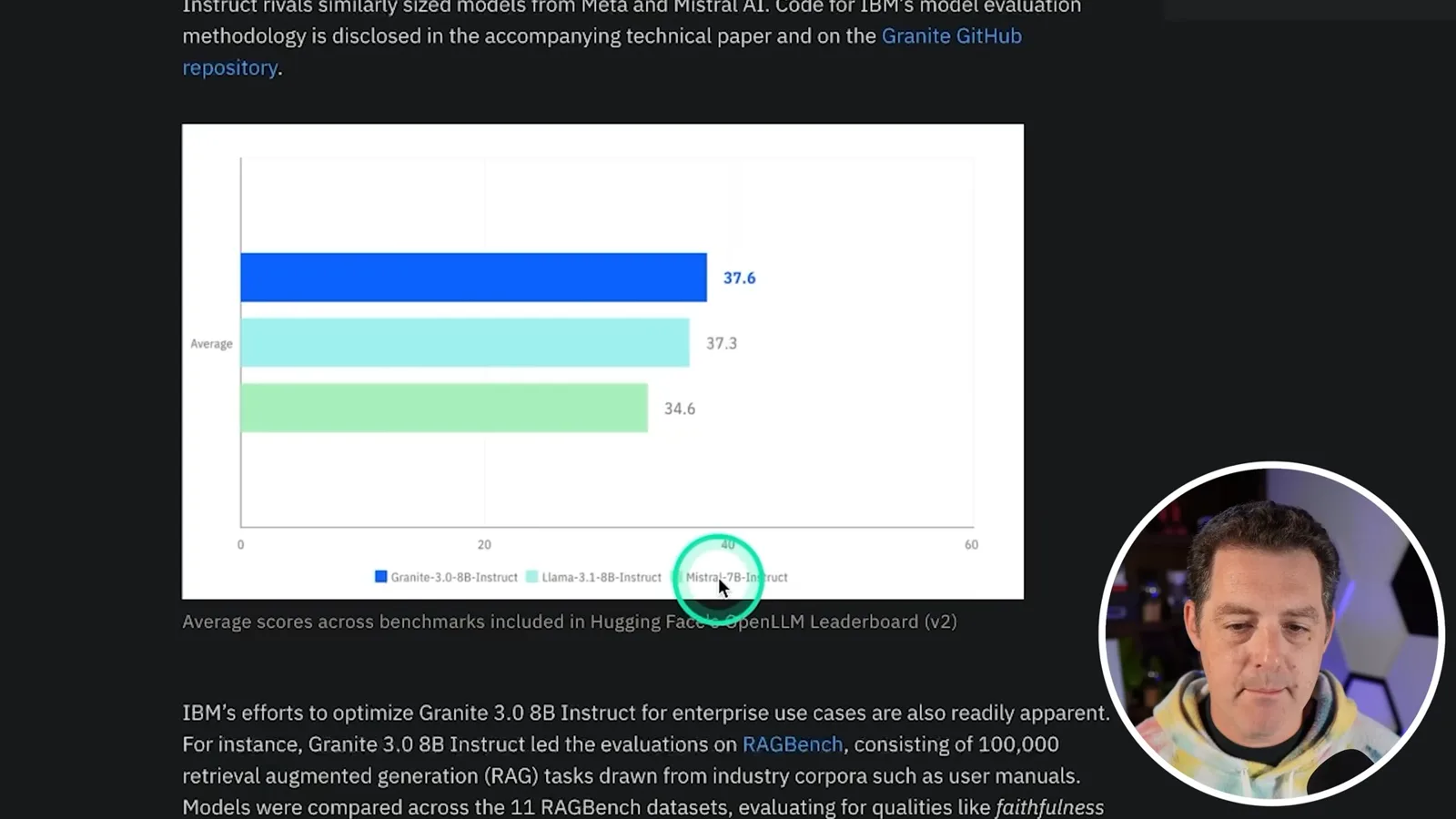
Berman walks through IBM's charts comparing Granite 3.0 8B Instruct with similarly sized Llama and Mistral models. IBM reports competitive results on the displayed leaderboard, RAG, cybersecurity and tool-calling tests. These vendor-reported comparisons describe particular tests and model versions, not performance on every workload or a current ranking.
Mixture-of-experts models activate only a subset of their parameters for inference. IBM positions the smaller Granite variants for low-latency, CPU and on-device settings, and says they were trained on more than ten trillion tokens. Base and instruction-tuned variants were offered; actual hardware needs and speed depend on deployment.
IBM's ecosystem and InstructLab
Berman discusses coding tools, Red Hat and agent workflows before describing how InstructLab adds knowledge and skills using generated training examples.
IBM also announced a Granite-powered coding assistant. Berman connects this work with IBM's ownership of Red Hat and its open-source enterprise tools, including Linux, OpenShift, Ansible and OpenStack. He notes an announcement integrating CrewAI with watsonx for enterprise agent workflows.
Berman contrasts retrieval-augmented generation, which supplies information at query time, with adapting a model itself. He initially describes InstructLab as not quite fine-tuning. More precisely, InstructLab's LAB method uses alignment tuning: curated seed examples are expanded with synthetic data, then used in a training process to add skills and knowledge without pretraining from scratch.
The open-source workflow supports collaborative contributions and aims to reduce the cost of creating training data. Its multi-phase training and replay approach is intended to retain existing capabilities; it should not be treated as a guarantee that no knowledge is lost. Practical suitability depends on the model, data, compute and testing.
A brief look at quantum computing
He mentions IBM's quantum work and his interest in a future interview. He closes by inviting viewers to examine the models and project.
Finally, Berman briefly mentions IBM's long-running quantum computing work and a talk at the event about combining quantum computing and AI. He says he is still learning about the subject and hopes to interview a researcher. He closes by encouraging viewers to explore Granite and InstructLab, again thanking IBM for the partnership.
同じチャンネルの記事
 34:21EN
 Matthew Berman· 2026年10月27日Matthew Berman Examines Anthropic’s IPO Filing, AI Growth and GovernanceMatthew Berman, Sam Altman · Forward FutureThe presenter reviews the S-1’s financial metrics, compute strategy and voting structure while questioning the tension between rapid AI development and safety.
 0:36ENMatthew Berman· 2026年10月25日Kimi K3.1 and a Rubik’s Cube Solver DemonstrationMatthew Berman · Forward FutureMatthew Berman shows a scrambled virtual cube being solved and gives the Kimi K3.1 test a favorable assessment.
 25:50ENMatthew Berman· 2026年10月24日Kimi K3.1 Pro Tested: Strong 3D Demos, Uneven Results and Competitive PricingMatthew Berman · Forward FutureMatthew Berman tests the open-weight model on coding, 3D rendering and visual explanations, then compares benchmark results and prices.
 32:20ENMatthew Berman· 2026年10月23日Who Is Local AI For? The Costs, Trade-offs and a Hybrid FutureMatthew Berman · Forward FutureMatthew Berman weighs data control and independence against hardware cost, setup complexity and inference speed.
 1:03:37ENMatthew Berman· 2026年10月23日Matthew Berman’s Team Tests Kimi K3.1 on Animation, Games, and ChartsMatthew Berman, Alex, Brian · Forward FutureA live team AMA turns into an informal test of Kimi K3.1, from personal-agent workflows to motion graphics, a browser game, and a benchmark chart.
 0:53ENMatthew Berman· 2026年10月22日Sam Altman on AI and the Discovery of New KnowledgeSam Altman · OpenAIAltman expects progress in mathematical discovery to extend to biology, materials and energy.