30 秒でわかる
Matthew Berman reviews early reactions to OpenAI’s deep research, from research reports and benchmark results to anecdotes involving cancer cases. He argues that the combination of reasoning and agent tools points toward a rapid AI takeoff. That takeoff and recursive self-improvement are predictions, not established by the examples. Benchmark scores and individual medical anecdotes have narrower scope, and OpenAI acknowledges that the tool can make factual and sourcing errors.
- 1A takeoff hypothesisBerman links recent advances to recursive self-improvement; the cited examples do not establish an autonomous self-improvement cycle.
- 2Reasoning plus toolsBerman highlights Ethan Mollick’s argument that reasoners and agents can combine to research and synthesize information.
- 3Benchmark limitsA GPQA chart shows results on a defined science question set, not comprehensive professional research ability.
- 4Medical anecdotes need validationEarly users praise particular cancer-related reports, but those cases are not a clinical study and should not replace clinician review.
- 5Google’s earlier productGoogle staff point to Gemini’s existing Deep Research product; a shared name alone does not establish copying.
ポイント
- Deep research combines multi-step reasoning with web research and other tools to produce reports.
- Benchmark progress measures performance on particular tests and does not establish general expert equivalence or recursive self-improvement.
- Claims of an imminent intelligence takeoff are forecasts rather than conclusions proven by the video’s examples.
- Favorable accounts of cancer-related reports are anecdotes, not clinical validation; treatment decisions require qualified clinical review.
- Google had an earlier product with the same Deep Research name, but the reactions do not prove copying.
チャプターごとに整えた全文を読む
Reactions and the takeoff argument
Berman surveys early reactions and predicts fast AI progress. The discussed examples do not demonstrate an autonomous recursive improvement cycle.
In February 2025 I look at reactions to OpenAI’s newly released deep research. Researchers and commentators describe its ability to search and synthesize sources, while some see it as evidence of rapidly accelerating AI progress. These reactions range from personal experiences to predictions, and they do not by themselves establish a general intelligence breakthrough.
I cite Stability AI founder Emad Mostaque’s prediction that machines will soon perform most digital knowledge work faster, better and more cheaply. He describes an intelligence takeoff. That is a forecast about future capability and economic impact, not a measured result from the deep research launch.
I connect this view to Leopold Aschenbrenner’s scenario of recursive self-improvement: an AI discovers useful knowledge, applies it to improve itself and repeats the process. I argue that we are approaching such a scenario, but the examples discussed here do not demonstrate an autonomous, sustained cycle of AI improving its own successor.
I mention an example discussed by Simon Willison in which a model was prompted to suggest a code optimization that reportedly made a specific operation twice as fast. A human-directed optimization of one workload is interesting, but it is not proof that a model has autonomously improved its own overall capabilities.
Technology columnist Kevin Roose compares reported scores on Humanity’s Last Exam, with deep research reaching 26.6% on the cited configuration shortly after a lower leading result. These are benchmark-specific results with particular tools and testing conditions, not a score for all human knowledge or a reliable forecast of a takeoff.
Reasoning models and research agents
He discusses reinforcement learning and Ethan Mollick’s comparison of research outputs. He explains how models and tools can work together.
I credit DeepSeek’s R1 paper with making reasoning-model techniques more visible, and highlight Nathan Lambert’s observation that OpenAI trained deep research using reinforcement learning on browsing and reasoning tasks. I see a combination of reasoning and tools as important, although describing it as a proven recipe for AGI goes beyond what these examples establish.
Ethan Mollick’s essay [“The End of Search, the Beginning of Research”](https://www.oneusefulthing.org/p/the-end-of-search-the-beginning-of) argues that reasoning systems and autonomous research agents are converging. In his examples, he judges the resulting reports to be of different levels of quality. Those are his evaluations of particular outputs, not a guarantee that every report matches expert work.
I describe the model as the reasoning component and tools as the way an agent can act: it can search the web, write and execute code, or consult other data sources. The combination can produce a synthesized report, but the quality still depends on the sources, the task and the model’s interpretation.
Benchmarks and medical examples
Berman interprets a GPQA chart and recounts cancer-research anecdotes. Both kinds of evidence have important limits.
The video shows a GPQA Diamond chart comparing model scores over time with human expert reference lines. The chart illustrates progress on a defined set of difficult science questions. It does not establish that a model is a general-purpose PhD, can independently conduct all research, or has exceeded experts across their work.
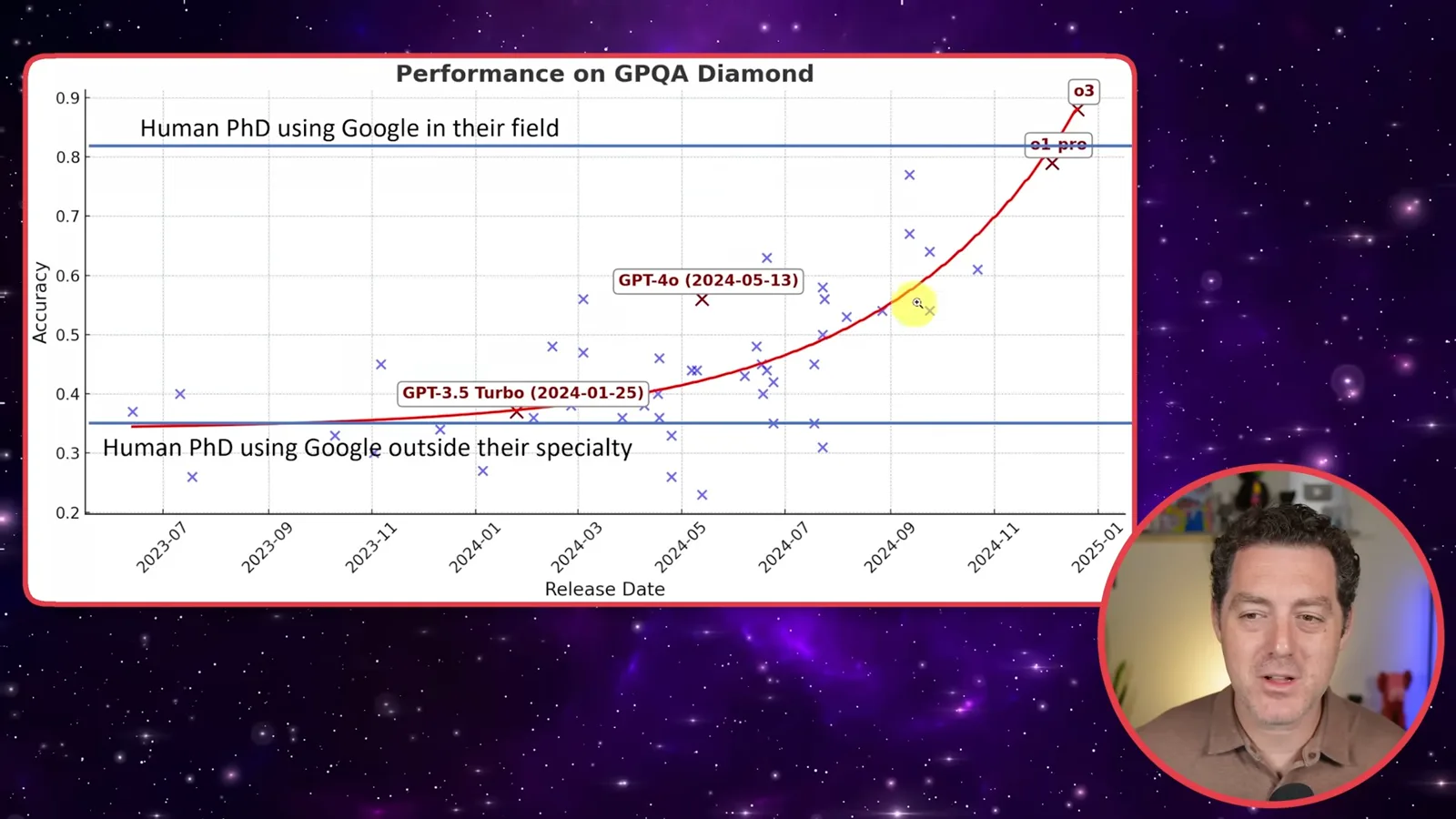
I interpret the graph as evidence for a hard takeoff and imagine many agents discovering AI research and improving themselves in parallel. That is my extrapolation. A rising benchmark score alone cannot establish recursive self-improvement, its rate or whether a hard takeoff is occurring.
I mention Sam Altman’s suggestion that inexpensive compute could produce substantially more value for a user. That is an illustration of possible value rather than a controlled economic measurement. Actual value and cost will differ with the task, output quality and review required.
Biomedical scientist Derya Unutmaz describes favorable early experiences with deep research and says two reports on cancer cases were impressive. This is a small anecdote and his professional assessment, not a clinical validation study or proof of reliable medical advice.
I also recount an OpenAI employee’s account of using deep research to investigate a breast-cancer treatment question for his wife and checking the information independently. The report is an example of information gathering, not evidence that the tool should decide treatment. Patients should discuss clinical choices with qualified clinicians and verify cited sources.
Economic claims and industry responses
He discusses Sam Altman’s estimates, Google’s earlier product and an anticipated announcement, all in the context of February 2025.
In a launch clip, Altman estimates that the system can perform a single-digit percentage of economically valuable tasks. He explicitly presents that as his estimate. I discuss its possible economic scale, but the percentage is not established by a comprehensive measurement of work across the economy.
Altman distinguishes synthesizing existing information from a future system that invents new knowledge. I think the direction could be transformative; the statement is a prediction, not proof that the product has achieved autonomous scientific discovery or recursive improvement.
Google staff react to the launch by pointing out that Gemini had already offered a product called Deep Research. I find the name overlap striking. Their reactions support the observation that a similarly named product existed earlier; they do not establish that OpenAI copied Google’s implementation.
Finally, I note Altman’s contemporaneous comment that deep research was not the additional announcement he had teased for o3-mini. That was a February 2025 snapshot of product announcements, not a statement about current release plans.
OpenAI’s own [launch material](https://cdn.openai.com/API/docs/deep_research_blog.pdf) notes that deep research can hallucinate, make incorrect inferences and struggle to distinguish reliable sources from rumors. Those limits matter especially for medical and other high-stakes research, where claims and citations need independent review.
同じチャンネルの記事
 34:21EN
 Matthew Berman· 2026年10月27日Matthew Berman Examines Anthropic’s IPO Filing, AI Growth and GovernanceMatthew Berman, Sam Altman · Forward FutureThe presenter reviews the S-1’s financial metrics, compute strategy and voting structure while questioning the tension between rapid AI development and safety.
 0:36ENMatthew Berman· 2026年10月25日Kimi K3.1 and a Rubik’s Cube Solver DemonstrationMatthew Berman · Forward FutureMatthew Berman shows a scrambled virtual cube being solved and gives the Kimi K3.1 test a favorable assessment.
 25:50ENMatthew Berman· 2026年10月24日Kimi K3.1 Pro Tested: Strong 3D Demos, Uneven Results and Competitive PricingMatthew Berman · Forward FutureMatthew Berman tests the open-weight model on coding, 3D rendering and visual explanations, then compares benchmark results and prices.
 32:20ENMatthew Berman· 2026年10月23日Who Is Local AI For? The Costs, Trade-offs and a Hybrid FutureMatthew Berman · Forward FutureMatthew Berman weighs data control and independence against hardware cost, setup complexity and inference speed.
 1:03:37ENMatthew Berman· 2026年10月23日Matthew Berman’s Team Tests Kimi K3.1 on Animation, Games, and ChartsMatthew Berman, Alex, Brian · Forward FutureA live team AMA turns into an informal test of Kimi K3.1, from personal-agent workflows to motion graphics, a browser game, and a benchmark chart.
 0:53ENMatthew Berman· 2026年10月22日Sam Altman on AI and the Discovery of New KnowledgeSam Altman · OpenAIAltman expects progress in mathematical discovery to extend to biology, materials and energy.