30 秒でわかる
Matthew Berman discusses a simulated fruit fly and asks whether a hypothetical human brain emulation would be human. He describes the fly as a fully simulated real brain with no training, but the team behind the demonstration says the model is simplified and uses existing trained walking controllers and hand-selected brain-to-body mappings.
- 1A connectome-based modelBerman describes a mapped fly brain in a computer; the team says it uses a simplified neural model constrained by measured connectivity.
- 2A simulated bodyThe model is connected to a virtual fly body and environment, producing a small set of fly-like behaviors.
- 3Training and approximationContrary to the video's blanket claim of no training, the team says its walking controllers were trained to imitate fly locomotion and some mappings were chosen by hand.
- 4The human questionBerman asks whether a hypothetical human brain emulation behaving like a human would itself be human.
ポイント
- The demonstration combines a model constrained by fruit-fly brain connectivity with a physics-simulated body.
- The team's own description says walking uses previously trained controllers and some brain-to-body mappings are hand-selected.
- The model omits many biological details and has not been validated as a complete replica of a fly brain or behavior.
- Whether a hypothetical human emulation would be human is a philosophical question, not a result of this experiment.
チャプターごとに整えた全文を読む
A virtual fly model
Berman describes a brain model in a virtual body. The project's own account identifies significant modeling assumptions and previously trained controllers.
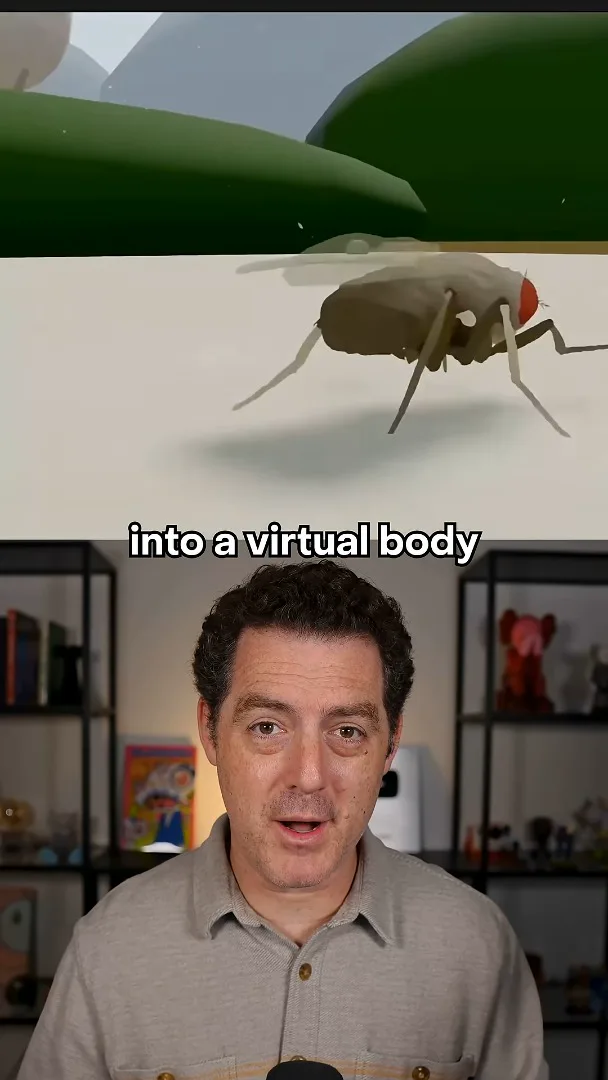
A virtual fruit fly appears to behave like a fly in a simulated world. I describe it as a real fly brain mapped and fully simulated in a computer, then placed in a virtual body. More precisely, [the Eon team](https://eon.systems/updates/embodied-brain-emulation) describes a simplified neural model constrained by a real fly's connectome, combined with a physics-based body and environment. It is an approximation, not a complete reproduction of every biological detail.
I say this behavior appeared with no training or machine learning. The team's later technical explanation qualifies that claim: the walking component uses existing controllers trained to imitate fly locomotion, and some mappings between neural outputs and body movements were selected by hand. It says only a small set of sensory inputs and behaviors is implemented and internal dynamics have not yet been fully validated against biological signatures.
A question about human emulation
Berman asks what a future human brain simulation would mean for human identity. The video leaves the question open.
That raises a question for the future: if a company could simulate a human brain down to its neurons and the simulation behaved exactly like a person, would it be human? The fly demonstration does not establish that such a human simulation is possible or answer that philosophical question.
同じチャンネルの記事
 34:21EN
 Matthew Berman· 2026年10月27日Matthew Berman Examines Anthropic’s IPO Filing, AI Growth and GovernanceMatthew Berman, Sam Altman · Forward FutureThe presenter reviews the S-1’s financial metrics, compute strategy and voting structure while questioning the tension between rapid AI development and safety.
 0:36ENMatthew Berman· 2026年10月25日Kimi K3.1 and a Rubik’s Cube Solver DemonstrationMatthew Berman · Forward FutureMatthew Berman shows a scrambled virtual cube being solved and gives the Kimi K3.1 test a favorable assessment.
 25:50ENMatthew Berman· 2026年10月24日Kimi K3.1 Pro Tested: Strong 3D Demos, Uneven Results and Competitive PricingMatthew Berman · Forward FutureMatthew Berman tests the open-weight model on coding, 3D rendering and visual explanations, then compares benchmark results and prices.
 32:20ENMatthew Berman· 2026年10月23日Who Is Local AI For? The Costs, Trade-offs and a Hybrid FutureMatthew Berman · Forward FutureMatthew Berman weighs data control and independence against hardware cost, setup complexity and inference speed.
 1:03:37ENMatthew Berman· 2026年10月23日Matthew Berman’s Team Tests Kimi K3.1 on Animation, Games, and ChartsMatthew Berman, Alex, Brian · Forward FutureA live team AMA turns into an informal test of Kimi K3.1, from personal-agent workflows to motion graphics, a browser game, and a benchmark chart.
 0:53ENMatthew Berman· 2026年10月22日Sam Altman on AI and the Discovery of New KnowledgeSam Altman · OpenAIAltman expects progress in mathematical discovery to extend to biology, materials and energy.