30 秒でわかる
In a video published March 6, 2024, Matthew Berman reviews OpenAI’s response to Elon Musk’s February 2024 lawsuit. Musk alleged that the organization departed from its founding commitments; OpenAI disputed his claims and published selected historical emails about funding, a possible Tesla relationship and openness. Berman offers his own interpretations and questions, including speculation about motives. The correspondence and each party’s account are evidence and claims in a contested dispute, not a judicial finding; this article preserves the historical context and corrects a reversal in the video’s interpretation of the Tesla funding proposal.
- 1Conflicting accountsMusk alleged a departure from founding commitments, while OpenAI disputed his lawsuit and described its own history.
- 2Funding commitmentA 2015 email proposes a $1 billion commitment; OpenAI separately reports the smaller amount it says Musk actually contributed.
- 3Control and structureOpenAI claims Musk sought control during discussions of a for-profit entity, a contested account rather than a court finding.
- 4Tesla proposalAn email suggested connecting OpenAI to Tesla as a source of funding; Berman reversed the relationship in his commentary.
- 5The openness exchangeSutskever discussed possibly sharing less science near advanced AI, and the published exchange shows Musk’s brief response.
- 6A conditional forecastMusk’s 2018 estimate concerned OpenAI’s prospects without a dramatic change in execution and resources.
ポイント
- Musk’s February 2024 complaint alleged breach of a founding agreement; OpenAI denied his account and said it intended to seek dismissal.
- OpenAI reported less than $45 million in contributions from Musk, distinct from a proposed $1 billion overall commitment.
- OpenAI claimed the founders and Musk discussed a for-profit structure but disagreed over control.
- A 2018 email proposed using Tesla as a funding source for OpenAI; Berman interpreted the cash-cow relationship in reverse.
- A 2016 exchange on openness and Musk’s brief reply provide context but do not by themselves resolve the legal dispute.
チャプターごとに整えた全文を読む
The complaint and OpenAI’s response
Berman examines OpenAI’s March 5, 2024 response to Musk’s lawsuit. The parties dispute the organization’s founding commitments and subsequent direction.
On February 29, 2024, Elon Musk filed a complaint against OpenAI, Sam Altman, Greg Brockman and related entities. He alleged that OpenAI departed from an agreement to develop AI for public benefit and keep its technology open, instead serving private commercial interests. These were allegations in a lawsuit, not findings by a court.
I review OpenAI’s March 5 response, signed by Greg Brockman, Ilya Sutskever, John Schulman, Sam Altman and Wojciech Zaremba. OpenAI disputes Musk’s account and says it intends to move to dismiss his claims. That statement of intent should not be confused with a court ruling or with a motion already granted.
OpenAI frames its mission as ensuring that artificial general intelligence benefits humanity. I notice that the response emphasizes distributing benefits rather than necessarily publishing the technology itself. That distinction becomes central to the disagreement about what “open” was supposed to mean.
Funding and a proposed for-profit structure
OpenAI recounts early funding and discussions about a for-profit entity. Berman distinguishes its account from what the displayed excerpts establish.
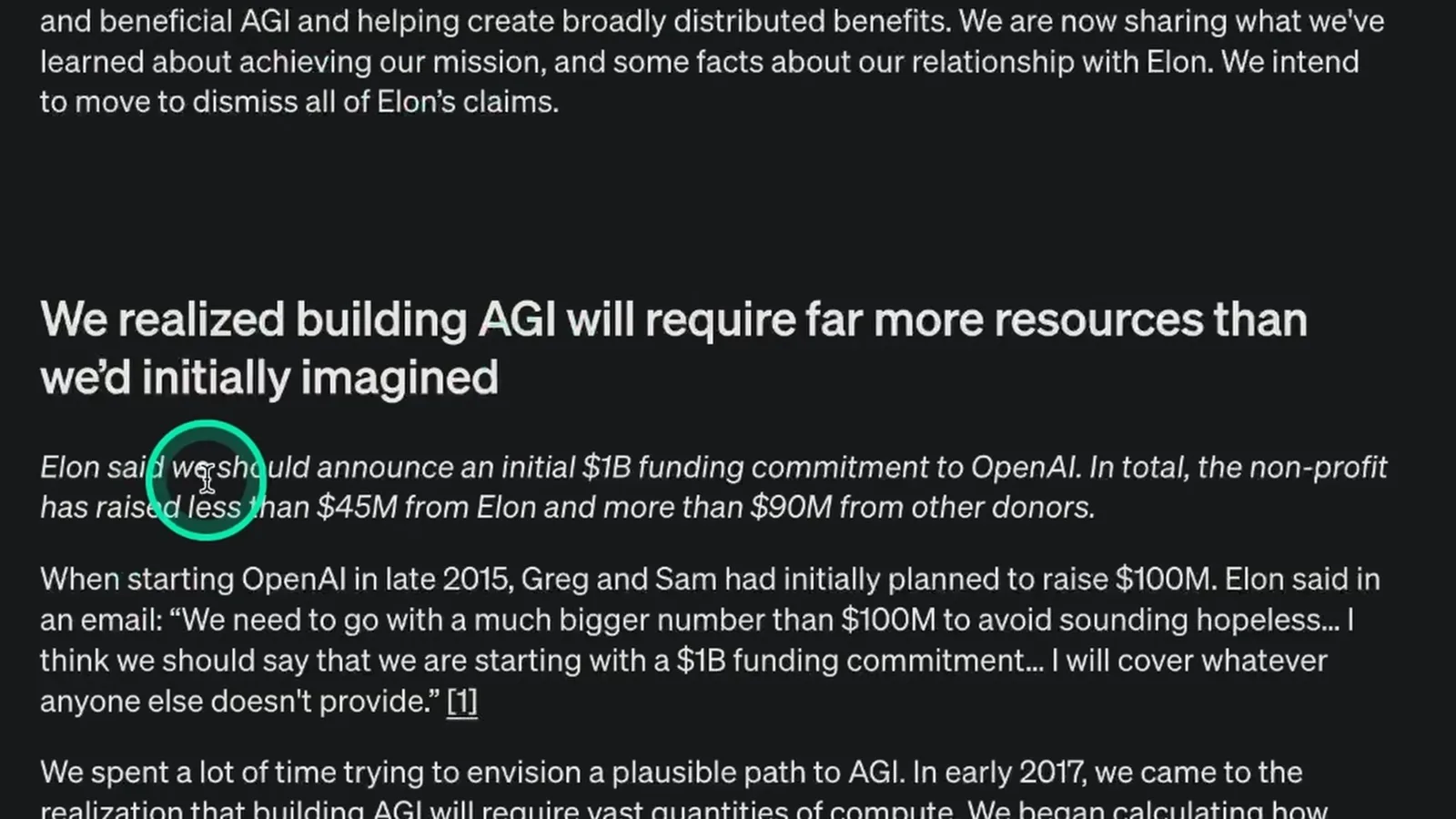
OpenAI says its early team concluded that developing advanced AI would require far more funding and computing power than initially expected. It reports that Musk contributed less than $45 million to the nonprofit and other donors more than $90 million. These are the company’s figures in its public response.
The company publishes a 2015 email in which Musk proposes announcing a $1 billion funding commitment rather than $100 million, saying he would cover what others did not provide. A proposed commitment is distinct from the amount ultimately contributed. I read the correspondence as suggesting Musk strongly emphasized fundraising, while acknowledging that interpretation is speculative.
OpenAI says that by early 2017 the founders believed the resources required could exceed what a nonprofit could raise. I discuss compute, personnel costs and the later Microsoft relationship. My comment that Microsoft received 49% of the company is not established by the evidence shown and should not be treated as a verified ownership figure.
OpenAI asserts that it and Musk came to see a for-profit entity as necessary. It says Musk sought majority equity, initial board control and the CEO role; the other founders say they would not agree to one person having absolute control. These are OpenAI’s account of negotiations, not adjudicated findings.
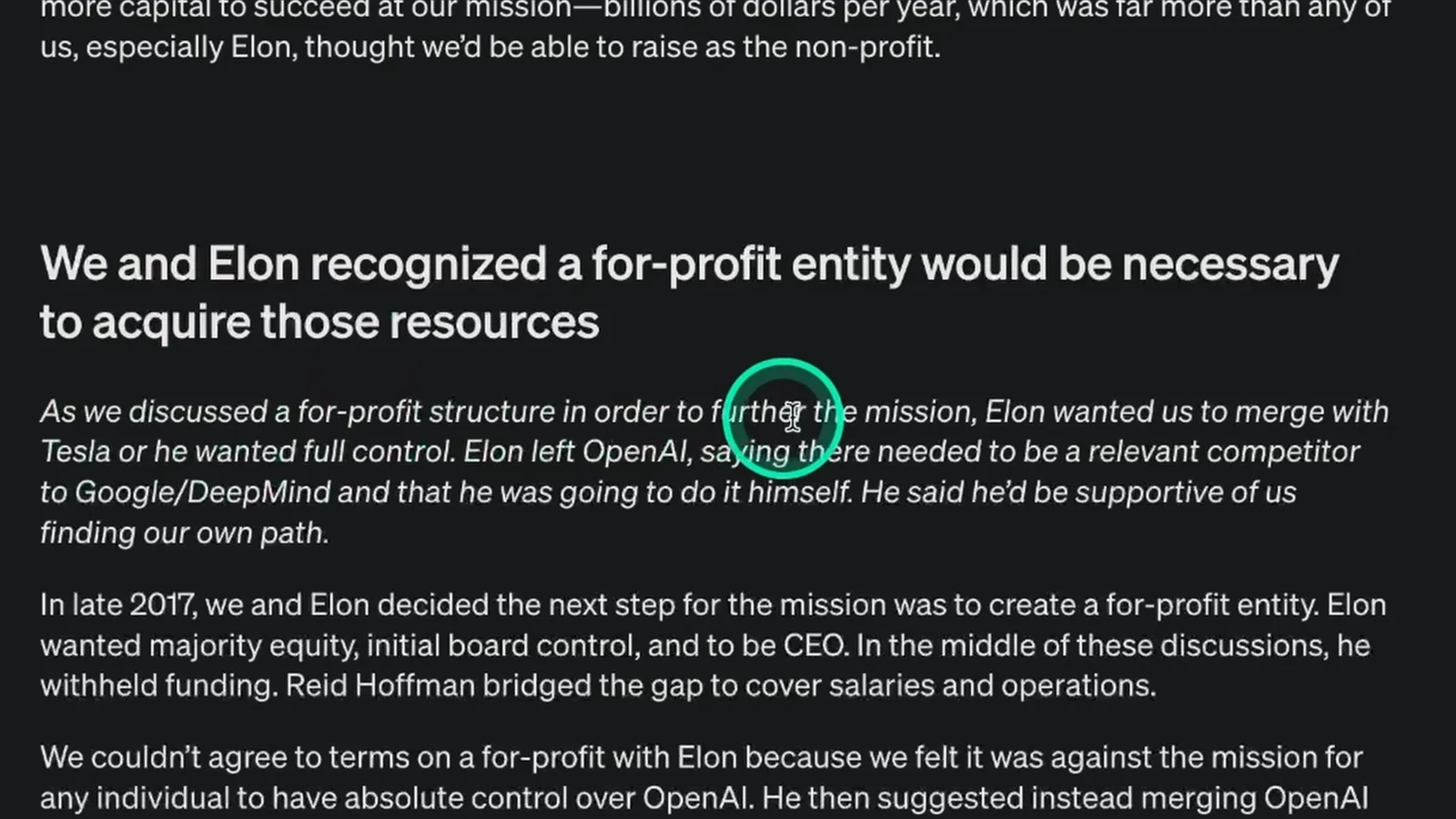
The company also alleges that Musk withheld funding during the discussions and that Reid Hoffman covered a funding gap. I interpret the alleged withholding as a pressure tactic, but Musk’s motives are not established by the published excerpts. OpenAI says discussions later turned toward a possible merger with Tesla.
Tesla, openness and control
The video considers a proposal involving Tesla and an email about sharing AI research. The meaning and legal effect of the correspondence are disputed.
A forwarded February 2018 email suggested that OpenAI attach to Tesla as its “cash cow,” and Musk endorsed the proposed route as a way to compete with Google. In context, the writer describes Tesla as a potential source of funding for OpenAI. My suggestion that OpenAI would itself be Tesla’s cash cow reverses that intended relationship.
I consider whether the proposed Tesla arrangement supports OpenAI’s position that Musk contemplated a for-profit path. It is relevant to the dispute, but it does not by itself settle what the parties agreed or establish that Musk accepted every later decision about proprietary technology.
OpenAI says Musk left in February 2018 and planned a competitor within Tesla. It also cites a December 2018 message in which he argued that the venture needed billions of dollars per year. I distinguish his expressed view about financing from a definitive agreement that all future research should be closed.
OpenAI argues that broadly available tools can deliver the benefits of AI even if the underlying science is not always published. I question how benefits can be distributed fairly when a single organization controls access and conditions. That is a governance concern, separate from whether a particular contract was breached.
To support its interpretation of openness, OpenAI displays a 2016 exchange with Ilya Sutskever. Sutskever wrote that as the organization got closer to building AI it might make sense to share less science, while seeking to spread the resulting benefits. The published reply from Musk was a brief “yup.”
I question how much can be inferred from that one-word reply. It is evidence of the exchange, but the published excerpts alone do not establish exactly what Musk read, all the surrounding discussions or the legal meaning of the response. My suggestion that he may have skimmed the message is speculation.
OpenAI says Musk eventually started a competitor and sued after the organization made progress without him. I speculate that Musk may have personal or competitive motives, while also taking seriously his objections to OpenAI’s change in structure. Neither the company’s characterization nor my inference proves his motives.
Reading the released emails
Berman examines messages from 2015, 2016 and 2018 and discusses their context. Some names and passages are redacted.
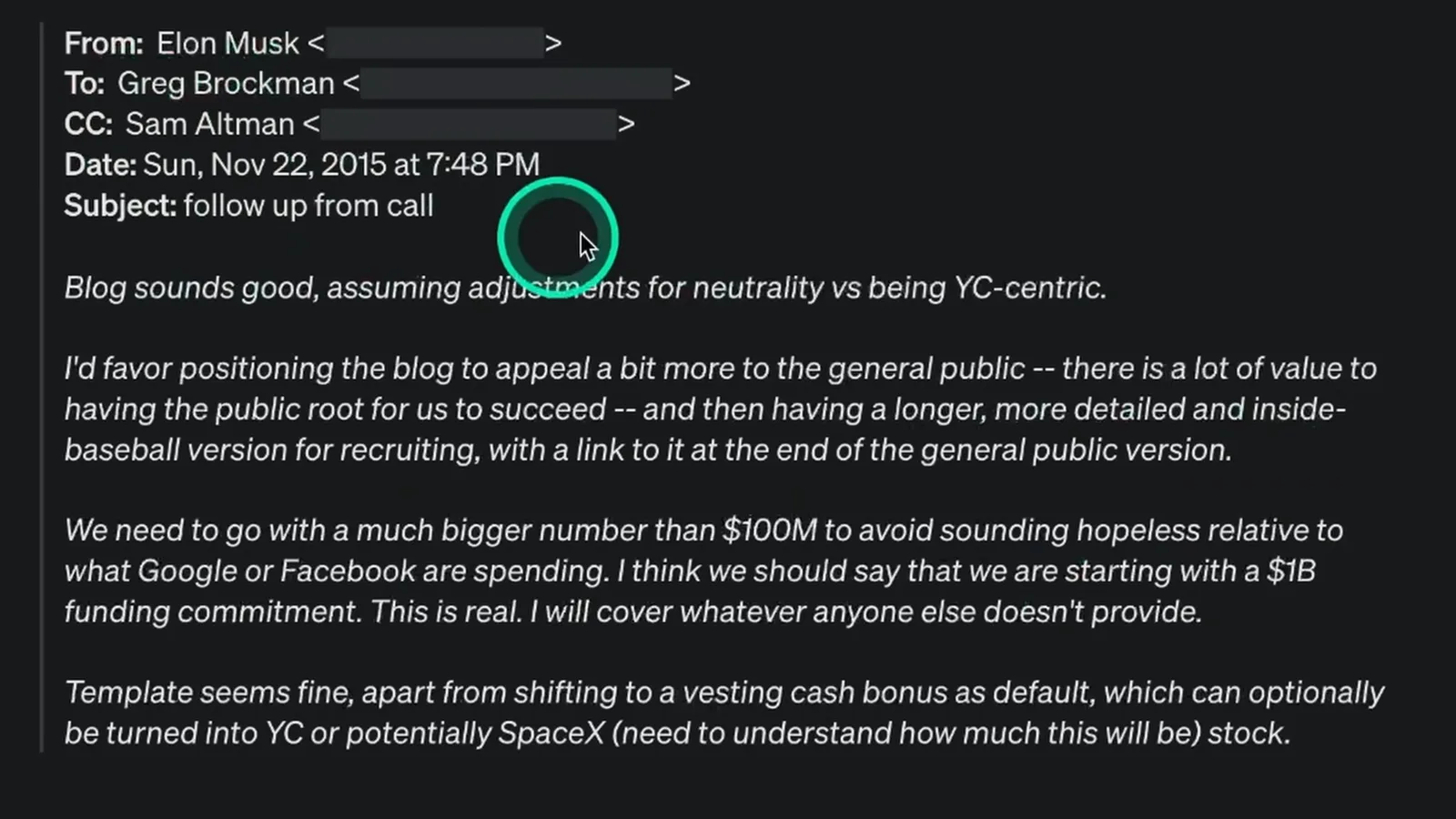
I return to the original 2015 email to Greg Brockman, with Altman copied. Musk recommends a public-facing announcement and a separate more detailed recruiting version, then argues for a larger funding commitment. He also discusses compensation involving possible equity in other entities; I say I do not know precisely how that proposal would have worked.
Another displayed message, dated February 1, 2018, forwards an email whose author is redacted. Musk agrees with its argument that linking OpenAI to Tesla offered a possible way to compete with Google. I consider the writer’s identity, but the redacted material does not establish who that person was.
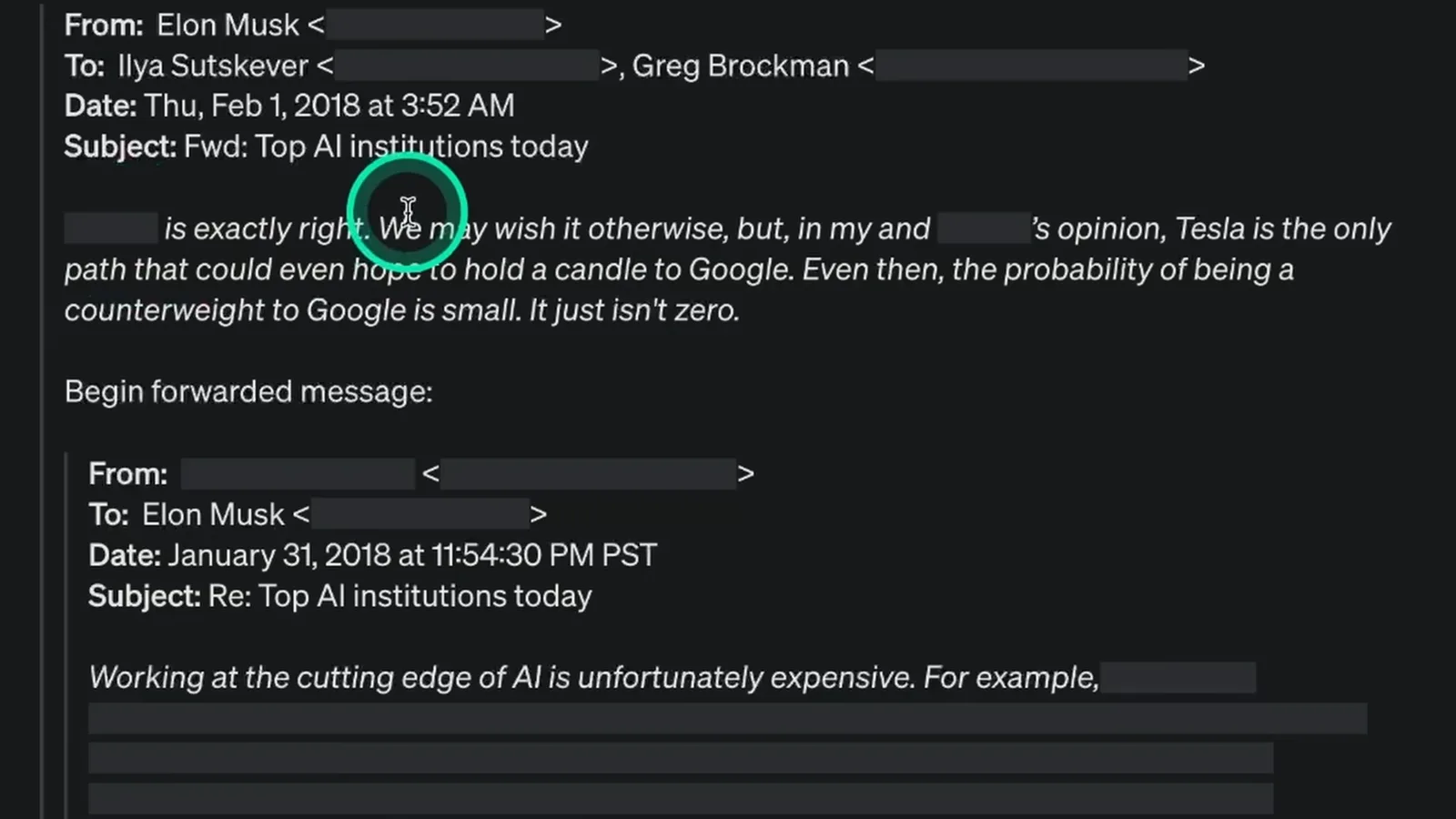
The anonymous writer argues that frontier AI research is expensive and that compute, data and infrastructure may be crucial. The writer suggests published advances could be adopted by a better-resourced competitor. These are forecasts and strategic arguments in the email, not proof that compute alone is sufficient for AGI.
The email weighs a for-profit pivot as a possible way to generate revenue and investment, but warns that creating a product could distract from research and give investors influence. It then proposes a connection to Tesla as a way to secure resources. I discuss the argument without treating its predictions as established outcomes.
I observe that Google’s Transformer research was openly published and later became influential across the industry, including at OpenAI. That history complicates a simple story that only one organization used the research; my broader remarks are commentary on the strategic value of published work.
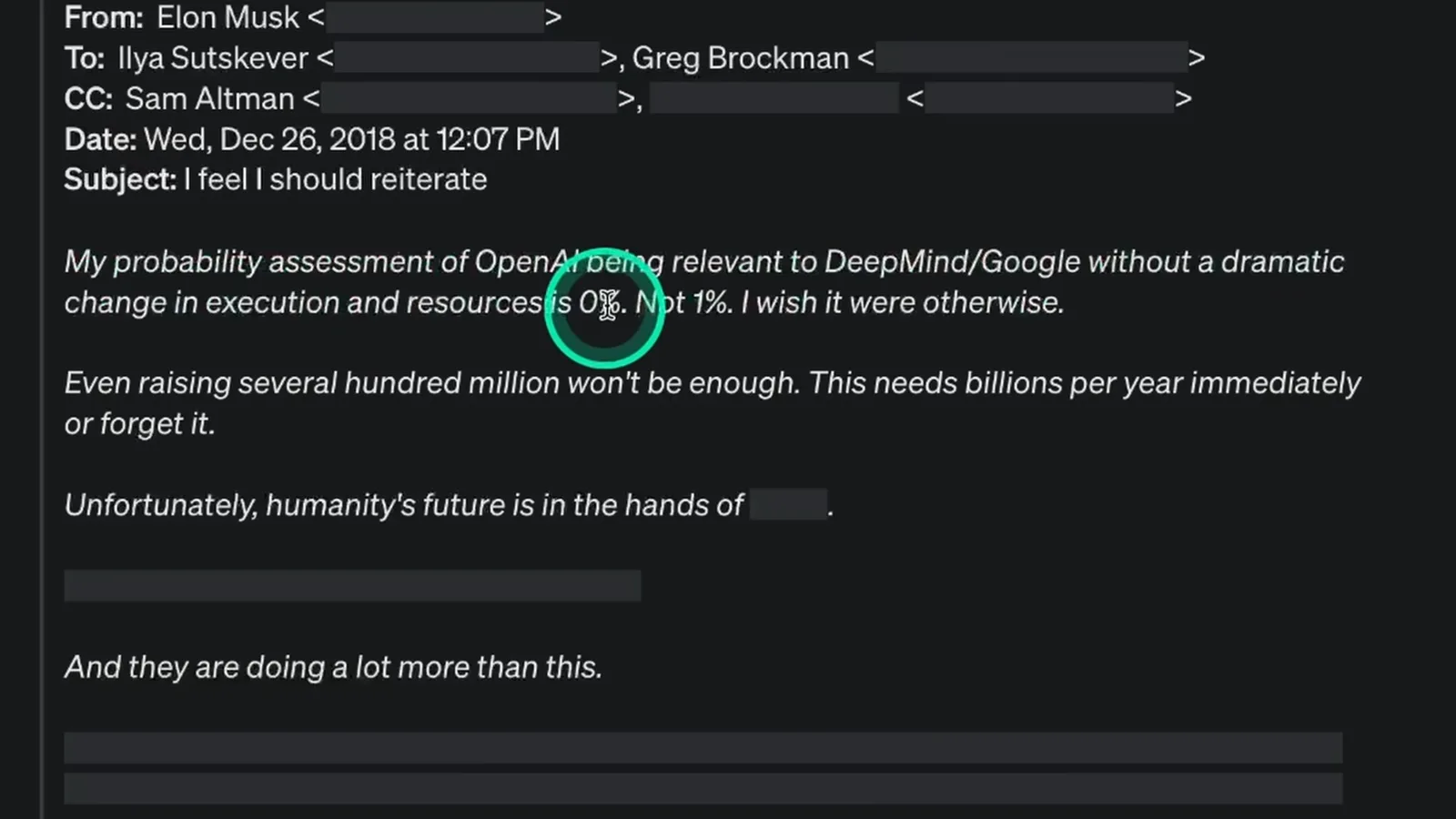
A separate December 2018 email has Musk assessing OpenAI’s chances of being relevant against Google and DeepMind at zero without a dramatic change in execution and resources. The condition matters: it was not an unconditional prediction that the organization could never succeed under any circumstances.
I read another redacted email warning that open-sourcing powerful AI is not necessarily a solution to safety and may create risks. Its author references an essay by Scott Alexander. The identity of the redacted sender is not established by the excerpt, and the risk scenario is an argument rather than an observed outcome.
Sutskever’s January 2016 email addresses a hypothetical rapid takeoff in which unsafe AI might be easier to build than safe AI. He suggests that openness might need to decrease closer to advanced AI, while sharing research could remain useful earlier. Musk’s brief reply appears beneath it in the material OpenAI published.
Safety, openness and the dispute
The discussion turns to a hypothetical rapid AI takeoff and Musk’s brief reply to Sutskever. Berman ends by questioning how the dispute will be resolved.
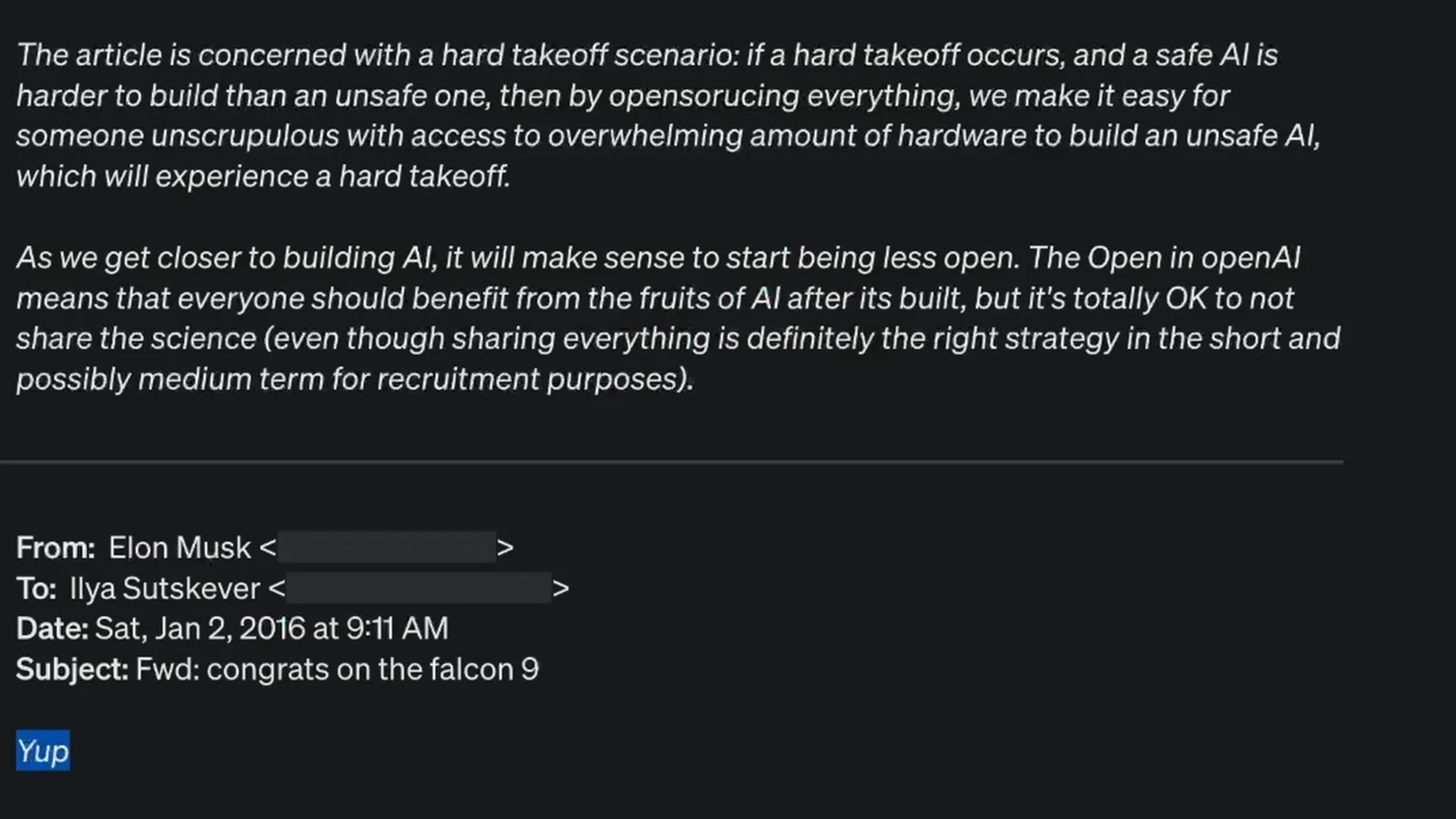
I play devil’s advocate about whether Musk’s “yup” should be read as agreement with every sentence. I say I am not a lawyer and do not know its legal significance. The exchange provides context for a disputed history, but does not on its own resolve the complaint or the parties’ wider disagreement.
The video closes by asking whether OpenAI can obtain dismissal and how viewers interpret the emails. As of this March 2024 discussion, the complaint and public response presented opposing positions; the video does not establish a legal outcome.
同じチャンネルの記事
 34:21EN
 Matthew Berman· 2026年10月27日Matthew Berman Examines Anthropic’s IPO Filing, AI Growth and GovernanceMatthew Berman, Sam Altman · Forward FutureThe presenter reviews the S-1’s financial metrics, compute strategy and voting structure while questioning the tension between rapid AI development and safety.
 0:36ENMatthew Berman· 2026年10月25日Kimi K3.1 and a Rubik’s Cube Solver DemonstrationMatthew Berman · Forward FutureMatthew Berman shows a scrambled virtual cube being solved and gives the Kimi K3.1 test a favorable assessment.
 25:50ENMatthew Berman· 2026年10月24日Kimi K3.1 Pro Tested: Strong 3D Demos, Uneven Results and Competitive PricingMatthew Berman · Forward FutureMatthew Berman tests the open-weight model on coding, 3D rendering and visual explanations, then compares benchmark results and prices.
 32:20ENMatthew Berman· 2026年10月23日Who Is Local AI For? The Costs, Trade-offs and a Hybrid FutureMatthew Berman · Forward FutureMatthew Berman weighs data control and independence against hardware cost, setup complexity and inference speed.
 1:03:37ENMatthew Berman· 2026年10月23日Matthew Berman’s Team Tests Kimi K3.1 on Animation, Games, and ChartsMatthew Berman, Alex, Brian · Forward FutureA live team AMA turns into an informal test of Kimi K3.1, from personal-agent workflows to motion graphics, a browser game, and a benchmark chart.
 0:53ENMatthew Berman· 2026年10月22日Sam Altman on AI and the Discovery of New KnowledgeSam Altman · OpenAIAltman expects progress in mathematical discovery to extend to biology, materials and energy.