30 秒でわかる
3Blue1Brown explains the Borwein integrals using shrinking plateaus and the convolution theorem. The video’s description corrects one displayed divergent integral in the cosine variant.
- 1A pattern breaks at 15The integral remains π through denominator 13 and is slightly smaller after the factor with denominator 15.
- 2A correction to the videoThe video description says the top line displayed at 4:12 diverges and should be omitted.
- 3Moving averages shrink a plateauEach averaging window reduces the width of the region where the function equals 1.
- 4A second threshold at 113The cosine variant corresponds to a wider plateau and a later threshold.
- 5Fourier transform and convolutionThe transform turns products into convolutions, which are moving averages in this example.
ポイント
- The integral remains π through denominator 13 and is slightly smaller after the factor with denominator 15.
- Each averaging window reduces the width of the region where the function equals 1.
- The cosine variant corresponds to a wider plateau and a later threshold.
- The transform turns products into convolutions, which are moving averages in this example.
- The video description says the top line displayed at 4:12 diverges and should be omitted.
チャプターごとに整えた全文を読む
The surprising integral pattern
Products of sinc functions retain the same integral until a tiny deviation appears.
A sequence of integrals appears to equal π each time, then suddenly falls just short. The discrepancy is so small that a researcher reportedly suspected a computer-algebra bug. The phenomenon is real, and the explanation connects moving averages with Fourier transforms and convolution.
Start with sinc(x) = sin(x)/x, defined continuously as 1 at zero. Its integral over the real line is π, with areas below the axis counted negatively. This is already a surprising result if you approach it using elementary integration techniques.
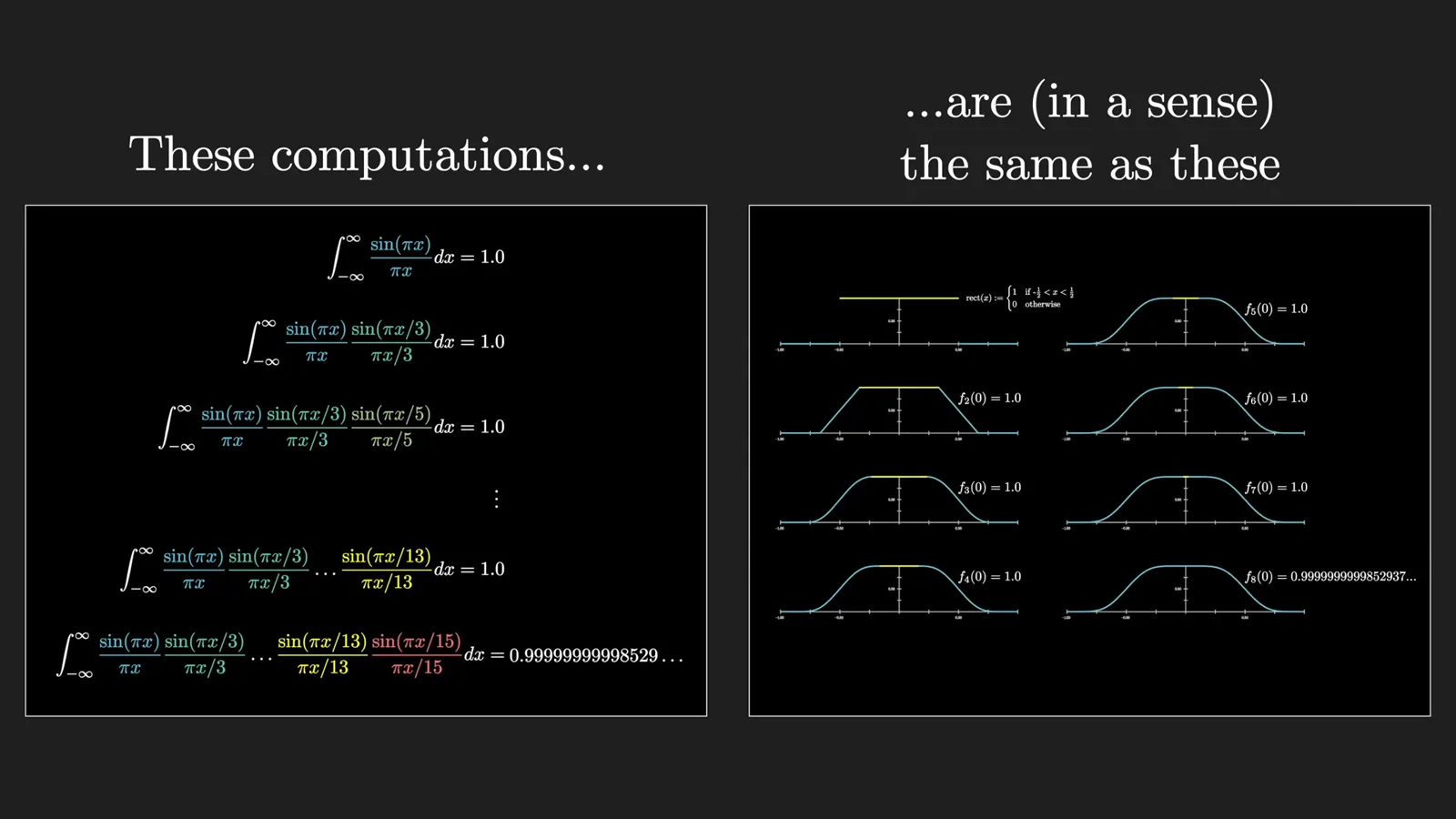
Now multiply by sinc(x/3), then by sinc(x/5), and continue with successive odd denominators. Each factor changes the graph, yet the integral stays exactly π through the factor with denominator 13. Adding the factor with denominator 15 makes it slightly smaller.
The tiny difference is not floating-point error; the exact answer is a rational multiple of π just below π. The Borweins also considered a version with a factor 2 cos(x), whose corresponding pattern persists much longer before breaking at 113.
The video description corrects the display at 4:12: its top line should not be included because that integral diverges. The later valid expressions are the focus of the longer-lasting pattern.
A moving-average analogy
Repeated averages narrow a plateau until the center finally drops.
To see a related phenomenon, define rect(x) to be 1 between −1/2 and 1/2 and 0 outside. Create a second function by taking a moving average of the first with a window of width 1/3. Where the whole window sits inside the original plateau, the average remains 1.
The new plateau is narrower by the window’s width, so its length is 1 − 1/3. Its value at zero is still 1. Repeat the averaging with a window of width 1/5; the plateau shrinks again, to length 1 − 1/3 − 1/5.
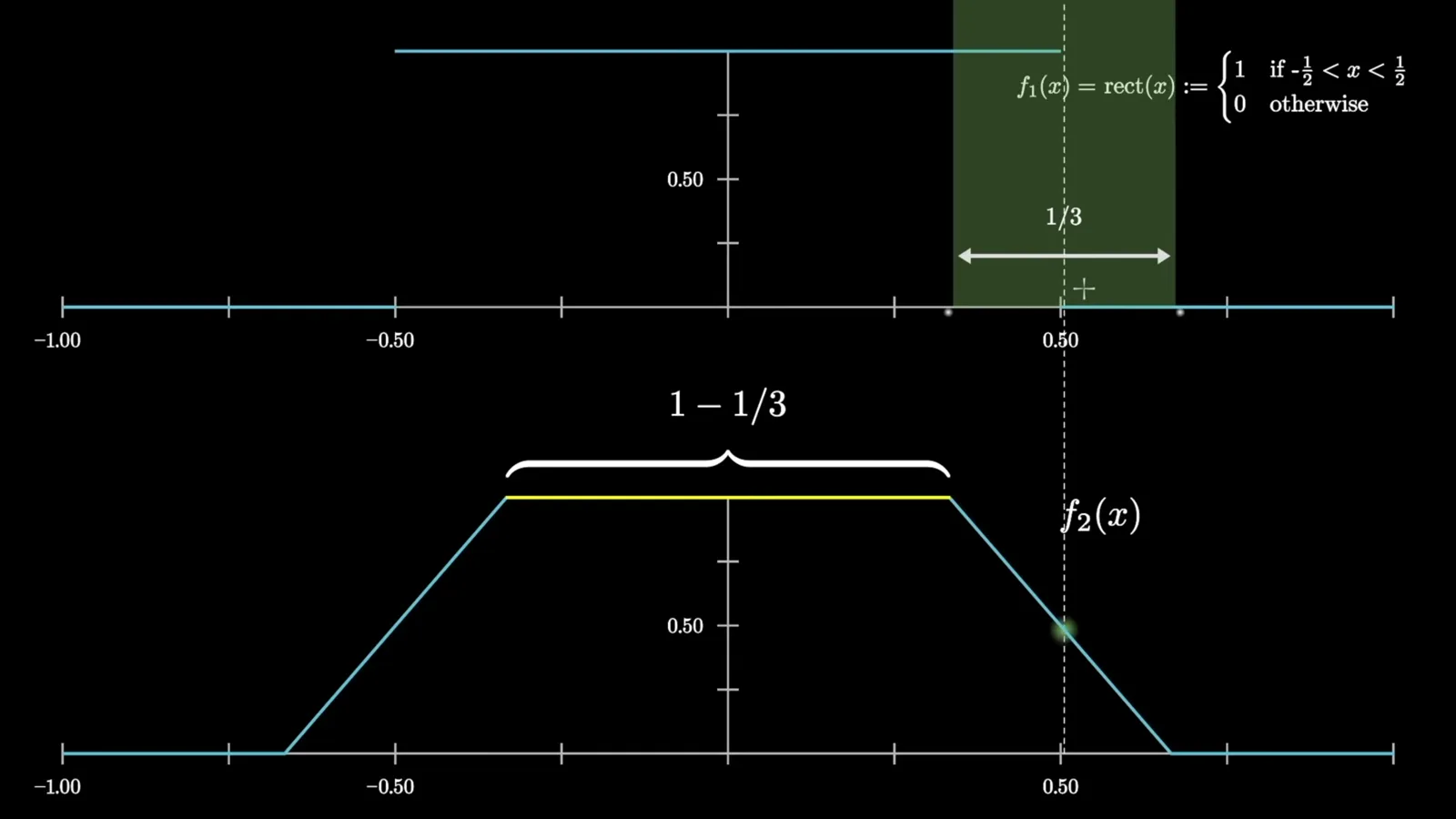
Continue with widths 1/7, 1/9 and so on. The plateau narrows, but near its edge the curve is still very close to 1 because it is built from repeated averages of nearby values.
At the 1/15 step, the previous plateau is narrower than the averaging window. Even at zero the window includes values slightly below 1, so the average drops below 1. This happens because 1/3 + 1/5 + … + 1/15 first exceeds 1.
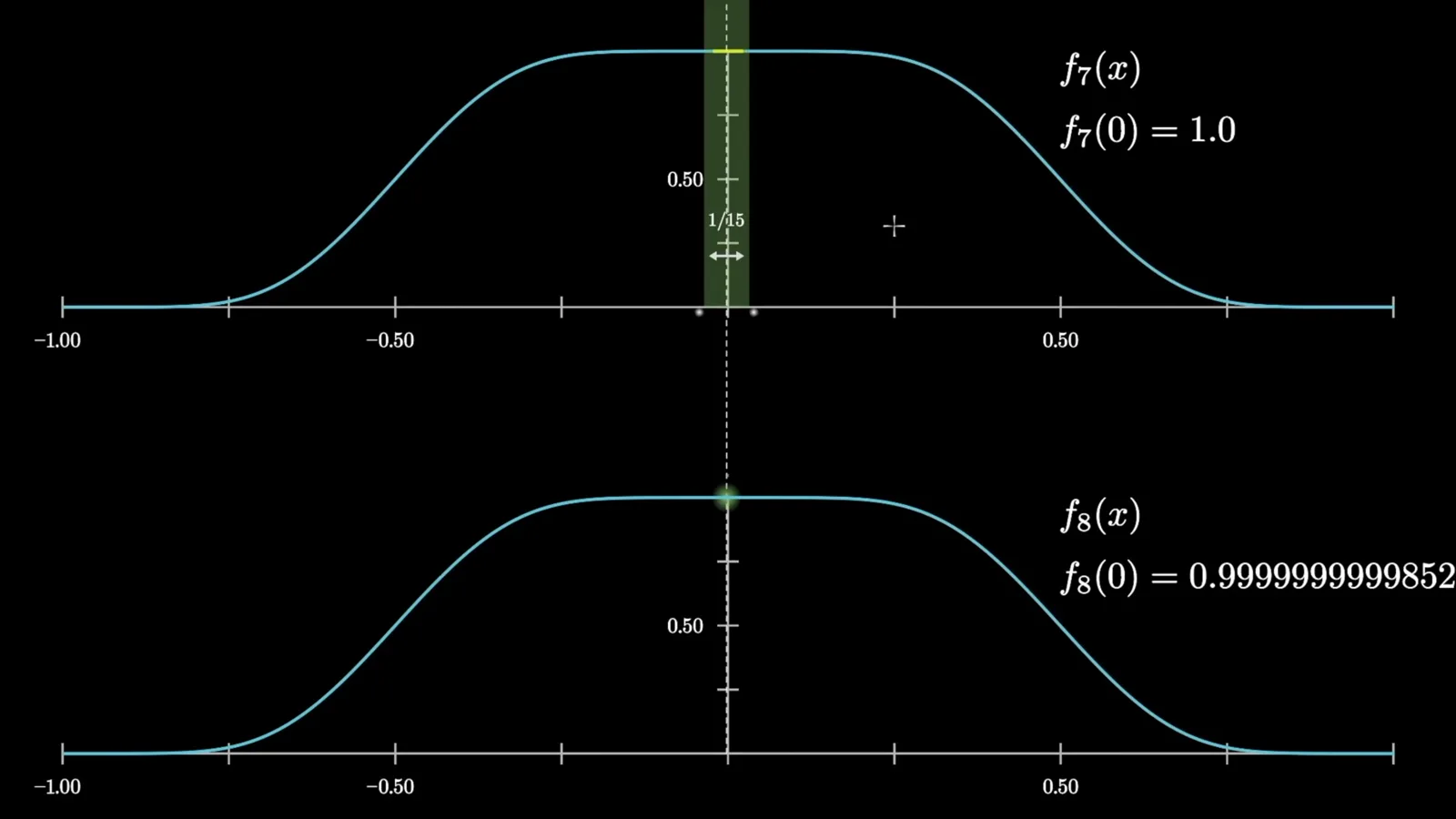
The resemblance is exact: the moving-average value at zero is the factor multiplying π in the corresponding integral. For the 2 cos(x) variant, the analogy starts with a plateau of width 2; the reciprocal sum first exceeds 2 at 1/113.
Odd reciprocals are not essential. The presenter explains the more general principle: for positive scaling values, the plateau remains intact while the total window width is below 1, then the central value falls once it exceeds 1.
Fourier transforms and convolution
The presenter outlines why the two calculations correspond.
Why are the integrals and moving averages the same calculation? The explanation uses Fourier transforms and convolutions. This video gives a high-level overview and leaves a fuller explanation of convolution for a subsequent video.
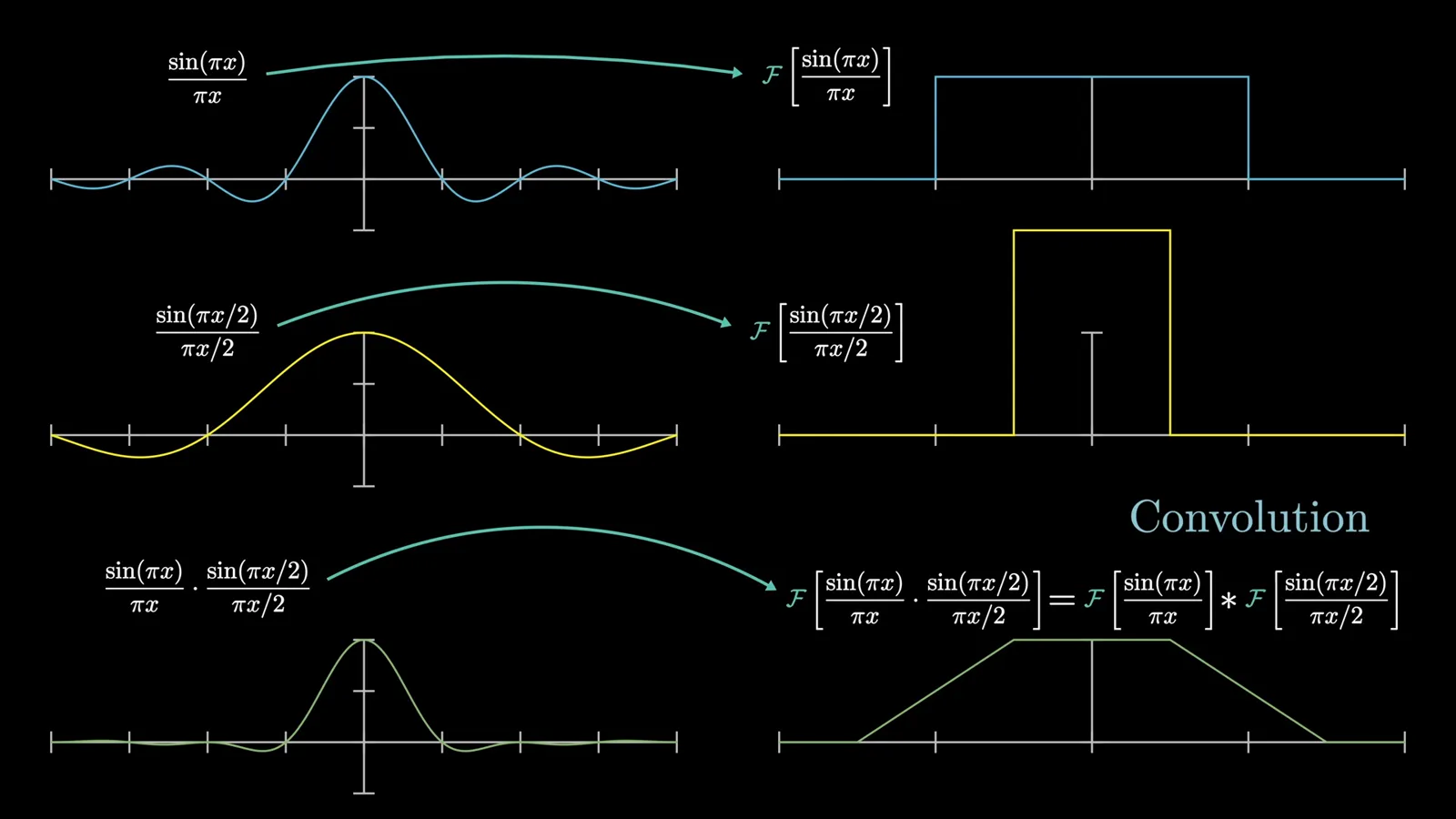
First replace x by πx. This rescales the sinc integral from π to 1. Under the Fourier-transform convention used here, the normalized sinc function corresponds to the rectangular function; a stretched sinc corresponds to a rescaled rectangle.
A Fourier transform can be understood as a change of perspective that expresses a function in terms of its frequency components. Statements that are difficult in the original representation can become simpler in the transformed one.
One useful fact is that the integral of a function over the whole line equals its Fourier transform evaluated at zero, under the convention used in the video. Thus the normalized sinc integral corresponds to evaluating rect at zero, which gives 1.
The convolution theorem supplies the other link: transforming a product corresponds to convolving the transforms. In this example, convolving with the relevant rectangular functions is the moving-average operation. Evaluating at zero therefore connects the product integrals to the shrinking plateaus.
The presenter acknowledges that these transform facts need more justification and promises to explore them in the next video. He adds that the convolution theorem has applications beyond this puzzle, including algorithms for multiplying large numbers efficiently.
同じチャンネルの記事
 40:44EN
 3Blue1Brown· 2026年10月16日Grant Sanderson: There's never been a better time to go into mathGrant Sanderson, Constantin Kogler · 3Blue1BrownStudents fear AI has solved mathematics. Grant Sanderson argues the opposite: even if machines prove theorems better than we do, the institution of math stays valuable—and this is a rare moment when newcomers can reshape it.
 51:55EN3Blue1Brown· 2026年9月18日The last IMO problem AI could not solveGrant Sanderson · 3Blue1BrownGrant Sanderson walks through IMO 2025 Problem 6 — a tiling puzzle that frontier models missed — and the visual patience it takes to prove a construction is optimal.
 0:55EN3Blue1Brown· 2026年7月24日The 64 Sugar Cubes Puzzle: Six Equal DistancesA 4×4×4 block has three colors; prove that six same-colored pairs share a distance.
 33:51EN3Blue1Brown· 2026年7月16日What Cross-Entropy Connects: Compression, Language Models and KL DivergenceGrant Sanderson · 3Blue1BrownGrant Sanderson builds cross-entropy from code lengths and uses it to explain next-token training and distillation.
 2:25EN3Blue1Brown· 2026年6月12日How Shannon Measured the Entropy of EnglishA guessing game helped Claude Shannon estimate how much information English text contains, and why prediction is central to compression.
 1:02EN3Blue1Brown· 2026年6月10日A Robot Walk and the Puzzle of Optimal Binary EncodingHow few bits does it take to send directions that occur with unequal frequencies?