30 秒でわかる
Berman examines a November 2025 complaint by former Figure AI safety engineer Robert Gruendel, who alleges retaliation after raising robot safety concerns. The video covers the plaintiff’s account, including impact tests, an alleged near miss and an E-stop certification dispute, then offers Berman’s view on balancing utility and physical safety. It does not present Figure’s defense or a court ruling resolving the allegations.
- 1Wrongful termination claimGruendel alleges retaliation for raising safety concerns; the company’s defense is not presented in the video.
- 2Impact-test allegationThe complaint reports force measurements and a skull-fracture estimate; the video does not independently verify them.
- 3Alleged near missThe complaint describes a robot striking a refrigerator near an employee.
- 4E-stop certificationThe complaint alleges an emergency-stop certification project was ended.
- 5A separate safety featureThe page shown refers to an unspecified safety feature, rather than identifying it as the E-stop.
ポイント
- Gruendel alleges he was fired after raising concerns about robot safety; the video does not establish the reason for his dismissal.
- The complaint describes an impact test and a refrigerator near miss, but its claims are not independently verified in the video.
- The complaint alleges an E-stop certification project was ended; that differs from claiming every emergency-stop function was removed.
- A separate safety feature is described as removed for aesthetic reasons, but the displayed complaint does not identify it as the E-stop.
- Berman favors testing and safeguards while weighing the benefits and physical risks of household robots.
チャプターごとに整えた全文を読む
The complaint and the disputed dismissal
Berman introduces Gruendel’s wrongful-termination and retaliation claims. They are allegations rather than findings of fact.
I review a lawsuit brought by former Figure AI safety engineer Robert Gruendel. The complaint alleges that a Figure 02 robot malfunctioned near an employee, struck a refrigerator and left a quarter-inch-deep gash. These are allegations in a complaint, not findings established by the video.
The case claims wrongful termination and whistleblower retaliation. Gruendel alleges that he raised concerns with Figure CEO Brett Adcock and other leaders and was fired because of those concerns. The lawsuit presents the plaintiff’s account; the video does not present Figure’s defense or a court finding on these claims.
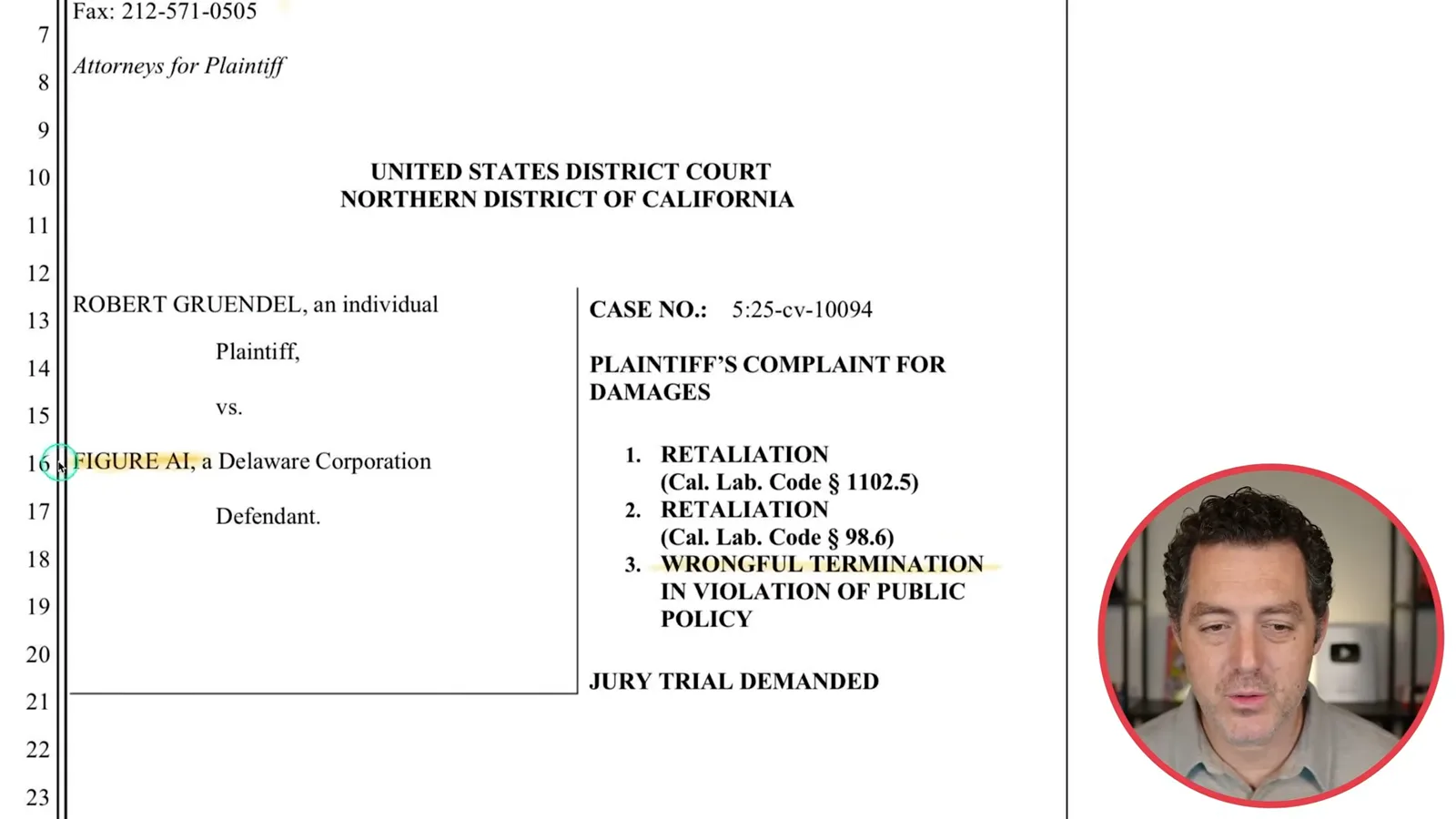
The complaint names Gruendel as plaintiff and Figure AI as defendant. Figure is developing humanoid robots intended for workplaces and homes. The proposed arrival of powerful machines in spaces shared with people makes the underlying safety questions worth examining, regardless of the outcome of this particular case.
According to the complaint, Gruendel was recruited to lead product safety and raised concerns while receiving positive feedback and a pay increase. He alleges that the company nevertheless prioritized bringing a robot to market over the measures he believed were needed.
The complaint points to Figure’s stated emphasis on moving fast and bringing a commercially viable humanoid to market. I compare that culture with fast-moving software companies, but a physical robot can cause physical harm, so speed and safety deserve careful scrutiny.
Gruendel alleges that he warned Adcock and chief engineer Kyle Edelberg about the force the robots could generate and the refrigerator incident. The complaint says he was fired on September 2, 2025, after being told that the company’s business direction had changed; it alleges that reason was a pretext.
Safety procedures and management
The complaint describes Gruendel’s job, his safety roadmap and alleged concerns about company practices.
The complaint says Gruendel joined on October 7, 2024, as principal robotic safety engineer, reporting to the CEO, and was tasked with developing the global safety strategy. It describes his prior experience in robotics, human-robot interaction and safety standards.
Gruendel alleges that, during his first week, he found no formal robot safety procedures, incident reporting system or risk assessment process, and no dedicated employee health and safety staff. He says he raised the concerns and developed a safety roadmap that leadership approved. Those assertions have not been independently verified in this video.
The complaint also alleges that Adcock and Edelberg disliked written product requirements and that Gruendel considered this unusual for machinery safety. I find the reported aversion troubling, while the record shown here is a plaintiff’s allegation rather than a determination of the executives’ intent.
The complaint describes risks associated with AI-driven control. I question its claims about self-preservation and apparent consciousness: those questions remain disputed and should not be treated as settled simply because they appear in a legal filing. More generally, uncertain behavior in a physical system needs safety analysis.
I argue that the stakes differ from an ordinary software release because robots act in the physical world. In the complaint, Gruendel says Adcock asked in January 2025 what it would take to put robots in homes; Gruendel then produced a safety roadmap.
The complaint alleges that Adcock did not attend the briefing or respond to a condensed version of the requirements. I acknowledge possible explanations for a lack of reply and speculate about another, but the filing and video do not establish why he did not respond.
Home safety and impact testing
Berman reviews the alleged safety plan and impact test, and discusses the tradeoffs involved in powerful machines.
Gruendel argues in the complaint that guarded, robot-only areas used in factories are impractical for a household assistant. He identifies detecting and classifying nearby objects and living things, then stopping or slowing motion to prevent injury, as a key home-safety challenge.
The complaint says Gruendel presented a safety strategy to investors in May and June 2025 and prepared a white paper that received praise. He alleges that parts of the plan were later downgraded and that he objected because investors had understood the safety plan would be implemented.
The complaint describes a July 28, 2025 impact test in which a Figure 02 was programmed to strike at its strongest capacity. Gruendel alleges the measured force exceeded a pain threshold referenced to ISO 15066 and estimates it was more than twice the force required to fracture an adult skull. The video does not independently verify the measurements or the estimate.
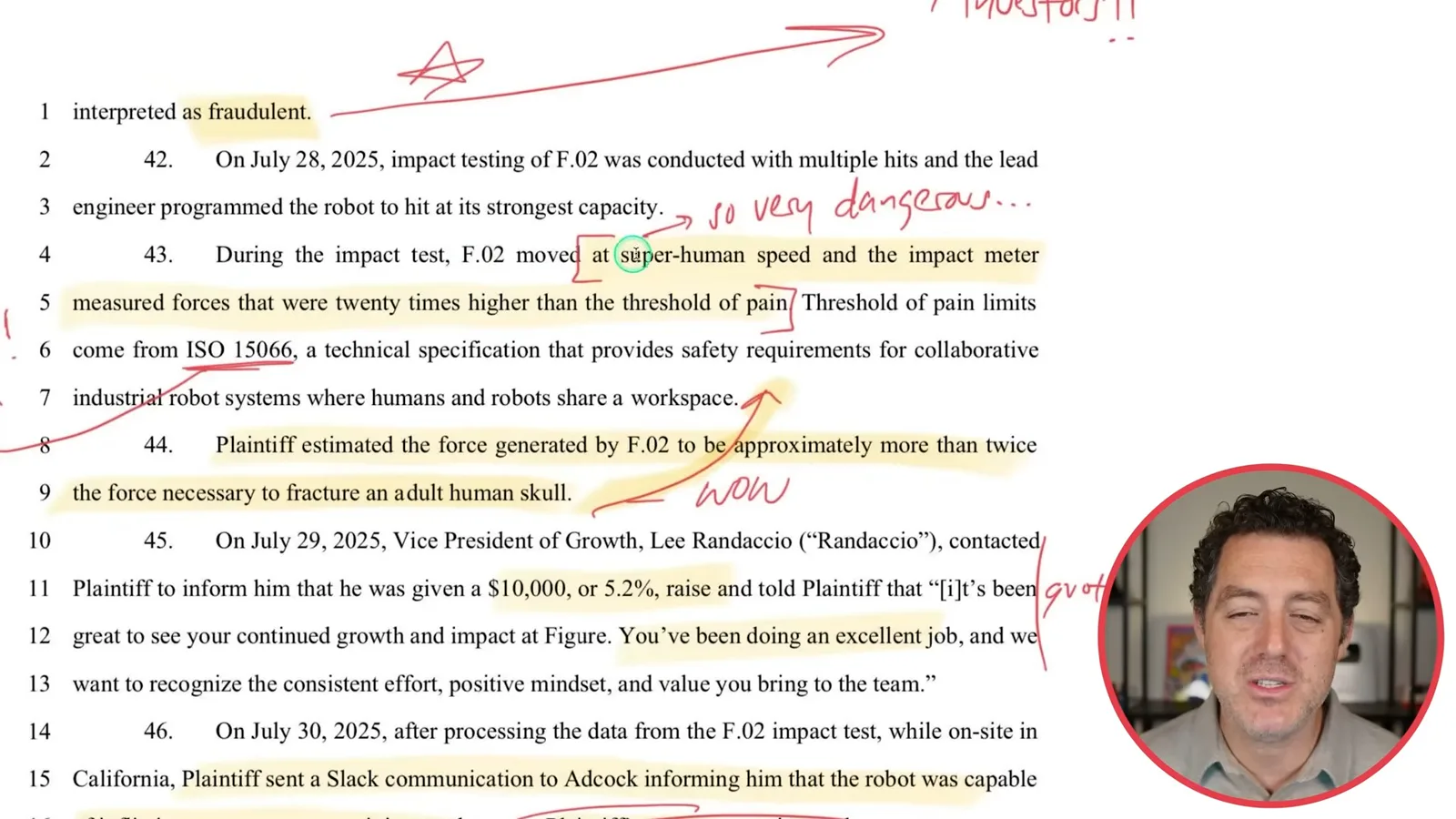
My view is that capability to cause injury does not by itself mean a device will injure someone. Cars, saws and other tools also create risks. I want serious testing and precautions, and I think deployment should be considered through an explicit assessment of benefits and risks.
The complaint says Gruendel received a $10,000 raise, described as 5.2%, on July 29, and subsequently warned Adcock that the robot could cause severe permanent injury. It alleges the message was ignored. A raise and a later dismissal are part of the plaintiff’s narrative, not proof of the reason for termination.
Near misses and emergency stops
The complaint alleges a workplace near miss and a decision to end an E-stop certification project. Berman also discusses a separate unspecified safety feature.
The complaint raises concerns about Figure employees working near robots as well as future customers. Gruendel alleges that workers reported near misses to him and that these incidents were not being tracked; the video does not establish how the company recorded workplace incidents.
The refrigerator episode is one of the complaint’s examples: a robot allegedly malfunctioned and narrowly missed an employee before striking the door. I find the account frightening, but it remains an allegation, and a near miss does not establish that an injury occurred.
An emergency stop, or E-stop, is a way to stop a machine when a hazard arises. The complaint alleges that around August 11, Edelberg ended a project to certify an E-stop function. That is an allegation about a certification project; it is not, by itself, proof that all emergency-stop functionality was removed.
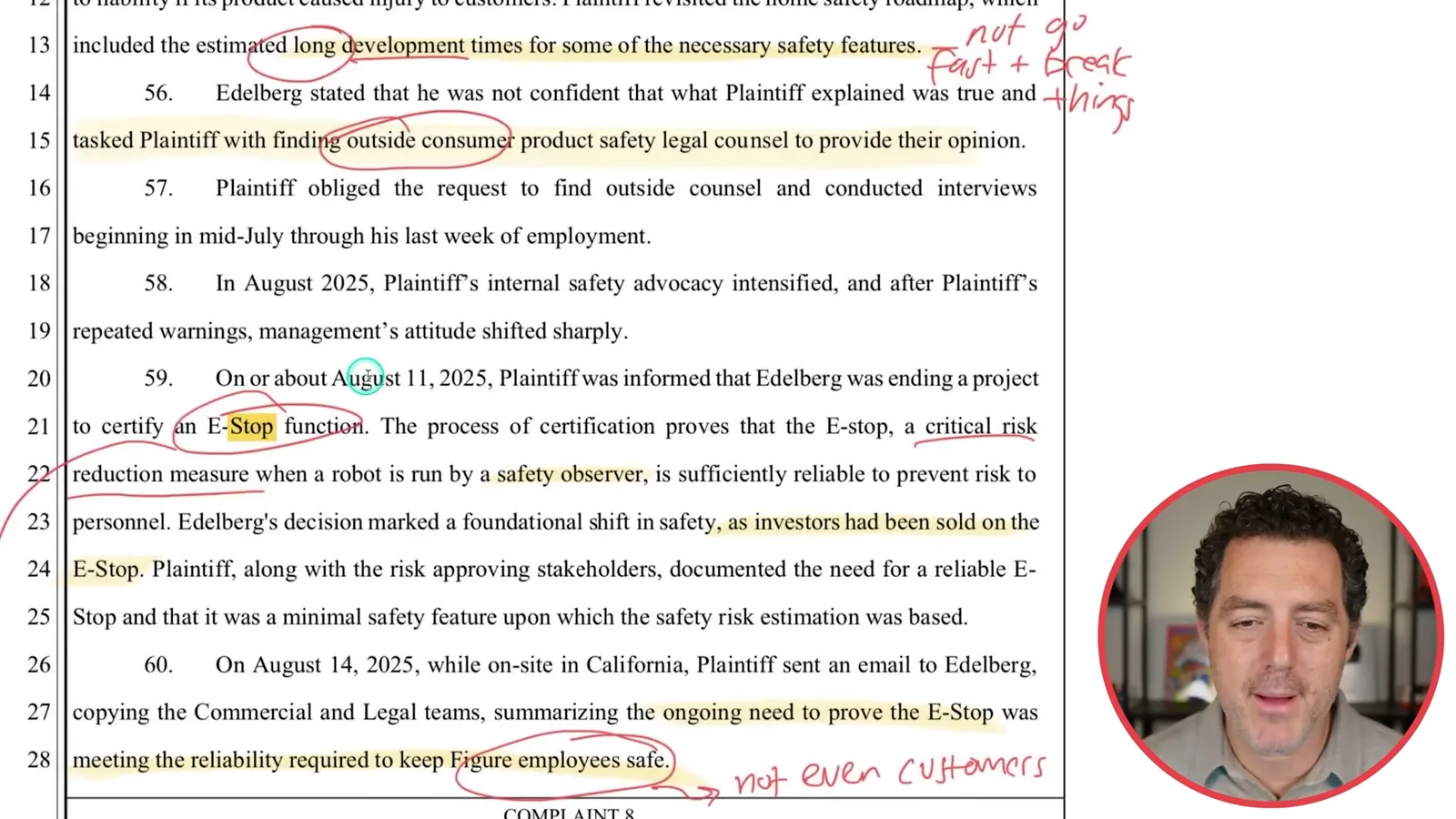
The complaint says Gruendel continued documenting his concerns and that two commercial employees expressed alarm about putting them in an email. He says he reiterated that the current E-stop was insufficient for employee safety. These allegations have not been adjudicated in the video.
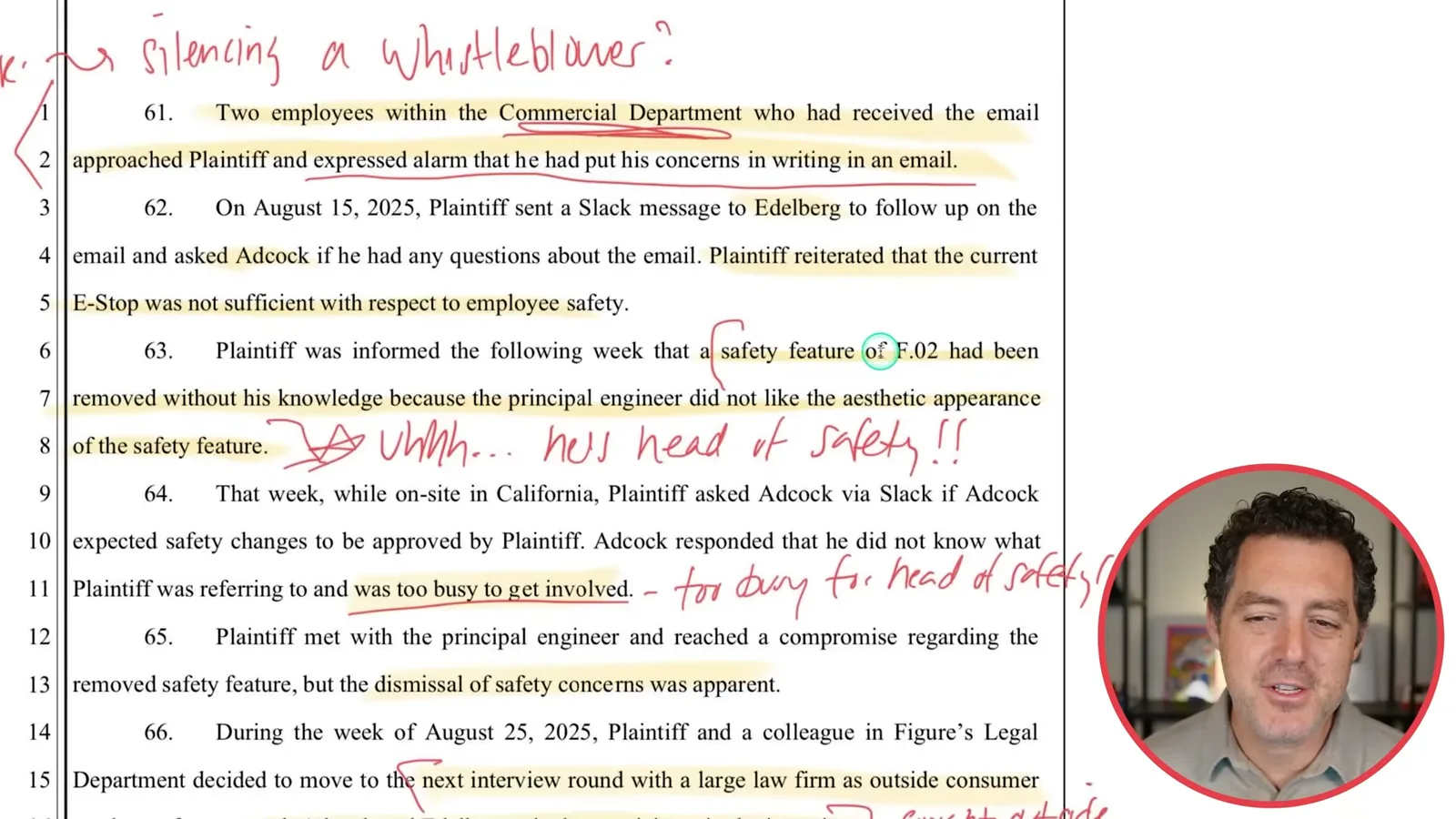
Berman says an E-stop was removed for aesthetic reasons, but the complaint page shown on screen instead describes an unspecified safety feature. It alleges that a principal engineer disliked that feature’s appearance and that Gruendel later reached a compromise. The displayed passage does not identify the feature as the E-stop.
The complaint alleges that Adcock became less engaged in safety discussions and that scheduled meetings grew less frequent. It also describes an exchange in which Adcock said he was too busy to get involved. Berman’s paraphrase of the CEO’s intentions is commentary, not a quoted admission.
Termination and the broader debate
Gruendel alleges his dismissal was retaliatory. Berman closes with his view on testing and the benefits and risks of household robots.
Gruendel alleges that he was dismissed on September 2, shortly after a safety training meeting and written warnings. He maintains the reason given to him—a change in business direction involving the home market—masked retaliation. Figure’s response and the eventual outcome are not presented in the video.
I remain interested in seeing humanoid robots eventually help at home, but they are powerful machines rather than toys. I want the risks mitigated through testing and safeguards while maintaining useful capabilities. The lawsuit will need to be assessed on its evidence and through the legal process.
同じチャンネルの記事
 34:21EN
 Matthew Berman· 2026年10月27日Matthew Berman Examines Anthropic’s IPO Filing, AI Growth and GovernanceMatthew Berman, Sam Altman · Forward FutureThe presenter reviews the S-1’s financial metrics, compute strategy and voting structure while questioning the tension between rapid AI development and safety.
 25:50ENMatthew Berman· 2026年10月24日Kimi K3.1 Pro Tested: Strong 3D Demos, Uneven Results and Competitive PricingMatthew Berman · Forward FutureMatthew Berman tests the open-weight model on coding, 3D rendering and visual explanations, then compares benchmark results and prices.
 32:20ENMatthew Berman· 2026年10月23日Who Is Local AI For? The Costs, Trade-offs and a Hybrid FutureMatthew Berman · Forward FutureMatthew Berman weighs data control and independence against hardware cost, setup complexity and inference speed.
 1:03:37ENMatthew Berman· 2026年10月23日Matthew Berman’s Team Tests Kimi K3.1 on Animation, Games, and ChartsMatthew Berman, Alex, Brian · Forward FutureA live team AMA turns into an informal test of Kimi K3.1, from personal-agent workflows to motion graphics, a browser game, and a benchmark chart.
 0:53ENMatthew Berman· 2026年10月22日Sam Altman on AI and the Discovery of New KnowledgeSam Altman · OpenAIAltman expects progress in mathematical discovery to extend to biology, materials and energy.
 0:22ENMatthew Berman· 2026年10月21日A Robot Bodyguard Video Shows Dramatic Rescue ScenariosMatthew Berman · Forward FutureMatthew Berman reacts to a short robot demonstration depicting fighting and vehicle-rescue scenarios.