30 秒でわかる
Databricks CEO Ali Ghodsi believes today’s AI is capable enough to transform work, yet most enterprises he visits still use it mainly for chat and coding. He says the obstacles are organizational context, access and security, cost, and control over data and intellectual property. A demonstration of Databricks’ Genie illustrates how he queries employee surveys and customer feedback, though the answers remain interpretations to examine. Ghodsi distinguishes broad adoption from a runaway self-improvement scenario: in his view, faster training, lower resource needs and general improvements would have to repeat in a loop. He expects enterprise adoption to take 10–15 years.
- 1Ghodsi sees a gap between present AI capability and adoptionHe believes current models meet an earlier definition of AGI, but says enterprise customers still mostly use chat and coding. That is his definition and assessment, not an agreed industry threshold.
- 2An agent cannot use context it never receivesA bank executive told him the bank would not record meetings. Ghodsi says missing meeting context limits what an agent can do with decisions made there.
- 3Data access brings security and cost questionsHe says access to company data expands the attack surface, while token bills can rise faster than measurable business returns.
- 4A survey dashboard prompted follow-up questions, not just a scoreGhodsi used a Genie demonstration to compare employee-survey categories and then ask for departmental breakdowns.
- 5Higher engineering output did not always coincide with higher spendGhodsi says Databricks compared pull-request activity and AI costs, observing that some high-output engineers spent less than others.
- 6More AI-written code alone does not prove a runaway loopGhodsi says fast self-improvement would require repeated gains in training speed, resource use and general capability.
- 7A defender must account for attacker asymmetryGhodsi says attackers can try many times and need only one success, while defenders must prevent every breach.
ポイント
- Ghodsi argues that an agent needs relevant organizational context before it can help with decisions made inside a company.
- Evaluate AI access, security, operating costs and control over intellectual property together.
- Ghodsi says AI-written code alone does not demonstrate a rapid recursive self-improvement loop.
- He expects cyberattacks to remain a serious practical risk and enterprise adoption to unfold over years.
チャプターごとに整えた全文を読む
Why Databricks bet on cloud and data
Ghodsi traces the company to Berkeley research and the practical obstacles facing enterprise data work.
Databricks CEO Ali Ghodsi says organizations already have access to enough AI capability to transform their work, but the difficult part is connecting it to company knowledge safely and affordably. He distinguishes that adoption problem from the prospect of a much faster, self-improving superintelligence.
Jason Calacanis introduces Ghodsi and asks how Databricks developed from an early research project into a large business. Ghodsi traces its origins to UC Berkeley's AMPLab and its work combining data processing with machine learning.
Ghodsi says the researchers started the company in 2013 because industry was not ready to adopt what they were building. One early application involved improving Netflix movie recommendations; the team believed many more organizations would eventually need similar data science capabilities.
The difficulty was not simply making an algorithm work. Ghodsi describes organizations with decades of legacy software, regulations, security requirements and established procedures. The academic work had not fully addressed governance and security.
Calacanis recalls how expensive storing raw logs once felt. Ghodsi says cloud services separated computing from storage, allowing businesses to retain more data and draw on computing resources when needed. Databricks bet early on cloud infrastructure, AI use cases and open source, choices he says were controversial then.
The host recalls the Netflix Prize as an example of organizations inviting researchers to improve prediction. Ghodsi explains that the “P” in AMPLab stood for people: researchers recognized that AI needed human feedback to handle the last mile.
Current capability and the enterprise gap
Ghodsi distinguishes his view of AGI from a faster hypothetical superintelligence and outlines four adoption obstacles.
Asked about the move from current AI to superintelligence, Ghodsi says he believes systems already meet the definition of artificial general intelligence that many colleagues held years ago. He says the definition has shifted, and argues present capabilities could transform the world even without further progress.
Ghodsi uses superintelligence for a different hypothetical: a system vastly faster and more capable than humans across intellectual work. Calacanis asks whether today's limitation is computing power or the models themselves. Ghodsi replies that current models are relatively slow and are often made useful through parallel agents working together.
Ghodsi says his enterprise customers mostly use AI for search-like chat and coding, often reporting coding speedups of 20–30%. In his account, organizations with thousands of agents performing core work remain uncommon. He contrasts that with what the models can demonstrate on difficult technical problems.
One barrier, he argues, is context. In a large company, decisions are distributed across meetings and documents. A bank executive told him the bank would not record meetings because of liability; Ghodsi says an AI cannot assist with a decision it never learns about.
The next problem is access. Giving agents unrestricted access to all company data expands the attack surface and can create an insider threat. Ghodsi says organizations also need to weigh rapidly rising token bills against the revenue or savings produced by using AI.
A fourth concern is control over intellectual property and avoiding dependency on one provider. Ghodsi praises model developers' contributions while saying that enterprises must address context, security, cost and control before adoption can move much further.
Calacanis adds that an organization's structure can limit what it does with a powerful tool: extra horsepower is of little use if the rest of the vehicle cannot handle it. He asks about model companies entering adjacent markets, including dashboards.
Ghodsi says Databricks does not charge for dashboards as a standalone product. Its business is governed data and the queries made against it. He expects more agents accessing that data to increase consumption, though he describes deployment as still early.
He says traditional organization charts route decisions up and down a hierarchy, while delivering a product crosses functions: customer feedback goes to product management, engineering, marketing and sales. AI that understands the business might shorten that cross-functional delay.
Ghodsi says he has seen this approach inside Databricks but cannot estimate how many other organizations do it at scale. He expects newer digital companies to move more quickly than long-established firms constrained by software, security and regulation.
A company graph behind a CEO’s assistant
A Genie demonstration examines surveys, management layers, engineering output and customer feedback.
Calacanis describes breaking his own podcast and investing work into services and agents with measurable intermediate goals. He says coordinating the pieces requires systems thinking, not just prompting a chatbot.
Ghodsi demonstrates Genie, which he describes as building a graph of an organization's people, reporting lines, meetings, documents and communications. In his account, background work appears in an inbox and draws on those sources to answer questions.
One example is an employee survey with more than 10,000 responses. Ghodsi asked for a dashboard and noticed lower scores on work-life balance and on whether the company acted on feedback. He says the latter mattered because employees had raised similar concerns before.
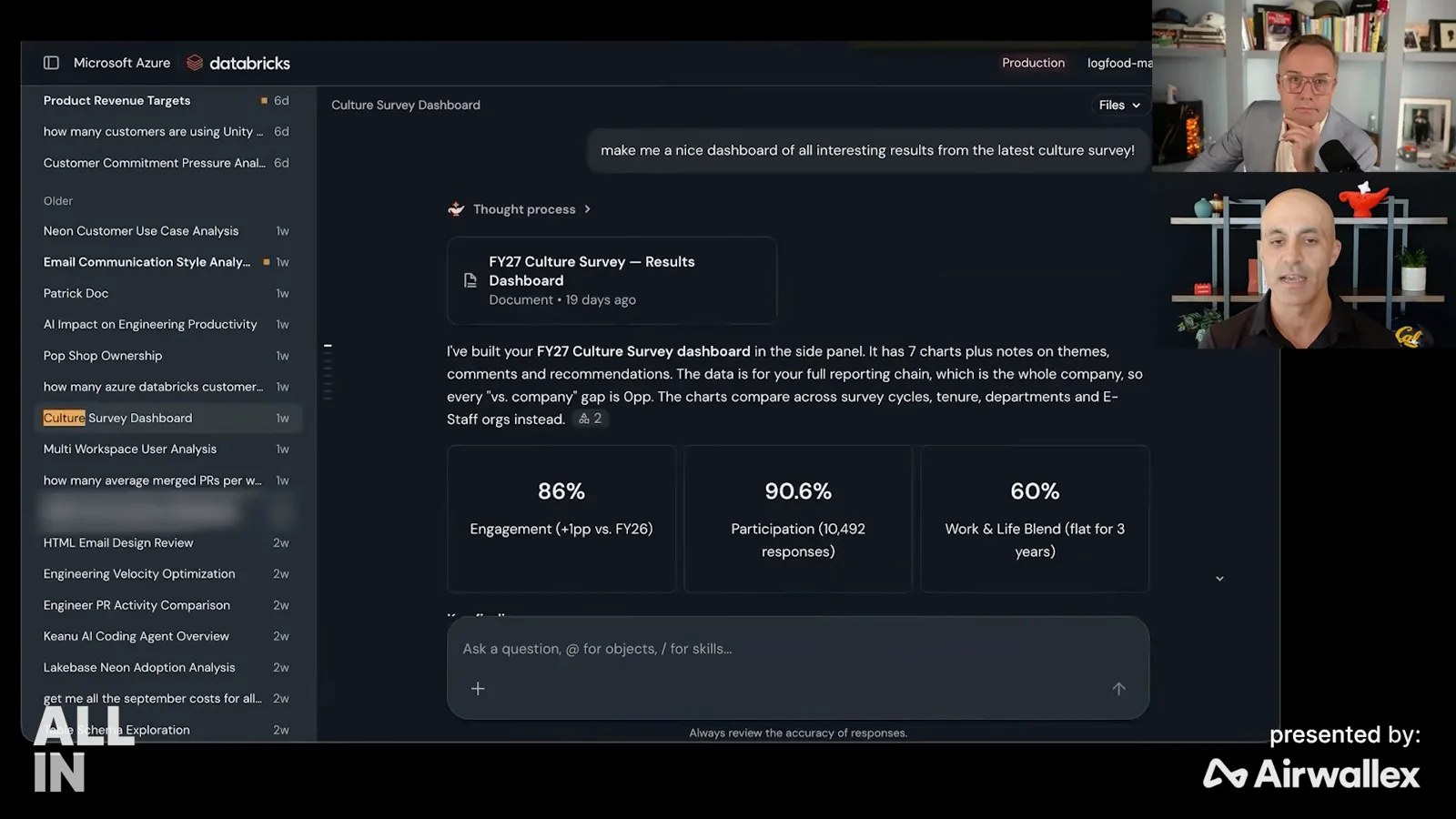
When the finance chief speculated that work-life balance caused the low action score, Ghodsi asked the system to compare the measures. He says it found examples that challenged a simple causal story. He then requested a breakdown by department to inspect the different concerns employees had raised.
The analysis, he says, surfaced concerns about decision-making in product management, tools in engineering and career growth in sales operations. He describes it as an iterative process: when the first answer was not useful enough, he refined the question.
Ghodsi says the system uses its existing graph rather than searching every source from scratch each time. The graph connects a metric to its author, relevant snippets and reporting relationships; the organization context is what makes the analysis possible in his demonstration.
A second query examined management layers and spans of control. Ghodsi says the system identified a deep reporting chain with relatively few direct reports at each level, prompting a discussion about how the organization might be structured differently.
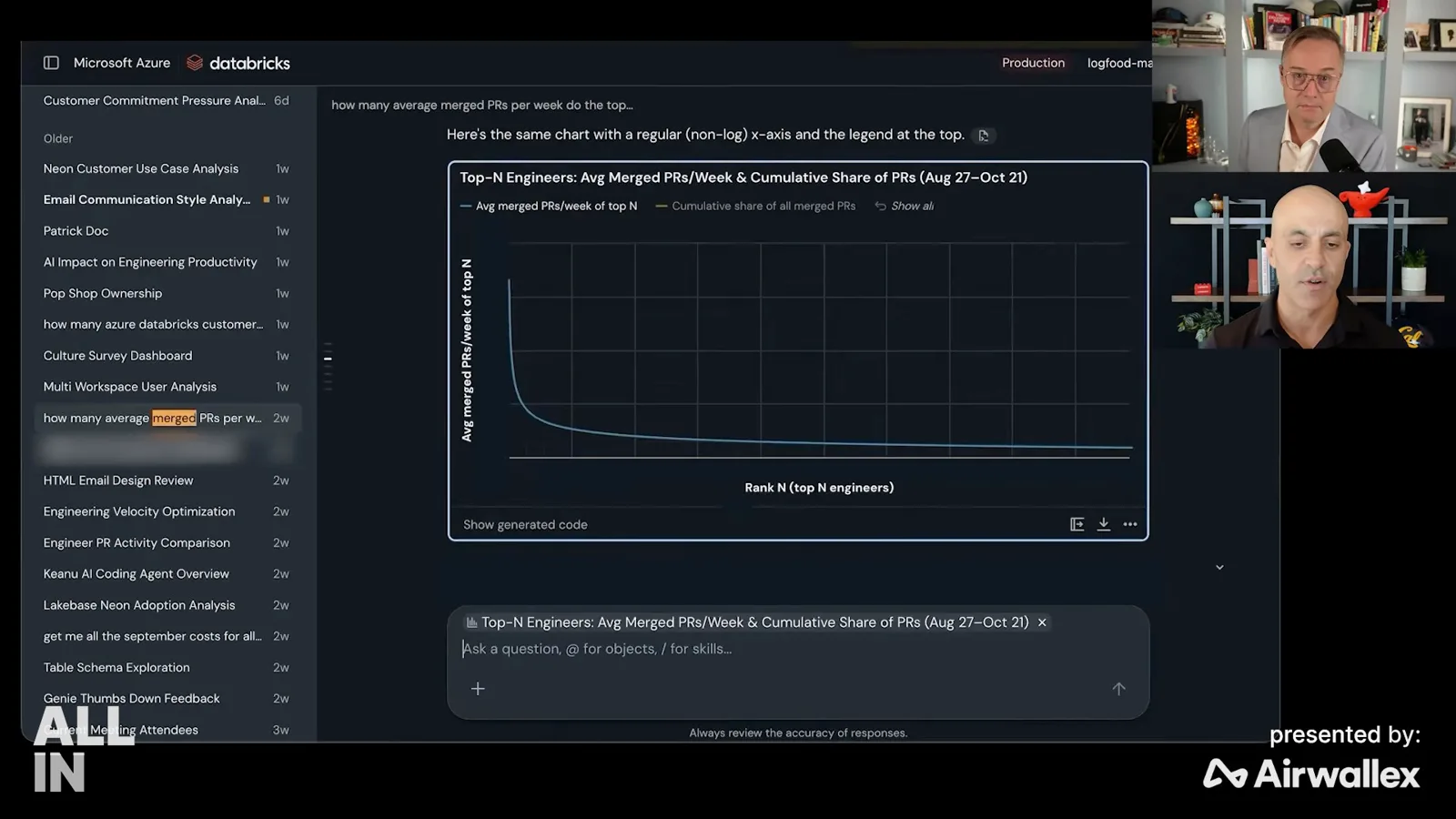
Another chart shows merged pull requests across roughly 2,000 engineers. Ghodsi says the leading group used automated workflows while others did not. He also compared spending and says some high-output engineers spent less than others, suggesting that usage can be routed and managed differently.
Recorded customer meetings provide another example. Ghodsi asks how a meeting went and says the system identifies concerns and feature requests. He describes background analysis that can gather customer feedback and pass it toward engineering, reducing delays between teams.
Calacanis compares management to detective work: leaders often reconstruct what happened through several meetings and partial accounts. He suggests that a shared record can give people a starting point for testing competing explanations.
Ghodsi says one objective is to reduce human blockers: a process may stop while an agent waits for legal, finance or another team to approve a step. The host describes his own experiment finding major decisions across communications, including sensitive employment discussions, before sharing the resulting bot more broadly.
Ghodsi says he also asks how a team actually operates compared with the company's stated cultural principles. A difference could be a warning or a reason to reconsider the wider policy; he says the point is to make the divergence visible and discuss it.
He says employees can access the information and that management shares its goal of improving the distribution of engineering output. Ghodsi views this internal use as a present competitive advantage, though he expects such practices eventually to spread.
The trade-off in going public
Ghodsi weighs capital and liquidity against market volatility and says he has no IPO date to announce.
Calacanis asks when Databricks will go public, noting that secondary markets give private shareholders some liquidity. Ghodsi says his decision centers on which path best supports building the business over the next decade or two.
Going public offers access to capital, publicity and a regular market for shares. Remaining private means organizing tender offers, which he calls a substantial process. He says employees have not used all the liquidity offered in previous tenders.
Ghodsi says the company has also been able to make large acquisitions while private. Calacanis notes that employees and investors still need to consider their own downside and reasons for selling.
Asked about competing with companies expanding into neighboring products, Ghodsi says Databricks will continue to build. He returns to the cost of public-market volatility: a falling share price can sharply change the value of employees' compensation and distract management.
He says Databricks will eventually go public, but prefers to avoid a public-market roller coaster during the current AI transition. He does not give a date; his stated priority is staying focused on long-term product decisions.
What a rapid self-improvement loop would require
Ghodsi describes faster, less resource-intensive training, general improvements and repetition as conditions for his scenario.
Calacanis returns to recursive self-improvement: the idea that an AI system could help produce a better successor repeatedly. Ghodsi says seeing agents write code can make that future feel imminent, particularly to people who spent their careers programming.
But, Ghodsi argues, moving from 98% to 100% AI-written code does not by itself establish a runaway loop. He proposes several conditions that would need to hold for the rapid takeoff scenario he is considering.
First, he says, successive training runs would have to become substantially faster. Second, they would need fewer resources, rather than merely being accelerated by buying ever more hardware. He contrasts that with the large, carefully supervised training runs he sees today.
Third, improvements would need to generalize across tasks rather than appear only in one reinforced domain. Fourth, all those improvements would need to repeat continuously in a loop. Even meeting the conditions, he says, would not prove that a conscious system would take over.
Ghodsi says he does not see that loop today: training can take longer, acquiring and cleaning data requires work, and improvements may be domain-specific. He argues that the scenario needs physical means as well as a capable model to create the kind of immediate danger he imagines.
Cybersecurity and the speed of adoption
The speakers discuss attacker-defender asymmetry, practical risks, biomedical applications and Ghodsi’s forecast of gradual economic diffusion.
Calacanis brings up attacks on connected refrigerators and argues that stronger default passwords could have limited that example. Ghodsi agrees that cybersecurity is a real concern and describes his company's work on monitoring and detecting intrusions.
The host asks whether defenders' greater computing resources could let them find flaws before attackers. Ghodsi points to an asymmetry: an attacker may need only one successful attempt, whereas a defender must protect the boundary repeatedly.
Ghodsi expects scanning and rewriting old code to reduce vulnerabilities over time. He presents this as his outlook, contrasting a finite set of existing flaws with attackers who can use agents to search more widely. Calacanis adds that people themselves can still be a source of compromise.
Asked about researchers who fear superintelligence, Ghodsi says he believes many are sincere and that reading the underlying arguments can be unsettling. He still does not see evidence for the four conditions of the fast loop he outlined, while acknowledging that others could possess information he does not.
Calacanis identifies other concerns, including children's relationships with chatbots, harmful advice and manipulation through online systems. Ghodsi says practical risks, especially cyberattacks on services such as hospitals, deserve attention even though he considers existential risk very low.
On claims that AI might cure cancer within a decade, Ghodsi says he does not know the timeline and notes that drug development requires human trials. He describes Databricks-supported research into liver disease and a model developed with Merck as examples of AI assisting biomedical work.
He cites crisis support and logistics as other applications customers have discussed. Ghodsi expects AI to make the world better while saying that the risks require attention; those examples are presented as uses, not a timetable for medical breakthroughs.
Despite his view that current AI is powerful, Ghodsi expects resolving the enterprise context gap to take 10–15 years and economic effects to diffuse slowly. The bank unable to record meetings illustrates his point: without access to what happened, an agent cannot perform the internal analysis shown in his demo.
Calacanis compares early AI adopters to people who saw the internet's potential before high-speed access was widespread. Ghodsi recalls the Morris worm as an early internet security incident; they close by noting that adoption and security will have to develop together.
同じチャンネルの記事
 1:24:55EN
 All-In Podcast· 2026年11月14日ポッドキャスト · 4 人Nvidia after Jensen Huang: the AI investment engine faces a testホスト Jason Calacanis, Chamath Palihapitiya, David Sacks, David FriedbergThe All-In hosts debate Nvidia’s leadership change, the future of AI chip controls and what a slower investment cycle could mean for Anthropic.
 1:33:03ENAll-In Podcast· 2026年11月7日ポッドキャスト · 4 人The All-In Hosts Debate the Midterms and the AI Infrastructure Backlashホスト Jason Calacanis, Chamath Palihapitiya, David Sacks, David FriedbergThe panel disagrees over the election’s causes, the future of data centers and who will control AI capacity.
 1:25:46ENAll-In Podcast· 2026年10月30日ポッドキャスト · 4 人All-In on Anthropic’s IPO, AI Infrastructure and the Midterm Electionsホスト Jason Calacanis, Chamath Palihapitiya, David Sacks, David FriedbergThe hosts analyze Anthropic’s filing, debate the costs of an AI infrastructure boom, discuss Alphabet and offer competing midterm forecasts.
 55:39ENAll-In Podcast· 2026年10月29日ポッドキャスト · 2 人Will Ahmed on WHOOP’s Subscription Model, Health Data and Wearable Strategyゲスト Will Ahmed · ホスト Jason CalacanisThe WHOOP CEO discusses the company’s business model, physiological data, AI features and its account of interactions with the FDA.
 1:43:22ENAll-In Podcast· 2026年10月23日ポッドキャスト · 4 人AI Security, Investment and the Debate Over France’s Futureゲスト Nikesh Arora · ホスト Jason Calacanis, Chamath Palihapitiya, David FriedbergThe All-In hosts and Nikesh Arora discuss cybersecurity and AI spending, then debate France’s unrest, public services and US policy.
 40:00ENAll-In Podcast· 2026年10月21日ポッドキャスト · 3 人Arvind Krishna and Nikesh Arora on Quantum Risk, AI Models and Software Consolidationゲスト Arvind Krishna, Nikesh AroraThe executives discuss post-quantum preparation, the economics of open-weight models and the changing shape of enterprise cybersecurity.