30 秒でわかる
The All-In hosts agree that affordability mattered in the 2026 midterms but disagree about why: David Sacks emphasizes the Iran war and fuel prices, while Chamath Palihapitiya sees a broader split between asset owners and wage earners. They also debate whether pressure on data centers will produce community deals or slow new capacity. Palihapitiya predicts that owners of existing computing infrastructure could gain leverage over model developers; David Friedberg worries about government control of AI, a scenario the others contest.
- 1Sacks ties the Republican defeat to the war and its economic effectsHe points to fuel prices, inflation and a split with antiwar media figures, while acknowledging that he underestimated the scale of the loss.
- 2Palihapitiya sees a wider split between asset owners and wage earnersHe says voters are demanding economic fairness and revises his earlier belief that gains at the top would reach everyone.
- 3Calacanis argues the decline began before the warHe points to tariffs, immigration enforcement and other controversies, challenging Sacks’s emphasis on one cause.
- 4A capacity slowdown could strengthen infrastructure ownersPalihapitiya argues that large companies with power and existing data centers could gain leverage over model developers that rent computing resources.
- 5The hosts disagree on how far AI regulation could goFriedberg warns about concentrated state control; Calacanis considers the scenario unlikely and Palihapitiya expects infrastructure constraints to matter more.
- 6Permitting could affect projects at different stagesSacks worries a pause on new permits could affect partially built facilities, while the others emphasize negotiation and the possibility of building elsewhere.
- 7An AI-generated mathematics preprint is still being evaluatedFriedberg describes a claimed refutation of the exponential time hypothesis and says third-party verification is ongoing.
ポイント
- Distinguish the panel’s competing explanations of voter behavior: war and fuel prices, structural affordability, and policy execution.
- A slowdown in new data-center capacity could affect infrastructure owners and renters differently, in Palihapitiya’s view.
- State permitting, federal AI rules and local community benefits are separate issues in the panel’s discussion.
- The hosts’ predictions about regulation, investments and contracts are contested and forward-looking.
- Friedberg describes an OpenAI preprint claiming to refute the exponential time hypothesis and notes that outside verification is ongoing.
チャプターごとに整えた全文を読む
Why the Republicans lost the midterms
The hosts review Democratic gains and debate whether the Iran war, affordability, inequality or policy execution explains them. Sacks and Palihapitiya revisit forecasts they say were wrong.
Jason Calacanis opens a post-election discussion with Chamath Palihapitiya, David Sacks and David Friedberg. They plan to examine the midterms, the remainder of President Donald Trump’s term and the implications of a sharp selloff in AI-related companies.
The panel records on Friday morning after Democrats won control of both chambers of Congress and gained governorships, including Texas. Calacanis asks what drove the Republican losses and what Democrats did successfully.
Sacks calls the result a major defeat and says he underestimated its scale. He attributes the outcome primarily to the Iran war and its economic consequences, particularly higher fuel and transportation costs that he says fed concerns about affordability.
He argues that inflation and mortgage costs worsened after the war began. Other hosts challenge his earlier optimism about growth. Sacks says he expected Republicans to fare better partly because employment and growth figures looked relatively strong to him.
Sacks says his forecast was wrong because voters’ experience of affordability mattered more than aggregate economic statistics. He also argues that the war fractured the Republican coalition, including relationships with influential podcast hosts and other media figures.
Calacanis cites reactions from Republican figures and asks Friedberg whether messaging or underlying conditions drove the result. Friedberg argues that the problem was more fundamental: in his view, government spending and the failure to reduce it contributed to the cost of living.
Friedberg recalls hopes for government efficiency and says the effort did not produce the spending reductions he wanted. He argues that many people still felt unable to afford housing, healthcare and other essentials, regardless of positive aggregate growth.
He also thinks concern that technology companies and wealthy investors capture the gains from AI became politically potent. He displays a Microsoft–Gallup survey comparing views of AI across countries and asks whether the resulting political pressure will persist.
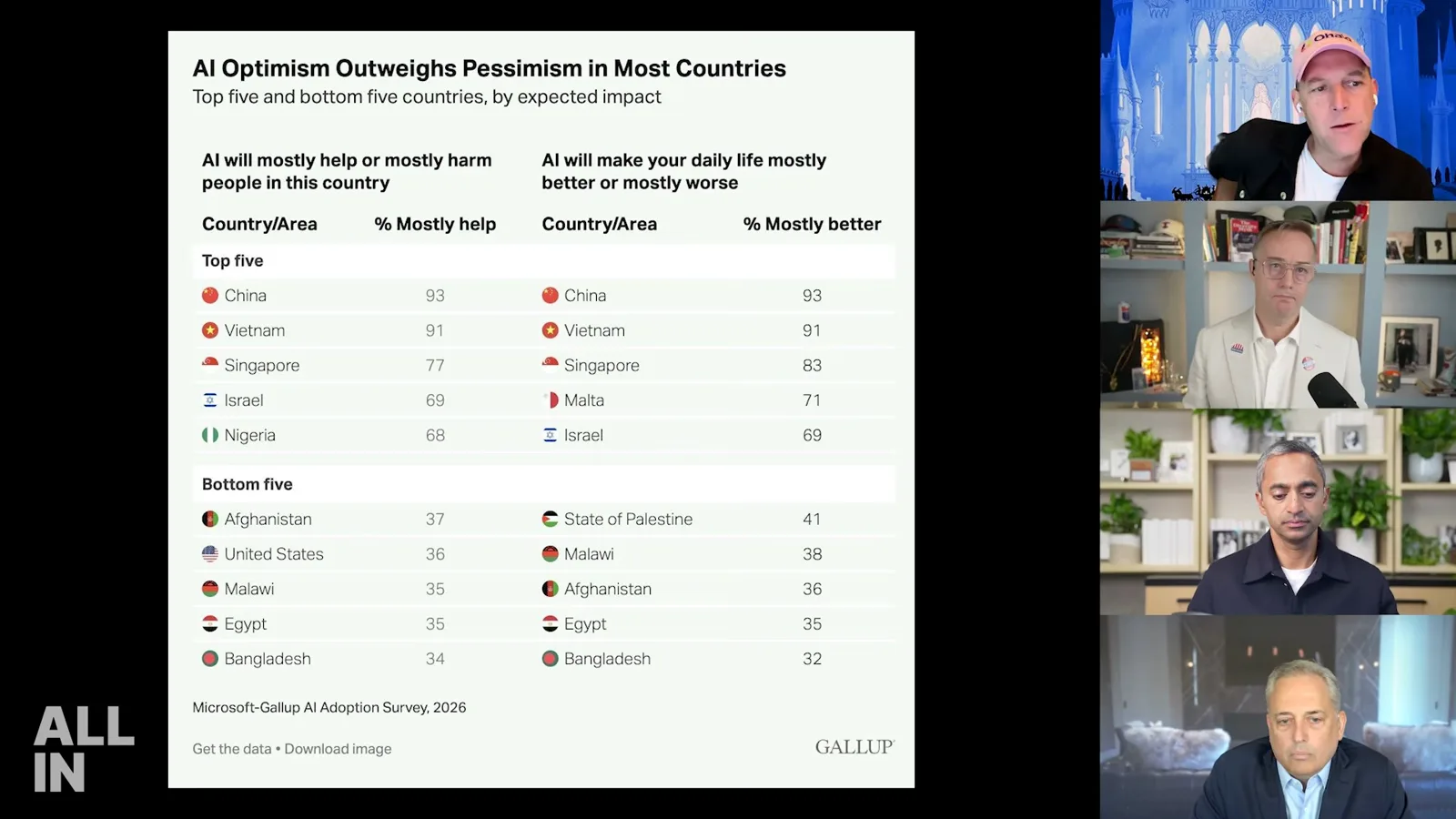
Palihapitiya says he got the election wrong and recognizes that his own experience as an asset owner shaped his perspective. He argues that a broad group of voters has moved between parties because its economic circumstances feel broken.
He contrasts investors who benefited in different interest-rate environments with wage earners facing higher living costs. In his view, the result reflected dissatisfaction with the economy more than a move toward a particular ideology or a single issue.
He points to spending and redistricting outcomes as evidence for his interpretation, arguing that candidates emphasizing affordability connected with voters across party lines. He now favors an economic-populist agenda and says he has revised his assumption that gains to asset owners would reach everyone.
His proposed changes include addressing tax loopholes, student debt and taxes for lower-earning households. He predicts that voters will continue to swing against incumbents if they do not see economic improvement.
Calacanis plays an earlier clip in which he predicted Democratic gains, citing prices and the war. Sacks responds that the war and the inflation associated with it were decisive, and argues that ending the conflict could relieve fuel costs.
Calacanis disagrees that the decline began with the war. He points to the administration’s tariff rollout, immigration enforcement and other controversies as earlier sources of dissatisfaction, and describes the president’s execution as chaotic.
Calacanis also returns to what he calls a divided economy: people without substantial assets may not feel included in growth. He argues that the administration did not persuade those voters that it was working on their concerns.
What Trump could do next
Sacks urges an end to the war; the others debate structural affordability and possible policy bargains. Their proposed remedies differ substantially.
Asked what could change the president’s trajectory, Sacks shows charts comparing approval, gasoline prices and political expectations. He argues that the war was the central turning point and says ending it would be his first priority.
He cites a voter survey on the importance of the Iran war and predicts that ending the conflict would reduce oil and fuel prices. These are his interpretation and forecast; Palihapitiya challenges the idea that the issue can be reduced to the war alone.
Palihapitiya says fuel prices are one visible expression of a broader economic problem. The hosts discuss Texas governor-elect Gina Hinojosa’s emphasis on utility costs and community concerns about data centers.
Friedberg agrees that voters may view both the war and data-center controversy through their own economic circumstances. He worries that a divided government will struggle to resolve budget and spending issues over the next two years.
Friedberg then outlines a concern that governments may seek greater control over AI through regulation of computing infrastructure. He presents a hypothetical in which widely distributed AI tools shift power away from centralized authorities.
Calacanis instead suggests that some data-center demands are bargaining over local benefits. He proposes a political deal involving healthcare, housing, minimum wages and taxes, and controversially suggests broad pardons before negotiations.
Palihapitiya argues that future political coalitions will have to address economic fairness. He also defends parts of Trump’s immigration and industrial agenda and suggests trading policy priorities to reach an agreement.
Sacks points to past presidents who recovered after midterm defeats and contrasts them with the Iraq-war-era Republican losses. His conclusion is that the administration should change course on Iran rather than escalate.
The AI selloff and a possible data-center slowdown
The panel discusses the market reaction and local resistance to new infrastructure. Palihapitiya argues that scarce capacity could strengthen existing owners relative to renters.
The discussion turns to an AI-related market selloff. Calacanis cites a loss of roughly $4 trillion in market value, notes that the market subsequently rebounded somewhat, and asks what uncertainty about data-center projects means for companies and investors.
He notes speculation about the prospective valuations of Anthropic and other AI companies, then asks whether incoming governors will slow data-center projects or bargain for better terms for their communities.
Palihapitiya describes a contested SpaceX presentation in Arizona and says the opposition reflects both economic frustration and concerns about the terms offered to local communities. He questions whether the largest companies need tax incentives for investments that could generate substantial returns.
His forecast is that slower construction would benefit large infrastructure owners with existing power and capacity while putting pressure on smaller cloud providers and model developers that rent compute. He names Amazon, Meta, Microsoft, Google and SpaceX in his discussion.
He describes a choice for infrastructure owners: continue renting capacity, or reserve more of it for their own products. In his view, a constrained supply could increase costs for leading model developers and give competitors more time to catch up.
Palihapitiya speculates that a reported termination option in a SpaceX–Anthropic compute arrangement could allow repricing if capacity becomes much scarcer. He presents this as a scenario, not as an announcement that either company will terminate the agreement.
Calacanis argues that if construction becomes difficult in the United States, companies could build abroad, shifting investment and jobs elsewhere. Friedberg raises a more expansive concern that policymakers could seek to restrict AI development or use itself.
Regulation, compute and competing forecasts
The hosts disagree about whether federal AI regulation could concentrate government power and how much the physical supply of computing will matter. Sacks separates federal rules from state and local permitting.
Friedberg argues that restrictions on software and computing could concentrate power in the state. Calacanis regards the most extreme version as unlikely, while Friedberg says he is warning about a gradual change in the balance between government and citizens.
Sacks predicts a major push for federal AI legislation and expresses concern about surveillance and censorship. Palihapitiya disagrees that government control is the central outcome, emphasizing instead the leverage of companies that already control power and data centers.
The panel disputes whether regulation would primarily favor model developers or large infrastructure owners. Palihapitiya argues that compute renters remain exposed if the supply of power and data centers becomes constrained.
Calacanis gives his own firm as an example of growing AI use. He estimates its spending and productivity gains and predicts that organizations will increasingly use local models as well as remote services; he presents these as his own estimates and forecasts.
Sacks separates federal questions about AI rules from state and local decisions on infrastructure. He worries that a pause on new permits could leave some partially built projects waiting for approvals, while acknowledging that the details of future policy are not yet settled.
His base case is that fully permitted projects can proceed in 2027, but that the pipeline for later projects could narrow. Calacanis and Palihapitiya argue that governments and companies may instead negotiate over local benefits, or companies may choose other locations.
Calacanis says he has been buying shares of SpaceX and Tesla. Palihapitiya revisits his hypothetical about repricing scarce compute, while Calacanis argues that longer-term commercial relationships may affect the outcome as well as spot prices.
Sacks says large infrastructure investments need predictable conditions and forecasts a materially smaller project pipeline by 2028. The panel’s assessments remain predictions about permitting and capital spending, not settled outcomes.
A claimed breakthrough in computational complexity
Friedberg explains an OpenAI preprint claiming a faster approach to a class of problems. He notes that outside researchers are still evaluating the work.
In the science segment, Friedberg introduces an OpenAI preprint that claims to refute the exponential time hypothesis. He explains the distinction between solving a problem and checking a proposed solution, and describes the paper’s claim of a subexponential algorithm for a satisfiability problem.
Friedberg emphasizes the novelty and potential significance of the result, but also says outside researchers are still evaluating the lengthy paper. A claimed subexponential algorithm does not by itself establish that P equals NP or that every problem is computable.
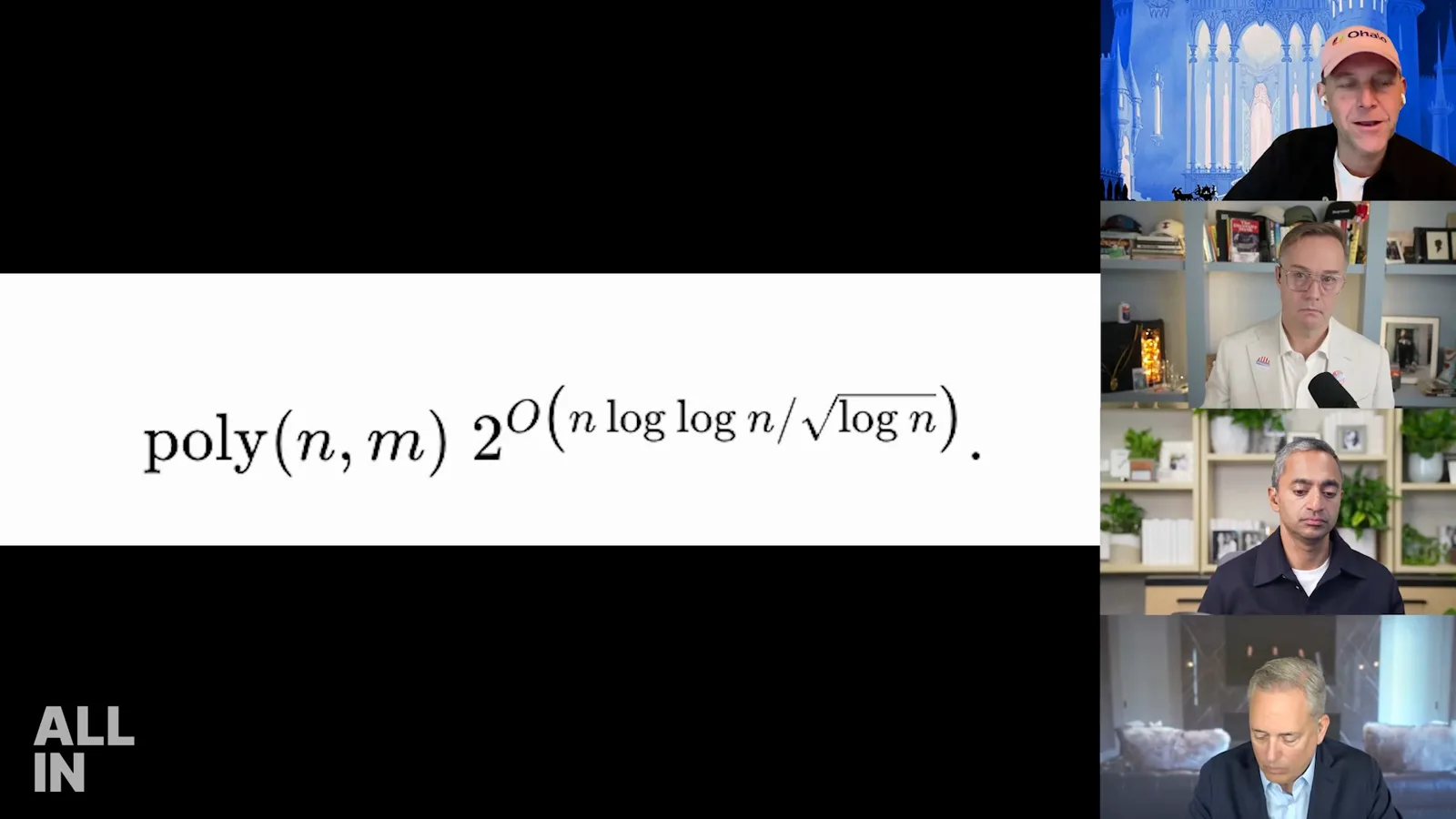
The hosts discuss what progress in mathematics might mean for AI’s benefits and for competition between countries. Sacks argues that the technology has significant potential benefits while acknowledging uncertainty about its future effects.
同じチャンネルの記事
 1:25:46EN
 All-In Podcast· 2026年10月30日ポッドキャスト · 4 人All-In on Anthropic’s IPO, AI Infrastructure and the Midterm Electionsホスト Jason Calacanis, Chamath Palihapitiya, David Sacks, David FriedbergThe hosts analyze Anthropic’s filing, debate the costs of an AI infrastructure boom, discuss Alphabet and offer competing midterm forecasts.
 55:39ENAll-In Podcast· 2026年10月29日ポッドキャスト · 2 人Will Ahmed on WHOOP’s Subscription Model, Health Data and Wearable Strategyゲスト Will Ahmed · ホスト Jason CalacanisThe WHOOP CEO discusses the company’s business model, physiological data, AI features and its account of interactions with the FDA.
 1:43:22ENAll-In Podcast· 2026年10月23日ポッドキャスト · 4 人AI Security, Investment and the Debate Over France’s Futureゲスト Nikesh Arora · ホスト Jason Calacanis, Chamath Palihapitiya, David FriedbergThe All-In hosts and Nikesh Arora discuss cybersecurity and AI spending, then debate France’s unrest, public services and US policy.
 40:00ENAll-In Podcast· 2026年10月21日ポッドキャスト · 3 人Arvind Krishna and Nikesh Arora on Quantum Risk, AI Models and Software Consolidationゲスト Arvind Krishna, Nikesh AroraThe executives discuss post-quantum preparation, the economics of open-weight models and the changing shape of enterprise cybersecurity.
 40:33ENAll-In Podcast· 2026年10月19日ポッドキャスト · 2 人Dylan Field on Figma, AI and Why Design Still Mattersゲスト Dylan FieldThe Figma CEO discusses the failed Adobe acquisition, competition from AI model providers and the role of human intention in creative work.
 1:34:06ENAll-In Podcast· 2026年10月17日ポッドキャスト · 4 人AI Infrastructure Debt, Anthropic’s IPO and a Debate Over Safetyゲスト Ben Horowitz · ホスト Jason Calacanis, Chamath Palihapitiya, David SacksThe All-In panel and Ben Horowitz assess a selloff in AI infrastructure, software economics and disputed claims about model safety.