30 秒でわかる
Matthew Berman used Fable 5.2 to build game levels, a spreadsheet, a video editor and visual simulations. His most ambitious examples ran for days and consumed billions of tokens: he estimates about $15,000 for one game-level run and $11,700 for the spreadsheet. Smaller visual projects cost less in his estimates. He reports strong autonomous code review, but says Opus 5.5 remains faster and cheaper in his use.
- 1One game level consumed billions of tokensBerman reports 8–12 billion tokens and about $15,000 in estimated API costs for a still-running job.
- 2A spreadsheet demo took almost 50 hoursHe shows formulas and a pivot table and estimates $11,700 at API rates.
- 3The multiplayer obstacle game cost an estimated $13,000He reports more than nine billion tokens and 71 hours for the build.
- 4A shorter explainer used fewer resourcesThe decompilation animation took an estimated 45 minutes and $25.
- 5Autonomous reviews finished faster in his testsBerman distinguishes observed task completion time from token throughput and cautions that Ultra Code is expensive.
ポイント
- Include token consumption and elapsed time when assessing ambitious agent-built software.
- Try a small visual task before committing to a multi-day run.
- Treat demonstrations of features as examples rather than proof of complete product parity.
- Choose effort and subagent settings with their cost in mind.
チャプターごとに整えた全文を読む
Build games, a spreadsheet and a video editor
Berman demonstrates several large builds and reports their estimated cost.
I used Fable 5.2 to build a playable level inspired by Gears of War. The demo has cover, lighting, textures and a timed reload. The animation reaching over a barrier looks awkward, but I found the level fun to play.

My prompt requested one complete-looking Unreal Engine level. I ran Ultra Code and let it continue for days. I report 8–12 billion tokens so far and estimate about $15,000 at API prices; the run was still going when I recorded.
The next demonstration is a browser spreadsheet resembling Excel. I show formulas, a sales-tracker example and a pivot table. I say it took almost 50 hours and that I could not find a missing feature in my testing.
The spreadsheet run used about eight billion cached-input tokens and 15 million output tokens, with an estimated API cost of $11,700. I also show Kestrel, a locally running Windows video editor resembling DaVinci Resolve.
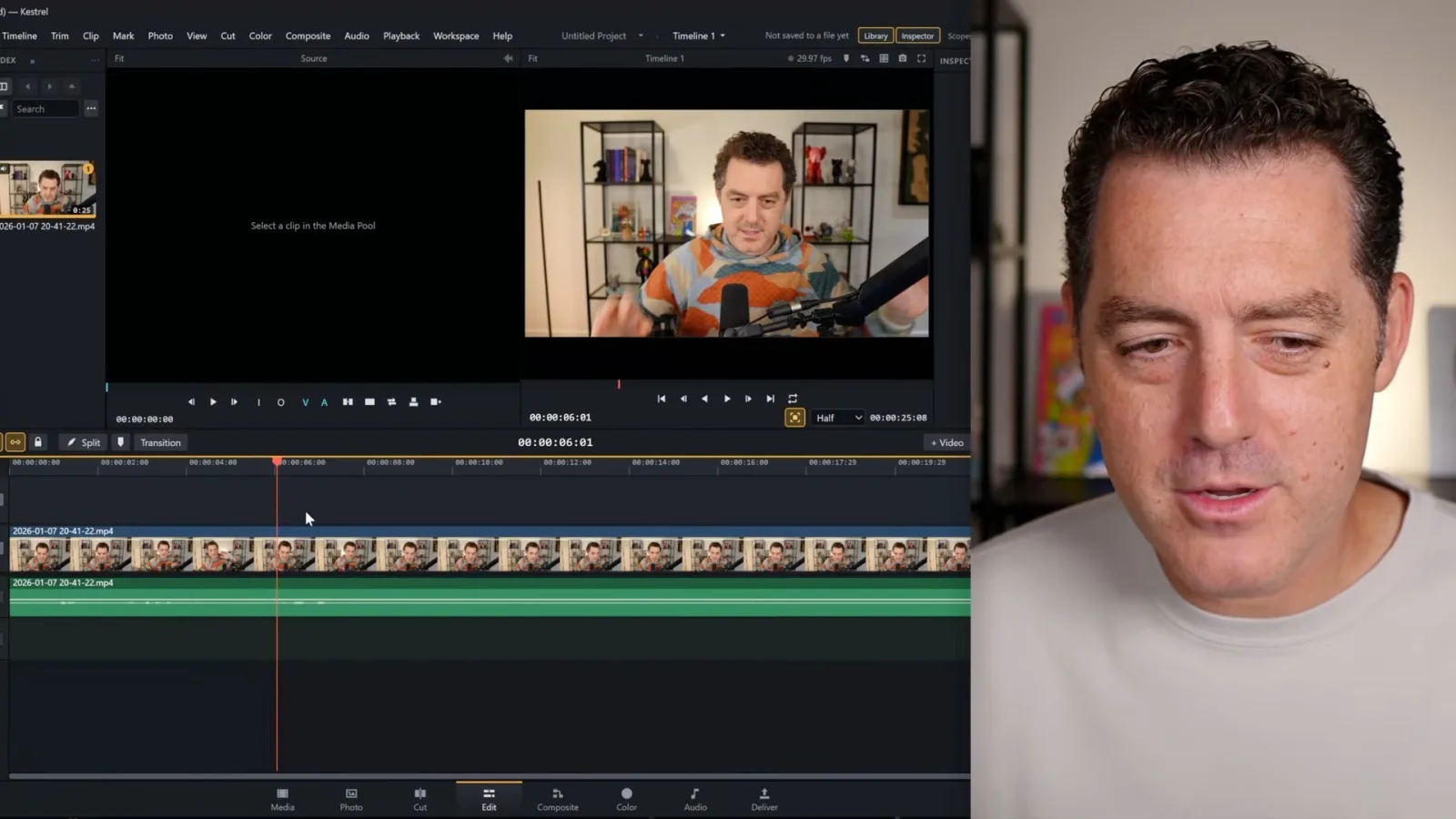
In Kestrel I import video, split and move clips, snap them together, and demonstrate zooms and keyframes. My teammate Alex independently made a video editor and has used his version for editing.
Tumble Beans is a multiplayer obstacle game inspired by Fall Guys. My teammates Alex and Brian join me to play through a level. I particularly like the movement and collision physics, though we encounter unexpected bounces during the race.
The prompt asked for ten varied, challenging levels and multiplayer. I report over nine billion tokens, 71 hours and an estimated $13,000. I think this kind of workflow could let a person turn a game idea into something playable and potentially sellable.
Simulations, physical objects and motion graphics
Smaller projects range from a balloon visualization to a printed tower and explainer animations.
Another project visualizes a projectile passing through a water balloon. The browser demo lets me pause, change the camera and adjust speed, size, lighting and gravity. I asked for a single file with WebGL2 and no external libraries.
For that simulation I report 41 million tokens, around two and a half hours and an estimated $91. I also asked for a printable tower weighing under ten grams and fitting a Bambu Lab P2S printer; the design used about ten million tokens and an estimated $37.
I stack a laptop, tablet, computers and other devices on the printed tower, then add a drill and the stack falls. The demonstration gives a practical stress test, though I do not provide a measured failure load.
A motion-graphics explainer on software decompilation runs for about one minute and 52 seconds. I say the run used 9.5 million tokens, took 45 minutes and cost an estimated $25. A second animation explains language-model concepts including embeddings, training and next-token prediction.
Generate buildings, cities and more games
The demos include both a flawed event recreation and a large Tokyo scene.
I asked the model to design a house in Blender. Its scene has a pool, solar panels, garage and interior; one visible mistake is a tree in the driveway. I report 13 million tokens and an estimated $30 for the render.

A recreation of a Roadster event from images and video disappointed me. A separate old European town includes people, animals and futuristic cars; I show characters conversing, but also a person walking through others.
A Tokyo scene in Unreal Engine took 6.72 billion tokens and about 70 hours, with an estimated $11,000 API cost. I show traffic, people, trains, reflections and a large city view.
My colleagues also built several games, including a multiplayer block-style shooter, a mobile Portal-like game, a futuristic racer and a crab game. These are brief demonstrations of projects made during early access.
Benchmark results and the cost of autonomous work
Berman compares benchmark scores and describes speed, model pricing and effort settings.
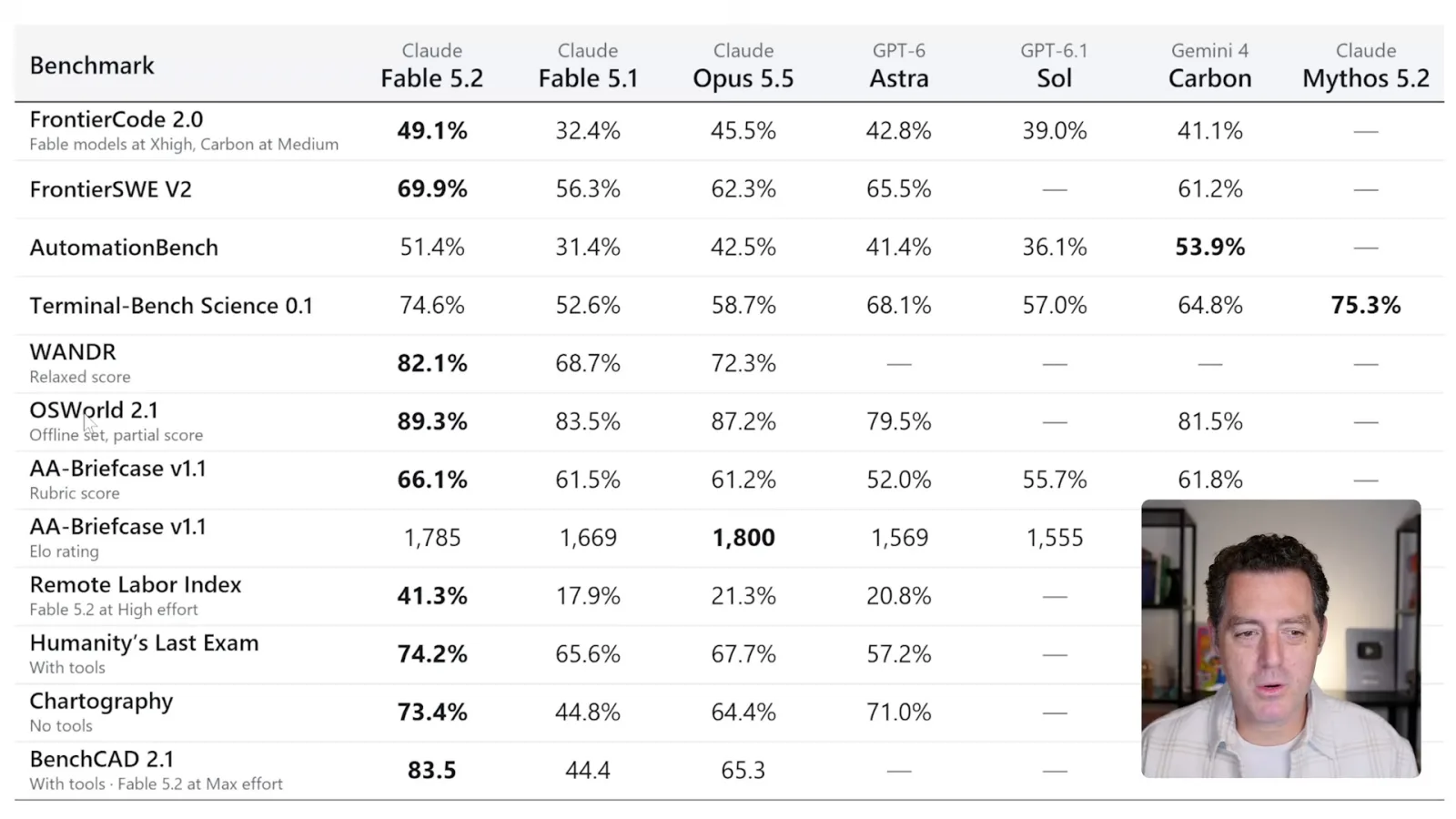
I show a benchmark table reporting Fable 5.2 at 69.9% on FrontierSWE V2 and 89.3% on the offline partial OSWorld 2.1 set. The same table shows Gemini 4 Carbon ahead on AutomationBench and Mythos 5.2 slightly ahead on Terminal-Bench Science.
In my own tests the model was highly autonomous and usually made decisions I agreed with. I also used maximum effort and Ultra Code to review existing codebases, where it found bugs, security issues and interface inconsistencies.
I found some reviews finished in about ten minutes where I expected 60–120 minutes. That is my observation of time to finish a task, not a measurement of tokens per second. Ultra Code fans work out to subagents and is very expensive, so I do not generally recommend using it indiscriminately.
I prefer Fable’s capabilities, but Opus 5.5 is faster, more efficient and less expensive in my experience. I quote Fable 5.2 pricing of $8 per million input tokens and $40 per million output tokens; the faster mode is $16 and $80 respectively. I had not tried fast mode.
I also mention subscription-dependent resets and speculate about how internal model development might proceed. The main practical tradeoff in the examples is the scale of the output against long runs and substantial estimated API costs.
同じチャンネルの記事
 20:08EN
 Matthew Berman· 2026年11月7日METR Finds Faster AI Research at Anthropic, With Major UncertaintyMatthew Berman · Forward FutureMatthew Berman examines an independent assessment of AI-assisted R&D and the limits on its access to evidence.
 19:53ENMatthew Berman· 2026年11月5日AI News: Kimi K3.1 Weights, Computer Use and Specialized Open ModelsMatthew Berman · Forward FutureMatthew Berman reviews a week of model releases, from desktop agents and scientific workflows to image, video and speech tools.
 26:47ENMatthew Berman· 2026年11月4日What Weight-Space Programming Experiments Show—and Their LimitsMatthew Berman · Forward FutureMatthew Berman reviews experiments in which a frontier model reads, repairs and writes other networks’ weights, from small game policies to a targeted language-model edit.
 12:58ENMatthew Berman· 2026年11月3日Matthew Berman on Building Personal Software With AIMatthew Berman · Forward FutureA homemade PDF reader leads Berman to argue that coding agents could make customized consumer software more accessible.
 14:45ENMatthew Berman· 2026年10月29日Matthew Berman Examines Google’s Gemini 4 Carbon AnnouncementMatthew Berman · Forward FutureMatthew Berman reviews Google’s reported benchmark results, staged rollout and pricing for Gemini 4 Carbon, while noting he has not yet used the model.
 21:11ENMatthew Berman· 2026年10月28日Matthew Berman tests DeepSeek V4.1 Flash: coding, vision and local appsMatthew Berman · Forward FutureA hands-on tour of visual coding, image reasoning, local applications and provider economics reveals both impressive results and visible flaws.