En 30 secondes
Tesla’s 2014 Model S update added a motor at each axle, which Elon Musk said could improve traction and efficiency by shifting power between them. He put the performance P85D’s 0–60 mph time at 3.2 seconds. Musk also said new cars already carried Autopilot hardware and described planned features from highway lane keeping to self-parking and summoning; some were presented as future capabilities rather than demonstrations.
- 1Two motors let the car adjust front and rear power rapidlyMusk said independent control could improve road holding and keep the motors closer to efficient operating points.
- 2The P85D added a front motor to the larger rear motorTesla’s performance target was a 3.2-second 0–60 mph run, with an “insane” driving setting.
- 3Musk said new cars already carried Autopilot hardwareHe described four inputs: forward radar, a camera, surrounding ultrasonic sensors, and navigation and traffic data.
- 4Parking, summoning and a self-plugging charger were part of his visionMusk described garage parking and summoning on private property; the articulated charging connector was an idea he wanted engineers to pursue.
- 5Digital steering and brakes were intended to respond quicklyMusk said rapid, precise control was important alongside sensors, and showed an instrument display for nearby vehicles and warnings.
À retenir
- Musk said two independently controlled motors could distribute power between the axles within milliseconds.
- Tesla claimed a 3.2-second 0–60 mph time for the P85D.
- The 2014 Autopilot design combined radar, camera, ultrasonic sensors and navigation data.
- Musk described automatic parking, summoning and a self-connecting charger as future possibilities.
Lire le texte remanié, chapitre par chapitre
A motor at each axle
Tesla showed the dual-motor Model S chassis. Musk said software could move power rapidly between axles to help traction and efficiency.
Elon Musk welcomed the audience to Tesla’s 2014 announcement and addressed speculation about the letter D. It stood for dual motor: the Model S would have a motor at the front and another at the rear. Tesla showed a diagram and brought out a chassis to illustrate the drivetrain.
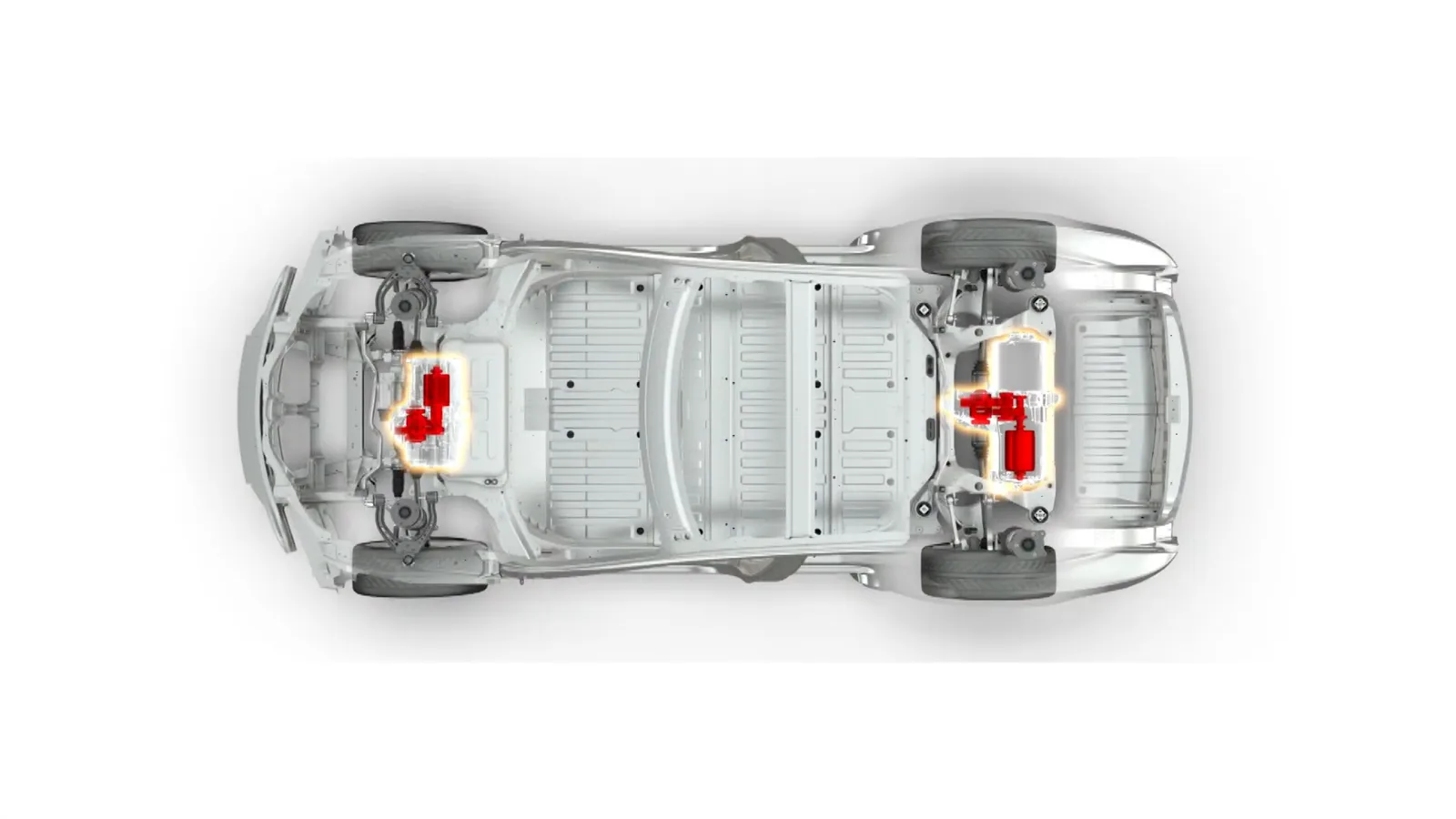
Musk said the motors could shift power between front and rear at millisecond speed. He contrasted electronic control with a mechanically linked all-wheel-drive system and argued that the faster adjustment could improve road holding.
He said the two-motor arrangement could also improve range and efficiency despite the extra motor’s weight. His explanation was that power could be shared so the motors operated closer to their efficient points. Traction would take priority, then efficiency; pressing the accelerator hard would call for maximum power.
P85D acceleration and software updates
The performance version paired a large rear motor with a front motor and a claimed 3.2-second 0–60 mph time. Musk expected software updates to refine its handling.
For the performance P85D, Tesla retained a larger rear motor and added a medium-sized motor at the front. Musk said this gave it roughly half again as much power as the P85. He described the acceleration as like a personal roller coaster and said Tesla had targeted the acceleration of the McLaren F1.
Musk announced a 3.2-second 0–60 mph time and said the car’s settings would include Normal, Sport and Insane. He praised the engineering work and said Tesla intended to keep refining torque distribution and road holding with software and firmware updates.
Four inputs for Autopilot
Musk described radar, camera, ultrasonic sensors and navigation data as the basis for driver assistance. He outlined lane keeping, cruise control and emergency braking.
Turning to Autopilot, Musk said Tesla had brought the hardware into production sooner than expected: cars made during the previous two weeks already had it, and every car leaving the factory now included it. He described the system as a combination of four inputs.
The first was forward-looking radar, which Musk said could detect vehicles at a distance and operate through fog, snow and sand. A camera with image recognition would read signs, distinguish pedestrians and traffic lights, and provide another source of information alongside radar.
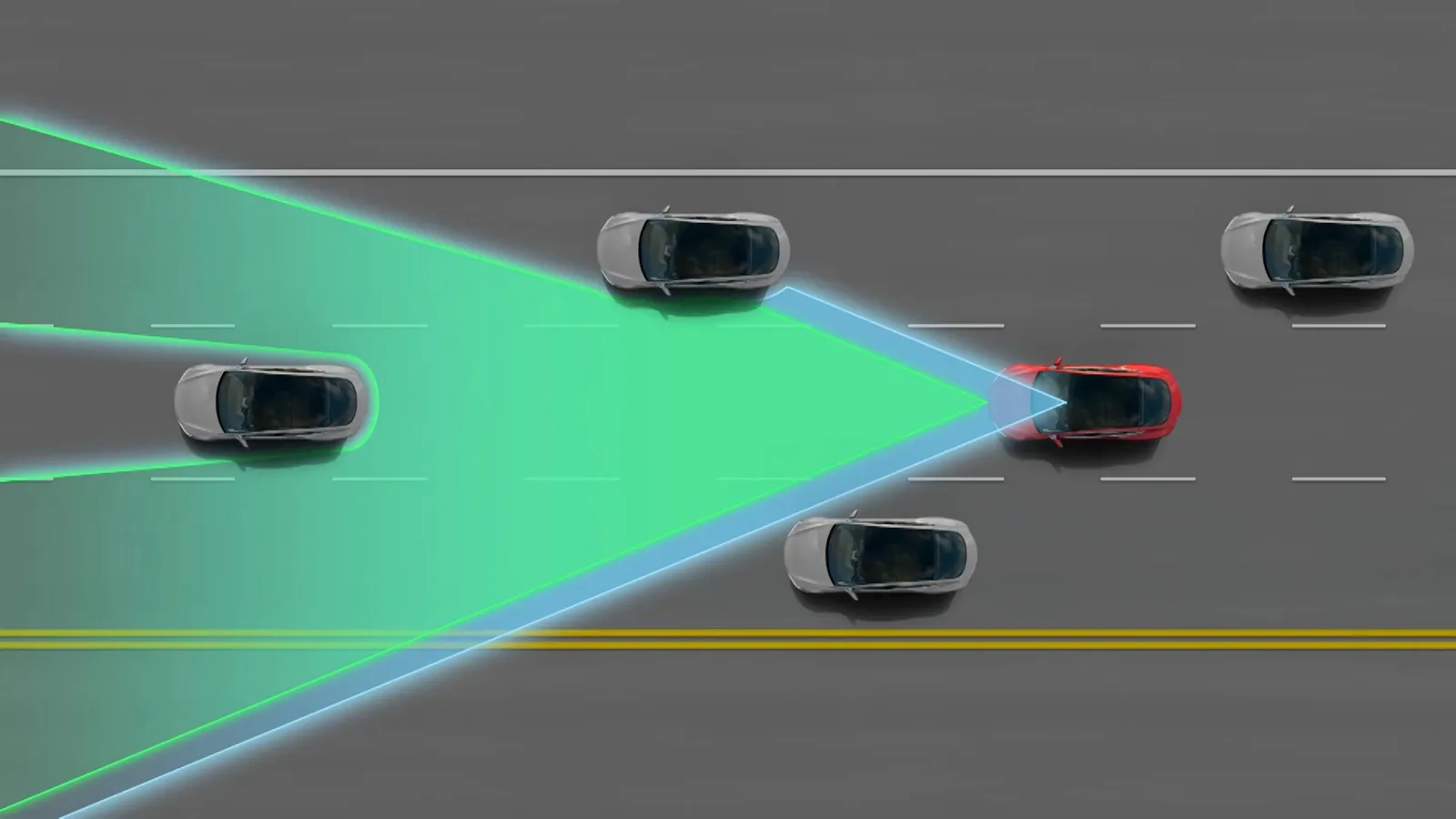
The third component was a ring of ultrasonic sensors around the car. Musk said they could detect nearby vehicles, barriers and even small or soft objects, and operate across the car’s speed range. The fourth combined navigation, GPS and real-time traffic information.
Musk said the combined system would support highway lane keeping, automatic cruise control and emergency braking. He also described automatic parallel parking and a car parking itself in a garage after the occupant stepped out.
A vision for parking and summoning
Musk described a car parking itself and being summoned on private property. He also floated an articulated charging connector and calendar-based preparation.
He floated an additional idea: a flexible, snake-like charging connector that could plug itself in after the car parked. Musk noted that some Tesla engineers might be hearing the idea for the first time and said he thought the company would probably try something like it.
Musk described summoning a car on private property, with ultrasonic sensors helping it move slowly toward its owner. He went further, imagining a car using a calendar to know when to emerge, prepare the air conditioning and music, and be ready for a trip.
Digital controls and the instrument display
Musk highlighted electric steering, brakes and motor control. He showed a dashboard concept displaying nearby vehicles and warning of potential hazards.
Sensors alone were not enough, Musk said: the car also needed precise, low-latency control. He pointed to the electric motors, an electromechanical braking system and electric power steering as the means to make the car respond quickly and smoothly.
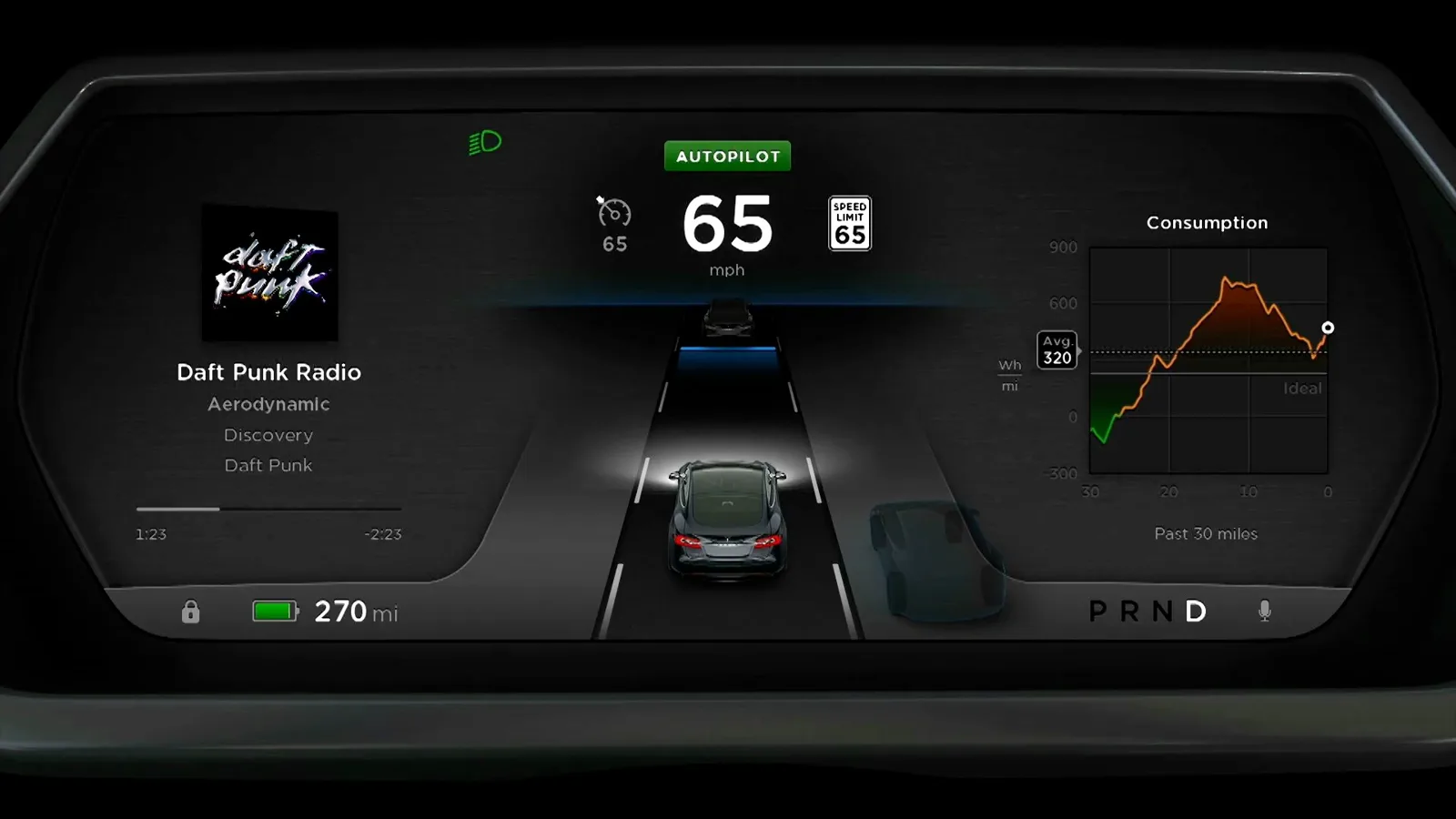
Musk showed an instrument-panel interface that would display nearby vehicles and obstacles. He described adjustable Autopilot sensitivity, a visual warning followed by an audible one for a possible collision, and steering resistance that a driver could override if the system detected a potential hazard.
To close, Musk invited the audience to take test rides in the cars. He said the rides would have several people aboard and suggested the car would feel faster with only one occupant.
Sur la même chaîne
 24:44EN
 Tesla· 6 nov. 2026Elon Musk Unveils the Cybertruck: Steel Body, Cracked Glass and a New Pickup DesignElon Musk · TeslaAt Tesla’s 2019 event, Musk introduced the electric pickup and demonstrated its body, glass, suspension and cargo bed.
 59:56ENTesla· 21 oct. 2026Tesla Q3 2026: Cash Flow, FSD Demand and the Cost of Scaling RobotsElon Musk, Vaibhav Taneja, Travis Axelrod · TeslaExecutives discuss quarterly margins, capital spending and plans for Cybercab, Optimus and chip production.
 23:21ENTesla· 16 oct. 2026Tesla’s Roadster Event: A Ramp Stunt, Aerodynamics and a 2028 Production TargetElon Musk, Franz von Holzhausen, Lars Moravy · TeslaElon Musk, Franz von Holzhausen and Lars Moravy demonstrate a prototype developed with SpaceX engineering.
 1:09:55ENTesla· 22 juil. 2026Tesla’s Q2: Margins Narrow as Spending on Robots and AI RisesTravis Axelrod, Elon Musk, Vaibhav Taneja, Ashok Elluswamy, Lars Moravy · TeslaTesla reported higher energy deployment and negative free cash flow while executives outlined Robotaxi and Optimus plans.
 27:27ENTesla· 21 mai 2026Tesla’s Final Model S and X Deliveries: How the Cars EvolvedElon Musk, Franz von Holzhausen, Lars Moravy · TeslaElon Musk and Tesla’s team recall a tent-based design studio, years of changes, and plans for the former production line.
 1:05:20ENTesla· 22 avr. 2026Tesla Plans a $25 Billion Investment Year as It Prepares OptimusTravis Axelrod, Elon Musk, Vaibhav Taneja, Lars Moravy · TeslaOn Tesla’s Q1 2026 call, executives detail one-time margin gains, battery constraints and plans for robots and driving software.