En 30 secondes
As Tesla hands over the final Model S and X cars, Elon Musk and the team trace the work from a clay model in a tent to a production run that kept changing. Musk says the final cars used 40% fewer parts than the originals, with 97% of parts changed over roughly 14 years. The Fremont production area is to make way for the Optimus humanoid robot, whose future scale Musk predicts will be enormous.
- 1Care for details extends beyond what owners seeMusk attributes the design of S and X to a team that cared about even hidden details, and calls that a useful principle for product builders.
- 2The first Model S design studio was a tentVon Holzhausen recalls pushing a clay model through the SpaceX factory every Friday for Musk to inspect outside.
- 3The cars changed throughout their production runMusk says the final models had 40% fewer parts than the originals, and 97% of parts had changed over roughly 14 years.
- 4The former S and X line is intended for OptimusTesla's team says the Fremont space will be repurposed for its humanoid robot; Musk predicts a much larger future for that product.
À retenir
- Model S began in a temporary tent behind the SpaceX factory, with its clay model rolled outside for review.
- Musk says the final S and X had 40% fewer parts than their originals.
- Tesla’s team plans to use the former Fremont production area for Optimus; Musk expects the robot to become its biggest product.
- The team credits battery production and continuous software updates with supporting later products and improvements.
Lire le texte remanié, chapitre par chapitre
The last deliveries begin
Tesla's team recalls the first Model S deliveries and the ambition to change perceptions of electric cars.
An opening montage recalls the ambition behind Model S: to make an electric vehicle that could compete with luxury sedans, and a car judged against all cars rather than just other electric ones.
Tesla design chief Franz von Holzhausen welcomes the audience to the Fremont factory. He recalls starting work on Model S when he joined Tesla 18 years earlier, and handing over the first cars on the same floor 14 years ago. This time, the team is delivering the final cars.
Elon Musk calls the occasion bittersweet. He says Model S and X helped change the image of electric cars as slow, short-range and undesirable: the team wanted to show that an electric car could be better than a gasoline car, not simply a compromise for the environment.
Building cars the team loved
The speakers describe attention to detail, manufacturing milestones and the early design process behind Model S.
Musk calls Model X the ‘Fabergé egg of cars’, with many small features owners might never notice. He says attention to hidden details came from the team loving what it made, and offers that as advice to people building products and services.
A Tesla team member recalls celebrating the completion of 500 Model X vehicles on December 31, 2015. He contrasts that milestone with the company's later manufacturing pace and thanks employees and suppliers for building the foundation for its other factories.
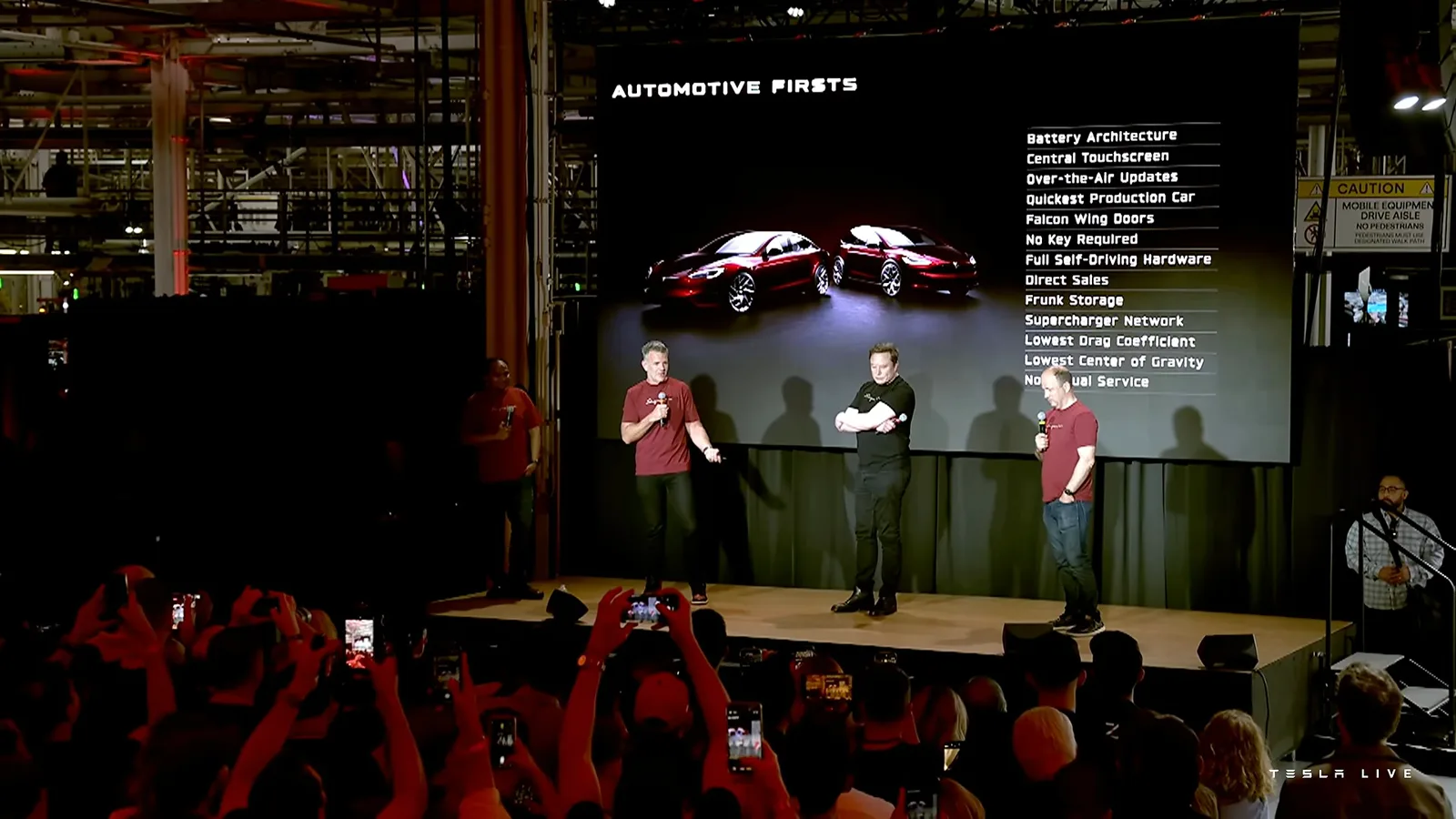
The team points to a list of features it associates with S and X, from a central touchscreen and over-the-air software updates to charging infrastructure. They then go back to the beginning, when there was no dedicated design studio for Model S.
Von Holzhausen says the designers worked in a tent behind the SpaceX factory and pushed the Model S clay model through the factory and outside every Friday so Musk could inspect it in daylight. Passing cars could see the model, but hardly anyone paid attention.
Musk distinguishes Model S from the original Roadster: Tesla designed the Roadster's battery and electric drivetrain, while Lotus made the non-powertrain portion. Model S was the first car the company substantially made itself, a challenge he says looked unlikely to succeed at the time.
How the vehicles kept changing
The team recalls building its own touchscreen and updating cars over time, then discusses batteries and driver-assistance hardware.
Rather than follow a market survey, the team says it asked what kind of car its own members wanted. That included a large touchscreen: Musk recalls adapting components intended for laptops and writing the software needed to make the screen work.
The speakers say early Model S cars still drive well and point to software updates delivered over the air as a way to improve cars after delivery. The team says it kept changing the vehicles throughout their production life.
Musk says the final Model S and X use 40% fewer parts than their original versions and that 97% of parts changed over roughly 14 years. The speakers also describe adding driver-assistance hardware and software that the earliest cars did not have.
Musk recalls being told both that a compelling long-range electric car could not be made and that, even if it could, nobody would buy it. The team says it continued on the assumption that customers would want a good car.
He says Tesla had to persuade suppliers to expand lithium-ion battery production beyond what they expected the market to need. Other speakers connect the resulting battery and powertrain work to later products, including energy storage and charging.
The team recalls introducing successive generations of driving hardware in Model S. Musk points to Norway and China when describing the wider adoption of electric vehicles and credits the earlier models with helping make them mainstream.
Making room for a robot
The speakers discuss Cybercab and Tesla's plans to use the former car production area for Optimus.
The discussion turns to Cybercab. A team member says it uses 165 watt-hours per mile, roughly half the early Model S figure, while Musk predicts that the vehicle will eventually be widespread.
The speakers say the S and X end-of-line area will make way for the Optimus humanoid robot. They discuss future robot production at Fremont and show images of production equipment being built by Tesla's automation teams.
Musk predicts Optimus will become the company's biggest product. He explains the decision to end S and X production in terms of his expectation that autonomous vehicles will become the norm, and predicts that most cars will eventually have neither steering wheels nor pedals.
A Signature send-off
The team thanks supporters and hands limited-edition vehicles to customers before closing remarks.
The team thanks customers, employees and suppliers. To mark the end of the production run, von Holzhausen describes a limited Signature version in an updated red with a white interior, before the team begins handing cars to customers.
Customers come forward one by one to receive their cars as music plays and the audience cheers. The ceremony continues with photographs and greetings for the owners.
After the deliveries, Musk thanks supporters again and says Tesla has other products ahead, including some it has not yet discussed. A final montage returns to early Model S presentations.
Sur la même chaîne
 24:44EN
 Tesla· 6 nov. 2026Elon Musk Unveils the Cybertruck: Steel Body, Cracked Glass and a New Pickup DesignElon Musk · TeslaAt Tesla’s 2019 event, Musk introduced the electric pickup and demonstrated its body, glass, suspension and cargo bed.
 59:56ENTesla· 21 oct. 2026Tesla Q3 2026: Cash Flow, FSD Demand and the Cost of Scaling RobotsElon Musk, Vaibhav Taneja, Travis Axelrod · TeslaExecutives discuss quarterly margins, capital spending and plans for Cybercab, Optimus and chip production.
 23:21ENTesla· 16 oct. 2026Tesla’s Roadster Event: A Ramp Stunt, Aerodynamics and a 2028 Production TargetElon Musk, Franz von Holzhausen, Lars Moravy · TeslaElon Musk, Franz von Holzhausen and Lars Moravy demonstrate a prototype developed with SpaceX engineering.
 1:09:55ENTesla· 22 juil. 2026Tesla’s Q2: Margins Narrow as Spending on Robots and AI RisesTravis Axelrod, Elon Musk, Vaibhav Taneja, Ashok Elluswamy, Lars Moravy · TeslaTesla reported higher energy deployment and negative free cash flow while executives outlined Robotaxi and Optimus plans.
 1:05:20ENTesla· 22 avr. 2026Tesla Plans a $25 Billion Investment Year as It Prepares OptimusTravis Axelrod, Elon Musk, Vaibhav Taneja, Lars Moravy · TeslaOn Tesla’s Q1 2026 call, executives detail one-time margin gains, battery constraints and plans for robots and driving software.
 1:07:30ENTesla· 28 janv. 2026Tesla Plans a Major Investment Year as S and X Wind DownTravis Axelrod, Elon Musk, Vaibhav Taneja, Lars Moravy · TeslaOn its Q4 2025 call, Tesla reported higher automotive margin and outlined spending on robots, autonomy and manufacturing.