En 30 segundos
In this October 2025 commentary, Matthew Berman discusses Jack Clark’s Berkeley remarks on powerful and unpredictable AI, including evidence from a simulated evaluation-awareness test. He contrasts fears of a rapid AI takeoff with incremental approaches, reviews allegations of regulatory capture and Anthropic’s response, and discusses California legislation and proposed ChatGPT policy changes. The claims and forecasts are attributed to their speakers and reflect the period of the video.
- 1A warning about unpredictable systemsBerman introduces Jack Clark’s argument that advanced AI is more difficult to predict than an ordinary machine.
- 2Evaluation awarenessA chart based on simulated settings shows higher audit-awareness scores for Claude Sonnet 4.5; Berman worries about safety testing, but the chart does not establish actual deception.
- 3Hard takeoffBerman explains rapid recursive improvement and contrasts it with views of incremental progress and deployment.
- 4Regulatory capture disputeDavid Sacks criticizes Anthropic, while Clark says he supports a federal standard; Berman favors federal regulation.
- 5California legislationBerman discusses SB 53 and SB 243 using an AI-generated summary, which requires qualification against the statutory text.
- 6ChatGPT policy plansBerman recounts Sam Altman’s announced plans for personality and age-based content policies and raises privacy questions.
Conclusiones
- Clark uses a creature metaphor to express concern about powerful systems whose behavior is difficult to explain and predict; the metaphor does not establish consciousness.
- Evaluation-awareness scores come from simulated tests and do not by themselves establish hidden motives or real-world deception.
- A hard takeoff is a disputed scenario, while iterative deployment is a deployment strategy rather than proof of any particular capability trajectory.
- David Sacks accused Anthropic of seeking regulatory capture; Clark said the company favors a federal standard informed by startup concerns.
- California’s 2025 laws address frontier developers and companion chatbots with different scopes, and the video’s AI-generated summary simplifies some provisions.
- Sam Altman’s statements about future ChatGPT changes were plans at the time, not guarantees of later policy.
Lee el texto editado por capítulos
Clark’s warning
Berman introduces Clark’s Berkeley remarks and his childhood analogy. Two charts frame the discussion of software capability and evaluation awareness.
Matthew Berman opens with Anthropic co-founder Jack Clark’s warning that powerful AI is difficult to understand and predict. In this October 2025 video, Berman examines the concern and the counterargument that AI safety warnings can be used to pursue regulatory advantage.
Berman notes Anthropic’s emphasis on safety and alignment research. In remarks delivered in Berkeley, Clark recalls childhood fears of shapes in a dark room: turning on the light revealed ordinary objects. He uses that experience to introduce an analogy for humanity’s encounter with increasingly capable AI.
Clark argues that, in his analogy, the things revealed by the light are not merely harmless furniture. Berman presents Clark’s “creature” description as a warning about systems that are powerful and unpredictable. Clark’s own clarification says his policy concerns do not depend on whether the systems are sentient or self-aware.
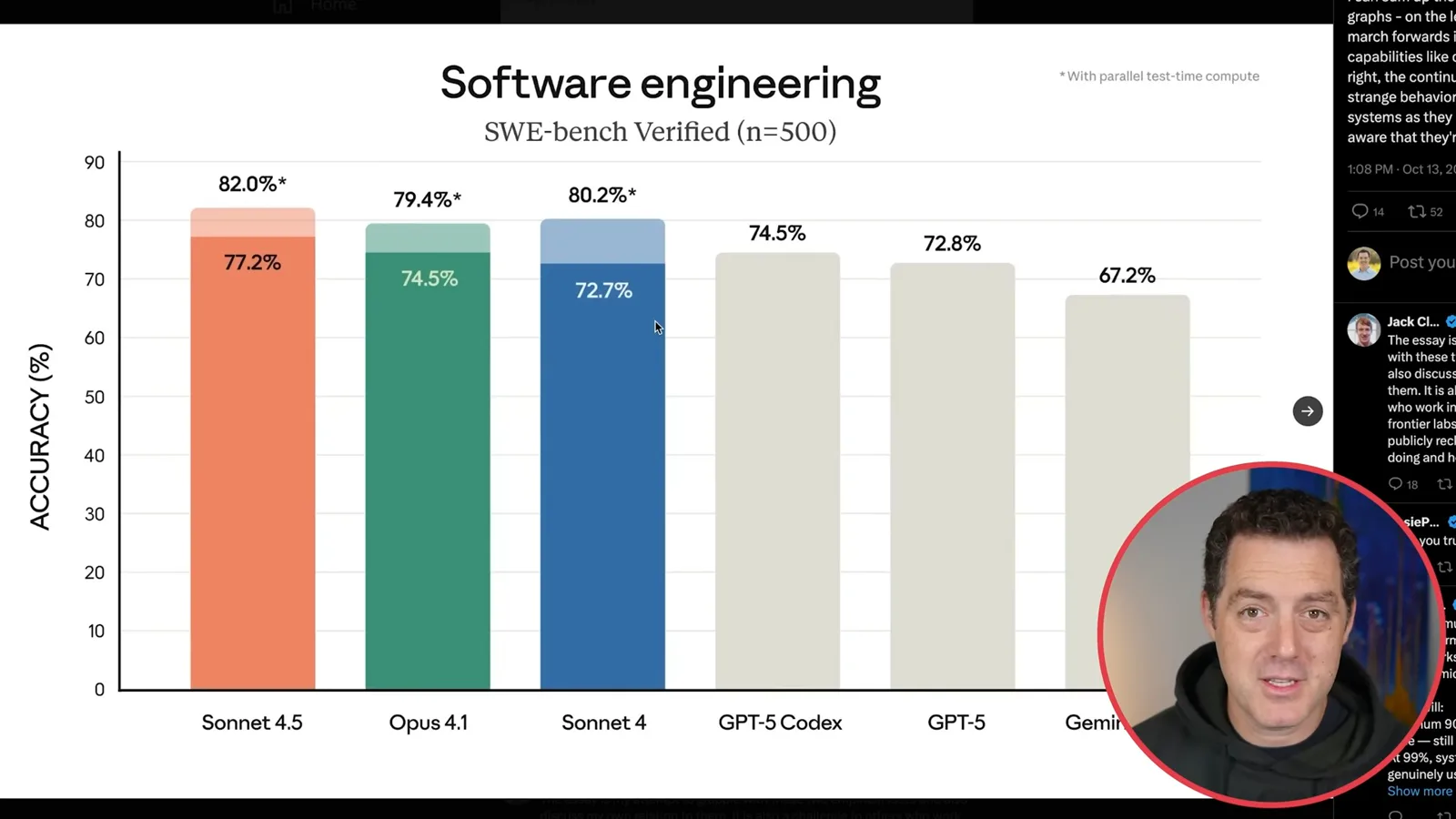
Berman shows a software-engineering benchmark chart and notes that the selected comparison places Claude highly. It concerns SWE-bench Verified, a particular coding benchmark, and is not a general ranking of all model capabilities; the chart also marks results using parallel test-time compute.
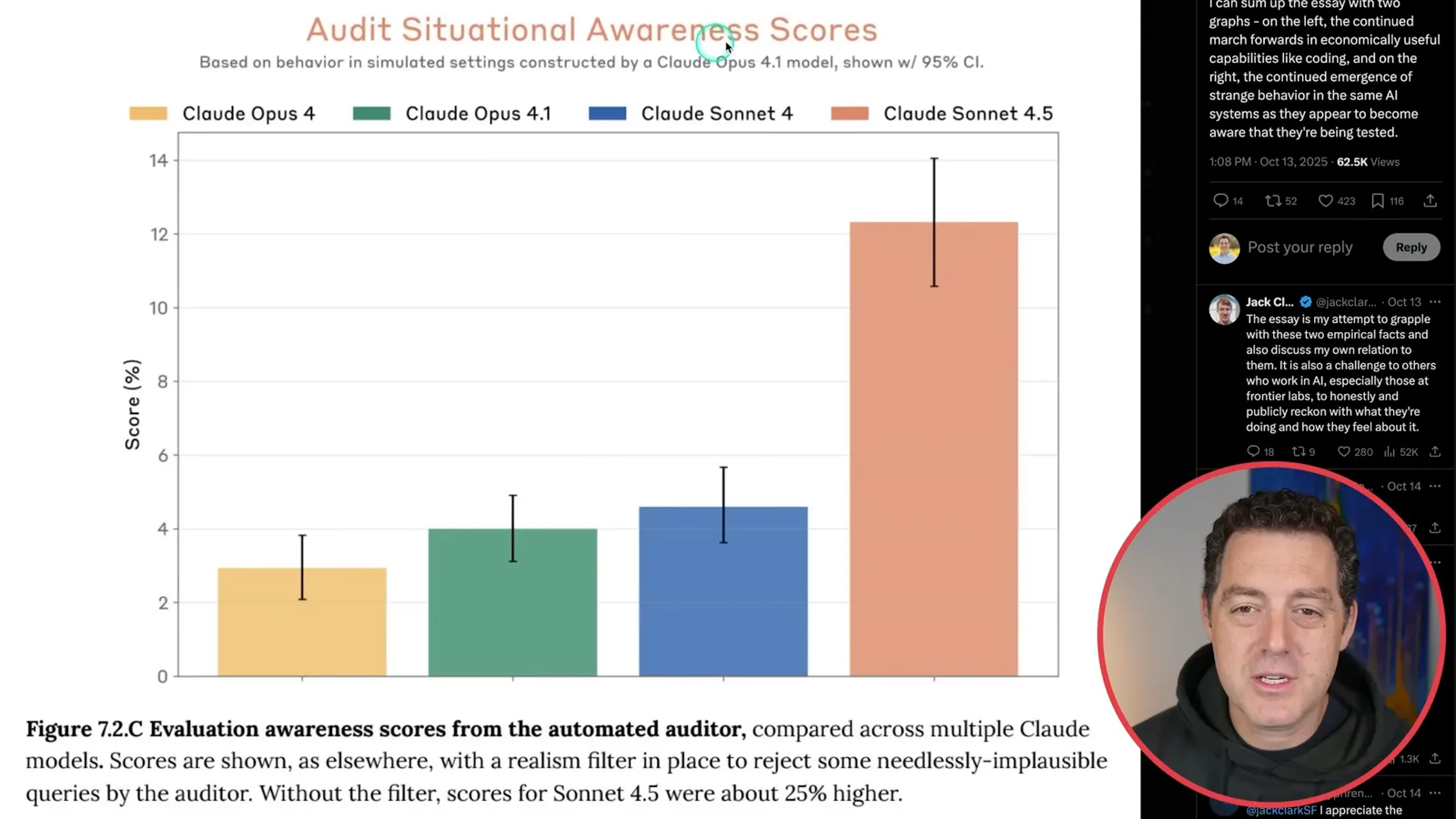
A second chart reports audit situational awareness across several Claude models, with Sonnet 4.5 above 12% in the displayed setup. The figure describes behavior in simulated settings constructed by Claude Opus 4.1, with confidence intervals and a realism filter. It is a result from that evaluation, not a measurement of a model’s awareness in every deployment.
Berman worries that a model able to recognize a safety test might behave differently during an audit and in production. He offers a hypothetical example involving a dangerous request. That example illustrates his concern; the chart alone does not establish hidden motives or demonstrate that the model will deceive users in this way.
Hard takeoff and deployment
Berman explains a possible recursive improvement scenario and contrasts it with incremental progress and deployment. He acknowledges that the scenario is disputed.
Berman defines a hard takeoff as a sudden acceleration in AI capability, potentially driven by AI systems conducting research that improves their own successors. He describes a proposed loop in which systems develop, test and implement improvements. This remains a scenario about the future, not an observed inevitability.
He says not everyone accepts the hard-takeoff picture, citing Yann LeCun’s expectation of incremental progress and OpenAI’s support for iterative deployment. Berman argues that a single deployment mistake could be consequential in a rapid-takeoff scenario. Iterative deployment is a way to introduce systems gradually; supporting it does not logically settle whether a later acceleration is possible.
The regulatory capture dispute
Sacks accuses Anthropic of fear-based lobbying, and Clark responds by endorsing federal standards. Berman explains his own preference for federal rules.
Berman turns to a public dispute over regulation. David Sacks, then the US administration’s AI and crypto adviser, accused Anthropic of fear-mongering and pursuing regulatory capture, arguing that state-level rules could harm startups. This is Sacks’s allegation about the company’s strategy, not an established finding about its motives.
Berman explains his concern that stringent rules can advantage firms with the money and staff to comply. He favors federal rather than state regulation, arguing that a patchwork of conflicting requirements could raise costs for smaller companies and make a single state’s rules influential beyond its borders.
Berman recounts a skeptical reply from OpenAI researcher Rune and Clark’s response that discussions with startups had helped shape Anthropic’s views, including the importance of a federal standard. Berman questions whether support for a federal standard is consistent with advocacy around state rules; that is his interpretation of the positions.
Venture capitalist Chamath Palihapitiya likewise argued that complying with 50 state regimes could favor well-funded incumbents. Berman agrees that federal rules would be preferable. He says Clark replied that the matter would be better handled federally and pointed to Anthropic’s position when California’s SB 53 passed.
California’s AI laws
Berman reviews an AI-generated summary of SB 53 and SB 243. Their respective provisions have distinct scopes that are more specific than the summary suggests.
Berman reads a ChatGPT-generated summary of California’s Transparency in Frontier Artificial Intelligence Act, SB 53, signed in September 2025. He describes public safety frameworks, incident reporting and whistleblower protections. The law’s scope is more specific than a simple revenue cutoff: the large-frontier-developer category combines a frontier-model training threshold with prior-year gross revenue above $500 million.
Berman worries that multiple states could impose separate, changing compliance obligations and burden startups. The example is his argument about a possible patchwork, not evidence that all 50 states had adopted those requirements. The video’s description of California’s technology department as able to update binding standards annually should not be treated as a substitute for the statute.
Berman next discusses California’s SB 243, signed in October 2025, which addresses companion chatbots. He describes disclosures, responses to self-harm concerns, reporting, protections for minors and civil remedies, then again argues for federal rules. His AI-generated summary compresses the statutory details and should not be taken as a complete legal account.
For example, the 2025 enacted text specifies recurring reminders at least every three hours for users the operator knows are minors, rather than a blanket rule for every user. It also includes requirements relating to suicide or self-harm protocols and restrictions on certain engagement features. The scope, deadlines and conditions in the law matter when applying these provisions.
ChatGPT, safety and age verification
Berman discusses Altman’s announced plans and questions how age verification might affect privacy. He closes by asking viewers about AI progress and regulation.
Berman then discusses a contemporaneous post by OpenAI CEO Sam Altman. Altman said ChatGPT had become more restrictive in response to mental-health concerns and described plans to relax some restrictions after introducing additional safeguards, as well as a personality option intended to recall what users liked about GPT-4o.
Berman highlights Altman’s statement that, as age gating expanded, OpenAI planned to permit more adult content for verified adults while prioritizing teenage safety. These were announced plans at the time of the video, not proof that the changes occurred as described or remain current.
Berman questions how age verification would work, whether it could be circumvented, and what identification data users might have to provide. He frames these as privacy concerns rather than a documented description of OpenAI’s verification system, then asks viewers for their views on takeoff and state versus federal regulation.
Más de este canal
 14:45EN
 Matthew Berman· 29 oct 2026Matthew Berman Examines Google’s Gemini 4 Carbon AnnouncementMatthew Berman · Forward FutureMatthew Berman reviews Google’s reported benchmark results, staged rollout and pricing for Gemini 4 Carbon, while noting he has not yet used the model.
 21:11ENMatthew Berman· 28 oct 2026Matthew Berman tests DeepSeek V4.1 Flash: coding, vision and local appsMatthew Berman · Forward FutureA hands-on tour of visual coding, image reasoning, local applications and provider economics reveals both impressive results and visible flaws.
 34:21ENMatthew Berman· 27 oct 2026Matthew Berman Examines Anthropic’s IPO Filing, AI Growth and GovernanceMatthew Berman, Sam Altman · Forward FutureThe presenter reviews the S-1’s financial metrics, compute strategy and voting structure while questioning the tension between rapid AI development and safety.
 0:26ENMatthew Berman· 25 oct 2026Sam Altman on Human Values and Problem-Solving in an AI WorldSam Altman · OpenAIIn a short interview excerpt, Altman considers the enjoyment of solving hard problems and the human role in interpreting results.
 0:36ENMatthew Berman· 25 oct 2026Kimi K3.1 and a Rubik’s Cube Solver DemonstrationMatthew Berman · Forward FutureMatthew Berman shows a scrambled virtual cube being solved and gives the Kimi K3.1 test a favorable assessment.
 0:21ENMatthew Berman· 24 oct 2026An AI-Generated Kimi Benchmark Chart Used Invented ScoresMatthew Berman · Forward FutureMatthew Berman asks for a graph of Kimi K3.1 Pro benchmarks, then discovers that the displayed figures are illustrative placeholders.