En 30 segundos
In May 2026, Matthew Berman reviews Anthropic’s policy essay on two possible futures for US–China AI competition. He agrees that advanced AI has security and surveillance implications, but disputes the lab’s approach to open models and worries that chip restrictions could accelerate China’s domestic industry. His prediction that recursive self-improvement will decide the contest by 2028 is his own speculation; Anthropic describes ongoing competition and says it expects transformative AI by that year. The video is sponsored by here.now.
- 1Two possible 2028 futuresAnthropic contrasts an allied lead with a competitive Chinese ecosystem; Berman questions whether its solutions are the only choices.
- 2Compute and distillationThe company emphasizes chips and alleges unauthorized model extraction; Berman recognizes Chinese research talent and disputes the importance of the alleged extraction.
- 3A disputed deadlineBerman predicts recursive self-improvement will decide the competition, while Anthropic expects transformative AI by 2028 and describes a continuing contest.
- 4Surveillance and safetyThe essay warns that AI may amplify authoritarian repression and cyber threats; Berman supports that concern but challenges restrictive policies.
- 5Four frontsThe paper names model intelligence, domestic adoption, global distribution and resilience; Berman prioritizes adoption and cost more than the paper does.
- 6Policy choicesAnthropic recommends stronger controls, measures against unauthorized access and exports of US AI. Berman advocates a stronger role for open-weight models.
Conclusiones
- Anthropic’s 2028 futures are policy scenarios, not a demonstration that only two outcomes are possible.
- The essay explicitly expects transformative AI by 2028; Berman’s specific self-improvement deadline and winner-takes-all outcome are separate forecasts.
- Anthropic alleges large-scale unauthorized distillation, while the impact on competitors’ capabilities and legal characterization require evidence beyond exchange counts.
- Export controls may restrict access to chips while creating incentives for domestic alternatives; their long-term effect is contested.
- Anthropic identifies intelligence, domestic adoption, global distribution and resilience as four fronts; Berman emphasizes the cost and reach of open-weight models.
- Mythos Preview was a gated research preview; the video’s 10-trillion-parameter figure is not established by the cited company materials.
- The video contains a paid here.now sponsorship.
Lee el texto editado por capítulos
The essay’s premise and alleged distillation
Berman introduces Anthropic’s geopolitical argument and discusses compute and allegations of model extraction. He identifies his American perspective.
Anthropic has published an essay setting out two possible scenarios for global AI leadership in 2028. I find its identification of risks compelling but disagree with several of its proposed solutions. I am approaching the debate from an American perspective, which matters when considering its geopolitical framing.
The company argues that the US and its allies should remain ahead of authoritarian governments, warning that advanced AI could amplify repression and change the balance of power. It regards the present as a limited policy window. These are the company’s strategic claims, not proof that its two scenarios exhaust the possible futures ([Anthropic](https://www.anthropic.com/research/2028-ai-leadership)).
Anthropic treats advanced compute as the central ingredient for training capable models and points to US export controls on chips. I note that companies have different views: for example, Nvidia’s leadership has warned that restrictions can encourage Chinese alternatives. The effectiveness and long-term consequences of these policies are contested.
The essay credits Chinese research talent but also alleges that labs have used access-control workarounds and distillation attacks to obtain capabilities from US systems. Distillation generally means training one model using outputs from another; it can be legitimate, although access methods and contract terms may be disputed.
I question whether the alleged activity alone explains the strength of Chinese models and mention possible benchmarking as an alternative interpretation in some cases. Anthropic’s February 2026 [report](https://www.anthropic.com/news/detecting-and-preventing-distillation-attacks) attributed over 16 million exchanges across three labs, including more than 150,000 to DeepSeek. Those are company allegations and exchange counts, not independent proof of the resulting capability gains or a general legal ruling.
Sponsor and the 2028 scenarios
A paid here.now segment precedes discussion of the essay’s two imagined futures. Berman offers a separate self-improvement prediction.
The video is sponsored by here.now, which I describe as agent-oriented hosting and private storage. Its free access, security and product capabilities are promotional claims and may depend on current service terms and configuration.
Anthropic presents a 2028 future in which allied policymakers defend a compute lead and another in which Chinese firms catch up or overtake. I speculate that the date reflects an approaching self-improving AI threshold, and that whoever reaches it first could win decisively. The paper itself says it expects transformative AI by 2028; it does not establish my particular recursive-improvement timeline.
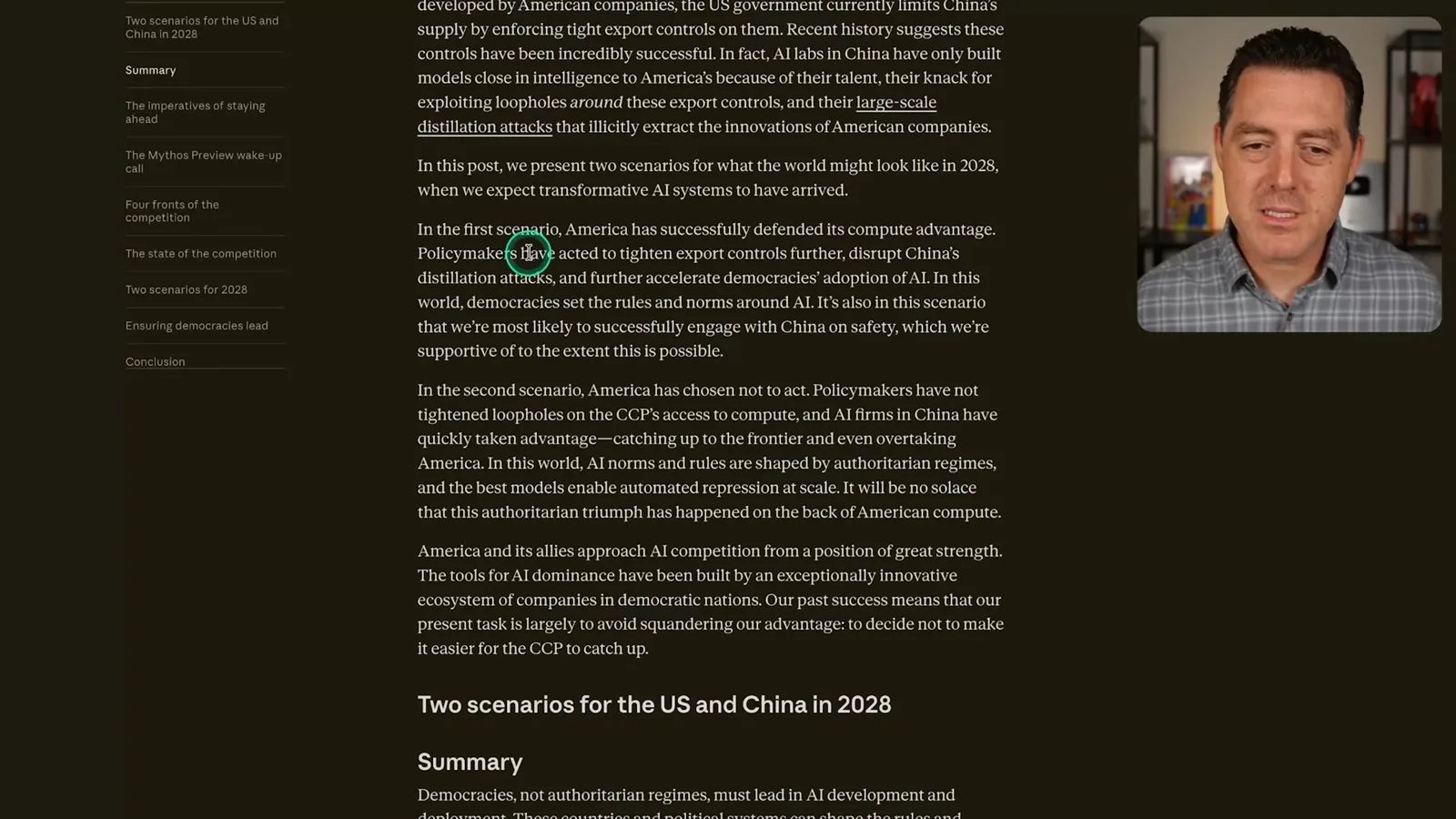
In the first scenario, stronger controls and faster adoption preserve a lead for democracies. Anthropic argues that such a lead would also improve the prospects for engaging China on AI safety. I interpret the argument in terms of negotiating leverage, though the relationship between capability leadership and successful cooperation is uncertain.
In the second scenario, restrictions are not tightened and Chinese labs approach or surpass the frontier. The essay imagines authoritarian actors gaining influence over norms and using AI for repression. I object to framing the proposed policies as the only route to a favorable outcome; these are illustrative scenarios, not measured 2028 results.
Talent, compute and strategic risk
He discusses Chinese researchers, chip restrictions and AI-driven surveillance and cyber capabilities. Claims about timing and policy effects remain disputed.
Anthropic says the US and its allies hold a compute advantage while Chinese labs remain close on model capabilities. I estimate that some open-weight Chinese models are months behind the public frontier, but such a gap depends on benchmark, model, date and task. It is not a universally established number.
Both the paper and I distinguish the Chinese government from Chinese people. The essay raises censorship, surveillance, hacking and military uses as concerns. I acknowledge that the US also conducts surveillance, while expressing my preference for democratic institutions as a check on government power.
I praise the technical talent and algorithmic work of Chinese researchers, including DeepSeek. I question whether distillation allegations are sufficient to explain their progress and argue that compute constraints can encourage efficiency and domestic chip development. Neither talent nor access allegations alone quantify the causes of performance gains.
The essay argues that rapidly increasing compute and AI-assisted research make policy decisions urgent. I object to its language about “allowing” evasion: the existence of violations or loopholes does not itself show that US authorities intended them. Anthropic hopes policies could produce a commanding lead by 2028.
Anthropic argues that the political systems behind frontier AI will shape its rules and deployment. I agree that leadership may confer geopolitical leverage. The strength and distribution of that leverage, however, depend on adoption, governance and international relationships as well as model performance.
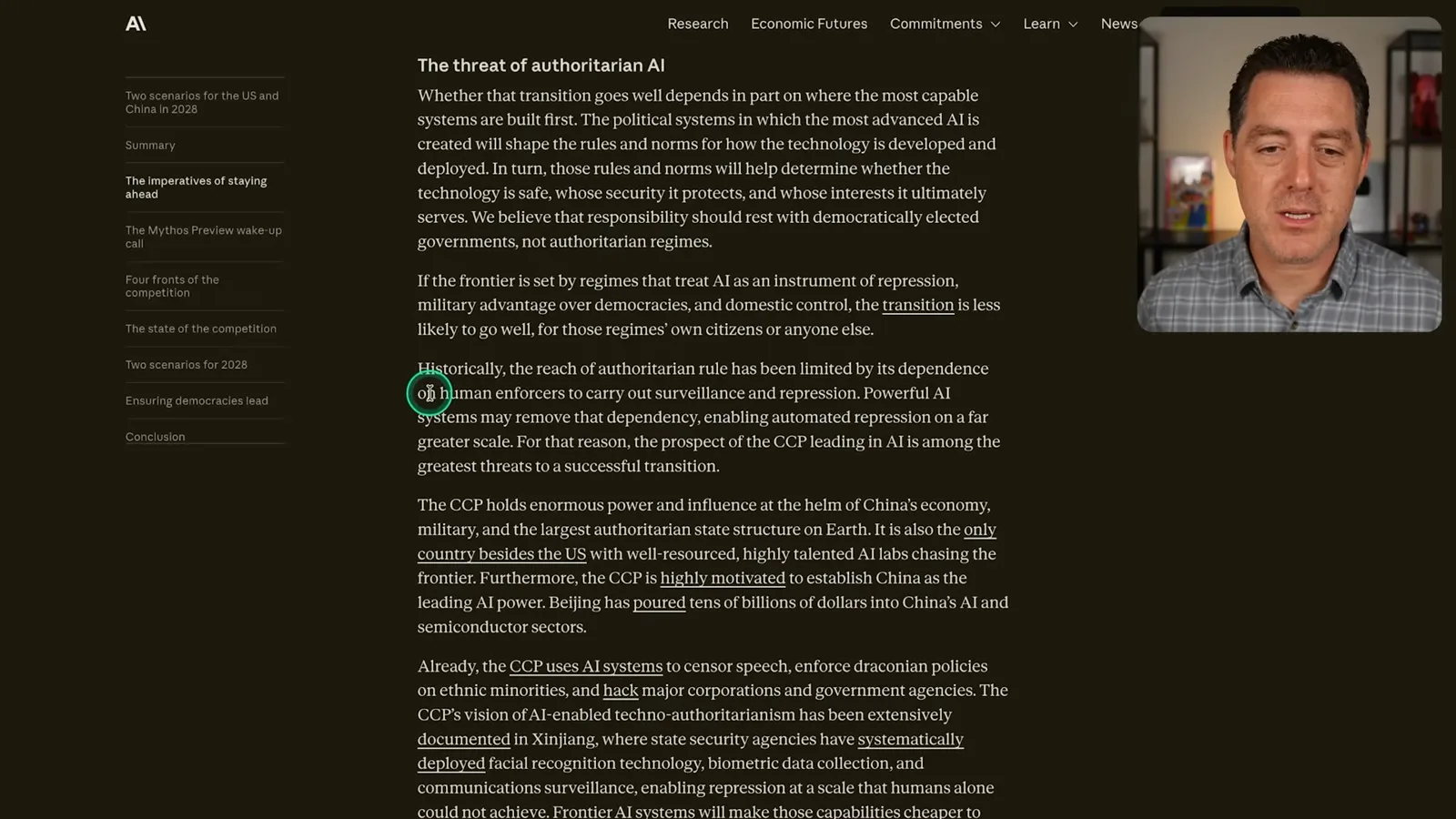
The company warns that powerful AI could automate and scale surveillance and repression, and points to China’s use of facial recognition, biometrics and communications monitoring. I agree that AI has dual uses: the same capacity that improves productivity can also support coercion. Future impacts depend on institutions and deployment choices.
Anthropic describes Chinese public investment in AI and semiconductors and cites military uses of commercial AI. I contrast state support with my understanding of the US system. The scale and form of public support differ across both countries; this is not a complete accounting of their industrial policies.
The essay suggests advanced AI could accelerate semiconductor, biotech and materials research, widening a technological lead. I connect that to my belief that self-improving AI could arrive around 2028. That connection is my interpretation, not a demonstrated deadline or a forecast explicitly made by the paper.
Anthropic uses a hypothetical Chinese-developed model with Mythos-like cyber capabilities to illustrate potential security risks. I consider offensive misuse plausible, but the example is a scenario rather than proof that a particular future model or attack will occur. Capability and security claims should be assessed in their actual test contexts.
Safety, Mythos and the idea of a finish line
The video examines competitive pressure, safety evaluations and the limited Mythos Preview. Berman disputes Anthropic’s view of an ongoing contest.
The paper argues that close competition could pressure firms to release systems before adequate safety measures. I criticize what I see as Anthropic’s preference for concentrating access and possible regulatory capture. Those are my interpretations of its incentives; the company’s stated concern is the risk of competitive pressure undermining safety.
Anthropic cites differences in published safety evaluations among leading Chinese labs. I also refer to Nathan Lambert’s observations from visits to labs in China. Those observations concern people and organizations he encountered; my broader characterization of what all Chinese researchers think is not supported by such a limited sample.
The essay cites a jailbreak comparison in which DeepSeek R1 complied with 94% of malicious requests versus 8% for US reference models. The figures apply to the specified evaluation, models and attack, not all Chinese or US systems. I argue that open weights can permit safeguards to be altered, while questioning whether restricting them is the best response to misuse risk.
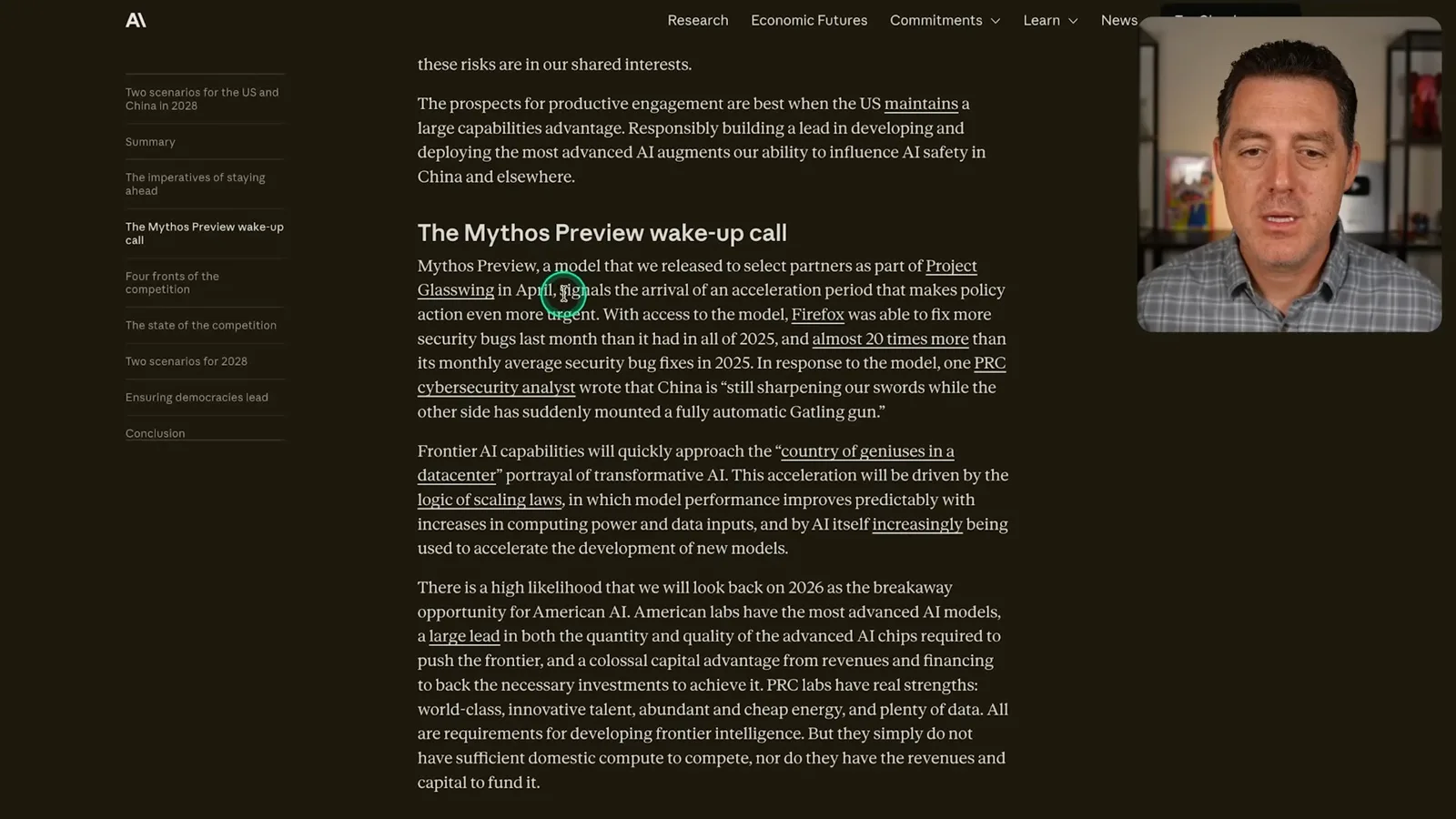
Anthropic presents its gated Mythos Preview and Project Glasswing as a signal of accelerating capability, especially in security work. I mention a 10-trillion-parameter figure and speculate that marketing or limited compute influenced its restricted release. The cited [Glasswing announcement](https://www.anthropic.com/project/glasswing) does not substantiate that parameter count or establish those motives.
I reason that a similarly capable model would still need compute, while arguing that China could develop its own chips or improve efficiency. The specific magnitude and timing of such improvements are unknown, and both infrastructure and algorithmic progress matter.
Anthropic warns that calling competition a race suggests a decisive finish line, whereas it expects an ongoing contest. I disagree: I predict that recursive self-improvement could give the first leader an insurmountable advantage, referring to the Situational Awareness forecast. That outcome and its speed remain speculative; they do not follow as a mathematical certainty from the graph.
Four fronts and the compute debate
The essay compares intelligence, adoption, distribution and resilience. Berman questions its ranking and considers semiconductor constraints and innovation.
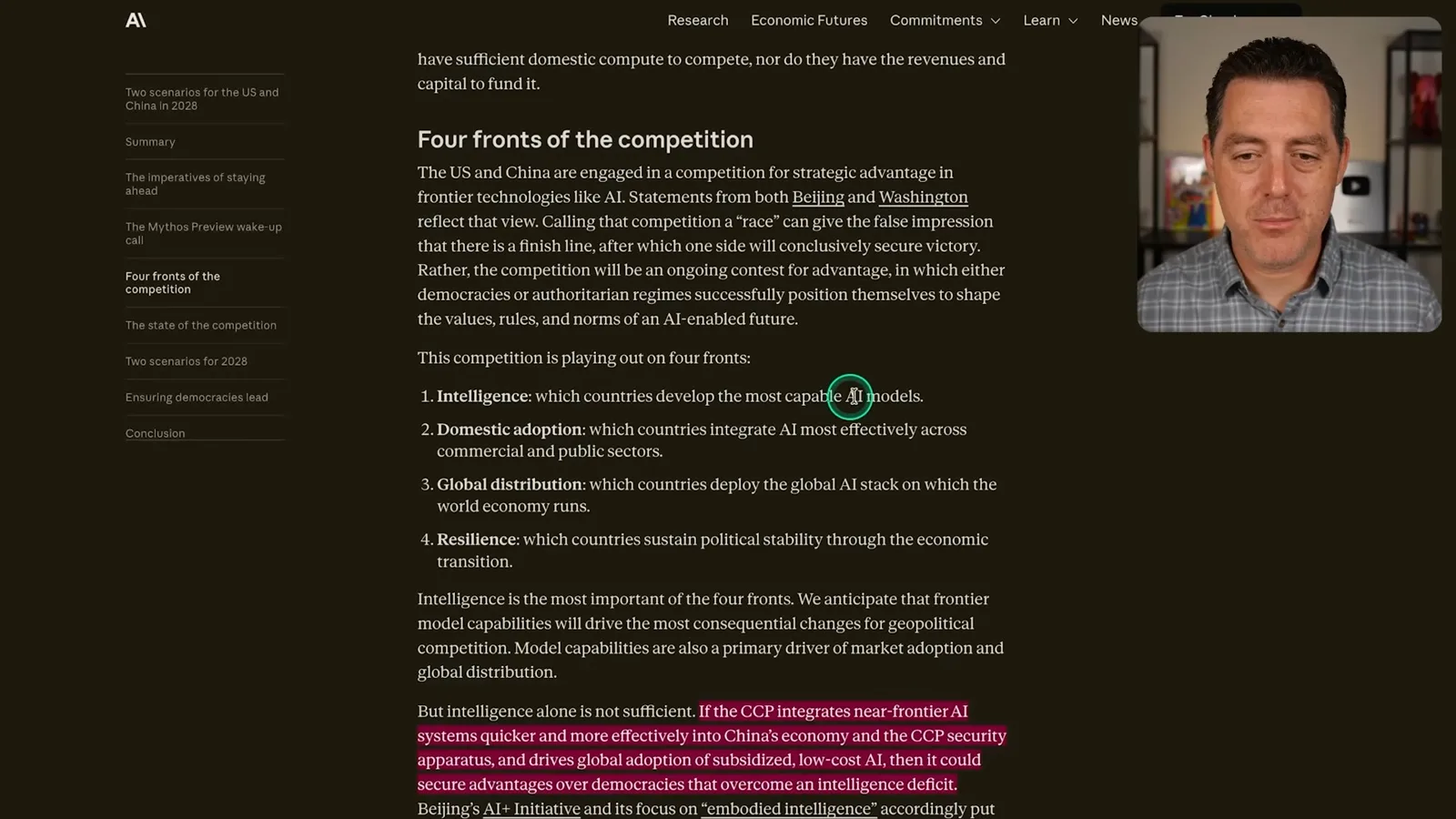
The essay identifies four fronts: model intelligence, domestic adoption, global distribution and political resilience through economic transition. Anthropic places intelligence first. I emphasize the possibility that inexpensive, near-frontier open-weight models could be adopted widely even if another provider leads on the strongest model.
I argue that many business tasks may be served by cheaper models and illustrate a hypothetical tenfold price difference. My claim that current models can handle 99% of use cases is an unsupported estimate, not an established measurement. Actual cost and suitability depend on task, quality, deployment and evaluation.
Anthropic itself says intelligence alone is insufficient and that widespread adoption of lower-cost AI could compensate for a capability deficit. I see tension between that statement and the paper’s ranking of intelligence. The company’s position is that intelligence is most important, not that adoption has no independent effect.
On compute, Anthropic argues that controls have constrained China’s advanced semiconductor supply and that domestic efforts have not yet overcome the gap. I compare that view with Nvidia CEO Jensen Huang’s warning that Chinese developers might optimize for local platforms. Both are arguments about uncertain future incentives, not conclusive evidence of a single outcome.
The essay cites a roadmap-based analysis projecting Huawei’s aggregate compute production at 4% of Nvidia’s in 2026 and 2% in 2027. These are forecasts based on an analysis, not independently observed future totals or a complete measure of the two countries’ compute ecosystems. Google, Amazon and other companies also supply chips.
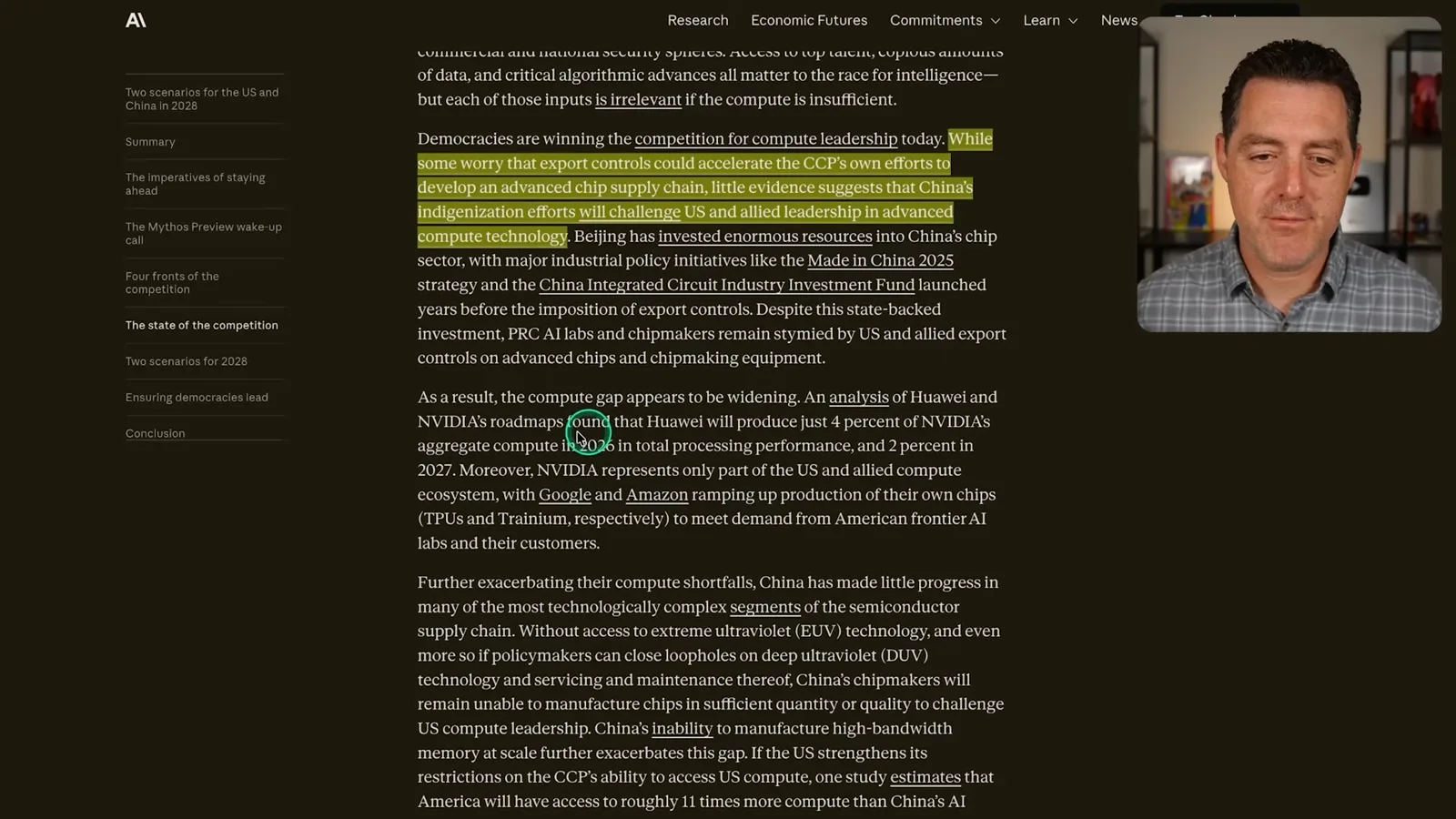
Anthropic highlights constraints in advanced lithography equipment, including EUV and DUV tools, and high-bandwidth memory. I regard the difficulty of those manufacturing steps as a strong argument for the impact of controls, but also think restrictions could motivate domestic innovation. Neither a permanent bottleneck nor inevitable rapid catch-up is established.
The essay argues algorithmic improvements multiply compute rather than replace it, because experiments and AI-assisted research also require computing resources. I again infer a possible self-improvement loop. This is a reasonable question to investigate, but the future speed and policy consequences are not settled.
Anthropic says Chinese open-weight enterprise adoption lags proprietary frontier models and suggests some labs are shifting away from open releases. I disagree with its emphasis, citing conversations with business leaders who face large AI bills and might consider cheaper models. Those conversations are anecdotes, not representative adoption data.
Proposed policies and open models
Anthropic calls for closing access loopholes, defending models and exporting US AI. Berman remains uncertain about export controls and favors open-weight alternatives.
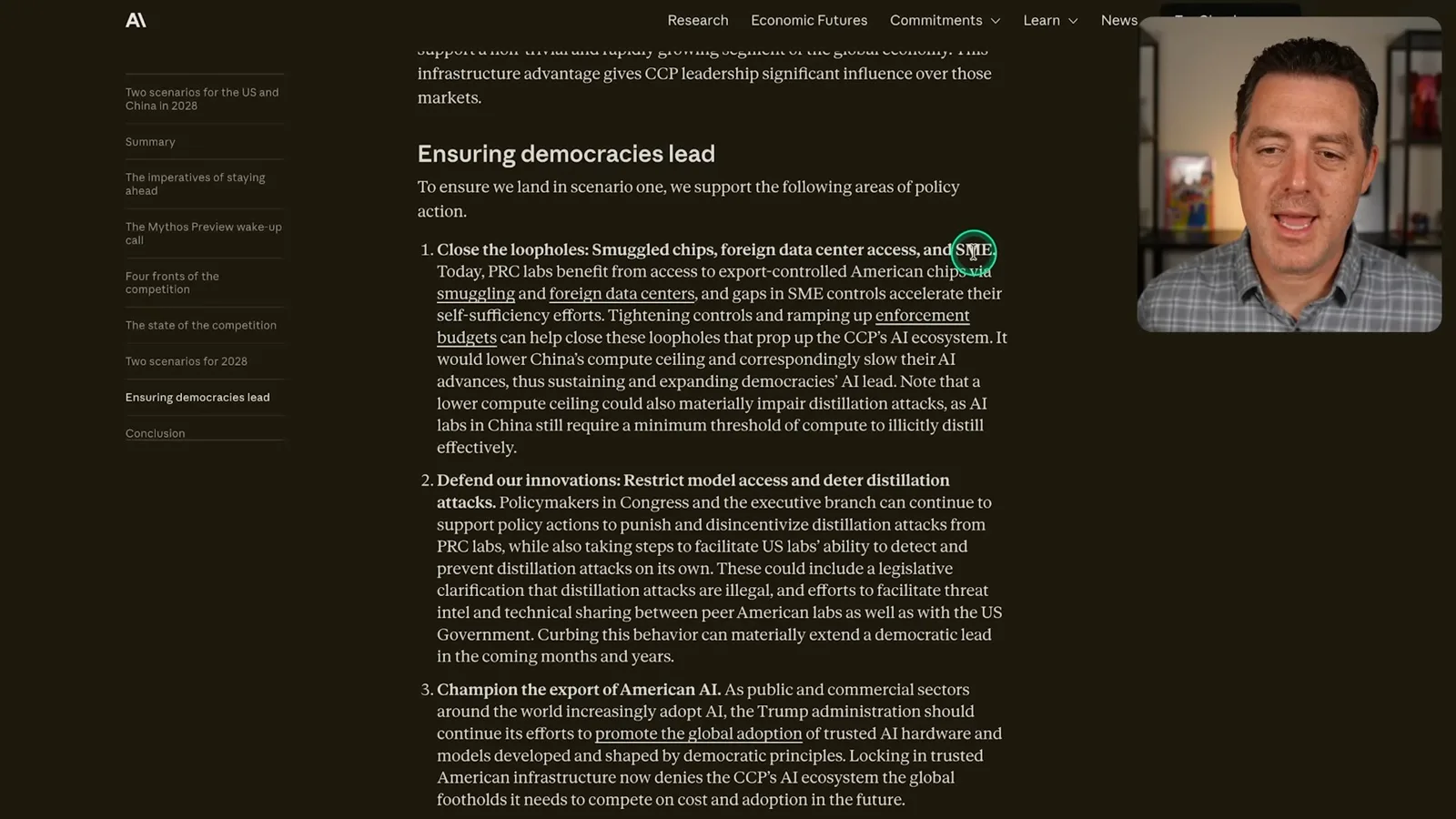
The first proposed policy is to tighten controls and enforcement around smuggled chips, overseas data-center access and semiconductor manufacturing equipment. I am unsure whether restrictions are better over the long term: they may constrain access now but also encourage the development of alternatives. My prediction that China will eventually overcome every constraint is not a certainty.
The second proposal seeks to restrict unauthorized access and deter distillation attacks, including possible legal clarification and information sharing. I support protecting model innovations, while noting the public criticism that model developers themselves trained on internet data. Whether a specific activity violates a contract or law depends on its circumstances.
The third proposal is to promote the global export and adoption of American AI. I argue that open-weight models should play a major part because they can be cheaper and easier to deploy. Whether a given model is more efficient, secure or economical depends on the model and deployment; open weights alone do not guarantee those properties.
I agree with much of Anthropic’s description of strategic risks but not its full set of solutions. My preference is to expand access to open models while considering how to protect innovations and manage security. The video closes by reiterating the here.now sponsorship and pointing to further commentary.
Más de este canal
 34:21EN
 Matthew Berman· 27 oct 2026Matthew Berman Examines Anthropic’s IPO Filing, AI Growth and GovernanceMatthew Berman, Sam Altman · Forward FutureThe presenter reviews the S-1’s financial metrics, compute strategy and voting structure while questioning the tension between rapid AI development and safety.
 0:26ENMatthew Berman· 25 oct 2026Sam Altman on Human Values and Problem-Solving in an AI WorldSam Altman · OpenAIIn a short interview excerpt, Altman considers the enjoyment of solving hard problems and the human role in interpreting results.
 0:36ENMatthew Berman· 25 oct 2026Kimi K3.1 and a Rubik’s Cube Solver DemonstrationMatthew Berman · Forward FutureMatthew Berman shows a scrambled virtual cube being solved and gives the Kimi K3.1 test a favorable assessment.
 0:21ENMatthew Berman· 24 oct 2026An AI-Generated Kimi Benchmark Chart Used Invented ScoresMatthew Berman · Forward FutureMatthew Berman asks for a graph of Kimi K3.1 Pro benchmarks, then discovers that the displayed figures are illustrative placeholders.
 25:50ENMatthew Berman· 24 oct 2026Kimi K3.1 Pro Tested: Strong 3D Demos, Uneven Results and Competitive PricingMatthew Berman · Forward FutureMatthew Berman tests the open-weight model on coding, 3D rendering and visual explanations, then compares benchmark results and prices.
 32:20ENMatthew Berman· 23 oct 2026Who Is Local AI For? The Costs, Trade-offs and a Hybrid FutureMatthew Berman · Forward FutureMatthew Berman weighs data control and independence against hardware cost, setup complexity and inference speed.